





From WordPress to BMS: A Comprehensive Upgrade Path to an Enterprise-Level Digital Experience Platform
Publication date: February 14, 2026
Introduction: WordPress's Limitations and Mismatch with Enterprise-Level Needs
According to W3Techs' 2024 statistics, WordPress held a 43.2% share of the global website market and has long been the mainstream website building choice for SMEs and individual website owners. Its low barrier to entry, low cost, and mature ecosystem made it highly cost-effective in the early stages of digitalization.
However, as Chinese companies accelerate their overseas expansion and enterprise digitalization moves from the "website building stage" to the "systematic operation stage," more and more companies are beginning to discover that WordPress is gradually revealing structural shortcomings in enterprise-level scenarios.
Gartner, in its "2024 Enterprise Content Management Platform Market Guide," clearly points out that when choosing a digital platform, enterprises should focus on the platform's scalability, security and compliance levels, and long-term maintainability, rather than just initial deployment costs. From this perspective, while WordPress is easy to learn, it often becomes a technical bottleneck restricting enterprise development in terms of complex business operations, global operations, and long-term growth.
I. Enterprise-Level Comparison: Why BMS is More Suitable for Medium and Large Enterprises
1. Architecture Comparison: WordPress Plugin Dependence vs. BMS Native Enterprise-Level Architecture
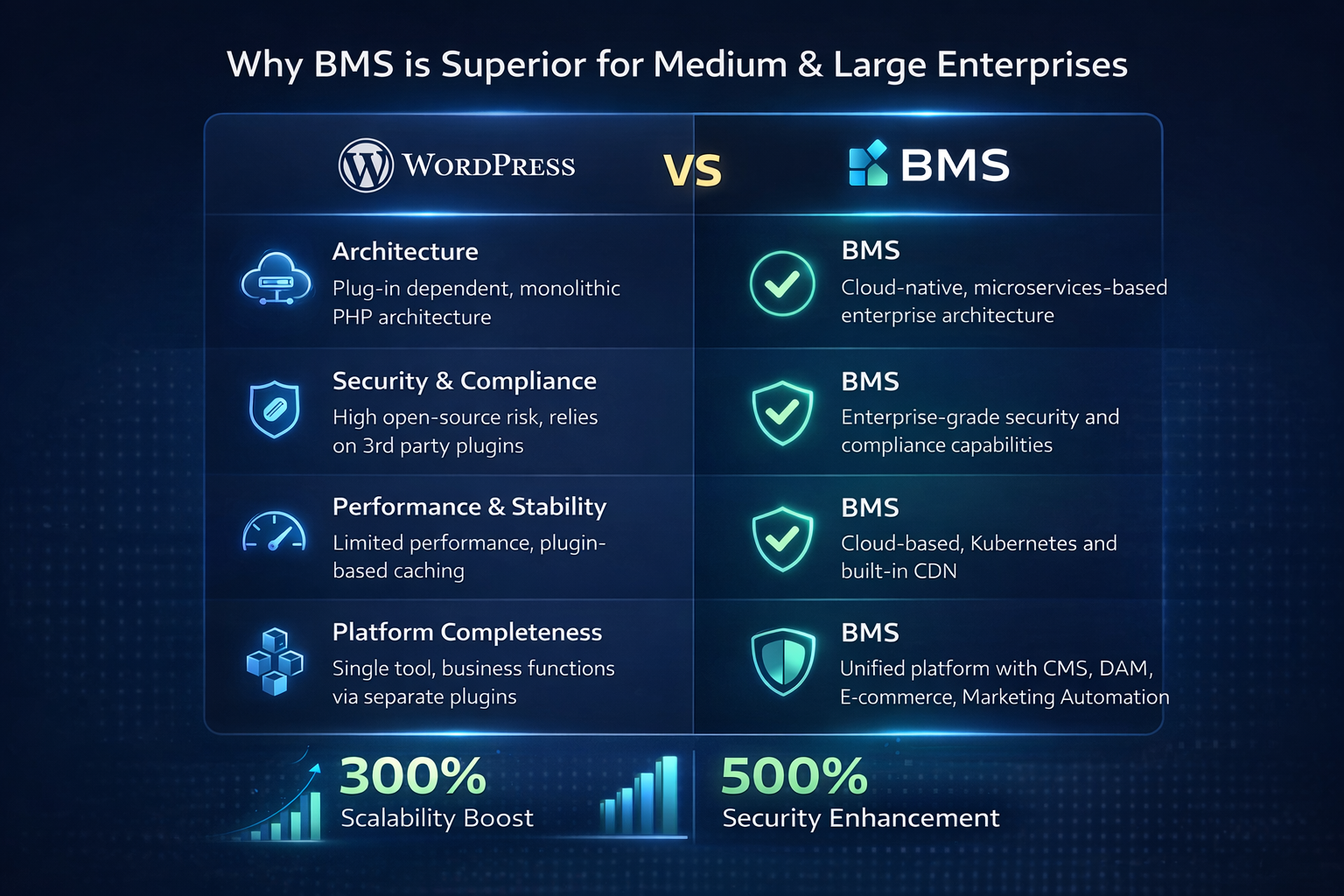
WordPress Architectural Characteristics
Monolithic architecture based on PHP, system expansion highly dependent on third-party plugins.
Lack of unified technical specifications for functional modules, plugin compatibility and stability are difficult to guarantee.
Relatively simple data model, not conducive to supporting complex business logic.
Multi-language and multi-site management mainly relies on external plugins, resulting in low overall integration.
BMS Enterprise-Level Architecture Advantages
Adopts a cloud-native microservice architecture, supporting elastic scaling and high availability.
Natively supports unified management of multiple languages, multiple sites, and multiple brands.
Built-in workflow engine, permission system, and compliance review mechanism.
Simultaneously supports both traditional CMS and Headless API modes, adapting to various business models.
According to the Forrester Wave™: Enterprise Content Management Platforms report, enterprise-level architecture offers a 300% performance improvement in scalability and a 500% improvement in security compared to monolithic architecture.
2. Security and Compliance Comparison: Open Source Risks vs. Enterprise-Level Protection Systems
WordPress Security Limitations
Large plugin ecosystem; security vulnerabilities mainly originate from third-party plugins.
Relatively simple permission model, making fine-grained permission control difficult.
Lacks native data encryption, audit logs, and security monitoring capabilities.
High compliance costs when dealing with international regulations such as GDPR and CCPA.
BMS Enterprise-Level Security Capabilities
Based on a zero-trust architecture design, achieving multi-layered security protection.
Adopts an RBAC permission model, supporting multi-tenant isolation and fine-grained control.
Provides end-to-end data encryption and complete audit logs.
Meets multiple international data security and compliance standards.
3. Performance and Stability Comparison: Shared Resources vs. Cloud-Native High Performance
WordPress Performance Bottlenecks
Often deployed on shared hosting or traditional virtual machine environments, making resources susceptible to impact.
Simple database structure; performance degrades significantly under high concurrency scenarios.
Caching and acceleration rely on plugins, resulting in limited overall stability.
Difficult to support promotional activities or peak access scenarios.
BMS Performance Advantages
Based on Kubernetes Containerized deployment supports second-level scaling.
Microservice architecture avoids single points of failure, ensuring high system availability.
Built-in multi-level caching and CDN integration mechanism.
Stable performance under high concurrency and global access scenarios.
4. Functional Completeness Comparison: Single Website Building Tool vs. Integrated Platform
WordPress Functional Characteristics
Content management-centric, with relatively limited business capabilities.
E-commerce, marketing, and data analysis capabilities rely on plugin assembly.
Data fragmentation between plugins, creating information silos.
Lack of enterprise-level workflow and approval mechanisms.
BMS Integrated Capabilities
Natively supports a unified management architecture for multiple languages, sites, and brands.
Built-in AI translation and localization tools, supporting automatic translation and content synchronization for 30+ languages.
Provides a visual editor for a WYSIWYG page building experience, lowering the barrier to entry for non-technical users.
Built-in SEO optimization capabilities, supporting SSR/SG. Automatic Generation of Rendering Modes and Sitemaps
Digital Asset Management (DAM)
Supports centralized management of various digital asset types, including images, videos, documents, and 3D models.
AI-powered intelligent classification, tagging, and search capabilities significantly improve asset retrieval and reuse efficiency.
Supports real-time collaborative editing by multiple users, meeting the needs of cross-team and cross-regional collaboration.
Deeply integrates with CMS and e-commerce platforms, enabling unified access to content and assets.
Supports 30+ languages, 50+ currencies, and 100+ mainstream payment methods, covering major cross-border markets.
Built-in marketing automation and personalized recommendation engine improves conversion rates and average order value.
Supports complex cross-border e-commerce business logic, including multi-regional pricing, tax, and inventory rules.
Seamlessly integrates with mainstream ERP, CRM, and other enterprise systems, enabling business data linkage.
Marketing Automation Capabilities
Provides visual design tools for the customer journey, clearly presenting user touchpoints and conversion paths.
Supports automated marketing processes triggered by user behavior, improving operational efficiency.
Built-in A/B testing and conversion rate optimization tools support continuous optimization of marketing effectiveness.
Provides real-time data analysis and reporting capabilities to assist operations and decision-making.
5. Comparison of Technological Frontiers: Traditional Technology Stack vs. Modern Technology System
WordPress's Technical Characteristics
- Based on PHP 7.x/8.x, traditional backend technology
- MySQL database, limited scalability
- Frontend mainly relies on traditional JavaScript libraries such as jQuery
- Low level of modernization, difficult to integrate emerging technologies
BMS's Technological Leadership
- Frontend Technology: Based on modern frameworks such as React 18/Vue 3, supporting Server-Side Rendering (SSR)
- Backend Technology: Based on mainstream technology stacks such as Spring Boot and Node.js
- Database Support: Supports relational databases (MySQL, PostgreSQL) and NoSQL databases (MongoDB, Redis)
- AI Integration: Natively integrates large language models such as GPT and Claude, supporting intelligent content generation and translation. Microservice architecture: A cloud-native architecture based on Kubernetes, supporting cutting-edge technologies such as service mesh (Istio).
6. Comprehensive Business Service Comparison: Community Support vs. Enterprise-Level Service Assurance
Limitations of the WordPress Service Model
Primarily relies on open-source community support; official technical support capabilities are limited, and problem response lacks stable assurance.
Third-party service providers vary in quality, making it difficult to standardize implementation quality and long-term service capabilities.
Lacks systematic enterprise-level consulting services, making it difficult to support complex business operations and long-term planning.
Version updates and security patches heavily rely on community contributions, posing uncontrollable security and maintenance risks.
BMS Enterprise-Level Service Assurance System
1. Professional Consulting Services
A professional team composed of senior digital transformation consultants with an average of over 10 years of industry experience.
Provides business process analysis, technical architecture design, and industry best practice consulting.
Supports the planning, design, and implementation of customized solutions.
2. Technical Support Services
Provides 24/7 professional technical support with a clear response time SLA guarantee.
Dedicated technical team provides one-on-one service to ensure efficient problem localization and resolution.
Regularly conducts security inspections and performance optimizations to reduce system operational risks.
3. Implementation and Deployment Services
We adopt an integrated project management model, covering the entire process from requirements analysis, solution design, implementation and delivery to online acceptance.
A professional implementation team is responsible for delivery, ensuring controllable project progress and quality.
Supports both cloud and private deployment modes to meet the compliance and architectural needs of different enterprises.
We provide mature migration solutions to help enterprises smoothly switch from other platforms to BMS.
4. Continuous Operation and Maintenance Services
We establish an automated operation and maintenance monitoring and early warning mechanism to identify and handle potential risks in advance.
We provide regular security updates and feature upgrades to ensure long-term stable operation of the platform.
We continuously output performance monitoring analysis and optimization suggestions to support business growth.
We provide 24/7 fault handling and technical support to ensure the continuity of critical business operations.
II. Real-world Case Comparison: WordPress vs. BMS Enterprise-level Application Practice
Case 1: Global Website Group Management of a Large Manufacturing Enterprise
Main challenges faced by the WordPress solution:
Websites covering 20 countries and regions require deployment of 20 separate servers. Each instance is unique, resulting in extremely high operational complexity.
Multilingual content relies heavily on manual translation and maintenance, leading to low efficiency and high costs.
The lack of a unified content review and publishing process makes standardized management difficult.
Inconsistent website styles and content across regions make it difficult to ensure brand consistency.
The total cost of ownership (TCO) over three years is approximately 5 million RMB, indicating significant long-term investment pressure.
Core improvements brought by the BMS solution:
Centralized operation and maintenance through unified management of websites in 20 countries and regions via a single platform.
Built-in AI translation capabilities significantly reduce the cost of multilingual content production, decreasing translation costs by approximately 90%.
A unified workflow and approval mechanism standardizes content production and publishing processes.
Centralized brand asset management ensures global brand consistency through templates and standards.
The total cost of ownership (TCO) over three years is approximately 2 million RMB, significantly reducing long-term investment.
Significant implementation results:
Website management efficiency improved by approximately 70%.
Content publishing cycle shortened by approximately 60%
Case 2: Omnichannel E-commerce Platform Construction for a Retail Chain
Limitations of the WordPress Solution:
Requires integration with multiple third-party components such as WooCommerce, marketing plugins, and ERP plugins, resulting in high system complexity.
Unstable data synchronization between plugins, making it difficult to guarantee inventory data accuracy.
High payment and data security risks, with significant compliance pressure.
Difficult to support complex promotional rules and high-frequency marketing activities.
Insufficient performance in high-concurrency scenarios such as major promotions, leading to system crashes.
Business Value Brought by the BMS Solution:
Unified platform management of product, order, inventory, and marketing data, avoiding data fragmentation.
Real-time data synchronization mechanism, improving inventory accuracy to 99.9%.
Enterprise-grade payment security system, compliant with international security standards such as PCI DSS.
Built-in intelligent marketing engine, improving conversion rate by approximately 35%.
High-availability architecture design, maintaining zero downtime during peak promotional periods.
III. Technology Selection Guide: How Enterprises Evaluate Digital Platforms
Core Evaluation Dimensions Recommendations
Business Adaptability: Does the platform's capabilities truly cover the enterprise's core business scenarios?
Scalability: Does it support business growth and continuous functional expansion?
Security and Compliance: Does it comply with industry security standards and international regulations?
Performance Capabilities: Can it support expected traffic and high-concurrency scenarios?
Total Cost of Ownership (TCO): A comprehensive assessment of initial investment, operation and maintenance, and upgrade costs.
Technical Support and Service System: Does it provide stable and sustainable enterprise-level service guarantees?
IV. Conclusion: Choosing a BMS to Open a New Chapter in Enterprise-Level Digitalization
At this critical stage of parallel digital transformation and overseas expansion, platform selection directly impacts an enterprise's long-term development capabilities.
WordPress offers certain cost advantages for small-to-medium-sized, lightweight scenarios, but for medium-to-large enterprises pursuing scalability, compliance, and long-term stable development, a BMS is clearly a more suitable enterprise-level choice. A BMS not only possesses significant advantages in architecture, security, and performance, but also provides continuous support for enterprise digital transformation and globalization through a comprehensive enterprise-level service system.
For companies planning their digital global expansion strategies, BMS offers more than just a platform; it provides a reliable and sustainable engine for digital growth.


Want to know more about our products?
With years serving Fortune 500 clients, we offer flexible solutions and integrated implementation.
