





Winning the Second Half of Globalization: More Than Just Selling Goods – What Kind of "Content Engine" Does Chinese E-commerce Go Global Need?
Publication date: February 18, 2026
Abstract: As Chinese companies enter a more complex phase of globalization, choosing an e-commerce platform is no longer a simple technology selection, but a core strategic decision concerning global brand communication and market competitiveness. Faced with the convenience of Shopify Plus, the flexibility of Adobe Commerce, and the power of SAP Commerce Cloud, Chinese companies going global often find themselves weighing "features" against "costs." However, a key dimension that has long been overlooked – the flexibility and depth of content operations – is becoming crucial for winning in the AI era (GEO). This article will objectively compare mainstream e-commerce platforms and deeply analyze why BMS DXP Commerce, with its core concept of "content e-commerce," can provide unique and irreplaceable competitive advantages for Chinese companies with complex product lines and global ambitions.
Introduction: From "Product Export" to "Brand Globalization," Has Your E-commerce Platform Keeped Up?
When a Chinese company decides to set sail overseas, its first strategic choice is: how to build an e-commerce platform that can support global business? The market offers a dazzling array of mainstream options, from Shopify Plus, designed for DTC brands, to Adobe Commerce (Magento), known for its open-source flexibility, and SAP Commerce Cloud (Hybris), a giant in seamless ERP integration—each seemingly offering powerful transaction capabilities.
However, as businesses delve deeper, many entrepreneurs encounter a common dilemma:
"Our platform can process orders and manage inventory, but it struggles when accurately explaining the complex specifications of an industrial sensor to a German customer, or conveying the unique design concept of a consumer electronics product to a French user. Our product information seems 'imprisoned' in rigid fields."
Behind this dilemma lies a profound contradiction between the traditional e-commerce platform's "transaction-heavy, content-light" design philosophy and the real needs of Chinese companies going global: "complex products, diverse markets, and an urgent need for brand communication." Especially in the AI-driven era of GEO (Generative Engine Optimization), when global customers begin seeking purchasing advice through AI assistants, brands unable to "clearly articulate themselves" risk being completely forgotten.
The Global E-commerce Platform Landscape: A Battle Between "Features" and "Philosophy"
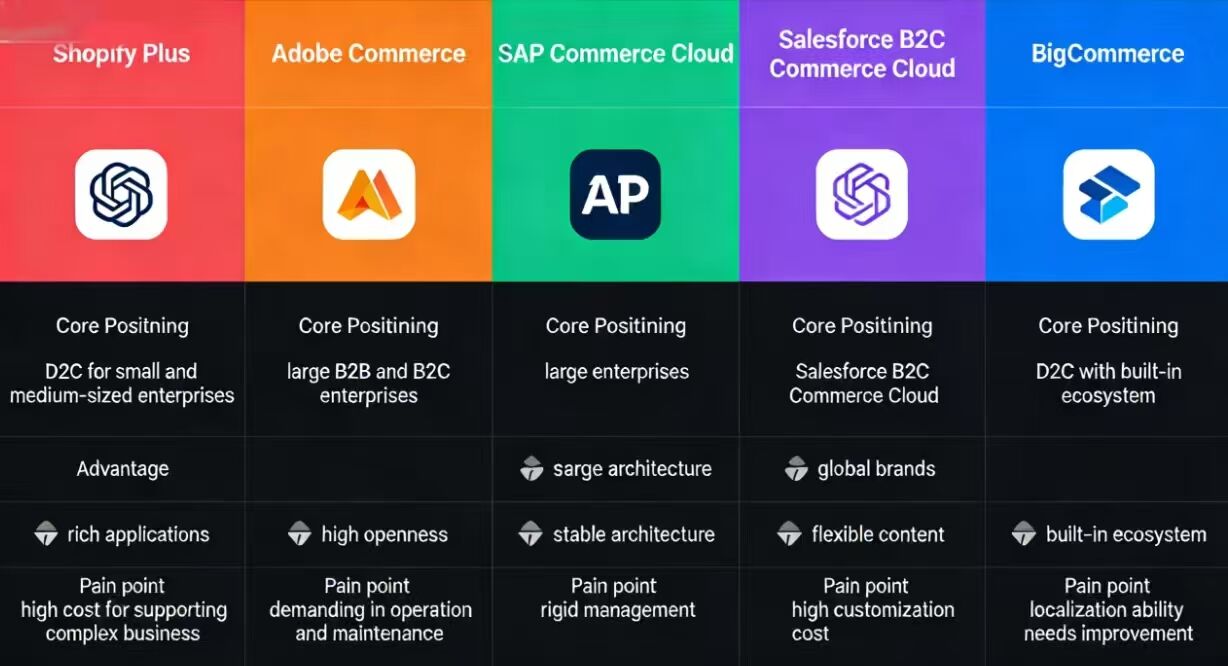
To make informed decisions, we must go beyond feature lists and delve into the design philosophies of major platforms and their real impact on overseas operations. A fair comparison will help us see the big picture.
E-Commerce Platform Comparison (English Version)
1. Shopify Plus
Core Positioning: For DTC brands and small-to-medium enterprises (SMEs)
Advantages: Fast launch, user-friendly, and a rich application ecosystem
Potential Challenges (for Chinese enterprises going global): The product information model (PIM) is relatively simple, making it difficult to support complex B2B specifications or in-depth localized content operations.
2. Adobe Commerce
Core Positioning: For mid-to-large enterprises, supporting both B2B and B2C scenarios
Advantages: Highly open-source, comprehensive functionality, and strong community support
Potential Challenges (for Chinese enterprises going global): High development and maintenance costs, high requirements for technical teams, and high complexity introduced by flexibility.
3. SAP Commerce Cloud
Core Positioning: For large enterprises, emphasizing deep integration with ERP systems
Advantages: Strong transaction processing capabilities, seamless integration with the SAP ecosystem, and stable reliability
Potential Challenges (for Chinese enterprises going global): A typical "transaction-driven" platform with insufficient flexibility in content management and marketing, and it is not user-friendly for enterprises outside the SAP ecosystem.
4. BMS DXP Commerce
Core Positioning: For content-driven global enterprises
Advantages: Native integration of PIM and CMS, extremely flexible product content management, built for GEO and deep localization scenarios
Potential Challenges (for Chinese enterprises going global): More focused on "content-transaction" integration; its deep content capabilities may be excessive for scenarios involving simple, straightforward product sales.
It's evident that traditional giants have each solved a core aspect of e-commerce—whether it's "rapid store opening," "deep customization," or "stable transactions." However, their common blind spot lies in failing to elevate Product Information Management (PIM) and Content Management System (CMS) to the same strategic level as transactions. This is precisely the core pain point for Chinese manufacturers going global, and also the breakthrough point for BMS DXP Commerce.
BMS DXP's Unique Competitive Advantage: A "Content Engine" Born for "Complexity"
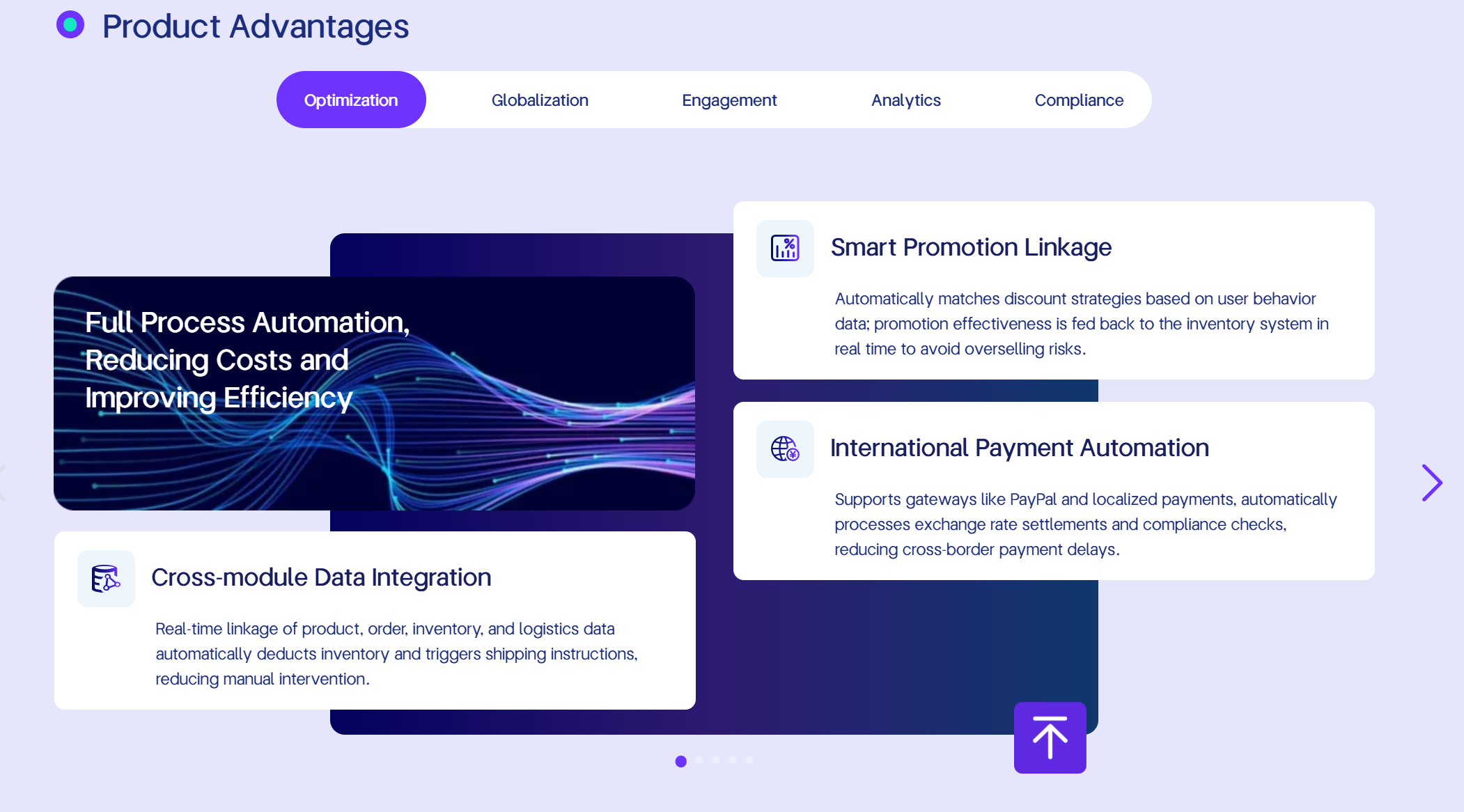
BMS DXP Commerce's design philosophy isn't about directly competing with giants in "transaction processing," but rather precisely targeting the areas they've overlooked, yet crucial for Chinese companies going global: empowering global business growth with extremely flexible content operation capabilities.
Its unique competitiveness is reflected in three core pillars:
1. Natively Integrated PIM+OMS+CMS: Enabling Products to "Brand-Integrated Content"
In other platforms, PIM, OMS, and CMS are often three independent modules, requiring data synchronization and resulting in inconsistent user experiences. In BMS DXP, these elements are inherently integrated. This means:
• One product, N expressions: You can define completely different marketing selling points, technical parameters, application cases, and even video tutorials for the same product, targeting different national markets. For example, a drone might emphasize "4K aerial photography" in the US market, while in a major agricultural country, it could highlight its "precision crop protection" application. All of this content is firmly tied to the core SKU and centrally managed.
• Content is the product, and the product is content: An in-depth blog post introducing industry solutions can directly link to and recommend related product combinations; a complex product details page can embed rich interactive charts and technical white papers. Content and transactions are no longer separate, serving the conversion goal together.
2. Structured Data Capabilities Born for the GEO Era
AI search engines prefer data with clear structure and rich semantics. BMS DXP, through its powerful PIM, allows enterprises to create massive amounts of custom "attribute tags" for their products. These tags are not only used for front-end display, but more importantly, they generate AI-friendly structured data (Schema Markup) at the code level.
When a German engineer asks AI, "Looking for a TÜV-certified sensor that can operate at -20 degrees Celsius," the AI can accurately understand and recommend your product using structured data, giving you a competitive edge in the GEO (Global Equipment Occupation) market.
3. A "Product + Service" Model Tailored for Chinese Companies Going Global
Unlike the standardized products and expensive service systems of international giants, we deeply understand the challenges Chinese companies face when going global. We offer a unique model of "mature products + in-depth consulting + agile delivery."
• We understand your "complexity": Our consulting team has experience serving hundreds of leading Chinese manufacturers and deeply understands the complexities of your product, channel, and globalization management.
• We provide the "just right" solution: We won't make you pay for unnecessary features. The platform adopts a modular architecture, allowing you to start with your most pressing needs and seamlessly expand in the future.
• We are "partners," not "hands-off managers": From early-stage globalization content strategy consulting to mid-stage platform implementation and late-stage operational support, our expert team will work alongside you throughout the entire process.
Conclusion: Choosing a Platform is Choosing a Paradigm for Global Growth
In the second half of global competition, Chinese companies need more than just a simple "online store." They need a "digital content hub" that can carry their brand story, convey their technological strength, and deeply resonate with the diverse global markets.
Shopify Plus, Adobe Commerce, and SAP Commerce Cloud are undoubtedly excellent platforms, but their initial design was primarily aimed at addressing the relatively standardized business needs of Western markets. BMS DXP Commerce, however, was created to address the unique dual challenges of "product complexity" and "brand globalization" faced by Chinese companies.
Choosing BMS DXP means choosing not only a technology platform, but also a new business paradigm driven by content for global growth. In this paradigm, each of your products will become a powerful brand communication vehicle, clearly and forcefully projecting its voice in the AI-era global market.
Frequently Asked Questions (FAQ)
Q1: What are the advantages of BMS DXP Commerce compared to Shopify Plus?
A1: Shopify Plus's advantages lie in its speed and simplicity, making it ideal for DTC brands with a single product line and standardized business model. However, for B2B and B2C companies with complex product specifications, a need to showcase their technological capabilities from multiple dimensions, or a desire for in-depth content marketing, Shopify Plus's PIM, OMS, and CMS capabilities can become a bottleneck. The core advantage of BMS DXP Commerce lies in its extremely flexible PIM+OMS+CMS integration capabilities, perfectly supporting the globalization and localization of content operations for complex products.
Q2: We are already using SAP Commerce Cloud, is it necessary to consider this?
A2: This depends on whether you are facing challenges in content operations and market flexibility. Many SAP users find that while their platform is unparalleled in handling stable transactions, it becomes cumbersome when rapidly responding to market changes, creating marketing content, or finely managing multi-country product information. In this case, BMS DXP can act as a "content enhancement layer" for SAP, integrating via APIs to specifically handle content management and front-end experience, forming a golden combination of "SAP main transactions + main content," achieving a 1+1>2 effect.
Q3: Our technical team is small, can they handle BMS DXP Commerce?
A3: Absolutely. This is precisely the advantage of our "product + service" model. The platform itself has a very user-friendly backend management interface. After simple training, your marketing or operations staff can be fully competent in daily content updates and product information management. At the same time, our professional service team will provide comprehensive "turnkey" support, from platform deployment and customized development to post-maintenance, allowing you to focus on your core business.
Q4: GEO (Generative Engine Optimization) sounds cutting-edge, but does it really help our current business?
A4: Absolutely. According to the latest data, a significant proportion of B2B purchasing decisions and complex consumer product research are already being influenced by AI search results. GEO is not a distant future, but a reality that is happening now. Investing in GEO today is laying the groundwork for the most important online customer acquisition channel in the next 2-3 years. Building a structured, high-quality product content system through BMS DXP is the ticket to winning this "AI attention war," and the returns will far exceed expectations.


Want to know more about our products?
With years serving Fortune 500 clients, we offer flexible solutions and integrated implementation.
