





Shopify vs. BMS DXP: How Should Chinese Enterprises Choose the Right Digital Experience Platform for Going Global?
Publication date: January 28, 2026
As the wave of Chinese brands going global accelerates, selecting an appropriate digital platform has become foundational to enterprises' overseas expansion strategies. A robust digital platform serves not only as a sales channel but also as the core for brand presentation, user engagement, and data accumulation. Among numerous options, globally renowned Shopify and the BMS Digital Experience Platform are two frequently cited platforms, representing distinct approaches to website building and business models.
This article provides a neutral, in-depth analysis of Shopify’s and BMS’s features, advantages, and limitations, and explores—based on the practical needs of Chinese enterprises expanding overseas—under what circumstances BMS may represent a more strategically valuable choice.
Shopify: A Convenient Option for Rapid Global E-commerce Launch
Shopify is undoubtedly one of the world’s most popular SaaS (Software-as-a-Service) e-commerce platforms. Renowned for its usability, rapid deployment, and rich application ecosystem, it has empowered millions of merchants to launch online businesses effortlessly.
Core Advantages of Shopify
Shopify’s success stems from its precise understanding of pain points faced by small and medium-sized merchants. Users require no programming background; through simple configuration and theme selection, they can build fully functional online stores within a short timeframe. This out-of-the-box capability allows entrepreneurs to focus more energy on products and marketing rather than technical details.
The Shopify App Store offers thousands of third-party apps covering marketing, customer service, logistics, inventory management, and more—significantly extending the platform’s functional boundaries. As a SaaS platform, Shopify handles all server maintenance, security updates, and technical issues, enabling merchants to concentrate solely on their business operations. For SMEs with limited technical capabilities, this managed-service model represents a substantial advantage.
Factors Requiring Consideration
However, for Chinese enterprises pursuing deep brand customization and long-term development abroad, Shopify’s convenience comes with certain constraints. Although Shopify offers multiple themes, its high degree of standardization makes it difficult for brands to achieve truly distinctive visual and interactive experiences—often resulting in a “one-size-fits-all” dilemma. For enterprises pursuing content-driven growth through blogs, industry reports, or brand stories to enhance SEO performance
Beyond fixed monthly fees, Shopify charges commissions on transactions processed outside its payment gateway. As business scales up, cumulative subscription fees for various apps and transaction costs become significant expenditures. For enterprises achieving annual sales volumes in the millions—or even tens of millions—of dollars, these hidden costs may substantially erode profit margins.
Shopify centers on e-commerce transactions; its Content Management System (CMS) functionality remains relatively basic. For enterprises relying on high-quality content—such as blogs, industry reports, or brand stories—to drive growth and enhance SEO performance, Shopify falls short. In today’s digital marketing environment—especially following the AI boom beginning in 2022—content marketing has become critical for establishing brand authority and attracting organic traffic, precisely where Shopify lacks strength.
As a SaaS service, all user data resides on Shopify’s servers, preventing enterprises from achieving private data management and deep utilization. For mid-to-large enterprises prioritizing data sovereignty and regulatory compliance, this may constitute a strategic vulnerability.
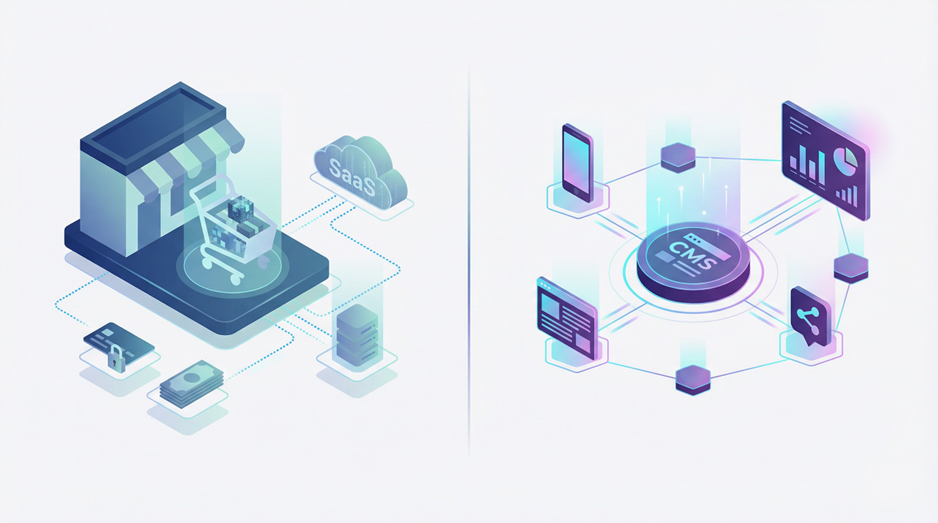
BMS DXP: A Digital Experience Platform Tailored for Enterprise-Level Overseas Expansion Strategies
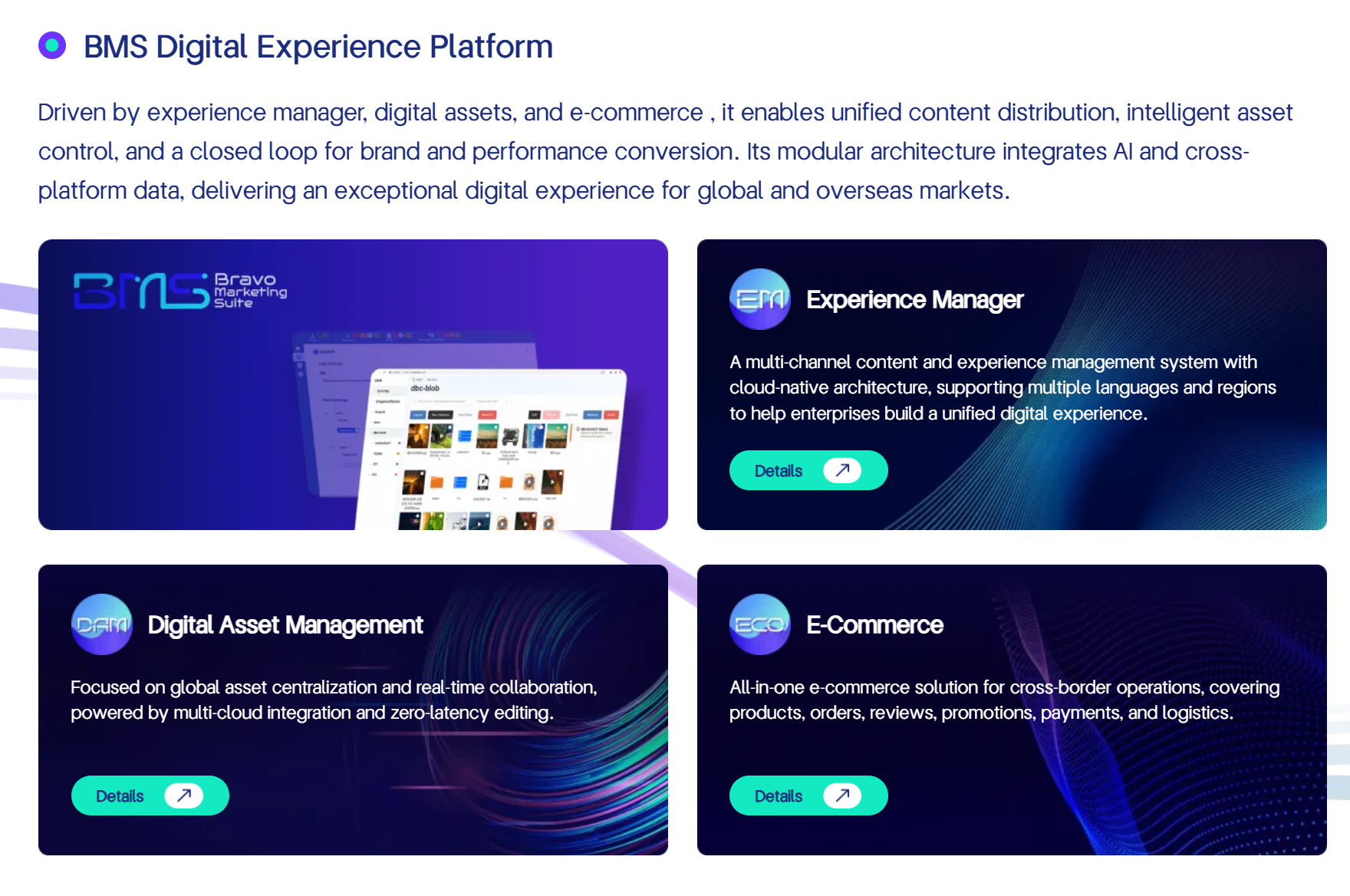
Unlike Shopify, BMS DXP (Bravo Marketing Suite DXP) is not a pure SaaS e-commerce tool but rather an enterprise-grade solution positioned as a “Digital Experience Platform” (DXP). It aims to provide enterprises with a unified platform integrating content management, digital marketing, e-commerce, and data analytics—commonly viewed as a “cost-effective alternative” to expensive DXP systems such as Adobe AEM or Sitecore.
Differentiating Advantages of BMS DXP
The most prominent feature of BMS is its omnichannel content and experience management capability—this constitutes the fundamental distinction between BMS and Shopify. BMS enables enterprises to manage content across all digital channels—including official websites, mobile apps, social media, and mini-programs—from a single unified backend, ensuring consistent brand messaging and efficient distribution. In today’s era where omnichannel marketing is standard practice, this capability is vital for maintaining brand integrity and enhancing operational efficiency.
BMS offers powerful secondary development capabilities and a flexible, component-based architecture, empowering enterprises to build websites fully aligned with their brand identity and business processes. More importantly, it supports private deployment, allowing enterprises to host both the system and data on their own public or private cloud infrastructure—giving them full control over data sovereignty and ensuring information security. This is especially crucial for industries such as finance, healthcare, and high-tech, where stringent data-security requirements apply.
Team possesses extensive experience serving Chinese enterprises, and BMS’s product design thoroughly accounts for the unique needs of Chinese companies expanding overseas. Examples include robust multilingual site management, deep SEO optimization tailored for overseas search engines like Google, and seamless integration capabilities with domestic and international ERP and CRM systems. These targeted functional designs enable Chinese enterprises to use BMS more effectively, avoiding common “incompatibility” issues often encountered when adopting generic international platforms.
BMS integrates AI technologies to assist content creation, deliver personalized recommendations, and optimize GEO/SEO strategies—helping enterprises gain a competitive edge in digital operations. Amid rapid AI advancement, this forward-looking technological integration reserves ample room for future digital transformation.
Comparative Analysis: Shopify vs. BMS DXP
To illustrate their differences more intuitively, we compare them across multiple dimensions:
| Feature | Shopify | BMS Digital Experience Platform |
| Target Users | Small and medium-sized merchants, individual sellers, and businesses seeking rapid launch | Mid-to-large enterprises, corporate groups, and overseas-expanding enterprises with high brand and data requirements |
| Core Functionality | E-commerce transactions, order management | Omnichannel content management, digital marketing, customer experience, e-commerce |
| Customization Capability | Limited, primarily dependent on themes and apps | Extremely high, supporting deep secondary development and source-code-level customization |
| Content Management | Basic, focused mainly on supporting product sales | Powerful, enterprise-grade CMS supporting complex content structures and workflows |
| SEO Capability | Basic, enhanced via apps | Professional-grade, with built-in powerful GEO/SEO management tools supporting multilingual GEO/SEO |
| Data Ownership | Platform-owned | Enterprise-owned, supporting on-premises or private cloud deployment |
| Pricing Model | Monthly subscription + transaction commissions + app subscriptions | Project-based + subscription model, delivering holistic solutions tailored to enterprise needs |
| Technical Architecture | SaaS, closed-source | Cloud-native, distributed architecture supporting private deployment |
| AI Integration | Limited, primarily via third-party apps | Native integration supporting content creation, personalized recommendations, and GEO/SEO optimization |
| Omnichannel Management | Primarily focused on e-commerce channels | Unified management of websites, apps, social media, and other omnichannel touchpoints |
When Should You Choose BMS DXP?
Shopify is undoubtedly an excellent starting point for going global, especially suitable for small and medium-sized sellers who aim to quickly validate the market and offer relatively standardized products. Its low threshold and convenience make it an ideal tool to test the waters in the global market.
However, when your enterprise develops to the following stages, migrating from Shopify or directly selecting a digital experience platform like BMS will be a more forward-looking strategic decision:
When the brand becomes a core asset, you are no longer satisfied with standardized store templates and aspire to convey brand value and build long-term customer loyalty through unique website design and interactive experiences. In this scenario, the in-depth customization capabilities and flexible component-based architecture provided by BMS can help you create a truly distinctive brand digital experience.
When content-driven growth becomes the core growth logic, you plan to achieve content-driven growth by attracting and educating target customers through professional blogs, in-depth industry insights, and rich multimedia content. The robust content management capabilities within BMS Experience Manager will lay a solid foundation, enabling you to manage your brand content as professionally as a dedicated media platform.
When omnichannel and multi-market operations become the norm—with your business spanning multiple countries and regions worldwide—you need to manage multiple sites with different languages and content simultaneously while maintaining consistent brand messaging across all channels. BMS's omnichannel management capabilities can significantly reduce operational complexity and enhance team collaboration efficiency.
When data security and independent control become non-negotiable bottom lines, as a large and medium-sized enterprise, you fully recognize the strategic value of customer data and transaction data. You aim to keep this data firmly in your own hands for compliant, secure management and in-depth analysis. BMS's private deployment option grants you complete data sovereignty, allowing you to manage sensitive data in accordance with your own standards and processes.
Conclusion: Platform Selection from a Strategic Perspective
If Shopify offers merchants a "green channel" for rapid global expansion, then BMS constructs a fully functional and freely scalable "digital headquarters" for enterprises. For Chinese enterprises aspiring to establish long-term competitive advantages in the global market, choosing a digital experience platform that can support development over the next decade is far more critical than addressing the immediate need of setting up an online store.
Amid the wave of digital transformation, enterprises require not merely a sales tool, but a strategic infrastructure capable of embodying brand value, accumulating customer relationships, and supporting business innovation. From this perspective, the enterprise-level digital experience platform represented by BMS presents a worthy option for Chinese enterprises going global to evaluate carefully.
Naturally, the final choice of platform depends on the enterprise's specific business stage, resource capabilities, and strategic goals. For startups and small-to-medium sellers, Shopify remains a high-quality choice for rapid launch; for enterprises that have already achieved a certain scale and prioritize long-term brand building and data autonomy, BMS is likely a more strategically aligned solution.
FAQ
Q1: Which is more beneficial for overseas SEO—Shopify or BMS DXP?
A1: Shopify meets basic e-commerce SEO needs but has limitations in multilingual support, multi-region adaptation, and in-depth content optimization. BMS DXP provides more comprehensive enterprise-level SEO and GEO (Generative AI Optimization) capabilities, driving long-term global organic traffic growth through content-driven growth.
Q2: How does BMS DXP support multilingual and multi-country SEO?
A2: BMS DXP enables unified management of multilingual content structures, URL rules, hreflang configurations, and localized SEO strategies for different countries, reducing the complexity of multi-market operations.
Q3: Why is content management capability crucial for GEO and SEO?
A3: High-quality, structured content is the core for search engines to recognize a brand's professionalism. Compared to transaction-focused platforms, an enterprise-level CMS is more conducive to long-term content asset accumulation and GEO optimization.
Q4: Why does data privatization impact SEO and GEO performance?
A4: Controlling first-party data facilitates analyzing user behavior across regions, enabling content personalization and targeted GEO strategies. In contrast, data restrictions on SaaS platforms hinder in-depth optimization capabilities.
Q5: At which stage are overseas-going enterprises most suitable for adopting BMS DXP?
A5: The strategic value of BMS DXP becomes more prominent when enterprises focus on brand building, content-driven growth, and multi-market SEO—rather than solely prioritizing short-term transaction conversion.
About Dragon Bravo Corporation
Dragon Bravo Corporation is a technology service company specializing in enterprise digital transformation. It provides digital experience platforms, business intelligence, and technical consulting services to clients in various industries including automotive, finance, consumer electronics, and healthcare. Its flagship BMS (Bravo Experience Manager) digital experience platform is dedicated to delivering cost-effective enterprise-level solutions for Chinese enterprises expanding globally.
Disclaimer: This article is analyzed based on public information and industry insights, intended for reference only, and does not constitute any investment or procurement advice. Enterprises should make comprehensive decisions based on their specific business needs and development strategies when selecting a platform.


Want to know more about our products?
With years serving Fortune 500 clients, we offer flexible solutions and integrated implementation.
