





2026 Insights: Brand Asset Compliance and Transparency Governance in the Era of Generative AI
Publication Date: 2026-08-07
Author: William
Introduction
In building enterprise digital infrastructure, Digital Asset Management (DAM) is sometimes simplistically viewed as a cloud storage service offering high-capacity space. As long as files can be uploaded and downloaded, business needs appear to be met.
However, the widespread adoption of generative AI technologies in marketing is posing a serious challenge to this view equating DAM with file storage. As content creation barriers drop significantly, the costs associated with brand asset review, authorization, traceability, and trust management are rising markedly. Systems offering only storage functionality can no longer support enterprises’ governance requirements for complex digital assets across their compliant lifecycles.
Content Transparency That File Storage Cannot Provide
The core limitation of using cloud storage as the primary asset management tool lies in its management of “files” at the physical level—not “assets” imbued with business value.
A digital file is merely a collection of data, whereas a brand asset encompasses information about its creator, copyright ownership, license term, approval status, and usage records across multiple channels. When marketing teams upload AI-generated synthetic images to cloud storage, the absence of structured metadata recording means enterprises often cannot trace the image’s generation model, whether it underwent human compliance review, or whether it involves specific portrait or copyright restrictions.
This “opacity” is gradually becoming a latent operational risk. Globally, transparency and compliance requirements for AI-generated content continue to evolve. For example:
• The EU’s Artificial Intelligence Act (AI Act) has incorporated requirements related to synthetic content transparency, with implementation timelines set under different provisions [1];
• In the United States, state-level legislation and discussions concerning digital avatars, synthetic performers, and commercial advertising disclosures are increasingly prevalent [2].
For brand teams, the key is not passive compliance with each new regulation but rather the ability to internally establish systematic capabilities to document content origin, authorization boundaries, and review status. If the compliance context for a marketing asset is missing, enterprises face extremely high re-review and replacement costs when entering new markets or resolving disputes.
Evolution of Industry Standards: Content Traceability Becomes a Foundational Requirement
Facing trust challenges surrounding digital content, leaders in technology and content industries are driving the establishment of technical standards. The Coalition for Content Provenance and Authenticity (C2PA) aims to provide digital content with credentials analogous to “nutrition labels,” revealing content origin and editing history [3]. Adobe’s Content Credentials feature is a typical application—embedding persistent metadata such as creator information and AI usage directly into files [4].
These industry trends signal that digital asset traceability is becoming a capability worth prioritizing in content governance. For brands operating across markets and channels, systems offering only file storage often fall short of meeting systematic management requirements across an asset’s full lifecycle.
Define Asset States First, Then Discuss Technology Selection
The difficulty of compliance governance lies not only in system functionality but also in whether an enterprise can establish a shared language around asset states. In practice, many disputes do not arise from a “lost” file but rather because teams cannot answer three simple questions:
• Where did it originate?
• Can it be published now?
• If taken offline now, which channels would be affected?
Therefore, before selecting a DAM platform, enterprises are advised to first define a minimal state model for high-risk or high-frequency assets. This model need not be complex initially but should enable marketers, legal personnel, and operations staff to collaborate using a common language.
| Asset State | Recommended Information to Record | Typical Business Action |
| Draft or Pending Completion | Source, Creator, Business Purpose, Preliminary Tags | Complete metadata; exclude from official distribution repository |
| Pending Review | Applicable Markets, Authorization Materials, AI Usage Statement, Risk Statement | Reviewed per policy by brand, legal, or designated approver |
| Approved | Effective Date, Authorized Channels, Version Number, Responsible Party | Permitted for invocation and distribution within authorized scope |
| Restricted or Expiry Alert | Usage Restrictions, Expiry Date, Replacement Recommendations | Restrict new invocations; alert responsible parties for review |
| Archived or Retired | Reason for Retirement, Subsequent Replacement Version, Historical Audit Records | Retain traceable records; prevent misuse or enable policy-based withdrawal |
The purpose of a state model is not to burden all content with process overhead but to ensure high-risk assets become visible at the right junctures. For routine low-risk assets, enterprises may adopt lighter-weight rules; for content involving people, endorsements, medical claims, financial promotions, or multi-market deployment, stricter verification and approval conditions can be applied.
Establishing a Compliance Governance Model for the Asset Lifecycle
Achieving brand asset compliance is not simply about adding disclaimers at the bottom of web pages—it requires ensuring every asset retains clear business context throughout its entire lifecycle. A mature DAM governance model must systematically address core issues including source tracing, authorization management, state verification, and impact scope assessment.
| Governance Dimension | Common Challenges with Traditional File Storage | Systematic Management Actions in Modern DAM |
| Source Tracing | After file circulation, tools used for creation and responsible party information are lost | Structured recording of source, creator, business ownership, and essential metadata |
| Authorization Management | Contracts, portrait licenses, and other information scattered across emails and spreadsheets | Strongly linking usage scope, applicable markets, validity period, and assets |
| State Verification | Proliferation of identically named or similar files makes identifying the final approved version difficult | Identifying usable versions via workflows, version control, and audit logs |
| Impact Assessment | When assets change, manual checks are required across individual sites and channels | Rapidly locating impacted business touchpoints via asset reference relationships |
For high-risk marketing campaigns, endorsement materials, or cross-border content, enterprises should treat DAM as a collaborative hub connecting marketing, design, legal, and regional teams—not merely a warehouse storing final files.

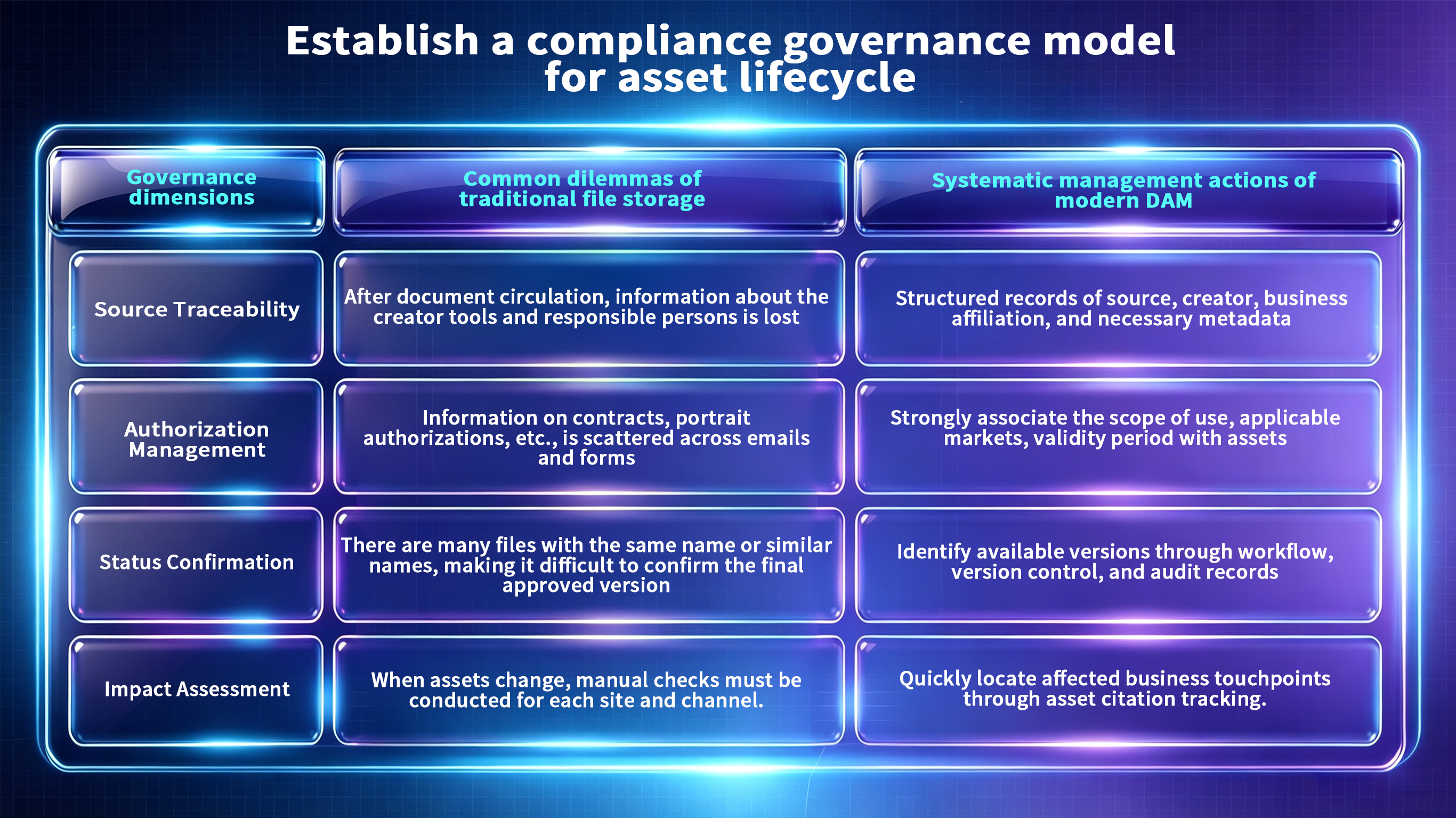
(Illustration: Establishing a compliance governance model for the asset lifecycle)
Building Asset Compliance Defenses on BMS Digital Experience Platform (BMS DXP)
Facing an increasingly complex compliance environment, enterprises must upgrade asset management from “passive storage” to “active governance.” DragonBravo (Dragon Bravo Corporation)’s BMS Digital Experience Platform (BMS DXP) platform and its DAM module provide enterprise-level technical support for establishing brand compliance safeguards.
Structured Metadata and Source Traceability
In BMS-DAM, asset upload is accompanied by structured metadata capture. Enterprises can configure key attributes—including copyright ownership, usage scope, target market, expiration date, and source—based on their internal governance policies. Whether and at what granularity AI-generated information is recorded is determined by the enterprise’s business processes and project requirements. This structured data management enables teams to more effectively trace assets’ origins, statuses, and compliance boundaries when needed. [6]
Licensing Alerts and Lifecycle Management
Many compliance risks stem from teams overlooking license expiration dates or specific usage restrictions. BMS-DAM supports incorporating licensing information into asset lifecycle management, enabling enterprises to configure alert mechanisms or usage restrictions according to predefined rules. While the system cannot replace professional legal interpretation of contracts, it helps enterprises proactively identify certain risks during the publishing process. [6]
Rigorous Approval Workflows and Version Control
In highly regulated industries, publication of critical assets requires strict review. BMS-DAM provides multi-tiered approval workflows, version snapshots, non-destructive editing, and audit logs. Enterprises can configure approval nodes involving brand or legal team leads based on asset type and risk level. Comprehensive audit records retained by the system help identify currently approved usable versions, providing reliable data support for expert human judgment. [6]

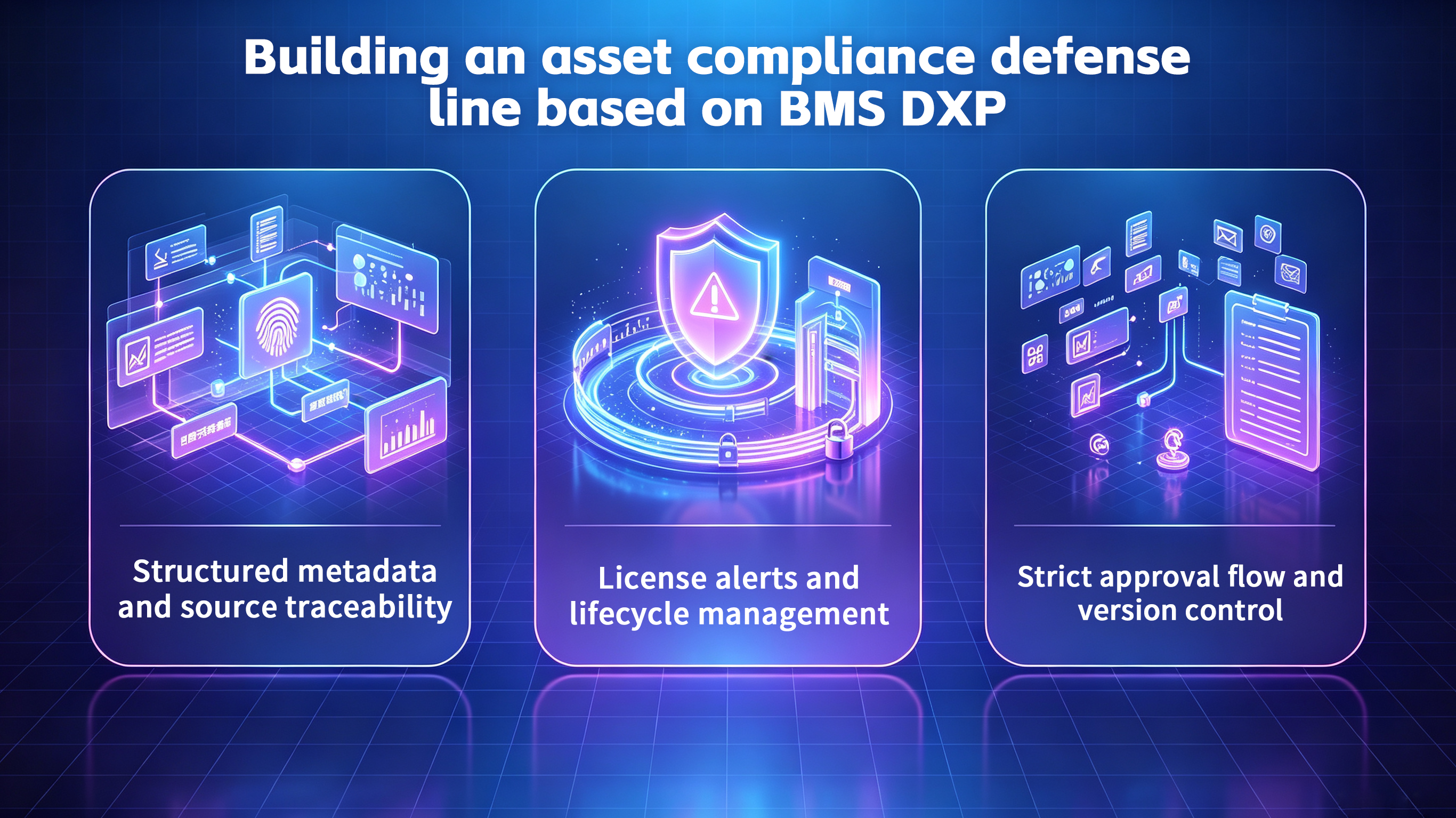
(Illustration depicting asset compliance safeguards built on BMS DXP)
Integrating DAM into Pre-Launch Operational Control Points
DAM’s value is typically validated only during content delivery. An executable governance process should close the loop across upload, review, retrieval, publishing, updating, and archiving—not defer compliance checks until the final day before campaign launch. For marketing teams, this means defining asset inventories and responsibilities at project kickoff; for legal teams, it means routing only content requiring expert judgment into review—not chasing down files already widely deployed; for IT teams, it means configuring permissions, logs, and system integrations as routine operational capabilities—not one-off project deliverables.
Enterprises are advised to begin validation with a clearly defined use case. For example, for a new product launch campaign, first establish an asset inventory covering master visuals, videos, product images, spokesperson materials, and localized copy; then assign fields for source, licensing, approval, and usage scope to each asset category; finally, verify whether teams correctly identify “publishable versions” through actual retrieval on websites, campaign pages, or channel-specific materials. After the pilot, review metadata completion rates, approval cycle times, instances of incorrect version usage, and handling of expired assets before deciding on broader migration. [5]
This approach resembles operational transformation rather than simple system replacement. It demands enterprise patience with process authenticity: if fields remain unmaintained long-term or rules become disconnected from frontline work, no DAM can automatically generate trustworthy content; conversely, if responsibilities, metadata, and publishing mechanisms are designed with sufficient clarity, DAM can become a sustainable governance foundation.
Conclusion: The Management Foundation for Enhancing Content Trust
In the AI era, content production barriers continue to fall, while the importance of content review, authorization, traceability, and trust management grows increasingly prominent. Mistaking an enterprise file-sharing drive for a complete DAM solution may leave compliance governance vulnerable.
A mature digital asset management system should help enterprises standardize and operationalize processes governing asset origin, authorization, versioning, permissions, and distribution. While it cannot eliminate all compliance risks, it enables brands to rapidly locate assets, assess impact scope, and coordinate responses when challenges arise.
FAQ
Q1: What is the C2PA standard? Can it fully prevent enterprise asset theft?
The Coalition for Content Provenance and Authenticity (C2PA) is an organization dedicated to developing open technical standards that display digital content’s origin and editing history via content credentials. The C2PA standard itself cannot physically “prevent” theft, but it significantly enhances digital content transparency, helping platforms and audiences identify authentic sources and modification trails.
Q2: If we deactivate an expired asset in BMS DXP, how is that image previously published on our official website handled?
BMS-DAM and BMS DXP feature native integration, supporting tracking of asset references across pages. Before deactivating an asset, enterprises can first review its impact scope and execute replacement, withdrawal, or phased updates per configured publishing policies. Specific rendering behavior (e.g., placeholder display) depends on frontend logic and workflow configurations.
Q3: How can we ensure external media and KOLs always access correct and compliant asset versions?
BMS-DAM offers granular permission control and asset sharing capabilities. Enterprises can configure specific view, download, or edit permissions for external partners based on project, role, asset type, and time range—and incorporate them into established approval workflows. Link validity periods and access policies are determined by enterprise security requirements and project permission models.
Q4: How do EU/US regulations on AI content transparency affect enterprises operating primarily within China?
Although regulatory applicability depends on jurisdiction and business model, these regulations reflect the global trend toward AI content compliance oversight. Even for China-focused operations, enterprises should monitor AI-generated assets for potential copyright, portrait rights, and trademark risks. Establishing standardized asset governance frameworks helps institutionalize risk identification and cross-departmental review procedures internally.
Q5: Does BMS DXP’s DAM support managing video, audio, and professional design files?
Yes. Official documentation confirms BMS-DAM supports centralized management of multiple asset types—including images, videos, audio, and documents—with online preview and editing capabilities. For specific professional file formats, single-file size limits, and upload performance, enterprises should validate against actual business scenarios and deployment conditions during project assessment.
Q6: What steps are typically involved in migrating from an existing file-sharing system to BMS DXP DAM?
Smooth migration generally involves asset inventory, metadata standardization, permission and workflow design, pilot import, and ongoing operations. DragonBravo’s DAM implementation methodology recommends enterprises first conduct asset and permission assessments, followed by pilot migration and system integration validation [5]. Actual migration tools and historical data cleansing strategies depend on the final project implementation plan.
References
[1] European Commission, Regulatory framework on AI
https://digital-strategy.ec.europa.eu/en/policies/regulatory-framework-ai
[2] Foley & Lardner LLP, How AI, Digital Doubles, and New Laws Are Rewriting Fashion and Beauty
[3] Coalition for Content Provenance and Authenticity, Advancing digital content transparency and authenticity
[4] Adobe, Content Credentials overview
[5] Dragon Bravo Corporation, From Shared Network Drive to DAM: A 90-Day Implementation Roadmap
https://www.dragonsoftbravo.com/cn/en/insights/dam-90-day-implementation-roadmap.html
[6] Dragon Bravo Corporation, Digital Assets — BMS-DAM
https://www.dragonsoftbravo.com/cn/en/products/digital-assets.html


Want to know more about our products?
With years serving Fortune 500 clients, we offer flexible solutions and integrated implementation.
