





BMS vs International Giants: The Rise of an Intelligent, Domestically Developed Digital Experience Platform
Publication date: February 9, 2026
I. Introduction: Market Opportunities Amidst International Giants' Dominance
According to Gartner's 2024 " Magic Quadrant for Digital Experience Platforms " report, Adobe Experience Manager (AEM) and Sitecore continue to hold leading market positions, commanding 15.8% and 8.3% market share respectively. However, prohibitively high implementation costs and steep technical barriers are becoming critical bottlenecks hindering enterprise digital transformation.
Per Adobe's official pricing information, AEM's entry-level edition starts at approximately USD 150,000 annually; total cost—including implementation—often exceeds USD 500,000. Similarly, Sitecore's licensing fees are substantial: the Experience Platform starts at USD 40,000 annually, while Content Hub begins at USD 25,000 annually.
Against this backdrop, opportunities for domestic alternatives are emerging. Dragonsoft Bravo's BMS Digital Experience Platform—featuring a lightweight architecture, modern technology stack, superior cost-effectiveness, and localized services—is increasingly becoming the preferred choice for enterprises.
II. Analysis of International Giants' Product Characteristics and Limitations
In the enterprise-grade digital experience platform domain, Adobe Experience Manager (AEM) and Sitecore have long been regarded as industry benchmarks. Both possess deep expertise in content management, personalized experiences, and ecosystem integration; however, their strengths and limitations are equally pronounced in real-world deployment.
Adobe Experience Manager (AEM): Comprehensive Ecosystem but Extremely High Cost and Complexity
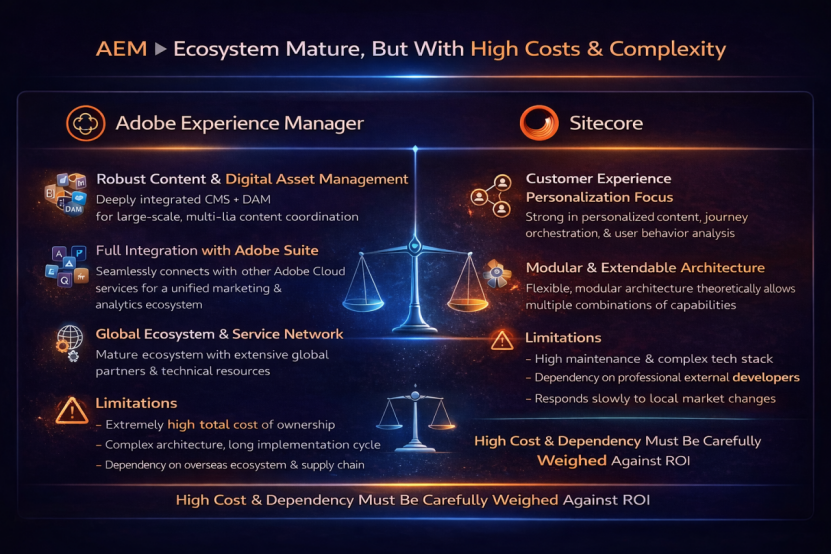
As a core component of Adobe Experience Cloud, AEM enjoys broad customer adoption across the global premium market—particularly among large multinational corporations and brand conglomerates.
Key features include:
Robust content management and digital asset management capabilities: AEM deeply integrates CMS and DAM functionalities, making it suitable for managing large-scale, multilingual, and multi-regional content systems, thereby supporting complex global content collaboration.
Tight integration with Adobe’s full suite: AEM seamlessly interoperates with Adobe Analytics, Adobe Target, Adobe Campaign, and other products, forming a complete marketing and data feedback loop—highly attractive to enterprises already fully committed to the Adobe ecosystem.
A mature international ecosystem and service infrastructure: Extensive implementation partners and comprehensive technical documentation worldwide make AEM well-suited for ultra-large organizations possessing mature IT teams and long-term budget planning capabilities.
However, its limitations are equally significant:
Extremely high total cost of ownership: Licensing, implementation, and ongoing operational expenses for AEM rank among the highest in the industry. Sustained, substantial budget commitments are required, with complex and unpredictable cost structures.
Complex system architecture and lengthy implementation cycles: Though feature-rich, the platform is highly intricate, demanding exceptional technical expertise from engineering teams. Implementation timelines typically span "months"—or even "years"—rendering rapid business responsiveness impractical.
High dependency on overseas ecosystems and supply chains: Enterprises may encounter elevated communication costs and extended adjustment cycles regarding localization support, compliance adaptation, and response speed.
Sitecore: Strong Experience Orientation, Yet Maintenance and Expansion Costs Are Non-Negligible
Centered on the concept of "Customer Experience Management", Sitecore excels in content personalization and user journey management, having accumulated numerous mid-to-large enterprises—especially in North America and Europe.
Its primary advantages include:
Strong emphasis on personalized experiences: Sitecore stands out in content personalization, user behavior analytics, and experience orchestration—ideal for enterprises whose core objective is refined user operations.
Modular architecture with strong extensibility: The platform supports on-demand assembly of distinct functional modules, offering theoretical flexibility.
Yet practical applications present clear challenges:
Overall technology stack complexity and high maintenance costs: Sitecore heavily depends on underlying technical environments; system upgrades and maintenance impose high demands on technical teams, and long-term operational expenses cannot be overlooked.
Implementation and secondary development reliant on external resources: Enterprises often require continuous engagement with specialized implementers, resulting in relatively limited internal technical control.
Varied localization and rapid-response capabilities: Under rapidly evolving local market demands, system adjustments and feature iterations face certain flexibility constraints.
⚖️ Summary: Real-World Tradeoffs Behind Mature Capabilities
Overall, AEM and Sitecore demonstrate clear advantages in functional maturity and international market validation. Nevertheless, their high costs, high complexity, and heavy reliance on external ecosystems render them suboptimal for all enterprises.
Especially amid today’s heightened corporate focus on return-on-investment (ROI), system controllability, and flexible scalability, these limitations have become critical factors requiring careful evaluation during decision-making.
III. BMS: Redefining Cost-Effectiveness Standards for Enterprise-Grade Digital Experience Platforms
Having analyzed the capabilities and limitations of AEM and Sitecore, an increasingly clear trend emerges:
Enterprises’ expectations for digital experience platforms are shifting—from "feature stacking" toward practical deployability, controllability, and long-term ROI. Against this context, Dragonsoft Bravo’s BMS Digital Experience Platform (BMS DXP) delivers a viable path balancing capability and cost, grounded in a product philosophy closely aligned with real-world business needs.
Core Advantage 1: Lightweight Architecture, Exceptional Performance
Pain points of traditional heavyweight architectures:
Products from major international vendors commonly adopt heavyweight architectures, resulting in slow startup times, high resource consumption, and complex maintenance.
BMS adopts a modern, lightweight design, with advantages including:
Fast startup: Application startup time < 30 seconds
Low memory footprint: Base runtime memory < 1 GB
Rapid response: Page response time < 200 ms
Simple deployment: Containerized, one-click deployment
Low maintenance cost: Automated monitoring and operations
Core Advantage 2: Modern Technology Stack, Ensuring Technical Foresight
BMS’s modern technology architecture:
Frontend technology stack:
Vue 3 + Composition API: Built on the latest Vue 3 framework, enhanced with TypeScript
Nuxt 3: Supports SSR/SSG, SEO-friendly
Modern toolchain: Vite build tool, ESLint code standards
Component-based design: Reusable UI component library
Backend technology stack:
Spring Boot: Latest Spring Boot version, supporting Java 21
Monolithic cluster: Low operational overhead
Cloud-native support: Native support for containers + Kubernetes
Databases and AI ecosystem:
Multi-database support: MySQL, PostgreSQL, Oracle, SQL Server, domestic IT innovation databases
NoSQL support: Redis
Vector database support: Milvus
AI models: Flexible integration with multiple AI frameworks (OpenAI and DashScope protocols), built-in Agent
Core Advantage 3: Technological Autonomy for Domestic Alternatives
Technological Independence & Full Controllability
Core Technology Localization
Domestic core technology: Built on an open-source technology stack to avoid technology blockades and vendor lock-in.
Independent intellectual property: 30+ software copyrights and 12 invention patents.
Security and controllability: No backdoor risks, fully compliant with domestic localization requirements.
Highly flexible customization: Supports deep customization and tailored development.
Localized Service Advantages
Chinese-first support: Native Chinese UI and complete Chinese documentation.
Local team coverage: 7×24 Chinese technical support.
Fast response: Localized service with response time < 4 hours.
Industry expertise: Deep understanding of Chinese enterprises’ digital transformation needs.
Core Advantage 4: Global Vision, Local Pricing
Feature Comparison
| Feature Module | AEM | Sitecore | BMS |
| Multilingual management | ✓ | ✓ | ✓ |
| Digital asset management | ✓ | ✓ | ✓ |
| Workflow engine | ✓ | ✓ | ✓ |
| Marketing automation | ✓ | ✓ | ✓ |
| API openness | Limited | Limited | ✓✓ |
| Customization flexibility | Low | Medium | High |
| Deployment simplicity | Complex | Complex | Simple |
| Learning curve | Extremely high | High | Low |
Cost comparison:
| Cost Item | AEM | Sitecore | BMS |
| License fee | Very high | High | Low |
| Implementation | Very high | Very high | Low |
| Annual maintenance | 22% of License | 18% of License | Included |
| Training cost | High | High | Low |
| 3-year TCO estimate | RMB 8M | RMB 5M | RMB 1M |
Core Advantage #5: AI-Native, Leading Intelligence
AI Integration Capabilities
Smart translation: LLM-based AI translation supporting 30+ languages.
Content generation: Integrated with GPT / Claude / DeepSeek and other large models.
Intelligent recommendation: Personalized content recommendations based on user behavior.
Auto-optimization: AI-driven SEO automatic optimization capabilities.
AI Capability Comparison vs. Global Vendors
AEM: Limited AI integration, requires additional paid modules.
Sitecore: Provides basic AI features, but customization is complex.
BMS: AI-native integration, free to use.
IV. Real-World Case Comparisons: Quantified Cost & Benefit Analysis
Case 1: Global Group Website for a Large Manufacturing Enterprise
AEM Solution
License: $180K / year
Implementation: $400K
Training: $80K
3-year total cost: $1,020K
Implementation cycle: 12–18 months
BMS Solution
License: $35K / year
Implementation: $170K
Training: $7K
3-year total cost: $282K
Implementation cycle: 3–6 months
Cost Savings
3-year savings: approx. $738K (≈ 5.2M RMB)
Case 2: Omnichannel E-commerce Platform for a Retail Enterprise
Sitecore Solution
License: $80K / year
Implementation: $350K
Marketing module: $60K / year
3-year total cost: $710K
BMS Solution
License: ¥80K / year
Implementation: ¥180K
Marketing module: Included
3-year total cost: ¥320K
Cost Savings
3-year savings: approx. $390K (≈ 2.8M RMB)
V. Technology Selection Guide: How to Evaluate a Digital Experience Platform
Weighted Evaluation Framework
According to the Forrester Total Economic Impact (TEI) report, enterprises should focus on the following key dimensions and weight distribution when evaluating a digital platform:
Functional completeness (25%): Whether the platform fully meets business needs
Technology foresight (20%): Whether the tech stack is modern and future-proof
Implementation cost (20%): Whether the total cost of ownership (TCO) is controllable
Maintainability (15%): Complexity of operations, maintenance, and upgrades
Service quality (10%): Technical support and response speed
Security & compliance (10%): Data security and regulatory compliance
Score Comparison Across Evaluation Dimensions
| Dimension | BMS | AEM | Sitecore | Weight | Weighted Score (BMS) |
|---|---|---|---|---|---|
| Functional Completeness | 8.5 / 10 | 9.5 / 10 | 9.0 / 10 | 25% | 2.125 |
| Technology Foresight | 9.0 / 10 | 7.5 / 10 | 8.0 / 10 | 20% | 1.80 |
| Implementation Cost | 9.5 / 10 | 4.0 / 10 | 5.5 / 10 | 20% | 1.90 |
| Maintainability | 8.8 / 10 | 6.0 / 10 | 6.5 / 10 | 15% | 1.32 |
| Service Quality | 9.2 / 10 | 7.5 / 10 | 7.0 / 10 | 10% | 0.92 |
| Security & Compliance | 8.8 / 10 | 8.5 / 10 | 8.2 / 10 | 10% | 0.88 |
BMS Overall Score: 8.935
ROI Analysis Report
According to IDC’s 2024 China Digital Transformation ROI Analysis Report, there are significant differences in return on investment across solutions.
BMS ROI Performance
Payback period: 12–18 months
3-year ROI: 280%
Annual cost savings: 40–60%
Traditional Global Vendor ROI Performance
Payback period: 36–48 months
3-year ROI: 120%
Annual cost savings: 10–25%
VI. Market Trends: The Opportunity Era of Domestic Substitution
Policy-Driven Factors
Domestic substitution policy: National initiatives accelerating localization in critical information infrastructure.
Data security regulations: The Data Security Law and the Personal Information Protection Law require stronger data localization and compliance.
Cost control pressure: Enterprises face tightening digital budgets and seek higher cost-performance solutions.
Technology independence: Avoiding systemic “chokepoint” risks caused by foreign dependency in core technologies.
Technology Development Trends
Cloud-native architecture: Containerization and microservices are becoming mainstream for enterprise systems.
Front-end innovation: Modern front-end frameworks are widely adopted.
AI-native applications: Large-model integration is increasingly becoming a standard feature.
Low-code / no-code: Significantly reduces development and iteration costs.
Competitive Landscape Shifts
According to the iResearch 2024 Enterprise Software Market Report:
Domestic software market share increased from 35% (2020) to 52% (2024)
SME digitalization demand grew by 300%
Under budget constraints, 70% of enterprises have begun proactively considering domestic substitution solutions
Current Technical Advantages
1. Leadership in Microservices Architecture
Built on the Spring Cloud Alibaba microservices solution.
Supports Service Mesh architecture.
Built-in capabilities for service discovery, configuration center, and distributed tracing.
2. Cutting-Edge Front-End Technology
Vue 3 Composition API, delivering an overall performance improvement of approximately 50%.
Nuxt 3 full-stack framework, supporting edge computing scenarios.
Full TypeScript coverage to ensure code quality and long-term maintainability.
3. Innovation in Containerized Deployment
Native support for Docker + Kubernetes.
One-click deployment with Helm Charts.
Built-in automated operations, maintenance, and monitoring systems.
Future Technology Roadmap
2024–2025 Technology Plan
AI Capability Enhancement
Integration with more large language models (ERNIE Bot, Tongyi Qianwen).
Continuous upgrades in intelligent content generation and content optimization.
Further strengthening of personalized recommendation algorithms.
Performance Optimization
Edge computing capability support.
Global acceleration via CDN.
Continuous database performance optimization.
User Experience Improvements
Low-code / no-code editor.
Visual workflow design.
Support for real-time collaboration.
Ecosystem Integration
More third-party system integrations.
Open API platform.
Plugin ecosystem development.
VIII. Implementation Recommendations: Best Practices for Choosing BMS
Applicable Enterprise Types
Enterprises best suited for BMS
Mid-to-large enterprises (annual revenue above RMB 100 million).
Enterprises with global expansion or multilingual website requirements.
Cost-sensitive enterprises.
Enterprises pursuing advanced and modern technology stacks.
Enterprises requiring rapid deployment and go-live.
Enterprises that require careful evaluation
Ultra-large enterprises with highly complex customization requirements.
Enterprises deeply invested in AEM / Sitecore.
Enterprises with strong dependency on the Microsoft .NET ecosystem.
Recommended Implementation Path
Phase 1: Pilot Validation (1–2 months)
Select 1–2 business scenarios for pilot implementation.
Validate core functional fit.
Evaluate system performance and stability.
Phase 2: Gradual Migration (3–6 months)
Migrate in phases by module.
Ensure business continuity.
Conduct technical team training in parallel.
Phase 3: Full Deployment (6–12 months)
Launch all functional modules.
System performance tuning and optimization.
Establish a complete operations and maintenance system.
Risk Control Measures
Technical Risk Control
Comprehensive testing and validation.
Rollback contingency plans.
Data backup strategies.
Business Risk Control
Phased go-live strategy.
Parallel run during transition period.
User training plans.
Team Risk Control
Professional technical training.
External expert support.
Knowledge transfer mechanisms.
IX. Conclusion: The Golden Era of Domestic Substitution
With global digital transformation accelerating, domestic software is entering an unprecedented era of opportunity. Dragon Bravo Corporation’s BMS Digital Experience Platform, empowered by a lightweight architecture, a modern technology stack, strong cost-performance advantages, and deeply localized services, is redefining the value standard of enterprise-level digital experience platforms.
Compared with global vendors such as Adobe AEM and Sitecore, BMS not only remains highly competitive in functional completeness, but also demonstrates significant advantages in technology advancement, cost efficiency, and localized service responsiveness. For Chinese enterprises pursuing high cost-performance and rapid deployment, BMS is a rational and forward-looking choice.
As domestic substitution policies continue to advance and technological capabilities evolve, domestic digital platforms represented by BMS will increasingly occupy a more important position in the global market. Choosing BMS is not only choosing an outstanding product, but also choosing a trusted long-term partner for digital transformation.
The golden era of domestic substitution has arrived. Let us witness together the rise of China’s digital power.
Dragonsoft Bravo BMS Digital Experience Platform
Official Website: www.dragonsoftbravo.com
Technical Consultation: sales-support@dragonsoftbravo.com
Hotline: +86-21-61483130
Dedicated Technical Team: 7×24-hour response


Want to know more about our products?
With years serving Fortune 500 clients, we offer flexible solutions and integrated implementation.
