





BMS Digital Experience Platform,Digital Asset Management : The Best Enterprise Asset Management Software for Business Growth
Publication date: December 4, 2025
In the digital era, enterprises are experiencing an explosive growth in digital assets (images, videos, documents, design files, marketing materials, etc.). Managing these assets using traditional methods such as folders, shared drives, or email attachments often leads to disorganization, version confusion, inefficient searches, and redundant work.
Adopting a modern enterprise-grade Digital Asset Management (DAM) system enables centralized storage, unified management, and rapid retrieval of all digital assets, while also supporting permission control, version management, security, and compliance. This is a crucial step for enterprises striving toward becoming "the best enterprise asset management software".
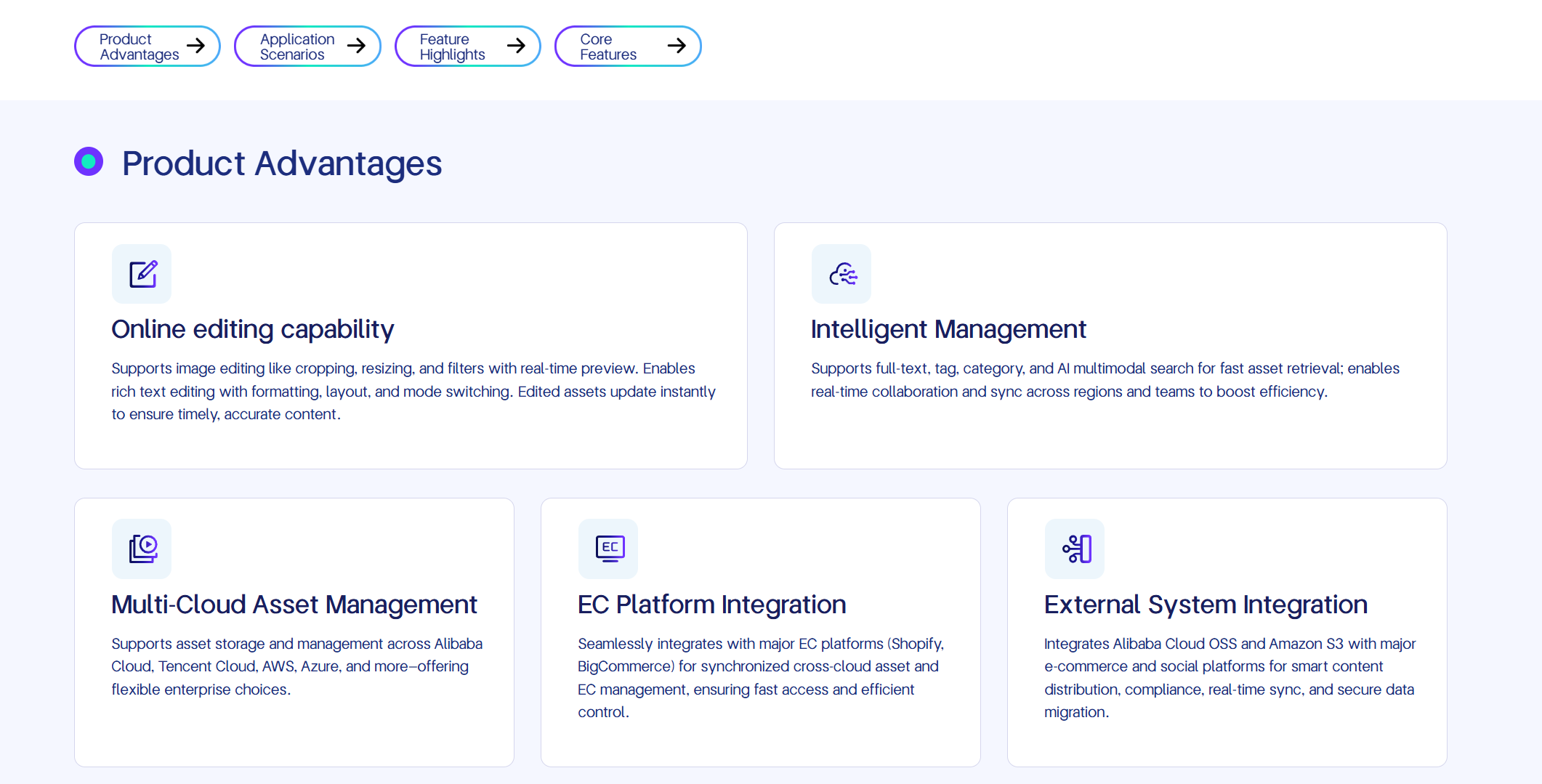
The DAM functionality offered by Bravo Marketing Suite (BMS) is precisely designed for this purpose — with intelligent management, full-text search, tag/category-based search, AI multimodal search, and real-time collaboration synchronization, it stands out among numerous asset management solutions and becomes a powerful tool for enterprise asset management.
How DAM Empowers BMS to Become the Best Enterprise Asset Management Software
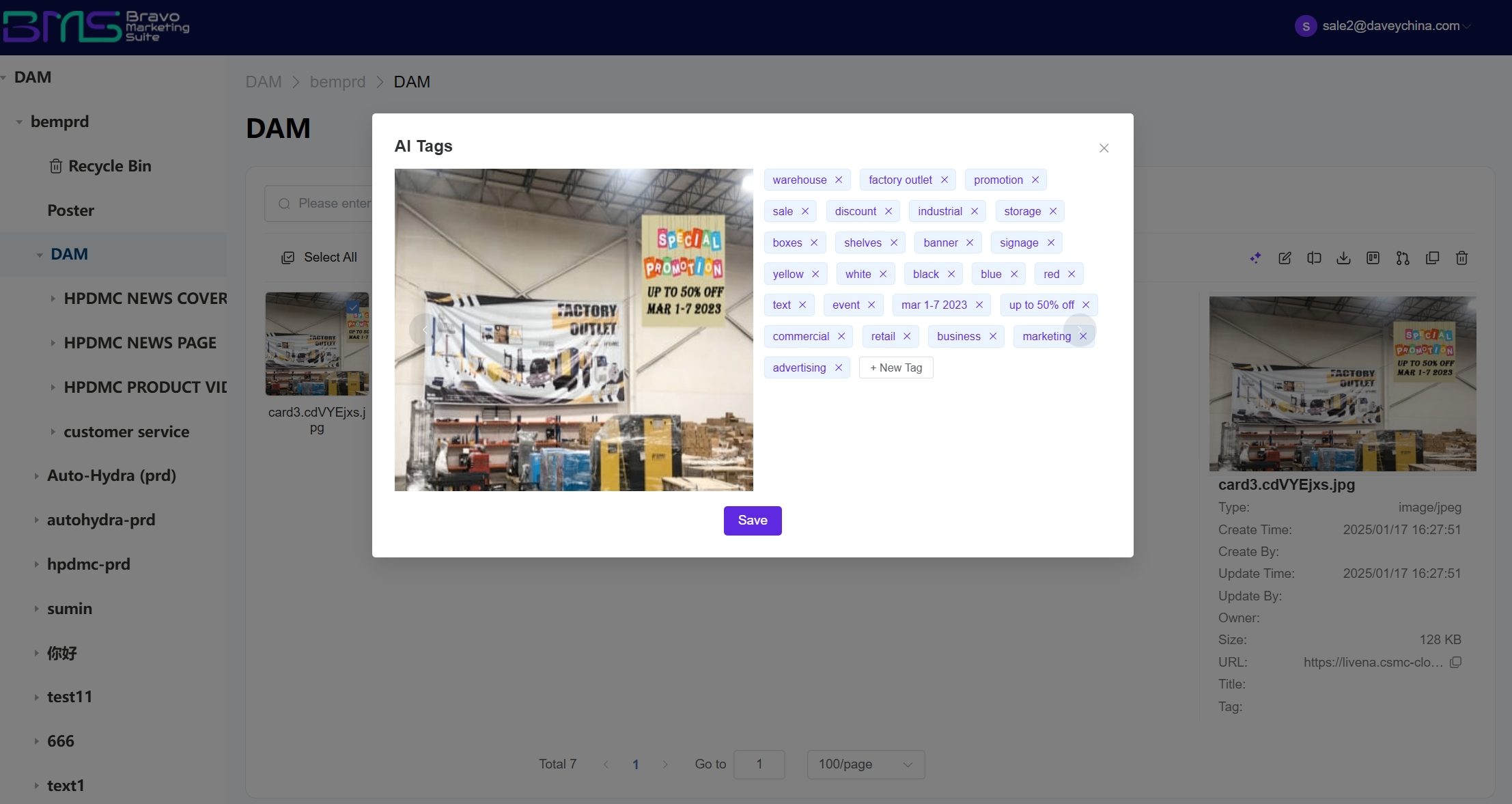
BMS's Digital Asset Manager (DAM) brings the concept of "the best enterprise asset management software" to life through the following ways:
● Centralized Asset Repository + Intelligent Search: All digital assets are stored in a single repository, supporting full-text search, tag search, category search, and AI multimodal search. Team members can quickly locate required assets using keywords, tags, content features, and other dimensions. By deeply integrating artificial intelligence technology, it breaks traditional storage and retrieval models, injecting intelligent capabilities into digital asset management and driving innovation in management practices.
● Real-time Collaboration and Synchronization Across Teams/Regions: Regardless of location, team members can instantly access, share, and collaboratively use the same assets. This is especially critical for multinational corporations or multi-department collaborations.
● Version Management + Permission Control + Compliance Assurance: Asset versions, attributes, usage permissions, and approval workflows can all be centrally managed, preventing duplicate creations, version chaos, or unauthorized usage.
With these capabilities, enterprises not only enhance efficiency but also significantly reduce asset management costs, improve brand consistency and compliance, achieving true "best enterprise asset management software" status.
● Connecting Multi-cloud and Cross-cloud Storage: Without migrating existing assets, BMS DAM can directly integrate with mainstream cloud storage services already used by enterprises, enabling "one-stop access" to digital assets such as images, videos, and design source files scattered across different clouds.
√ To learn more about BMS DAM's specific advantages in AI-powered intelligent management, refer to this article:
Why BMS’s DAM Is Indispensable for Enterprises Seeking the Best Asset Management Software
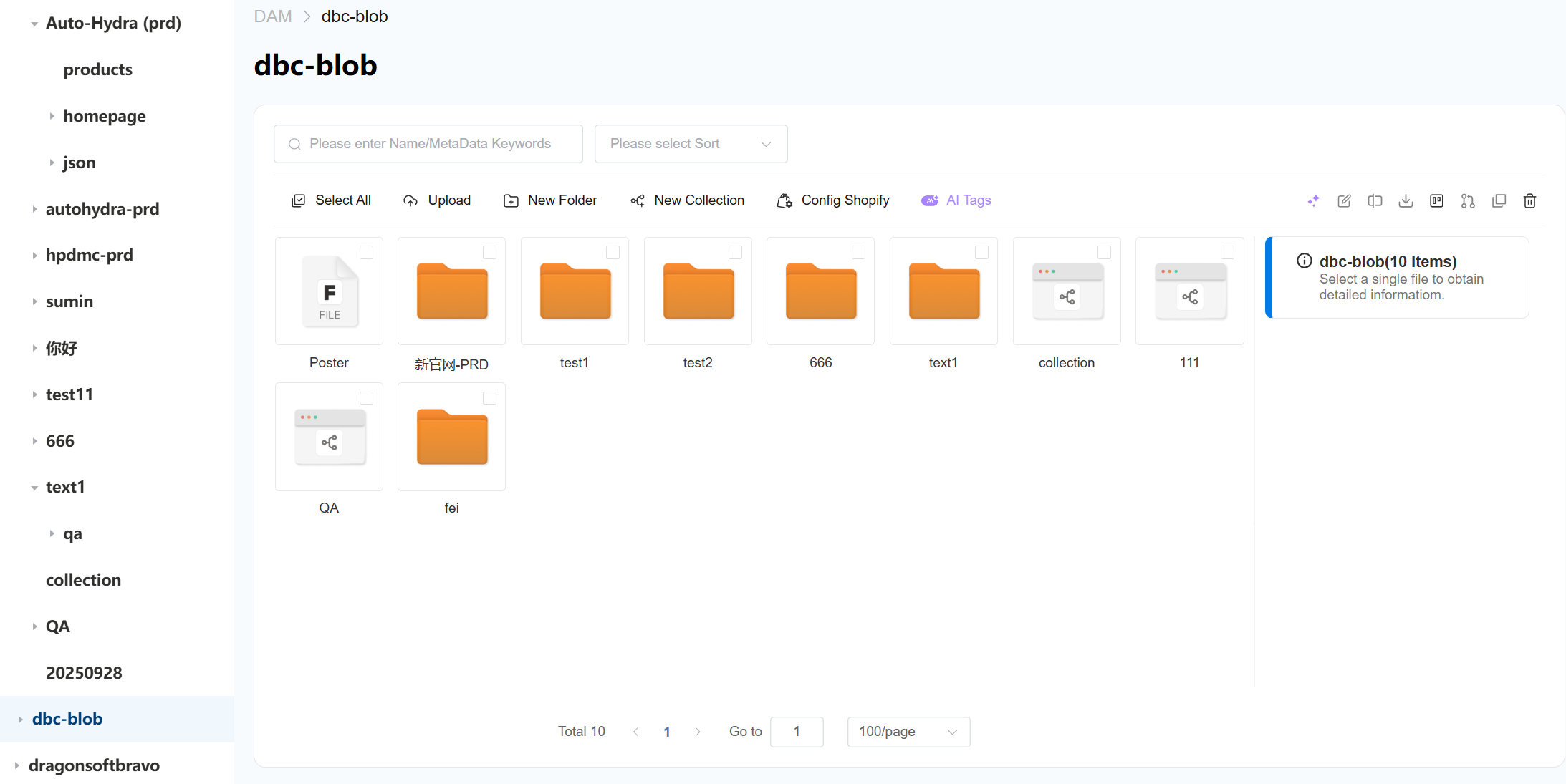
Introducing a DAM system as the central hub for enterprise asset management brings multiple benefits:
● Significantly Improves Search Efficiency and Team Productivity: Searching for assets within traditional folders can be extremely time-consuming. With DAM’s intelligent search and classification features, search time is greatly reduced, allowing teams to focus on creativity and execution.
● Ensures Brand Consistency and Content Compliance: All marketing/branding materials are centrally managed, standardized, categorized, and controlled in terms of version and permissions, avoiding the use of outdated, unauthorized, or incorrect versions of assets.
● Reduces Redundant Work and Costs: Prevents repeated design, duplicated storage, and redundant approvals, saving manpower, time, and storage costs, while accelerating project and marketing launch timelines.
● Enhances Team Collaboration and Cross-departmental Coordination: Whether it’s marketing, design, sales, legal, or regional teams, everyone can access the same asset library, enabling seamless collaboration, synchronized information, and lower communication costs.
● Unified Management Experience: Regardless of where assets are physically stored, users only need to log in to the BMS DAM system to perform editing, version management, permission assignment, and other operations entirely within BMS DAM, independent of the actual storage location;
Therefore, for organizations aiming to elevate digital asset management to a strategic level, a powerful DAM is the foundation for achieving "the best enterprise asset management software".
Why BMS with DAM Module Is the Optimal Choice for Enterprise Asset Management Software
BMS's DAM module excels in several key areas, making it a recommended solution for "best enterprise asset management software"
1. Comprehensive Intelligent Search Capabilities — Supports not only traditional tag/category/full-text search but also AI multimodal search, ideal for handling diverse asset types like images, videos, and documents, delivering faster and more accurate results.
2. Real-time Collaboration and Synchronization Across Geographies and Teams — For multinational companies, multi-team collaboration, or remote working environments, BMS DAM ensures all members access a unified resource library, enabling efficient collaboration.
3. Flexible and User-friendly + Seamless Integration with Existing Processes — BMS can be embedded into existing enterprise workflows such as marketing, content creation, approvals, and version control, reducing transition costs and increasing adoption rates.
4. Cost Savings and Improved ROI — By reducing repetitive tasks, improving retrieval and approval efficiency, and centrally managing copyrights and versions, BMS helps enterprises control asset management costs while enhancing execution efficiency and brand consistency.
Based on these strengths, BMS DAM represents a high-value choice for enterprises aiming to achieve "best enterprise asset management software" status.
Three Concrete Cases Showing How DAM Helps BMS Become the Best Enterprise Asset Management Software
Below are three representative cases illustrating how BMS's DAM functionality helps enterprises reach their goal of "best enterprise asset management software".
Case 1: Multinational Brand Company — Unified Global Management of Marketing Materials
A brand company operating across Asia, Europe, and the Americas needs its marketing teams to create localized materials (images, posters, videos, etc.) for different regions. After adopting BMS DAM, all materials are centrally stored — regional teams can quickly find suitable local-market assets via tags/categories/multimodal search and directly share them with local teams. The result is more efficient asset management, elimination of duplicate production, and consistent brand visuals.
Case 2: Large Advertising Agency — Optimized Project Collaboration and Approval Workflow
A large advertising agency operates with frequent collaboration among multiple creative teams, each project involving design, copywriting, client feedback, and approvals. Using BMS DAM, all assets are automatically archived, tagged, and categorized upon upload, and approvals and version tracking happen directly within the platform. Team members no longer rely on email exchanges or shared drives to locate or review materials, dramatically speeding up project delivery and reducing errors and rework.
Case 3: E-commerce Retailer — Efficient Management of Product Images and Marketing Content
An e-commerce retailer launches numerous new products daily, requiring product images, detail pages, promotional graphics, and social media visuals. With BMS DAM, they centrally manage all product-related images, design drafts, promotional videos, and marketing materials, using tags/categories and AI multimodal search to quickly retrieve needed assets — for example, rapidly finding images matching "red dress + front view + white background + 500x500px" for social channels. This improves launch speed while reducing redundant design and storage overhead.
Conclusion: BMS with DAM Module Is the Ultimate Choice for Enterprise Asset Management Software
Amid the digital wave, enterprises are accumulating more and more digital assets, which are increasingly vital. Achieving genuine "best enterprise asset management software" status relies far beyond traditional methods like folders, shared drives, or email attachments.
Bravo Marketing Suite (BMS)'s Digital Asset Manager (DAM) functionality elevates digital asset management to a new level through centralized storage, intelligent AI multimodal search, tag and category management, version control, permission management, and real-time collaboration. It not only enhances efficiency and reduces costs but also ensures brand consistency and facilitates cross-team and cross-regional collaboration — making it a highly effective solution for modern enterprises pursuing "best enterprise asset management software".
For enterprises seeking to optimize asset management, improve operational efficiency, and strengthen brand governance, BMS DAM is a critical tool worth serious consideration and deployment.
FAQ
Q1: Why should BMS with DAM module be considered the "best enterprise asset management software"?
A: Because enterprise digital assets are massive, diverse, and used by multiple teams. Without unified management, chaos and redundancy easily occur. DAM provides centralized storage, multi-cloud/cross-cloud integration, intelligent search, permission control, version management, and collaboration mechanisms that significantly improve asset management efficiency, reduce costs, and ensure brand consistency.
Q2: What is the difference between BMS DAM and traditional shared drives/network hard disks?
A: Traditional shared drives or network hard disks are merely file storage/sharing tools without professional DAM capabilities such as intelligent categorization, multi-cloud/cross-cloud storage, tag/metadata management, AI search, multimodal support, version control, permission management, or collaboration workflows. In contrast, BMS with DAM module is a system specifically designed for enterprise digital asset management.
Q3: What are the specific benefits of using BMS DAM?
A: Benefits include — faster asset retrieval, reduced duplication, improved team collaboration, consistent brand and content output, savings in storage and labor costs, and reduced risks of errors, copyright violations, or compliance issues.
Q4: Which types of enterprises are most suitable for adopting BMS DAM?
A: Any enterprise with large volumes of digital assets, cross-team/cross-regional collaboration, frequent creation of design/marketing materials, and a strong emphasis on brand consistency and asset management efficiency is well-suited. Particularly ideal for brand companies, advertising/marketing agencies, e-commerce businesses, and large multinational enterprises.


Want to know more about our products?
With years serving Fortune 500 clients, we offer flexible solutions and integrated implementation.
