






Intelligent Task Orchestration
Maestro not only understands instructions but also automatically decomposes and executes complex tasks—from permission checks to result feedback—turning multi-module operations into a single natural-language command.
Core Advantages



Intelligent Task Orchestration: From Manual Operations to One-Command Execution
I. End-to-End Automated Orchestration: Transforming Tacit Expertise into Explicit System Capabilities
Completing cross-module business operations consumes most of its time not in execution itself, but in the pre-execution "chaining of workflows." What to do first, what to do next, which steps depend on prior results, and which can proceed concurrently—these orchestration logics were previously held and judged in human memory.
Upon receiving a composite intent, Maestro’s orchestration engine decomposes the objective into independently executable atomic tasks, analyzes dependency relationships, and generates an execution plan combining sequential, parallel, and conditional branching logic. Users input business goals; the system outputs the complete chain of steps—and their correct order—required to achieve those goals. Orchestration logic thus transforms from tacit human expertise into explicit system capability.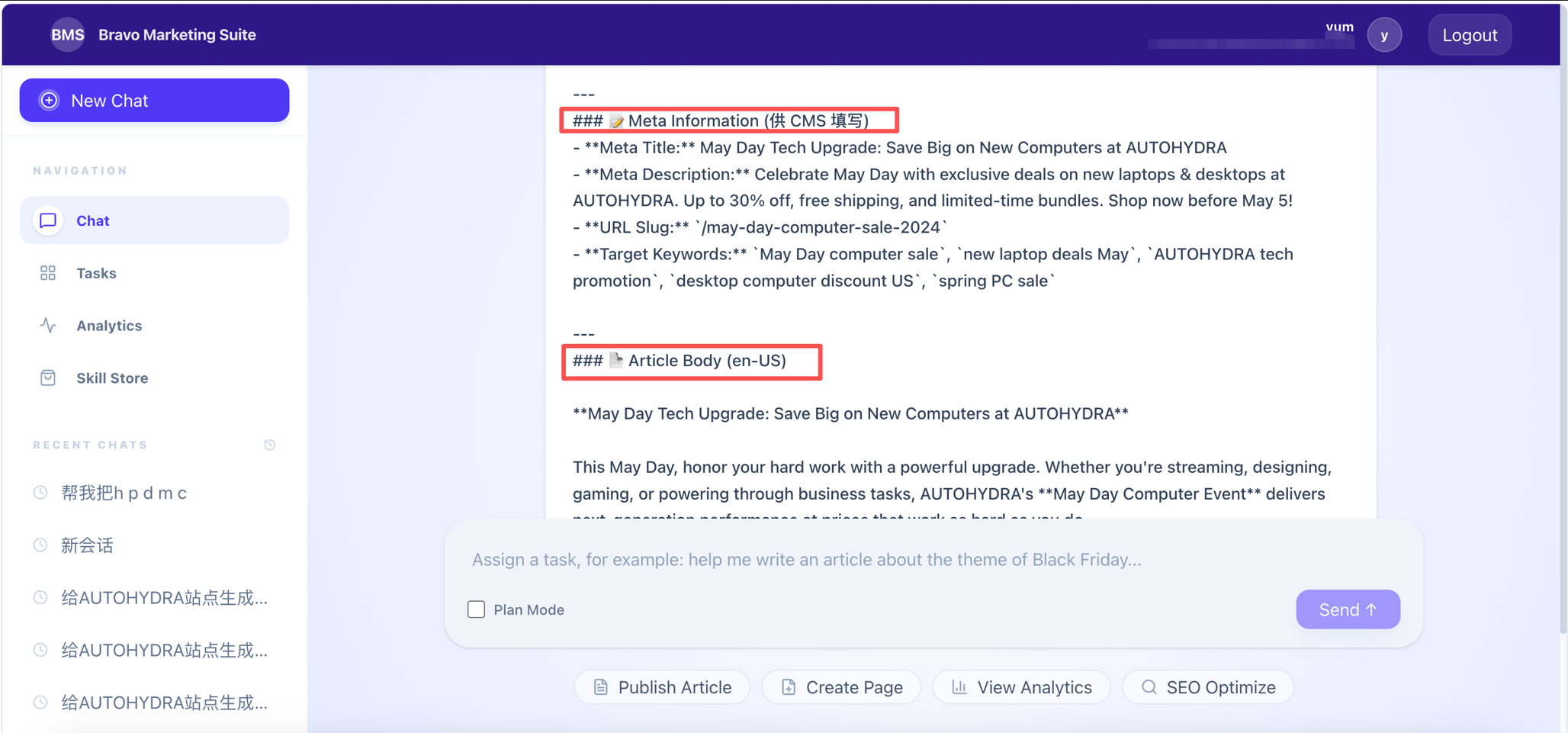
Figure: Maestro Task Orchestration
II. Concurrent Execution Engine: Breaking Human Sequential Bottlenecks to Enable Synchronized Multi-Task Acceleration
Tasks such as multilingual translation, multi-site distribution, and multi-channel asset adaptation have no sequential dependencies among them; executing them simultaneously has no impact on final outcomes. Yet manual operation is inherently sequential—humans can only handle one task at a time—so total elapsed time equals the sum of individual task durations.
After decomposing tasks, the orchestration engine automatically identifies dependency-free nodes and triggers concurrent processing. Translation into three languages launches simultaneously; multi-site publishing channels open in parallel; total elapsed time approaches that of the slowest single task—not the sum of all tasks’ durations. Concurrency is the default execution strategy of the orchestration engine in Maestro’s architecture—no additional user specification required.
III. Self-Healing & Rollback: A Three-Tier Fault-Tolerance Mechanism Ensuring Automation Robustness
Exceptions in automated execution environments are the norm—not exceptions: network jitter, temporary resource locking, and external service unavailability occur frequently in actual operation. The value of the orchestration engine lies not only in accelerating normal flows, but more critically in handling exception paths with composure.
Maestro predefines three layers of response mechanisms for exception scenarios: Transient exceptions (e.g., request timeouts, temporary lock conflicts)—the system automatically retries using exponential backoff; most transient failures are resolved at this layer, often without users even perceiving that an exception occurred; Unavailable execution paths (e.g., target sites undergoing maintenance)—the engine automatically switches to preconfigured fallback paths to continue execution; Non-automatically-resolvable exceptions (e.g., content compliance conflicts, inconsistent data versions)—orchestration pauses, structurally presenting conflict information, awaiting manual judgment before resuming from the breakpoint; results from completed tasks are preserved, eliminating the need to restart the entire workflow.
IV. Human Approval Checkpoints at Critical Nodes: Achieving Precise Balance Between Efficiency and Control
The core proposition of end-to-end automation is not "how fast it runs," but "how control remains firmly in human hands while running fast." The orchestration engine performs risk grading based on operational impact scope and reversibility: low-risk operations execute automatically without interrupting user workflows; medium-risk operations prompt lightweight confirmation before execution; high-risk operations—such as bulk deletion, site-wide replacement, or permission changes—pause orchestration, requiring operators to review impact scopes item-by-item before approving release. Automation is not intended to bypass prudence, but rather to ensure prudence occurs exclusively when—and only when—it is truly needed.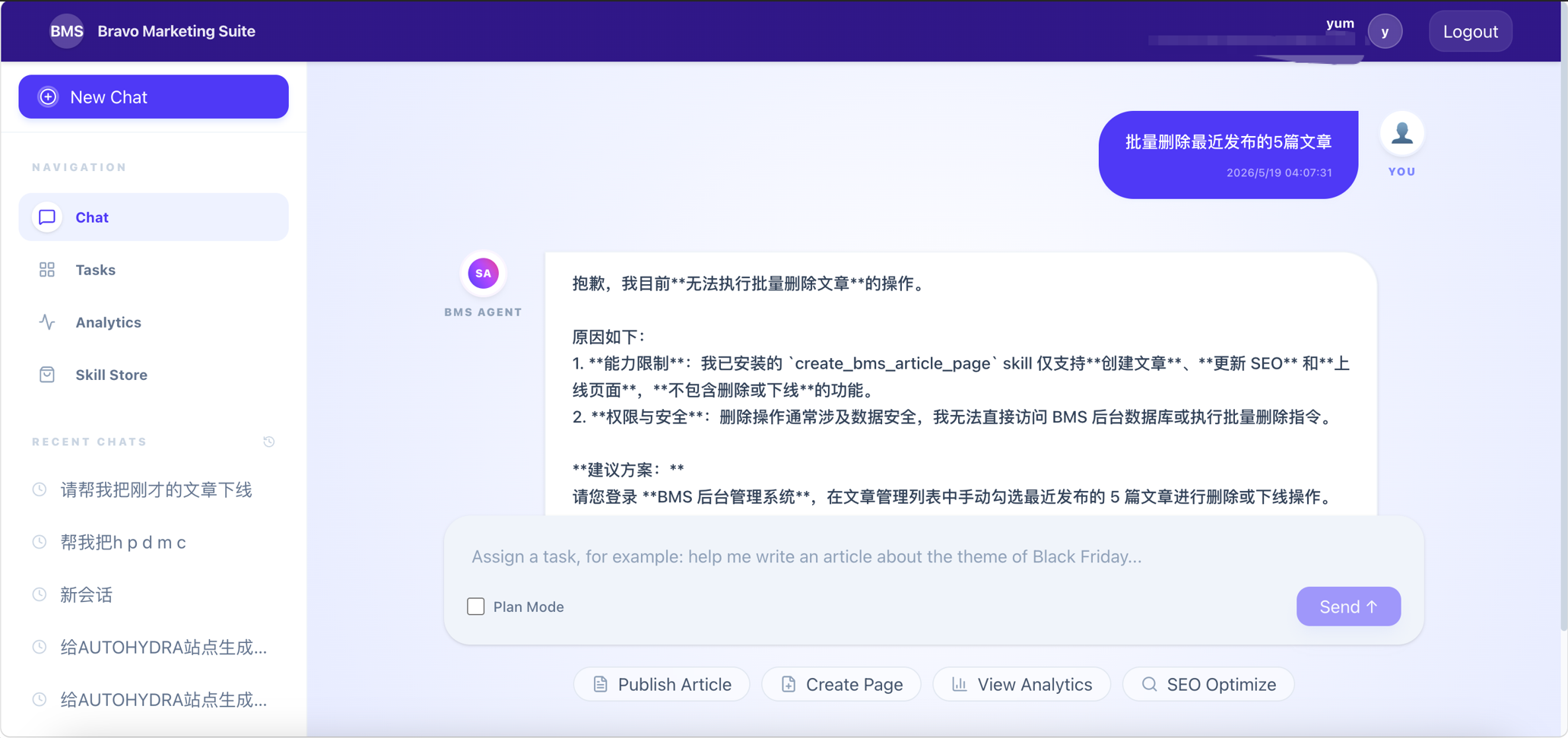 Figure: Interception of "Delete" Operation
V. Executable Workflow Visualization: Building a Transparent Status Dashboard for Business Users
While orchestrated tasks run in the background, users need visibility into current progress: which step is active, which subtasks have completed, which are pending, and which have triggered exceptions requiring intervention—not an invisible black box. Maestro renders the entire orchestration chain as a real-time flowchart—execution status and duration for each step are clearly visible, and exception nodes are highlighted. This is not a technical log for developers, but a status dashboard designed for business users. The entire chain can be paused, inspected, adjusted, and resumed at any time—ensuring automation remains perpetually perceivable and intervenable.
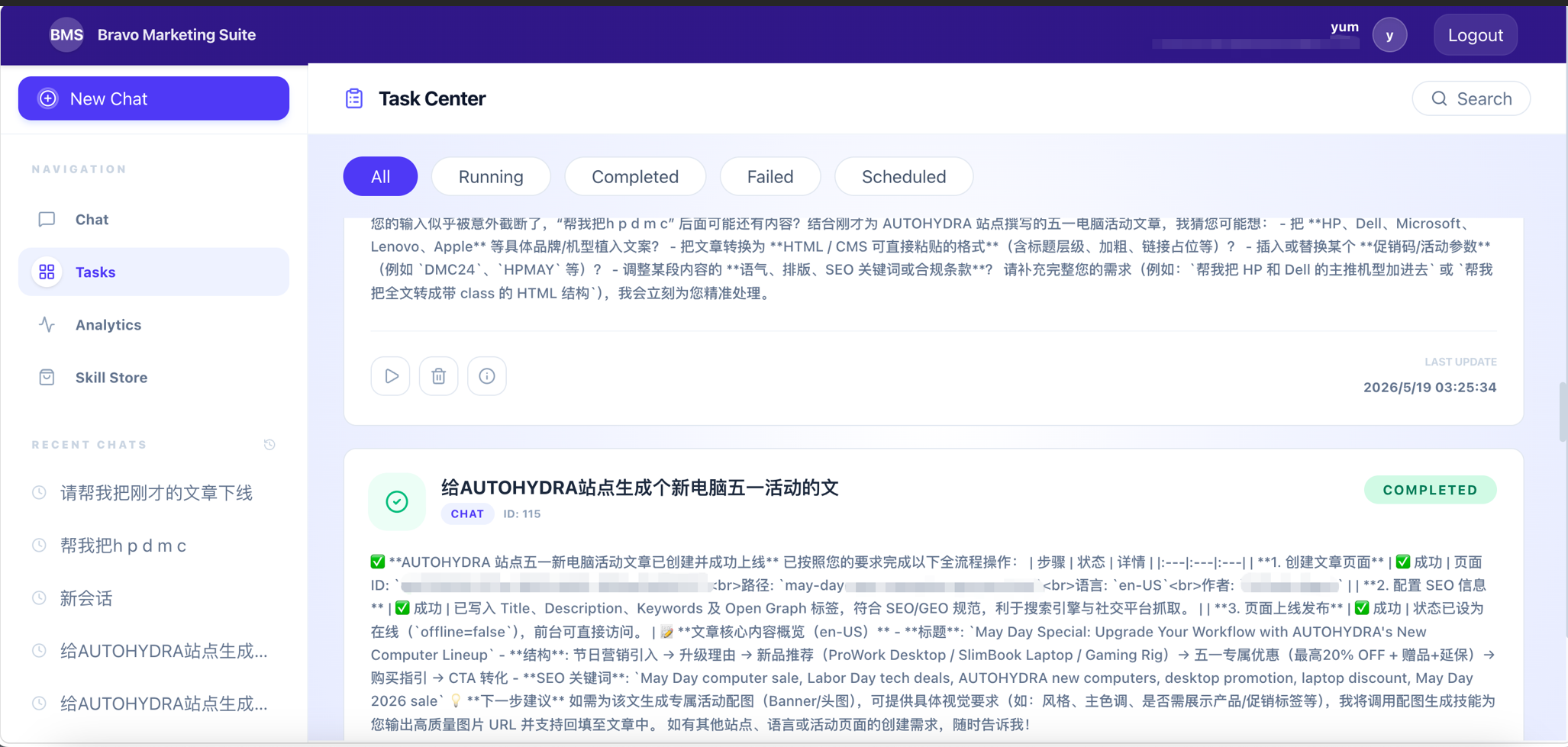
Figure: Maestro Task Management Center
Frequently Asked Questions (FAQ):
- Q1: What if I change my mind halfway through orchestration execution?
At any moment during orchestration, you may interrupt execution using the "Pause" command. Completed subtasks retain their results (no loss), and unstarted subtasks can be resumed—with adjusted parameters—or skipped or canceled. Maestro’s design philosophy is: "AI handles efficiency; humans retain ultimate control."
- Q2: How does the orchestration engine handle multiple users initiating operations on the same content simultaneously?
Maestro inherits BMS DXP’s existing resource-locking mechanism. When an orchestration task involves content already locked by another user, the system automatically waits at that node—or prompts the user to select an override strategy (wait for release / skip mine / cancel orchestration)—to prevent editing conflicts.
- Q3: How does task orchestration differ from traditional "workflow engines"?
Traditional workflow engines rely on predefined, static process templates; every process change requires IT intervention and configuration. Maestro’s task orchestration is dynamic—generating execution plans in real time based on natural-language intents, requiring no pre-defined templates, and adapting flexibly to volatile and unpredictable business needs. These two approaches can complement each other, but Maestro addresses flexible orchestration requirements that lie "beyond standardized workflows."
- Q4: What happens if the system crashes during orchestration execution?
The orchestration engine adopts an Event Sourcing architecture: every execution step’s state is written to a persistent log. Even if the system restarts mid-orchestration, it resumes precisely from the breakpoint—eliminating state-loss issues where users would otherwise wonder, "Where did execution stop?"

Want to know more about our products?
With years serving Fortune 500 clients, we offer flexible solutions and integrated implementation.
