






Natural Language-Driven
Say goodbye to complex menus and manual operations. Maestro, powered by BMS DXP’s natural language engine, lets users execute complex tasks through everyday language—enabling a true “what you say is what you achieve” experience.
Core Advantages




Intent-to-Execution — How Maestro Makes 'Speaking Your Mind' the Most Efficient Way to Operate
I. Sub-Second Intent Recognition
Upon receiving a natural language instruction, Maestro’s intent parsing engine efficiently completes three tasks—intent classification, entity extraction, and parameter completion—within two seconds.
This mechanism replaces the user’s internal “translation layer” present in traditional interaction models—the cognitive process of translating a business objective into a system path: determining which module to enter, which function to invoke, and what operational sequence to follow. The richer the system functionality, the higher the cognitive load imposed by this translation layer. Maestro shifts this burden from the user side to the system side, collapsing the interface from a complex functional menu into a single text-input field, while seamlessly connecting behind the scenes to the full capability set of the BMS (Business Management System).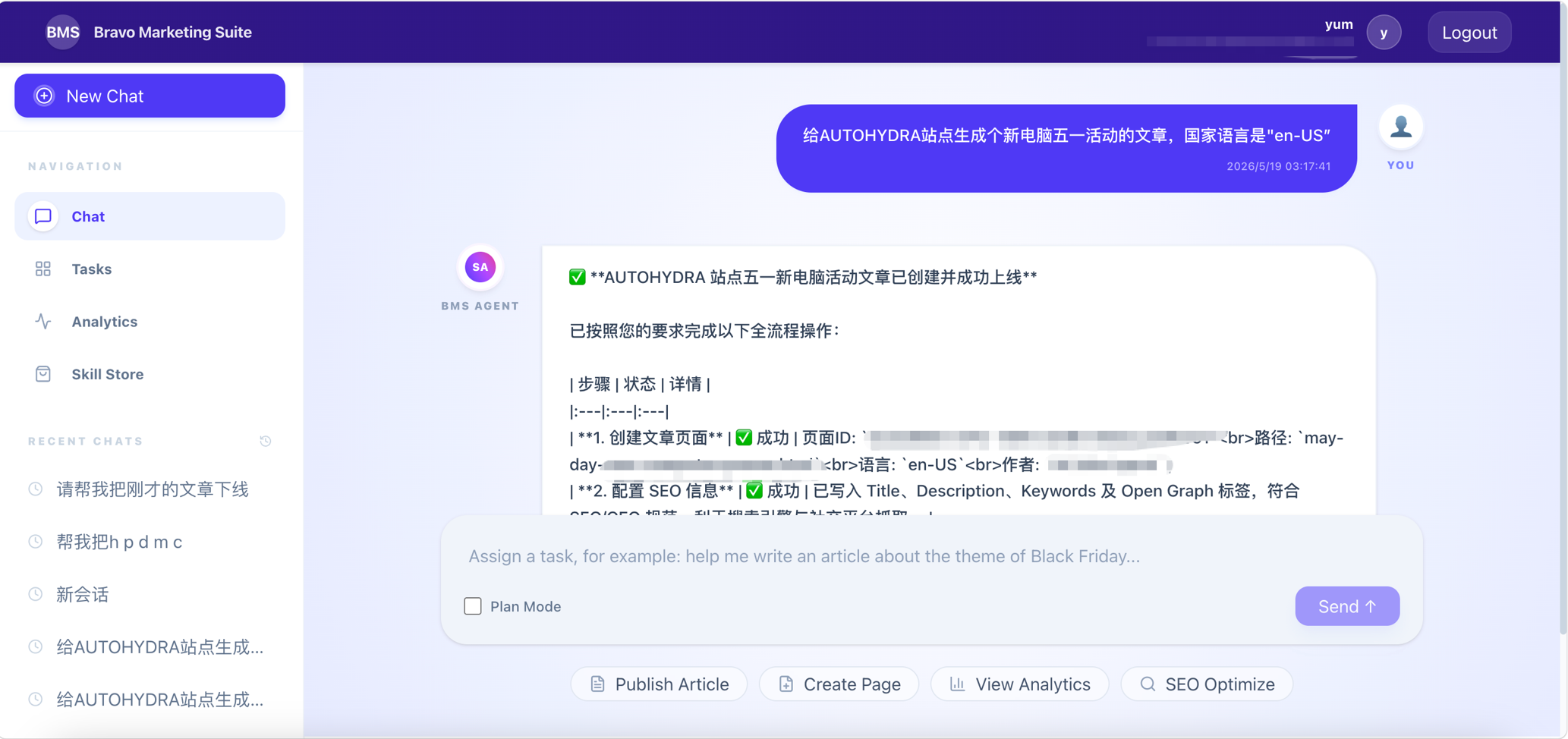
Figure: Example Maestro conversational command
II. Single-Pass Parsing of Composite Instructions
For example: “Translate this batch of content into Japanese and Korean, and publish it separately on the Japan and Korea sites tomorrow morning”—a single sentence embeds four distinct operations: translation, localization adaptation, multi-site distribution, and scheduled publishing. Under traditional architectures, these operations are scattered across translation tools, site management modules, and scheduling systems; users must navigate sequentially between them, execute each step, record intermediate results, and switch contexts. While modules are functionally segmented, business processes are goal-oriented—module boundaries fracture the natural flow of business operations.
Maestro’s intent parsing engine is specifically designed for composite semantics. Users express complete business objectives as input, and the engine automatically reconstructs dependency relationships, parallelizable nodes, and final convergence points—all within a single parsing pass—generating an end-to-end execution plan. Users maintain cognitive continuity, while the system handles complexity decomposition.
III. Proactive Ambiguity Clarification
Ambiguity is an inherent property of natural language. When an instruction admits multiple interpretations—for instance, “publish the article on the main site,” yet the account is associated with multiple main sites—the system faces a strategic choice: guess the most probable interpretation and execute directly, or pause to request confirmation? The efficiency advantage of the former applies only when the guess is correct; however, the cost of correcting one erroneous decision far exceeds the time saved by ten correct guesses.
Maestro chooses the latter—but restructures the confirmation mechanism from “error-driven blocking” to “dialogue-based clarification”: ambiguity points are presented as structured options, enabling users to resolve them with a single click. Rather than interrupting the workflow, the system safeguards it against deviation.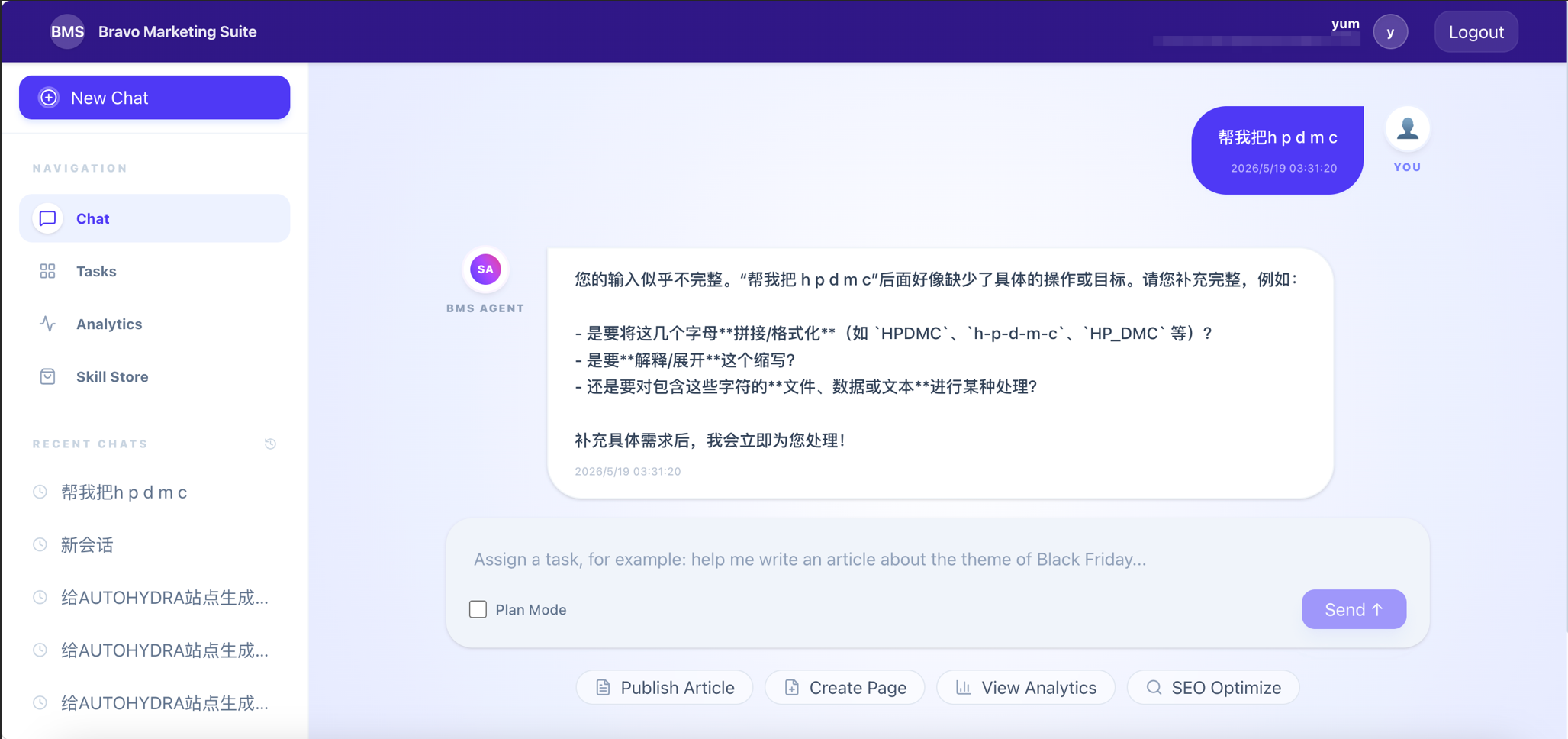
Figure: Example of ambiguity clarification
IV. Support for Chinese, English, and Mixed-Language Instructions
Maestro’s intent parsing engine natively supports multilingual corpora without requiring translation middleware. Whether the instruction is in Chinese, English, or a naturally occurring mix of both—as often occurs in cross-border collaboration—it is processed directly by the same parsing logic. Team members across regions can interact with the Agent using their most comfortable working language, without needing to conform to a system-imposed language policy.
V. Continuous Learning and Adaptation
Through daily interactions, Maestro continuously absorbs enterprise-specific business terminology, process conventions, and expression preferences via user feedback signals—including selections, confirmations, and corrections. For example: which specific site “main site” refers to, which product line corresponds to “Starlight Series,” and which content assets are linked to the “Q3 Sprint Plan.” These enterprise-specific contextual associations are progressively annotated and consolidated through repeated interactions. A Maestro instance deployed for one month demonstrates a perceptibly deeper contextual adaptation to its enterprise environment compared to a version deployed for only one week—and this evolution requires no dedicated training or configuration effort.
Frequently Asked Questions (FAQ)
- How complex a natural language instruction can Maestro handle?
Maestro supports deeply nested composite instructions. From simple commands such as “publish this article” to complex ones like “analyze content performance across all sites last quarter, identify pages with traffic decline exceeding 20%, generate optimization recommendations for them, and prioritize those recommendations,” the system reliably performs intent parsing and task orchestration. For instructions beyond the current Skill capability scope, Maestro explicitly communicates its capability boundaries and suggests alternative approaches.
- If team members use inconsistent colloquial expressions, can Maestro still understand correctly?
Maestro’s intent parsing engine relies on the semantic understanding capabilities of large language models—not simple keyword matching. Whether the input is “help me post an article” or “please execute multi-site distribution for this content,” the system extracts the identical core intent. Moreover, the system continuously learns the specific business terminology and expression habits of a given team based on historical interaction data, and its comprehension accuracy improves steadily with continued usage.
- Do natural language inputs pose security risks—e.g., command injection attacks?
Maestro implements security filtering and sandbox isolation for all natural language inputs at the system architecture level. All parsed instructions execute strictly within the existing BMS permission framework—users can only perform actions within their authorized scope via natural language, and no permission boundary is crossed simply due to a change in interaction modality. Additionally, all operations triggered by natural language are logged in the audit trail, ensuring full traceability and rollback capability.
- For business operations requiring precise parameters, is natural language less reliable than forms?
For operations involving precise parameters—such as monetary amounts, inventory quantities, or compliance thresholds—Maestro displays all extracted parameters in a structured card format after parsing the instruction, requiring explicit user confirmation before execution. This approach balances the convenience of natural language input with the rigor required for precise operations—input remains free, but execution remains strictly controlled.

Want to know more about our products?
With years serving Fortune 500 clients, we offer flexible solutions and integrated implementation.
