






Enterprise-Level Knowledge Accumulation
Build an enterprise-level knowledge accumulation system that transforms scattered tacit knowledge into inheritable and reusable explicit assets, bridges knowledge flow and sharing across all domains, and empowers various business scenarios with standardized knowledge to continuously drive efficient business growth and innovative upgrades.
Core Advantages



Enterprise-Level Knowledge Accumulation: Building a Secure and Traceable Intellectual Asset Repository
Say Goodbye to Knowledge Loss and Empower Organizational Wisdom Transfer
In today's increasingly complex business environment, knowledge has become an enterprise's most valuable asset. However, fragmented, decentralized storage of knowledge—and knowledge loss due to employee turnover—frequently challenges numerous organizations. Our BMS system, equipped with a powerful knowledge base functionality, provides enterprises with a unified, efficient platform that not only enables effective knowledge consolidation and accumulation but also ensures the security, traceability, and continuous appreciation of intellectual assets through refined management mechanisms.
Key Advantages
I. Efficient Knowledge Consolidation and Accumulation
Transforming Dispersed Experience into Structured Wisdom
Our BMS system offers an intuitive and robust platform capable of aggregating dispersed experience, solutions, best practices, and critical information from various departments and employees into structured knowledge assets. Leveraging the Fragment architecture, this knowledge can be decomposed into independent, taggable content fragments enriched with comprehensive metadata. This means:
Comprehensive Knowledge Capture: Whether project documentation, technical specifications, customer case studies, market analysis reports, or daily work summaries, all can be efficiently captured and stored by the system.
Intelligent Categorization and Tagging: Custom classification frameworks and flexible tagging features ensure precise categorization of all knowledge, enabling rapid search and browsing.
Promoting Tacit-to-Explicit Knowledge Conversion: Encourages employees to transform personal experience and insights into shareable knowledge fragments, breaking down information silos and fostering internal knowledge sharing and innovation.
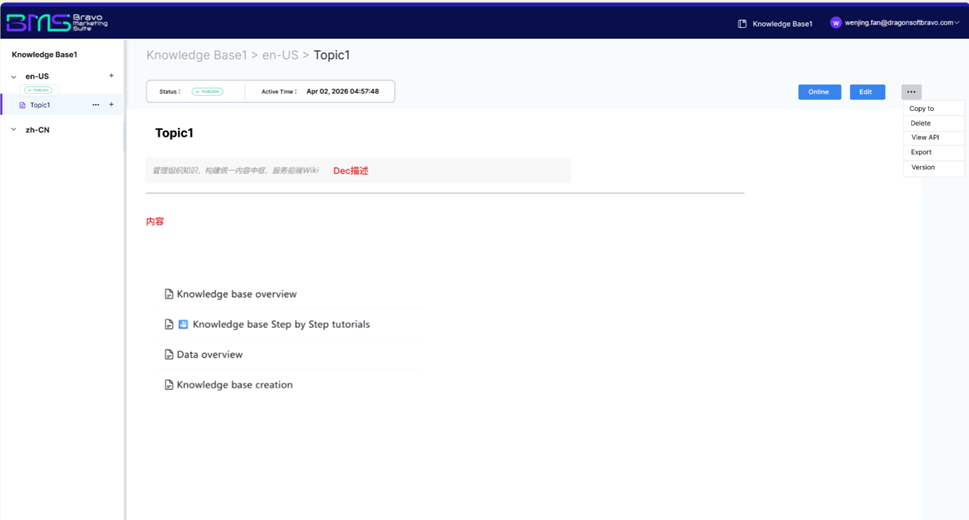
(Image: Knowledge Center preview interface)
II. Refined Multi-Level Permission Management
Ensuring Information Security and Enabling Need-Based Access
Information security of knowledge assets is a top priority for enterprises. Our BMS system provides flexible, fine-grained multi-level permission control mechanisms to safeguard sensitive information while ensuring team members efficiently access required knowledge:
Role-Based Access Control (RBAC): Administrators can assign distinct permissions—including access, editing, publishing, and deletion—based on user roles (e.g., editor, reviewer, publisher, standard user), department, or content type.
Internal vs. External Knowledge Isolation: The system supports independent permission management for internal knowledge bases and external help centers, ensuring enterprise-sensitive information remains protected while external users access only public content.
Content-Level Permission Control: Permissions can even be assigned individually to specific knowledge articles, enabling more granular content security management to meet complex enterprise compliance requirements.
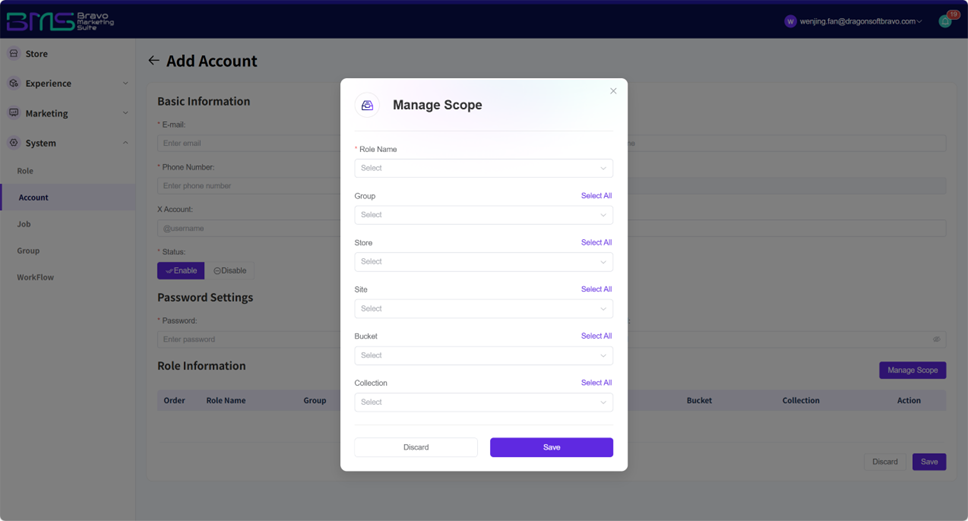
(Image: Account permission configuration interface)
III. Comprehensive Version Control and Traceability
Every Modification Leaves a Verifiable Trail
Knowledge is dynamic; content updates and iterations are routine. Our BMS system embeds comprehensive version control functionality to ensure rigor and trustworthiness of the knowledge base:
Automatic Version Logging: Each article in the knowledge base maintains a complete version history. Every modification, update, and publication is automatically saved as a new version, recording the modifier, timestamp, and changes made.
Content Rollback and Comparison: Team members can review historical versions anytime, perform content rollbacks, and compare differences across versions—better understanding content evolution and preventing operational errors.
Audit and Compliance: Full version history provides enterprises strong auditing capabilities, fulfilling diverse industry regulations and internal compliance requirements, ensuring transparency and reliability of knowledge assets.
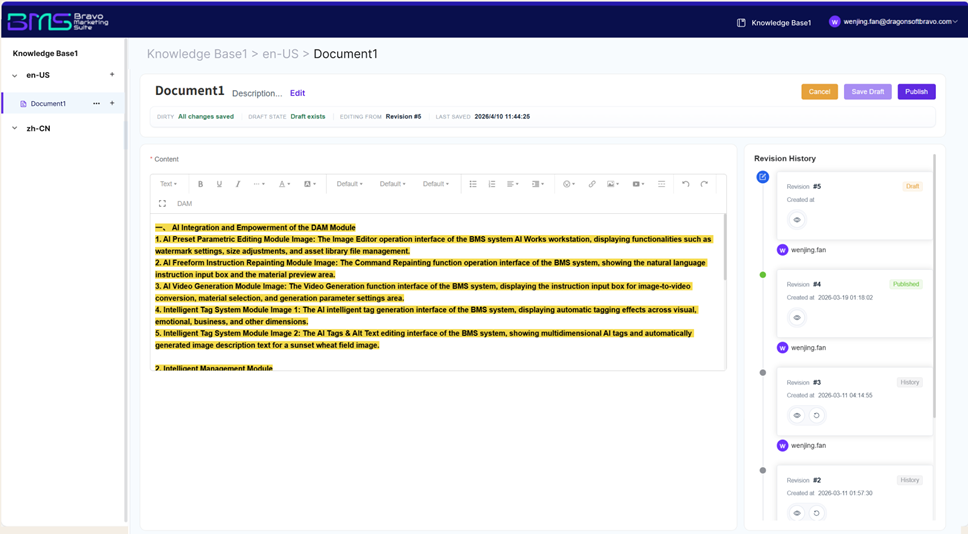
(Image: Knowledge base editing page—version history on right side)
IV. Intelligent Search with Precise Matching for Efficient Knowledge Retrieval
Powered by an intelligent search engine supporting multidimensional queries—including keywords, semantics, and scenarios—employees and customers can quickly locate required knowledge. Combined with user behavior analytics, the system intelligently recommends relevant knowledge fragments, shortening knowledge acquisition time, enabling employees to rapidly enhance professional competencies, and empowering customers to efficiently obtain needed information—thus improving both employee productivity and customer experience.
Conclusion
Our BMS system is far more than just a content publishing tool—it is a powerful enterprise-grade knowledge management platform. Through efficient knowledge consolidation, refined permission management, comprehensive version control, and data-driven optimization mechanisms, it helps enterprises build a secure, traceable, and continuously appreciating intellectual asset repository—truly empowering organizational wisdom transfer and development.
Frequently Asked Questions (FAQ)
Q1: Why is knowledge consolidation important for enterprises? How does our BMS support it?
A1: Knowledge consolidation is critically important for enterprises, transforming employee experience and insights into organizational assets, preventing knowledge loss caused by staff turnover, and promoting internal knowledge sharing and innovation. Our BMS leverages the Fragment architecture to structure and tag fragmented information, providing a unified platform for knowledge capture, categorization, and storage—ensuring effective inheritance of intellectual capital.
Q2: How is knowledge base content security ensured?
A2: Our BMS provides refined multi-level permission management. You may configure access, editing, and publishing permissions based on user roles, departments, or content types. The system supports isolation between internal and external knowledge, ensuring sensitive information remains secure and controllable—meeting enterprise compliance requirements.
Q3: What is the purpose of the knowledge base’s version control feature?
A3: Comprehensive version control ensures rigor and traceability of knowledge base content. Every modification is automatically logged—including the modifier, timestamp, and details of changes—allowing teams to review historical versions, perform rollbacks or comparisons at any time, facilitating audits, effectively preventing operational errors, and enhancing content credibility.
Q4: What types of knowledge content does enterprise-grade knowledge consolidation support?
A4: Supports consolidation of all knowledge types—including employee experience, business processes, product knowledge, industry case studies, customer service scripts, training materials, policies, and regulations. Whether textual, image-based, tabular, or video content, all can be standardized for consolidation and reuse—fully meeting enterprise-wide knowledge management needs across all scenarios.

Want to know more about our products?
With years serving Fortune 500 clients, we offer flexible solutions and integrated implementation.
