






Global Multilingual Support
Build global multilingual intelligent support capabilities to precisely break down geographical and linguistic communication barriers, enable cross-regional content interoperability and efficient collaboration, comprehensively empower enterprises' global expansion across all business domains, and support robust international brand growth.
Core Advantages

Globalization and Seamless Integration: Building an Interconnected Global Content Ecosystem
Break Through Geographic Barriers and Connect to Global Markets
In the wave of globalization, enterprises must extend their products and services to users worldwide. This means content must be localized quickly and accurately, and seamlessly integrate with various existing enterprise systems. Our BMS system is specifically designed to address these challenges—powered by robust multilingual globalization support and API-First integration capabilities, it helps enterprises break through geographic barriers and build an interconnected global content ecosystem.
I. Native Multilingual Globalization Support
Easily Manage Multilingual Content and Expand into Global Markets
From its inception, our BMS system has embedded multilingual support as a core capability—not merely as an add-on plugin. This enables enterprises to effortlessly manage and publish localized content tailored to users across diverse regions and languages:
Multilingual Management: Each piece of content can have independent versions created and managed for different languages. This allows content teams to perform precise localization adjustments—including titles, descriptions, and more—tailored to specific regions or cultural contexts, ensuring accurate information delivery and cultural appropriateness.
SEO/GEO Localization Optimization: Through structured management of multilingual content and metadata configuration, the system better supports multilingual SEO and GEO strategies, helping enterprises achieve higher visibility in search engines and generative AI platforms across countries and regions—effectively reaching target audiences.
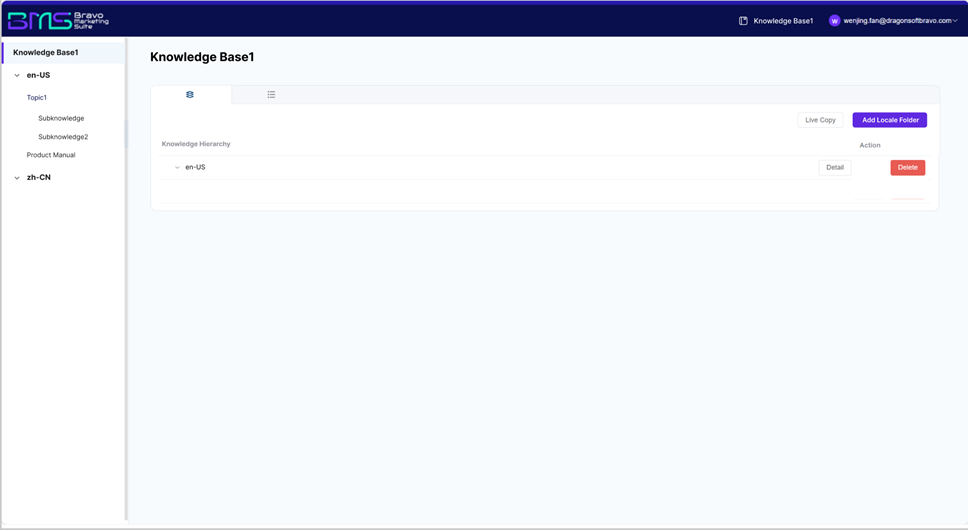
(Multilingual hierarchy in the Knowledge Center)
II. Efficient AI-Powered Translation
One-Click Synchronized Translation to Boost Multilingual Content Efficiency
The system supports integration with professional AI translation tools, simplifying translation workflows and improving efficiency. Content teams can clearly track the status of each language version, ensuring all localized content goes live promptly.
By integrating intelligent translation engines, knowledge content can be translated with a single click—significantly shortening the multilingual content production cycle. Post-translation, local teams can perform manual review and refinement to ensure linguistic expression aligns with local cultural norms and contextual nuances—balancing translation speed with content professionalism and reducing operational costs for multilingual content.
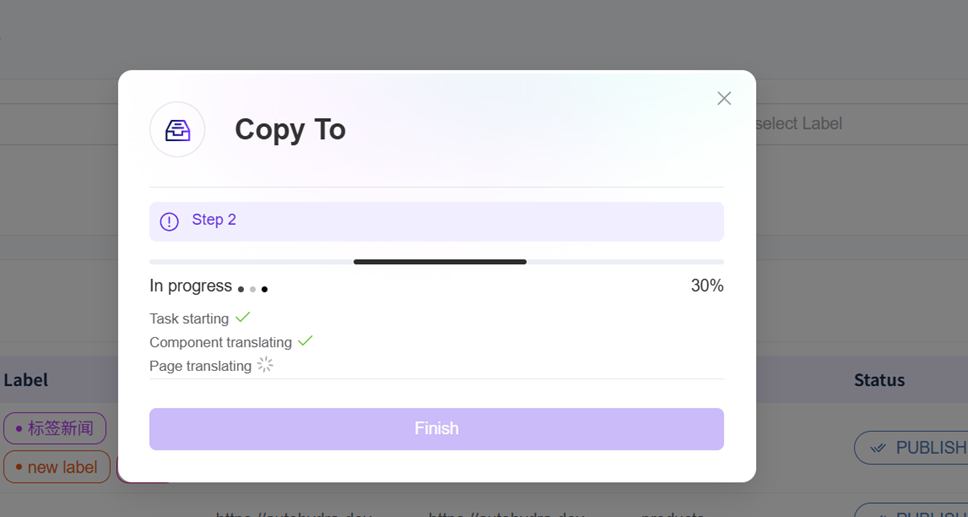
(Content “Copy To” AI Translation)
III. Multilingual Intelligent Search
Multilingual Intelligent Search for Efficient Enterprise-Wide Knowledge Retrieval
Equipped with multilingual intelligent search, the system supports keyword-based and semantic search across languages. Users can rapidly retrieve required knowledge using their native language—without switching languages—to obtain precise results. It also supports automatic language detection, dynamically delivering the appropriate language version based on users’ browser settings or IP geolocation, thereby enhancing knowledge access experiences for global users and employees.
IV. API-First Design Philosophy for Seamless Integration
Breaking Down Information Silos and Building a Unified Digital Hub
In modern enterprises, a content management system is no longer an isolated component—it must collaborate tightly with diverse business systems. Our BMS system embraces the API-First design philosophy, offering powerful and flexible APIs to ensure seamless integration with your existing digital ecosystem:
Open and Standardized APIs: The system provides a comprehensive, easy-to-use set of RESTful APIs aligned with industry standards, enabling developers to conduct secondary development and integrations with ease. Whether retrieving, publishing, updating content, or managing users—all operations can be programmatically controlled via APIs.
Seamless Integration with Leading Business Systems: Through APIs, our BMS can effortlessly exchange data and integrate functionality with your existing CRM (Customer Relationship Management), ERP (Enterprise Resource Planning), e-commerce platforms, marketing automation tools, analytics platforms, and other third-party systems. This breaks down traditional information silos and deeply integrates content with business processes.
Flexible Support for Headless Deployment: The API-First architecture enables our BMS to operate as a “headless CMS,” fully decoupling content from frontend presentation. Enterprises retain complete freedom to choose any frontend technology stack—including React, Vue, Angular, etc.—to build user interfaces, achieving maximum flexibility, performance, and customization for unique frontend requirements.
Empowering Innovative Application Development: Powerful APIs unlock limitless innovation potential. Developers can rapidly build new digital products, services, or internal tools leveraging the CMS’s content capabilities—accelerating your enterprise’s digital transformation journey.
Conclusion
With its exceptional multilingual globalization support and API-First seamless integration capabilities, our BMS system provides a solid content infrastructure that empowers enterprises to gain a competitive edge in global markets. It not only helps you efficiently manage and publish localized content for global audiences but also deeply integrates with your existing systems—building a unified, efficient, and interconnected digital ecosystem that fuels continuous innovation and growth worldwide.
Frequently Asked Questions (FAQ)
Q1: How does our BMS support multilingual content management?
A1: Our BMS system natively supports multilingualism—each piece of content can have independent versions created and managed per language. This enables content teams to perform precise localization adjustments for specific regions or cultural contexts, and—through efficient translation workflows—ensures multilingual content is published quickly and accurately.
Q2: What benefits does multilingual support bring to enterprise global operations?
A2: Multilingual support enables enterprises to easily manage multilingual content and respond swiftly to global market demands—effectively reaching users across diverse cultural backgrounds. Structured multilingual content management and metadata configuration further enhance multilingual SEO and GEO strategies, boosting content visibility worldwide.
Q3: What is the API-First design philosophy, and why is it critical for a CMS?
A3: API-First is a development methodology where APIs are designed and built first, followed by user interfaces and integrations with other services. For a CMS, API-First guarantees high openness and flexibility—enabling seamless connectivity with existing enterprise systems such as CRM, ERP, and e-commerce platforms—breaking down information silos and building a unified digital hub.
Q4: How does our BMS support headless deployment?
A4: The API-First architecture enables our BMS to function as a “headless CMS,” completely separating content from frontend presentation. Enterprises may freely select any frontend technology stack—including React, Vue, Angular, etc.—to build user interfaces, achieving ultimate flexibility and performance while meeting customized frontend needs—and empowering innovative application development.

Want to know more about our products?
With years serving Fortune 500 clients, we offer flexible solutions and integrated implementation.
