






Fragment Architecture
Leveraging a modular, component-based reuse system, it comprehensively empowers efficient business content production, rapid assembly, and flexible iteration, helping enterprises accumulate high-value knowledge assets and achieve cross-scenario, full-domain efficient reuse and maximum value realization.
Core Advantages

Fragment Architecture: Reshaping Content Management Flexibility and Reusability
Say Goodbye to Content Silos, Embrace a Modular Future
In today's rapidly evolving digital era, content has become the core bridge connecting enterprises with their users. Yet traditional CMS platforms often treat content as a monolithic entity, resulting in low efficiency in content creation, management, and distribution—making it difficult to meet multi-channel and personalized content demands. Our BMS system, powered by its revolutionary Fragment (content fragment) architecture, completely transforms this status quo, delivering unprecedented flexibility and reusability in content management for enterprises.
I. Highly Modular & Infinitely Reusable
Decompose content into intelligent building blocks—combine freely
The core of the Fragment architecture lies in decomposing complex content into independent, reusable smallest units. These “content building blocks” can be headings, paragraphs, images, videos, CTA buttons, or even complete FAQ entries. Each Fragment carries clear definitions and independent metadata, enabling it to exist independently of any specific page. By decomposing knowledge content into independent, reusable Fragments (content fragments), organizations achieve atomic-level management of knowledge assets. Whether product descriptions, FAQs, industry solutions, or marketing copy—they can all be broken down into standardized fragments, created once and reused across all channels, eliminating redundant content production and significantly improving the efficiency of knowledge content creation and updates to meet enterprises’ multi-scenario, multi-channel knowledge delivery needs. This means content teams can assemble and reuse these fragments flexibly across different pages and channels—just like LEGO bricks—greatly enhancing content production efficiency while ensuring brand message consistency across all touchpoints. Whether for marketing campaigns, product documentation, or help center articles, rapid response is possible, achieving “create once, publish everywhere.”
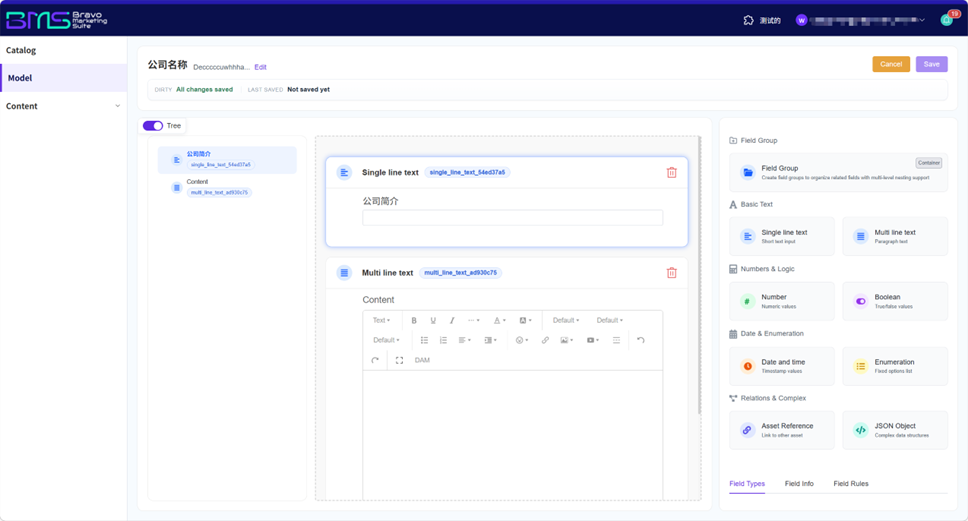
(Image: Fragment-Model online editing interface)
II. Outstanding Structured Data Support
Built for machines, paving the way for an intelligent future
In today’s AI- and big-data-driven world, content serves not only human readers but also machines. Every Fragment in the Fragment architecture is inherently a structured data unit. This means each Fragment can carry rich semantic information and metadata—such as type, topic, keywords, author, and publication date. This intrinsic structural nature makes content far easier for search engine crawlers, AI models, and various automation tools to parse and process efficiently. It delivers more precise semantic signals for SEO (Search Engine Optimization) and lays a solid foundation for GEO (Generative Engine Optimization), ensuring your content receives priority display and citation in AI-powered search and Q&A scenarios.
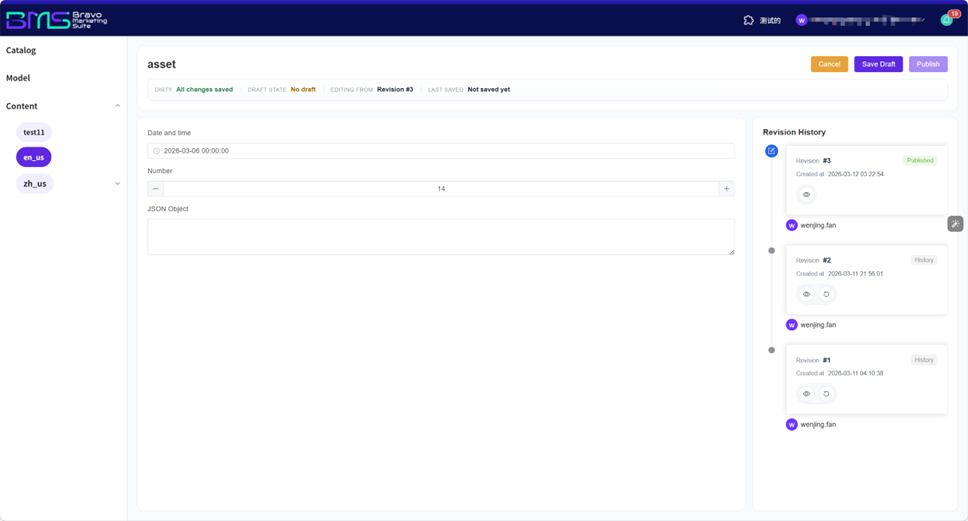
(Image: JSON Content editing interface for Fragments)
III. Real-Time, Global Updates
Real-time synchronization and global updates—efficient, controllable content maintenance
After modifying a single Fragment, all pages and channels referencing that Fragment automatically update in real time—eliminating the need for manual edits one-by-one. This fully resolves the traditional content management pain point of “change one place, affect everything,” boosting content maintenance efficiency and ensuring timeliness and accuracy of knowledge content—perfectly supporting the full lifecycle management of enterprise knowledge assets.
IV. Seamless Multi-Channel Publishing Capability
Breaking platform boundaries—reaching every user
Another major advantage of the Fragment architecture is its powerful multi-channel publishing capability. Since content is no longer coupled to any specific presentation layer but instead exists purely as structured data, it can be seamlessly delivered to diverse endpoints and platforms via APIs or other interfaces. Whether traditional websites, mobile applications, social media, smart speakers, chatbots, or future emerging digital touchpoints—your content can be rendered optimally on each. This dramatically expands content reach while guaranteeing consistent, high-quality user experiences across any device or scenario—truly realizing the “Content-as-a-Service” philosophy.
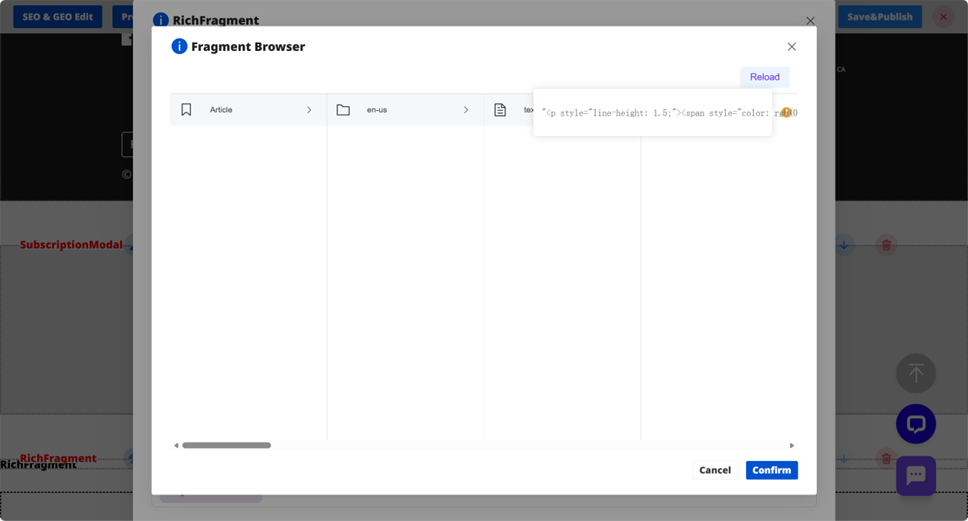
(Image: Fragment-to-page component association)
Frequently Asked Questions (FAQ)
Q1: What is the Fragment architecture? How does it differ from traditional CMS?
A1: The Fragment architecture is a content management approach that decomposes content into independent, reusable smallest units—i.e., Fragments. Unlike traditional CMS systems—which treat content as a monolith—the Fragment architecture emphasizes modularity and structure, allowing content to be flexibly assembled, reused, and published across diverse channels like building blocks—significantly enhancing content management efficiency and flexibility.
Q2: How does the Fragment architecture improve content reusability?
A2: With the Fragment architecture, a single content fragment—such as a product description or company profile—can be created once and then reused across multiple pages, multiple websites, or even multiple platforms (e.g., corporate website, help center, mobile app). When updates are needed, simply modify the Fragment once; all locations referencing it will auto-update—avoiding redundant work and ensuring content consistency.
Q3: What benefits does the Fragment architecture offer for SEO and GEO?
A3: The Fragment architecture renders content inherently structured, with each fragment carrying rich metadata—making it easier for search engine crawlers and AI models to understand. For SEO, it delivers more precise semantic signals; for GEO, it enables AI models to parse, cite, and generate answers from content more effectively—enhancing visibility and authority in AI-driven search results.
Q4: How does our BMS achieve multi-channel publishing?
A4: Our BMS decouples content from the presentation layer, storing Fragments purely as structured data. This allows content to be seamlessly delivered to any digital endpoint or platform—including websites, mobile apps, smart speakers, chatbots, etc.—via APIs or other interfaces, implementing a true “create once, publish everywhere” multi-channel content strategy.

Want to know more about our products?
With years serving Fortune 500 clients, we offer flexible solutions and integrated implementation.
