

Customer Experience & Retention Boost
Personalized promotions delivered based on behavioral data; after-sales service and inventory automatically synchronized for restocking; end-to-end visual tracking; unified multi-channel experience to comprehensively enhance user experience and loyalty.
Core Advantages


Enhancing Customer Experience and Loyalty: Building an E-commerce Growth Engine for High Repeat Purchase Rates and Strong Customer Loyalty
Introduction: In today's e-commerce landscape—characterized by continuously rising traffic acquisition costs and extremely scarce user attention—the cost of retaining an existing customer is far lower than acquiring a new one. Customer experience is no longer solely the responsibility of the service department; it has become the core battlefield of corporate growth strategy. This article outlines a comprehensive, end-to-end customer lifecycle operations system—from "first touchpoint" to "lifetime value"—built upon four core capabilities: intelligent interactive engagement, integrated after-sales service, full-chain visibility, and membership systems with incentive mechanisms—transforming occasional transactions into predictable growth.
I. Intelligent Interactive Engagement: Data-Driven Personalized Outreach
The system dynamically integrates multi-dimensional user data—including historical purchase records, browsing trails, review preferences, and cart-add behavior—in real time, leveraging AI algorithms to construct and continuously update dynamic user interest profiles. Upon subsequent visits, the engine no longer delivers generic promotional messages but instead precisely surfaces personalized content such as "You May Also Like" and "Frequently Bought Together". This data-powered intelligent interaction not only significantly reduces users’ information filtering effort and delivers a thoughtful, "valued" experience, but also accurately activates latent demand, substantially boosting product conversion rates. Simultaneously, it minimizes disruptive, irrelevant push notifications—gradually strengthening users’ platform engagement and delivering dual value: "retaining customers through interaction, and converting them precisely".
Key Value Highlights:
Personalized push click-through rate increased by over 35%
Average promotional campaign conversion rate improved by 28%
User repeat-purchase decision cycle shortened by 20%"
II. Integrated After-Sales Service: Turning the Service Endpoint into a Repeat-Purchase Starting Point
End-to-End Automated Returns & Exchanges
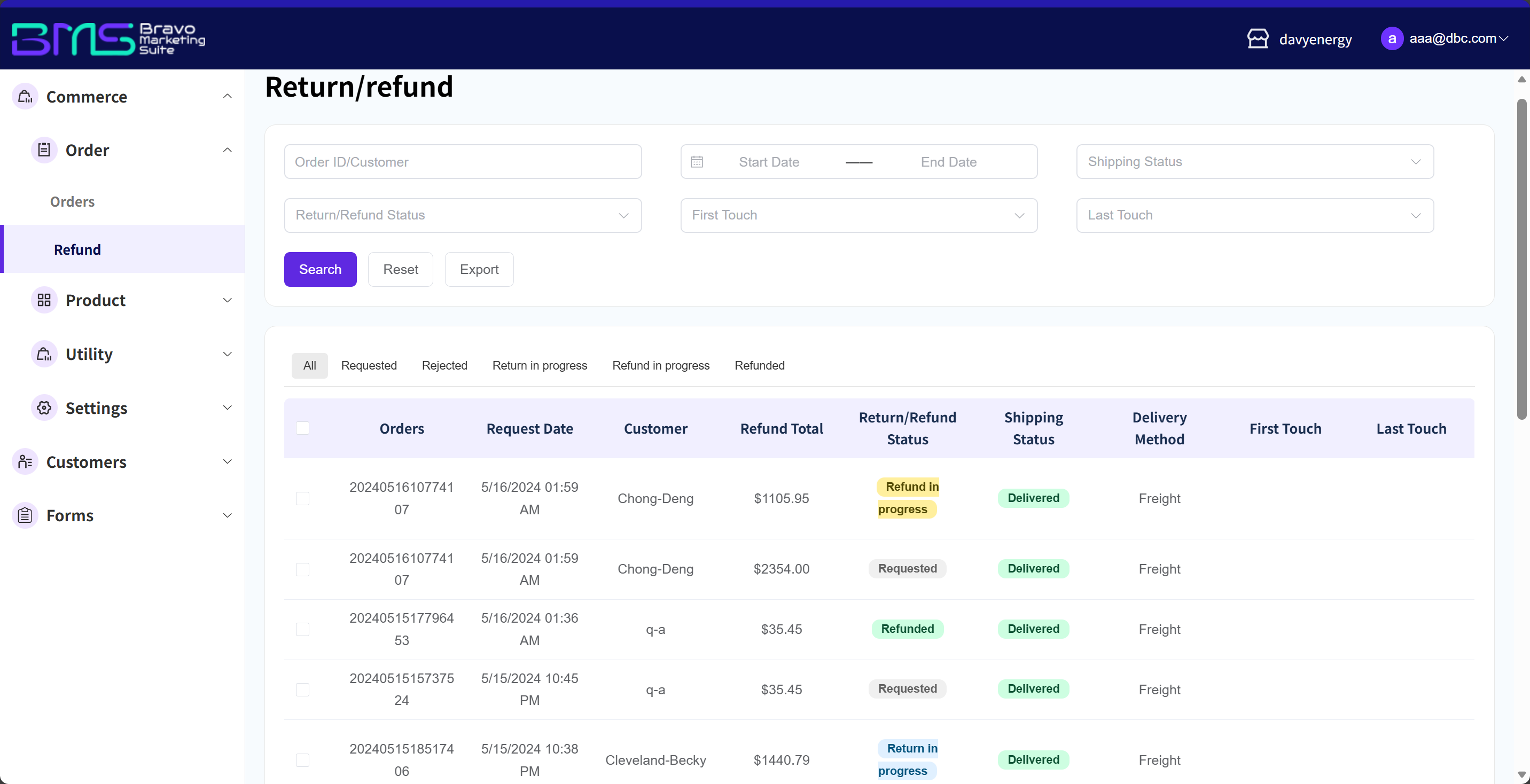
Traditional after-sales processes involve manual reviews and switching across multiple systems, resulting in long user wait times and fragmented experiences. Our system achieves deep integration among after-sales, order, inventory, and finance modules:
Upon submission of an after-sales request, the system automatically validates order status and return eligibility
Once approved, inventory is instantly released, and procurement/replenishment instructions are triggered synchronously
Warehouses automatically receive pre-notifications for returns; finance initiates refunds simultaneously
Key Value Highlights:
After-sales processing time reduced by 65%
Inventory turnover efficiency improved by 30%
After-sales customer satisfaction score reached 4.8/5.0
III. Full-Chain Visibility: Transparency Is the Best Currency of Trust
Real-Time Order Status Tracking
From "order confirmed" to "warehouse picking", "shipped", "in transit", and finally "delivered and signed for", users can view the complete lifecycle status of their orders anytime. The system automatically pushes key milestone notifications—shifting passive inquiry to proactive communication.
Multi-Carrier Logistics Integration
Integrates APIs from leading domestic and international carriers—including DHL and FedEx—to support consolidated tracking across multiple logistics segments. Cross-border orders achieve seamless visibility across domestic and overseas legs; logistics anomalies (e.g., delays, unclear addresses, customs clearance issues) automatically trigger alerts and guide users through next steps.
Review System & Service Feedback Loop
Users can rate products—and also provide granular feedback on installation service, delivery timeliness, customer service attitude, and packaging integrity. Review data flows back in real time to both product operations and supplier management systems, establishing a continuous optimization loop: "feedback → analysis → improvement".
Key Value Highlights:
Customer service inquiries reduced by 40%
Logistics-related complaints declined by 55%
Review system usage rate increased by 50%"
IV. Unified Multi-Device Experience: Breaking Device Boundaries for Seamless Shopping Flow
Real-Time Omnichannel Data Synchronization:
In an era of fragmented, cross-device shopping, disjointed experiences mean abandonment and churn. BMS Digital Experience Platform E-commerce Engine builds an omnichannel unified user center, integrating all front-end touchpoints—including PC official website, WeChat Mini Programs, standalone mobile apps, and H5 micro-stores:
Cart synchronization across all channels: Items added to cart in the app automatically appear when the user opens the PC site—no re-searching required
Cross-device favorites sharing: Products favorited during your commute can be ordered instantly from your office computer
Seamless login state propagation: Login completed on any single device maintains authenticated status across all channels
Consistent Interaction Experience
The system adopts a cross-platform component library and unified interaction standards, ensuring users enjoy familiar, smooth interactions across PC, tablet, and mobile devices—regardless of screen size. Button placement, gesture logic, and page transition animations remain identical across all terminals.
Key Value Highlights:
Cross-device cart abandonment rate reduced by 35%
Monthly average order frequency per multi-device user increased by 28%
Omnichannel login conversion rate improved by 40%
Time from first touchpoint to first purchase shortened by 25%"
Conclusion: These four strategic advantages holistically optimize the user’s end-to-end shopping journey—effectively elevating satisfaction, trust, and engagement. They empower enterprises to overcome the twin challenges of "difficulty acquiring customers and difficulty retaining them", enabling a virtuous cycle of "traffic accumulation → user retention → revenue growth". Moving forward, BMS Digital Experience Platform E-commerce Engine will continue deepening its understanding of user needs, constantly refining and upgrading its core capabilities—delivering higher-quality, more convenient, and increasingly personalized services to help businesses achieve high-quality growth while providing users with an exceptional shopping experience, leading the way in differentiated development across the e-commerce industry.
Frequently Asked Questions (FAQ)
Q1: How does personalized recommendation work for new users without historical behavioral data?
A1: The system employs a cold-start solution:
- Dynamically adjusts recommendations based on real-time browsing behavior (e.g., clicks, dwell time)
- Applies "clustering of similar-user preferences" algorithms (e.g., "users who viewed A also viewed B")
- Employs fallback strategies including trending lists, new arrivals, and editor picks
Q2: Does personalized recommendation involve misuse of user privacy data?
A2: The system strictly adheres to the principle of data minimization:
All user behavior data collection requires 100% opt-in via pop-up consent—with full revocability
Sensitive data (e.g., contact list, location, photo gallery) is never requested unless absolutely necessary
The recommendation algorithm uses only anonymized behavioral features—not linked to real identities
Q3: Can the system integrate with a company’s existing ERP or CRM?
A3: Yes. We provide over 300 standardized OpenAPIs covering all business domains—including products, orders, inventory, and after-sales. We also support private deployment and hybrid cloud architecture to meet financial-grade data security requirements.

Want to know more about our products?
With years serving Fortune 500 clients, we offer flexible solutions and integrated implementation.
