






Omni-Context Awareness
Maestro integrates with the BMS DXP data bus to access roles, permissions, operation history, and business data—ensuring every interaction is context-aware, permission-based, and business-specific.
Core Advantages


Omni-Context Awareness: Making Maestro Truly Business-Savvy
I. User Identity and Permission Awareness
The identity of the questioner determines the appropriate data dimension, aggregation level, and decision-making perspective for the correct answer. Generic AI dialogue operates under the assumption that "the questioner's identity is unknown," inevitably limiting response accuracy due to the absence of this critical information.
Maestro Agent inherits the user system and RBAC permission model from the BMS Digital Experience Platform (BMS DXP). At the start of a conversation, the Agent automatically knows the user's role, data access boundaries, and organizational affiliation; thus, query scope instantly narrows to authorized data, and responses precisely align with the user's role-based perspective. Identity information is not an additional parameter users must restate with every query—it is a foundational variable already incorporated into the Agent's computation prior to dialogue initiation.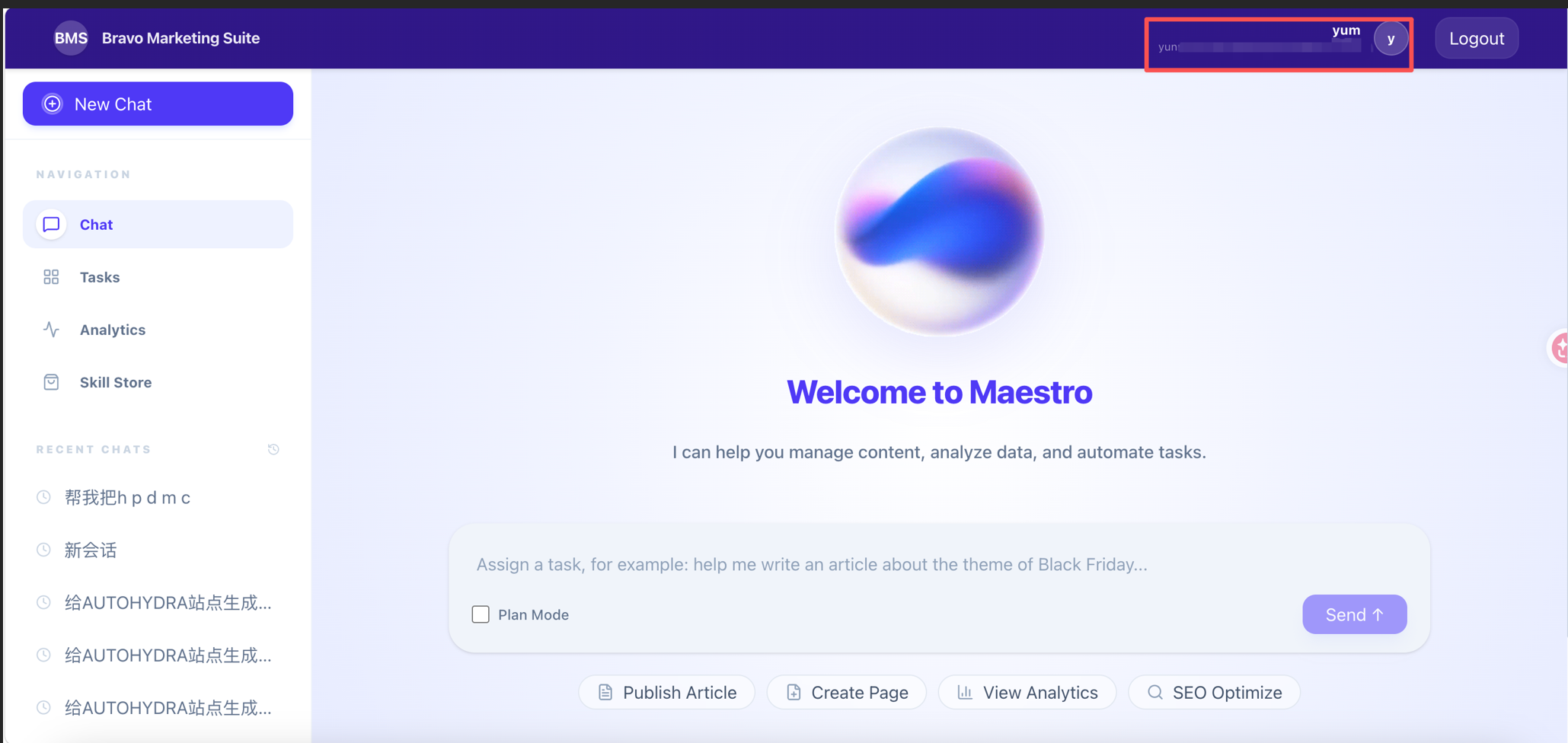
Figure: Unified User Identity Authentication
II. Business Data Context Awareness
Pronouns and omissions are common in natural language instructions—efficient for human communication but challenging for AI comprehension. When business entities referenced in instructions—such as content items, digital assets, product SKUs, or site configurations—are not explicitly declared with their full paths, the Agent must possess the capability to resolve these references directly from the data layer, rather than requiring users to expand every omission into verbose descriptions.
Maestro connects to the BMS data bus to obtain in real time the business entities mentioned in instructions and their interrelationships. These entities already have complete mappings and topology records within BMS; the Agent reads them directly instead of inferring from scratch. Business context is not knowledge gradually taught during dialogue—it is pre-existing information directly retrieved from the enterprise data layer.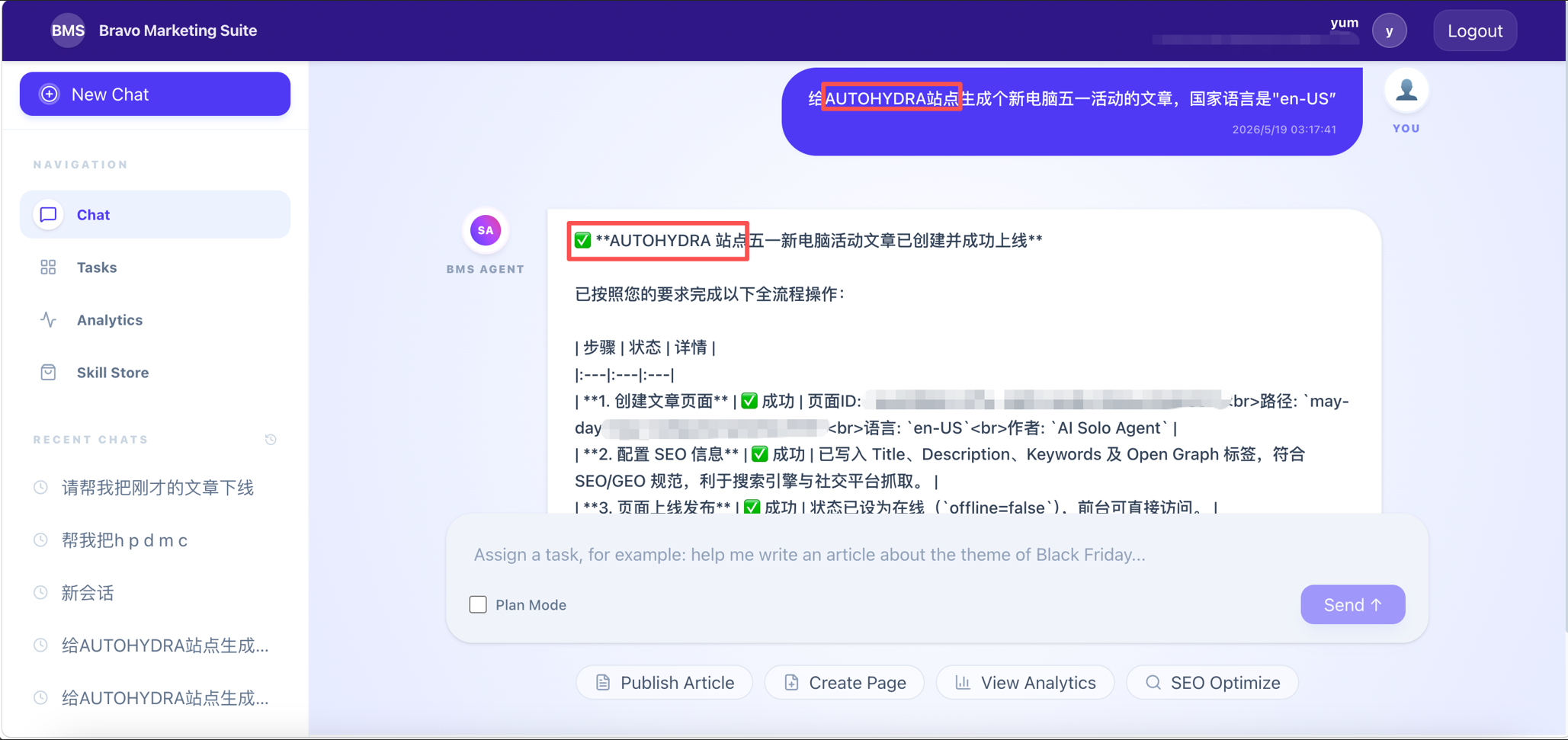
Figure: Business Site Identification
III. Historical Interaction Learning
Every interaction between a user and Maestro incrementally provides the system with insights into that user’s work patterns. Instruction type distribution, operational timing patterns, and default parameter preferences—these behavioral traits are continuously collected and structured during daily use, enabling progressive modeling of the user’s operational rhythm and decision-making habits. Execution paths for high-frequency tasks are intelligently shortened; commonly used parameter combinations are proactively recommended; periodic operations are preloaded near their scheduled times. Learning effectiveness improves with interaction frequency—no need for users to step out of their workflow to configure preferences or rules.
IV. Multi-Role Adaptation
Role complexity is the norm in enterprise operations. Traditional systems design roles as separate workbenches requiring manual switching—the more frequent the switching, the stronger the sense of fragmentation.
Maestro handles multi-role scenarios through role overlay—not role switching. Users do not need to declare their current role before interacting; the Agent comprehensively presents information and recommendations from each relevant role perspective, clearly labeled by source. Users may also manually lock into a specific role perspective at any time to focus on a particular business dimension.
V. Business Terminology Understanding
Every enterprise develops its own internal language—product codenames, project names, process abbreviations. These terms enable efficient, precise communication internally but pose comprehension barriers for newcomers and external systems. Maestro absorbs enterprise terminology via dual channels: first, dynamically inferring term meanings from context during everyday interactions and establishing semantic mappings to BMS entities; second, allowing administrators to maintain a key-term reference table in the backend to ensure accurate recognition of core business concepts. Users always work using their organization’s familiar expressions, while the Agent seamlessly performs semantic mapping in the background.
FAQ
- Q1: How does Maestro distinguish between different users’ identities and permissions?
A1: Maestro directly inherits the user system and RBAC permission model from the BMS Digital Experience Platform (BMS DXP). Upon user login, the Agent instantly retrieves the user’s role, permission scope, and organizational affiliation via SSO. All subsequent dialogue strictly adheres to the user’s visible data boundary and never bypasses permission restrictions due to natural language interaction.
- Q2: How does Maestro learn business terminology—is it automatic or configuration-driven?
A2: Both approaches operate in parallel. First, continuous learning—the Agent infers meanings of business terms naturally used in dialogue from context and retains them. Second, proactive configuration—enterprise administrators can maintain a terminology mapping table in the backend to ensure accurate understanding of critical business concepts.
- Q3: If a user changes positions or permissions change, how quickly can Maestro adapt?
A3: Once permission changes take effect in the BMS user system, Maestro synchronizes immediately. Historical learning data (e.g., instruction preferences, high-frequency tasks) can be migrated to the new role with administrator assistance—or cleared on demand and relearned.
- Q5: Does sharing the data bus mean Maestro can access all BMS data?
A5: No. Data bus access remains constrained by the permission model—Maestro always reads data using the current user’s RBAC identity. Whatever data the user can access, the Agent can read; data inaccessible to the user remains equally inaccessible to the Agent. The shared data bus provides interface connectivity—not permission exemption.

Want to know more about our products?
With years serving Fortune 500 clients, we offer flexible solutions and integrated implementation.
