






Multilingual Management
An Intelligent Translation Center Driving Global Growth
Core Advantages
Product Deep Dive: How Our BMS Digital Experience Platform Solves "Post-Translation Breakdown" and "Rigid Synchronization"?
Industry Pain Points and Current Status: When managing multilingual websites, enterprises commonly face two major challenges: First, "Translation Equals Redoing," where translated content lacks intelligent localization, and character length or word order changes often cause complete layout breakdowns, requiring manual fixes. Second, ""Synchronization Equals Lockdown,"" where traditional CMS platforms cannot support differentiated modifications during source-site content synchronization, limiting localized marketing and reducing global asset reuse rates.
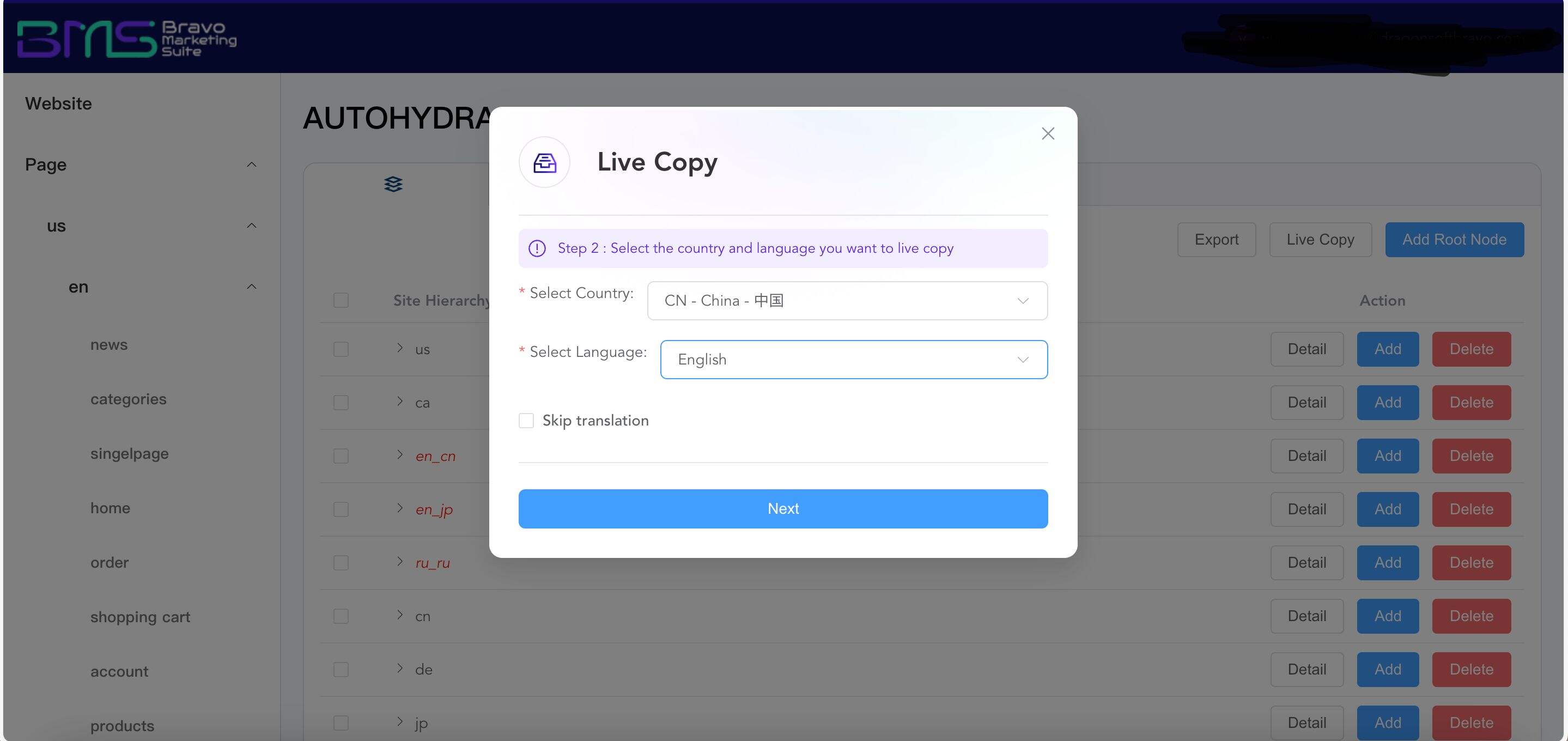
Our BMS DXP Implementation Solution: Leveraging built-in AI translation APIs and nested Live Copy technology, we have completely redefined the logic of global operations. The system enables one-click management across multiple countries and languages: Operations personnel simply click "Translate" on the source site, and the AI automatically polishes content according to the target market’s linguistic context, achieving second-level content migration.
To address the industry pain point of "Layout Anomalies After Translation" ,we provide highly flexible content editing capabilities. The system allows operations personnel to perform localized fine-tuning—such as adjusting for text overflow or alignment shifts—without violating global brand guidelines, ensuring every pixel aligns with local aesthetics and reading habits.
Furthermore, via nested Live Copy mechanisms, we achieve optimal content synchronization and reuse. Headquarters can globally synchronize core product parameters while granting regional sites independent editing permissions for specific sections. This flexible mirrored linkage enables enterprises to drive large-scale global website networks with minimal human effort—maintaining brand ""consistency"" while ensuring market responsiveness ""agility"".
Frequently Asked Questions (FAQ)
Q1: Does AI translation accuracy meet professional B2B or technical business requirements?
A1: The integrated AI features industry-specific deep learning capabilities to recognize domain terminology and contextual nuances. Through ""AI Draft Translation + High-Freedom Local Fine-Tuning,"" operations personnel can rapidly produce content that is both technically accurate and linguistically natural for the target locale.
Q2: What is the fundamental difference between nested Live Copy and conventional content synchronization?
A2: Conventional synchronization is ""full overwrite,"" whereas nested Live Copy supports more complex hierarchical logic. For example: headers and footers are globally locked and synchronized, but middle-content areas allow region-specific copying or reassembly. This lets you assemble global standardized content and locally unique content like building blocks.
Q3: Why is this model more friendly to global team structures?
A3: It breaks the high-cost ""one-country-one-team"" model. Core headquarters teams can centrally update and distribute standards across all global sites via an intelligent control center, while local operations only handle minor polishing tasks—significantly optimizing enterprise human resource allocation.

Want to know more about our products?
With years serving Fortune 500 clients, we offer flexible solutions and integrated implementation.
