






AI Power Embedded
BMS-DAM deeply embeds AI capabilities across the entire asset lifecycle—from automatic tagging upon ingestion, to multimodal second-level search, to automated compliance screening—making assets searchable, controllable, and trustworthy.
Core Advantages




AI Power Embedded: Making Assets Searchable, Controllable, and Trustworthy
In traditional DAM systems, tagging, searching, and reviewing assets after ingestion largely rely on manual effort—tags must be added manually, search only matches filenames, and compliance checks require reviewing each asset individually. As the volume of assets grows, the marginal cost of this process continues to rise. BMS-DAM’s strategy is to embed AI capabilities at critical nodes of asset management: automatic tagging upon ingestion, multimodal matching during search, and automated pre-publication security inspection. AI is not an isolated toggle switch but rather an underlying capability woven throughout the entire workflow.
I. Tagging Upon Ingestion
The moment an asset upload completes, AI automatically extracts key information using computer vision and NLP technologies, generating corresponding tags and Alt Text descriptions. This means assets become immediately searchable upon ingestion—no waiting for manual cataloging. For general scenarios, AI tagging maintains a high baseline accuracy; for specialized domains such as medical imaging, industrial components, or fashion textiles, users may submit a small set of annotated samples to fine-tune the model, with human-corrected data continuously fed back to improve recognition accuracy.
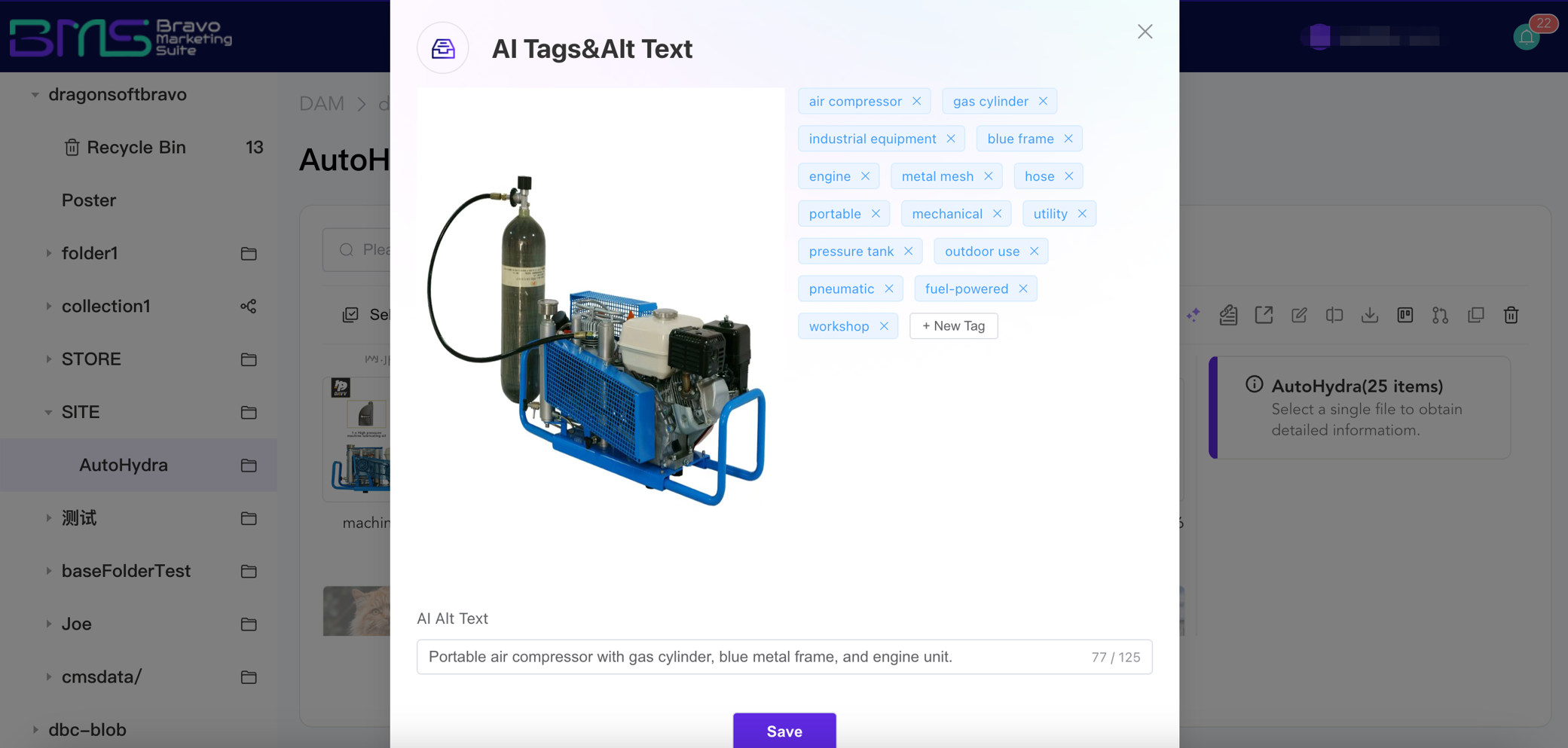
Image: AI-generated tags and Alt Text
II. Multimodal, Full-Format Search
When asset volumes reach hundreds of thousands—or even millions—search efficiency directly impacts overall usability. BMS-DAM’s multimodal search no longer relies on filename matching: users input natural-language descriptions, and AI understands semantic intent to return relevant results; uploading a reference image triggers visual feature extraction to locate similar assets; mobile users can issue voice commands directly; subtitles and visual content within audio/video assets are also fully searchable. Cross-modal semantic association further breaks down format barriers: searching a single keyword simultaneously retrieves matching images, video clips, and audio assets across 200+ formats.
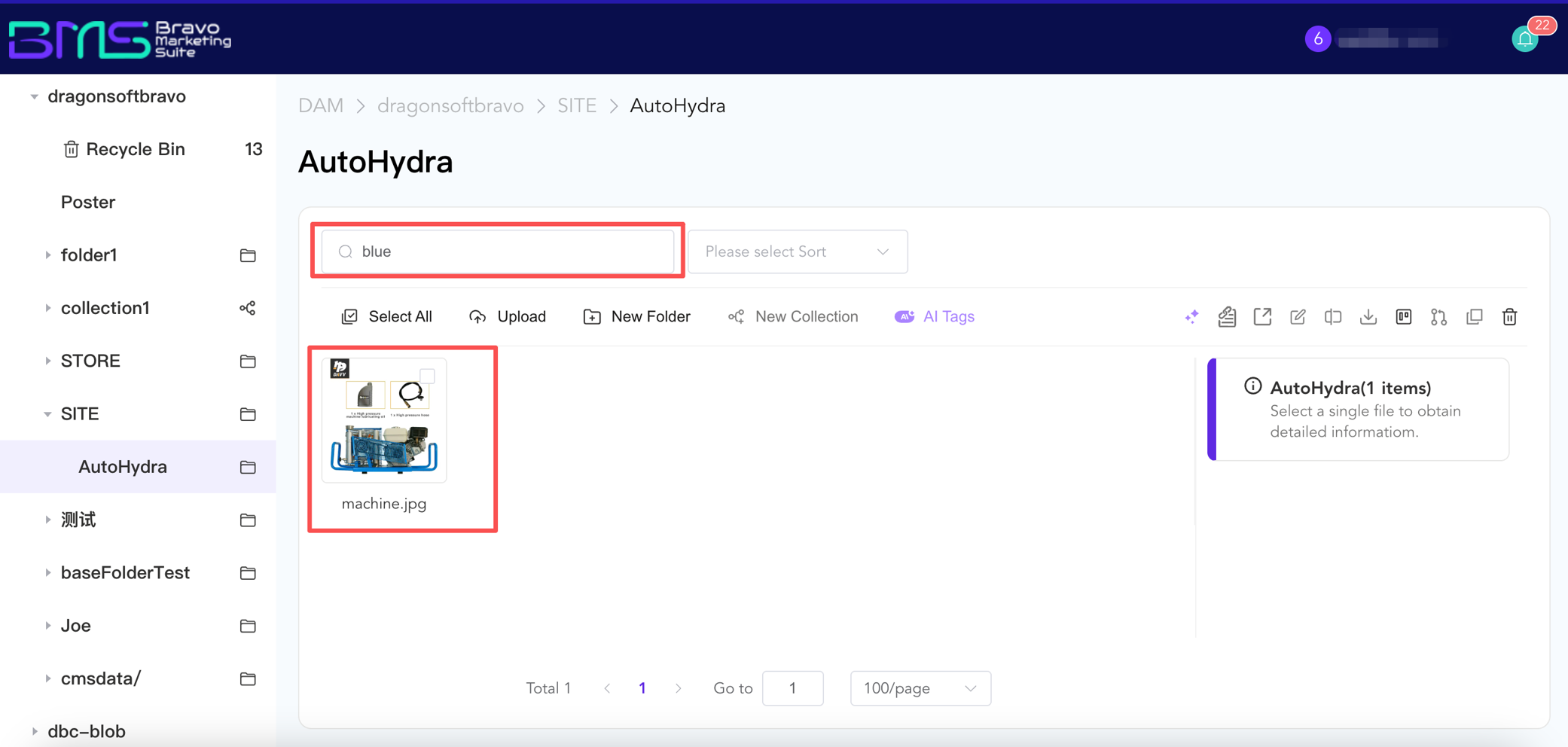
Figure: AI multimodal search
III. Automated Compliance Screening
Prior to entering the publishing workflow, AI automatically performs comprehensive compliance scanning—including unauthorized font detection, competitor element identification, sensitive person portrait screening, image content safety review, and copyright material risk assessment. Acting as the first line of defense, AI handles initial screening, shifting human review from "checking every asset" to "targeted re-verification", shortening time-to-availability while reducing oversight risk. All scan records and disposition outcomes are fully auditable, satisfying compliance audit requirements.
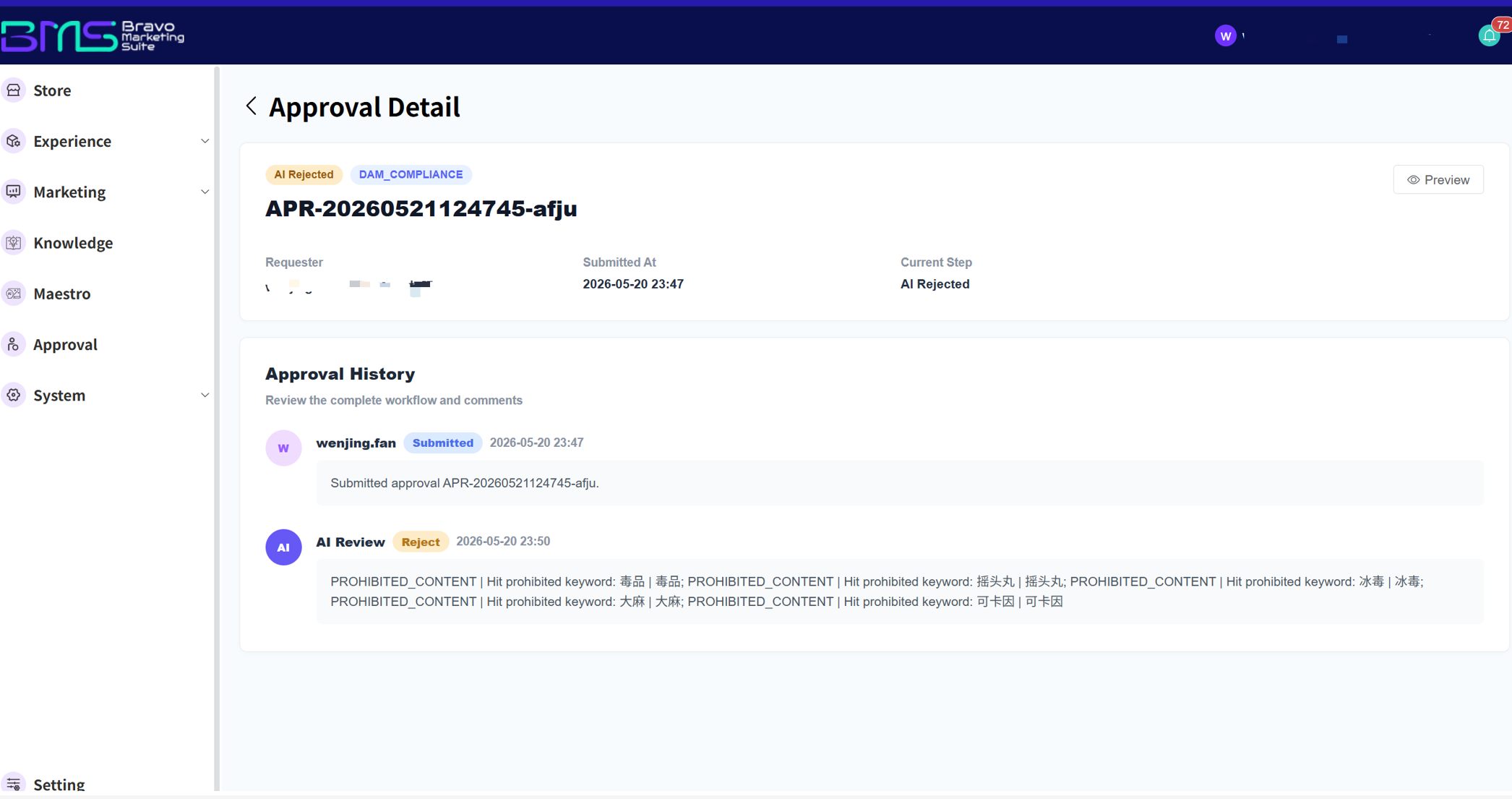
Image: AI compliance detection
IV. Knowledge Graph with Continuous Learning
The tags generated by AI are not isolated—they form a dynamic knowledge graph structured around "Product–Scenario–Style–Channel". During search, the system returns matching results and additionally recommends stylistically similar or contextually related assets based on graph associations. Every user interaction—tag calibration, click-through on search results, adoption of recommended assets—optimizes model weights. The deeper the usage, the more precisely the system understands the enterprise’s business context, making frequently used assets easier to discover and reactivating dormant assets.
Summary
AI Power is not merely a functional module of BMS-DAM—it is an underlying capability spanning the full asset lifecycle. From ingestion and search to publishing, AI reduces human dependency at every critical node: assets are tagged upon ingestion, located upon search, and compliance-verified upon publishing—simultaneously enhancing management efficiency and asset security.
Frequently Asked Questions (FAQ)
- Q1: What is the accuracy of AI-generated tags and Alt Text? Is manual verification required?
A: In general scenarios, AI tagging maintains high baseline accuracy and can be used directly, with manual correction available anytime. For specialized domains such as pharmaceuticals, industrial manufacturing, and fashion, submitting a small set of annotated samples enables customization of industry-specific models. All manually corrected data is fed back in real time to optimize the model, establishing a positive feedback loop where accuracy improves with usage.
- Q2: Which search methods does multimodal search support? Does it cover audio/video content?
A: It supports natural-language text search, reverse image search, voice-command search, and cross-modal semantic association search. Speech content in audio/video assets is automatically transcribed into searchable text via ASR, while visual content participates in matching through feature extraction—achieving full-format coverage.
- Q3: How do AI compliance detection and human review collaborate?
A: Once an asset enters the publishing workflow, AI first conducts comprehensive compliance scanning, flags potential risks, and generates a detection report. Assets passing AI screening proceed to the human review stage, where reviewers make final decisions based on the AI report. By performing upfront screening, AI shoulders the initial filtering load, transforming human review from "blind item-by-item inspection" to "targeted re-verification", balancing efficiency and accuracy.
- Q4: Is knowledge graph data shared across enterprises?
A: No. Each enterprise maintains its own independent knowledge graph and behavioral model. Data is strictly isolated and serves only that enterprise’s asset management and search optimization needs.

Want to know more about our products?
With years serving Fortune 500 clients, we offer flexible solutions and integrated implementation.
