





DAM vs Cloud Drive: AI Compliance for Brands
Cloud Storage ≠ DAM! AI Asset Compliance Storm Hits — Can Your Brand Assets Go "Naked"?
In many enterprises’ digital transformation checklists, Digital Asset Management (DAM) is often simplistically equated with “purchasing a high-capacity cloud drive.” As long as files can be uploaded and downloaded, it seems all is well. Yet if you ask the General Counsel of any large multinational corporation today, they will surely tell you: Calling it “digital asset management” simply to dump assets into a cloud drive is akin to running naked with your brand reputation. Especially in today’s era of widespread generative AI, the cheaper the storage solution, the more likely it is to postpone compliance disasters until the moment a campaign goes live.
A Cloud Drive Can Hold Files—but Not “Transparency”
Why can’t cloud drives meet the demands of AI-era asset management? Because cloud drives recognize only “files,” not “assets.” A file is merely a collection of pixels or bytes; whereas a brand asset carries information about its creator, copyright ownership, license term, approval status, and usage history across channels. When a designer generates a stunning synthetic-model poster using an AI tool and uploads it to a cloud drive, that image becomes a “ticking time bomb.” The cloud drive cannot tell you which large language model generated the image, cannot record whether it underwent human review, and certainly cannot automatically alert all overseas sites currently using the image to remove it on the day its font license expires. This “lack of transparency” is now a Damoclean sword hanging over enterprises.
Globally, transparency and compliance requirements for AI-generated content are continuously evolving. The EU’s Artificial Intelligence Act already incorporates provisions related to synthetic-content transparency, with phased implementation timelines specified across different articles; enterprises targeting the EU market must continuously monitor official interpretations and their own compliance obligations. In the United States, state-level legislation and discussions concerning digital avatars, synthetic performers, and commercial advertising disclosures are also increasing. For brand teams, what matters most is not memorizing individual regulations, but rather being able to substantiate, upon request, the origin, licensing status, and approval status of content. This does not mean every AI-generated image will immediately trigger penalties—but it does shift enterprise management practices: If the origin, licensing scope, and approval status of a marketing poster cannot be clearly articulated, enterprises face significantly higher costs—searching, re-verifying, and replacing assets—when entering new markets, responding to customer inquiries, or resolving disputes. For brands expanding internationally, asset governance is not a legal department’s last-resort remediation measure; it must be embedded into the content production workflow.
C2PA and Content Credentials: An Industry Standard Awakens
Facing the trust crisis brought by AI, tech giants have already taken action. The Coalition for Content Provenance and Authenticity (C2PA) is advancing an open technical standard designed to provide digital content with “nutrition labels” similar to those found on food packaging. Industry leaders including Adobe, Google, Microsoft, and OpenAI have all joined the coalition’s steering committee. For example, Adobe’s Content Credentials feature embeds persistent metadata into files—including creator information and production method (e.g., whether AI or Photoshop was used). These industry trends send a clear signal: traceability of digital assets is shifting from a “nice-to-have” to a foundational capability for enterprise content governance. For brands operating across markets and channels, simple file storage alone is typically insufficient to support systematic management of asset origin, editing history, licensing scope, and usage status.
Compliance Is Not a “Statement”—It Is an Asset Lifecycle
The real challenge lies not in adding a footnote at the bottom of a webpage stating “This image was generated by AI,” but in ensuring every asset retains readable business context throughout its entire lifecycle. A mature DAM governance model must answer at least four questions: Where did the asset originate? What usage rights does the enterprise hold? Is the asset still authorized for current use? And—if rules change—which pages, campaigns, or external partners will be affected?
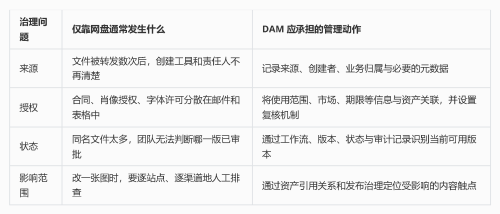
These four questions also explain why “file upload successful” does not equal “asset ready for use.” For high-risk landing pages, celebrity-endorsed assets, cross-border promotional campaigns, or text-and-image content involving sensitive industries, enterprises should treat DAM as a collaborative layer connecting marketing, design, legal, IT, and regional teams—not merely a storage layer.
Building Brand Compliance Defenses with BMS DXP
Faced with increasingly severe compliance pressures, enterprises must elevate asset management from “passive storage” to “active governance.” Dragon Bravo Corporation’s BMS DXP platform establishes robust brand compliance defenses precisely through its specialized DAM module. Unlike ordinary cloud drives, BMS DXP’s DAM is purpose-built to address complex business and compliance scenarios:
- Structured Metadata and Provenance Tracking
In BMS-DAM, asset upload is not merely file transfer—it is metadata deposition. Official documentation lists features such as metadata, tagging, audit logs, reference details, and license compliance. Enterprises can align these capabilities with their internal governance policies to maintain attributes like copyright ownership, usage scope, market, expiration date, and origin for each asset. Whether and to what granularity AI generation is recorded depends on enterprise work standards and specific project configurations. Thus, teams retain the ability to trace an asset’s origin, status, and usage boundaries whenever needed.
- License Alerting and Lifecycle Management
Many risks stem not from malicious misuse, but from teams overlooking license expiration dates or usage scope. BMS-DAM’s official documentation describes capabilities including license tracking, multi-market compliance rules, risk scanning, and violation blocking. Enterprises can incorporate license information into the asset lifecycle and configure alerts, reviews, or publishing restrictions according to their own rules. While it cannot replace contract interpretation or legal judgment, it shifts enterprises’ reactive approach—“scrambling to locate images after problems arise”—to a manageable, proactive process.
- Rigorous Approval Workflows and Version Control
In highly regulated industries, critical assets typically require explicit review. BMS-DAM’s official documentation lists capabilities including multi-tier approvals, version snapshots, non-destructive editing, audit logs, and one-click rollback. Enterprises can configure approval nodes for brand, legal, or business leads based on asset type, market, and risk level—and identify the currently approved, usable version via versioning and audit records. The system supports process execution but does not substitute professional judgment by approvers regarding asset compliance.
Conclusion
In the AI era, the barrier to content creation is lowering—but the importance of review, authorization, and traceability is rising. Cloud drives solve “storage,” but not “governance.” A mature DAM system is more than a warehouse; it is a governance platform that integrates origin, authorization, versioning, and distribution into executable workflows. It is not a panacea for compliance—but when issues occur, it enables faster asset localization, scope assessment, and action. And this distinction is often the critical line separating crisis management from daily operations.
Frequently Asked Questions
- Q1: What is C2PA—and can it completely prevent our assets from being misused?
C2PA (Coalition for Content Provenance and Authenticity) is an organization developing open technical standards to display digital content’s origin and editing history via content credentials analogous to “nutrition labels.” It does not itself “prevent” misuse—but it greatly enhances content transparency, helping consumers and platforms identify the true source of assets (e.g., whether AI-generated).
- Q2: If we delete an expired asset in BMS DXP, will the image previously published on our official website disappear automatically?
No, it will not simply “disappear.” BMS-DAM is natively integrated with BMS DXP, enabling traceable asset reference relationships. Before changing or retiring an asset, enterprises can first assess its impact scope and complete replacement, withdrawal, or phased updates per configured approval and publishing policies. Whether a placeholder appears, automatic replacement occurs, or notifications are sent depends on front-end and workflow configurations defined within the project.
- Q3: Our assets are frequently shared with external media outlets and KOLs—how does DAM ensure they receive only the correct versions?
BMS-DAM provides fine-grained permission control, tiered approval, and asset sharing capabilities. Enterprises can configure visible, downloadable, editable, or submittable asset ranges for external collaborators based on project, role, asset type, and time frame—and integrate external collaboration into established approval workflows. Specific account settings, links, and validity policies are determined by the project’s permission model and security requirements.
- Q4: Do the EU’s AI Act and U.S. regulations affect enterprises that operate solely within China?
These regulations are territorial in scope; their applicability must be determined based on the enterprise’s location, target market, content type, and business model. Even if operations are currently domestic-only, enterprises should monitor potential issues related to copyright, portrait rights, trademarks, and platform rules concerning AI-generated assets. Establishing a standardized asset governance system is not a substitute for legal advice, yet it provides a stronger foundation for risk identification, internal review, and cross-departmental collaboration.
- Q5: Does the DAM of BMS DXP support managing large files such as videos and 3D models?
BMS-DAM supports centralized management of multiple asset types—including images, videos, audio, and documents—and offers online preview, online editing, and multi-cloud storage capabilities. In industrial scenarios, it also supports management and preview of 3D models and CAD files. Specific file formats and upload performance must be confirmed during project assessment based on actual business conditions.
- Q6: Is migrating from an existing enterprise cloud drive to BMS DXP DAM complex?
Migration typically involves several phases: asset inventory, metadata standardization, permission design, pilot import, and ongoing operations. DragonBravo’s DAM implementation methodology recommends conducting asset and permission assessments first, followed by pilot migration. BMS-DAM provides standard APIs and Webhooks for integration; the specific migration tools and scope of historical data cleansing shall be defined per the project plan.


Want to know more about our products?
With years serving Fortune 500 clients, we offer flexible solutions and integrated implementation.
