





Ending Asset Silos: Brand Globalization with DAM
Excessive localization empowerment is turning global brands into "content silos"—outdated logos, unauthorized assets, and uncontrolled AI-generated content.
The brand manager at the Shanghai headquarters opens the German team’s shared folder and discovers that the logo is an outdated version from three months ago. The product images on the French website feature an unauthorized model photograph. The promotional poster sent by the Southeast Asian distributor uses colors and fonts completely inconsistent with the brand guidelines. This is not a fabricated scenario—it is a daily reality for numerous Chinese enterprises expanding overseas. Amid China’s vigorous wave of global expansion, one term has become sacrosanct: Localization. To better resonate with local markets, headquarters grants overseas teams significant autonomy: selecting local agencies, managing social media independently, and building their own official websites. Yet, at the digital marketing level, this excessive “delegation” is evolving into a disaster. Pursuing so-called “localization” by allowing overseas teams to independently procure, generate, and manage marketing assets does not constitute globalization—it amounts to “feudal fragmentation.” When the same brand conveys a high-tech aesthetic in North America but exudes cheap collage-style visuals in Southeast Asia, brand consistency has long since vanished. The ultimate goal of global expansion is not regional silos operating in isolation, but rather the harmonious unification of regional autonomy and global consistency.
The Localization Trap: Fragmented Digital Assets
In its recent white paper, Growing Globally: A New Paradigm for Chinese Enterprises’ Global Expansion in the AI Era, Microsoft states that enterprises’ overseas expansion is shifting from traditional models centered on products, channels, and cost, toward a new phase supported by branding, technology, operational capabilities, and global collaboration [1]. However, the greatest obstacle to global collaboration often lies hidden within the most fundamental aspect of marketing asset management. According to SAP insights, enterprises expanding overseas commonly face collaboration challenges such as data fragmentation between headquarters and overseas teams and information silos. Many enterprises initially adopt localized deployment solutions to “achieve rapid go-live,” but as business scales, overseas subsidiaries struggle to integrate system architectures and data formats with headquarters—severely undermining global collaboration [2]. In the field of Digital Asset Management (DAM), this fragmentation is especially pronounced. Imagine headquarters spending millions to produce a set of flagship annual product core visuals. Yet, lacking a unified asset distribution platform, these high-resolution assets can only be emailed or shared via temporary cloud storage links to marketing directors across countries. Months later, headquarters decides to update the logo guidelines. Chaos ensues: the European team fails to check emails promptly, leaving outdated logo posters live on its website. The Latin American team engages a local designer who crudely replaces the logo using AI, resulting in jagged image edges. The Middle Eastern team cannot locate the original high-resolution PSD files at all and instead downloads compressed web images for continued use. Under this model, while enterprises may possess a globally distributed sales network, their digital brand shatters into countless disconnected “asset universes.” This not only causes massive resource waste but also renders global brand building an empty slogan.
The Double-Edged Sword of AI Translation and Generation
As AI technologies proliferate, this fragmentation is intensifying further. Previously, budget constraints forced overseas teams to rely on assets provided by headquarters. Today, they can effortlessly leverage AI tools to instantly translate copy and automatically generate marketing posters aligned with local aesthetics. Superficially, this significantly boosts localization efficiency. Yet if assets remain scattered across personal cloud storage, agency folders, and disparate AI tools, headquarters struggles to gain a holistic view: which content has entered the market, which assets involve specific spokespersons or licensing boundaries, and which expressions deviate from brand requirements. The issue is not whether local teams should use AI—but whether enterprises have established traceable, auditable collaboration mechanisms to govern such usage. AI translation and generation is a double-edged sword. While it lowers the barrier to producing localized content, it simultaneously increases complexity around asset versioning, compliance review, and cross-regional collaboration. Without a unified digital asset foundation, AI’s efficiency yields only localized speed—not scalable global operational capability.
Ending “Asset Silos” with BMS DXP
A truly global brand must possess the capability to “orchestrate globally while adapting locally.” This requires enterprises to build a unified Digital Asset Management (DAM) platform supporting multilingual, multi-site operations. BMS DXP, developed by Dragon Bravo Corporation, is specifically designed to resolve such complex global collaboration pain points. Its built-in DAM module delivers an elegant solution for enterprises expanding overseas:
- 1. Centralized Control of Core Assets and Live Copy Mechanism:
Within BMS-DAM, headquarters centrally manages core assets such as official logos, standard product images, and global campaign master visuals. According to BMS-DAM’s official documentation, its native integration with BMS DXP enables synchronized updates to sites, pages, stores, and knowledge bases, while tracking asset references and impact scope. BMS DXP’s multilingual capability supports nested Live Copy for inheriting and managing multi-regional content. For enterprises, a more practical objective is not to promise “instant synchronization of every asset,” but rather to clearly define which assets constitute global master data, which regions may inherit them, which modifications require local review, and how updates are executed per defined publishing strategies.
- 2. Localization Adaptation Within Compliance Boundaries:
Centralized control does not equate to suppressing localization. A more reasonable approach is for headquarters to provide pre-approved core assets, components, and brand rules, empowering regional teams to execute localized copywriting, campaign combinations, and channel adaptations within clearly defined permission and approval boundaries. BMS-DAM’s granular permissions, multi-level approvals, version snapshots, and audit logs provide a configurable technical foundation for such collaboration. It does not replace regional market judgment but ensures headquarters and regional teams collaborate on identical asset statuses, workflows, and audit trails.
- 3. Deep Integration of DAM with Multilingual CMS:
For enterprises expanding overseas, integrating DAM with a Content Management System (CMS) is critical. BMS-DAM natively integrates with BMS DXP; its official documentation also lists multi-channel distribution capabilities and standardized API and Webhook integrations with platforms such as Shopify and Salesforce. Overseas operators can retrieve pre-approved, region-appropriate assets directly from the unified asset library and content workflow; language-specific fields, tagging systems, and invocation rules must be modeled during implementation. Thus, asset management evolves beyond simple upload/download to form a more complete operational closed loop with page, campaign, and channel publishing.
Global Consistency Does Not Mean Headquarters Writes All Copy for the World
“Global consistency” is most easily misconstrued as headquarters retaining absolute control and regional teams merely executing directives. The truly effective model is precisely the opposite: headquarters defines immutable brand facts and risk boundaries, regional teams interpret local users, channels, and cultural contexts, and DAM enables both parties to collaborate on a shared set of assets and rules.
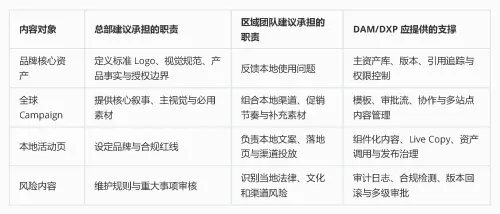
This division of labor is far more dynamic than “locking all files at headquarters.” It grants regional teams sufficient agility while freeing headquarters from relying on emails, spreadsheets, and post-facto follow-ups to maintain brand order.
Validate First Through a Global Campaign Workflow
For enterprises newly embarking on global expansion, the most common mistake is viewing DAM implementation as a one-time migration of all historical files. A more robust approach begins with a single cross-regional campaign workflow: select a product line, catalog required assets—including master visuals, product images, videos, sales collateral, and landing pages—establish minimal yet mandatory metadata fields, clarify roles for headquarters, regional teams, agencies, and legal departments, then verify whether asset updates, language adaptation, approvals, and publishing form a closed loop. DragonBravo’s publicly available DAM implementation methodology recommends first conducting asset and metadata inventories, followed by permission and workflow design, pilot migration, DAM-DXP integration, and operational metrics establishment [3]. This reminds enterprises that the primary goal of global asset governance is not “how many files reside in the repository,” but whether critical activities can be completed with fewer reworks, fewer erroneous versions, and clearer accountability boundaries. After successfully piloting, gradual expansion across additional languages, sites, and business lines proves more controllable than pursuing an all-encompassing initial rollout.
Conclusion
Chinese enterprises’ global expansion journey is undergoing a difficult transition—from “selling goods” to “building brands.”
FAQ
- Q1: Overseas teams complain that headquarters’ system is too slow and difficult to use, prompting them to set up their own cloud storage. How does BMS DXP address cross-border access speed issues?
BMS-DAM official documentation lists multi-cloud storage compatibility (e.g., Alibaba Cloud, Tencent Cloud, AWS, Azure), unified multi-cloud management, intelligent tiered storage, and cross-cloud disaster recovery capabilities. Cross-border access speed is also affected by deployment region, network conditions, file size, and enterprise security policies; therefore, performance testing and architectural design must be conducted during project evaluation. Rather than promising uniformly fast access across all regions, it is more effective to reduce the incentive for teams to create isolated silos due to inability to access correct assets—by implementing a unified platform, appropriate deployment strategy, and clear collaboration workflows.
- Q2: How exactly does the Live Copy mechanism mentioned in the article work?
Live Copy is a content inheritance and collaboration mechanism within BMS DXP’s multilingual management, supporting nested Live Copy. In practice, enterprises may designate global pages or content structures as upstream references, then establish inheritable and localizable copies per region. For assets themselves, BMS-DAM supports synchronization or replacement via native integration with DXP, asset reference tracking, and publishing policies. Which content is automatically inherited, which assets require regional review, and which copies may detach from inheritance should be defined by the enterprise according to brand and market rules.
- Q3: We operate numerous overseas sites spanning over a dozen languages—how does the DAM manage these multilingual assets?
BMS-DAM official documentation lists metadata management, AI-powered auto-tagging, and Alt Text generation capabilities; BMS DXP further provides multilingual management and AI translation interfaces. Enterprises may define asset attributes tailored to different languages, markets, product lines, and usage scenarios during implementation, and apply corresponding rules when invoking content. Whether multilingual fields match automatically and how they are displayed must be configured in alignment with site models and publishing workflows; copy and alternative text for key markets should still be reviewed by personnel possessing local linguistic and cultural expertise.
- Q4: If overseas teams generate risky assets using AI, can headquarters detect them promptly?
Enterprises may configure cross-regional approval workflows. BMS-DAM official documentation lists AI compliance detection, multi-level approval, audit logs, and version rollback capabilities; for critical marketing campaigns, assets uploaded or modified by regional teams may be routed into review chains involving brand, legal, or designated personnel. AI detection serves as risk alerting and auxiliary screening—but cannot replace local legal counsel or human judgment.
- Q5: Is BMS DXP’s DAM limited to managing website assets only? Can it manage social media assets?
BMS-DAM functions as the central repository for enterprise asset operations and natively collaborates with BMS DXP. Official documentation lists multi-channel distribution and API/Webhook integration capabilities with platforms such as Shopify and Salesforce. For social media, email marketing, or offline materials, enterprises may adopt DAM as the single source of approved assets, then configure channel-specific integrations, exports, or publishing workflows; the scope of automation per channel should be determined based on actual project specifications.
- Q6: We are still in the early stages of global expansion—with only an English-language website—do we really need such a complex system?
Although the number of sites is small at this stage, it presents an ideal opportunity to establish conventions around naming, tagging, licensing, permissions, and publishing. A more suitable approach typically begins with a single English-language site or one key campaign to validate the minimum closed loop encompassing asset library, approvals, and content invocation—then scales incrementally to support multiple sites, languages, and cross-regional workflows as business expands. BMS-DAM offers both cloud and on-premises deployment options, multi-cloud management, and BMS DXP integration capabilities; the specific module scope and rollout cadence should be determined based on enterprise compliance requirements, budget, and business priorities.Digital AssetsBMS DXP


Want to know more about our products?
With years serving Fortune 500 clients, we offer flexible solutions and integrated implementation.
