





Domestic DXP Rising: Beyond International Platforms
China's DXP market trends and localization journey. How DragonSoft Bravo BMS grew from a "substitute" to a "leader," building core competitive barriers in the AI era.
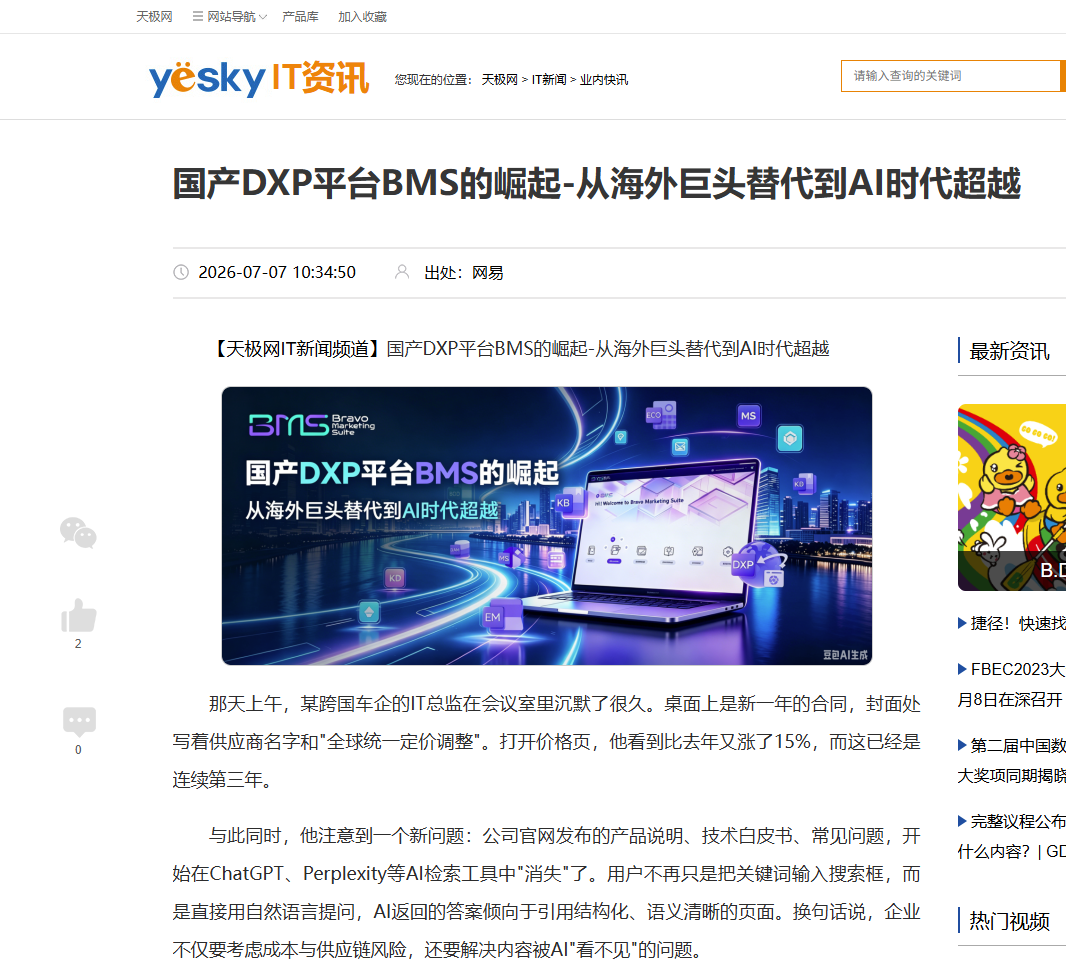
That morning, the IT Director of a multinational automotive enterprise sat silently in the conference room for a long time. On the table lay the contract for the new year, with the supplier’s name and “Global Uniform Price Adjustment” printed on the cover. Upon opening the pricing page, he saw another 15% increase compared to last year — the third consecutive annual hike.
Meanwhile, he noticed a new issue: product descriptions, technical white papers, and FAQs published on the company’s official website began “disappearing” from AI-powered search tools such as ChatGPT and Perplexity. Users no longer simply entered keywords into search boxes; instead, they asked questions directly in natural language. The answers returned by AI tended to cite pages that were well-structured and semantically clear. In other words, enterprises must address not only cost and supply chain risks but also the problem of content being “invisible” to AI.
Is there an option that is both reliable and controllable, while ensuring brand content is cited by AI search tools?
“The Sweet Trap” of Overseas Giants
Over the past decade, Adobe AEM, Sitecore, and OpenText have nearly become synonymous with enterprise-grade content and experience management. They offer feature-rich, mature products — yet their design logic was not tailored specifically for Chinese enterprises.
Adobe AEM boasts rich scenarios and high modularity, but typical projects require 18–24 months from requirements gathering to go-live, with annual licensing fees often exceeding RMB 1 million. More critically, its content architecture is designed for “humans finding content”, not for “machines reading content”. To make Adobe AEM sites citable by AI search tools, enterprises typically need to invest an additional RMB several hundred thousand to millions in customization engineering. Sitecore excels in personalization and user profiling, but its internal content model centers around complex page components. Its pricing policies have changed frequently in recent years, often locking enterprises into dependence on external teams. OpenText offers advantages in content compliance and archival management, but its product portfolio is vast and fragmented, with limited localization support for the Chinese market.
The shared challenge across these three platforms is not their technical capability per se, but rather their foundational design premise: pages built for “human browsing”, not knowledge built for “machine citation”.
The Allure and Reality of Open Source
Faced with steep licensing fees, many enterprises turn to open-source alternatives. WordPress is free, has abundant plugins, and is quick to adopt — yet it falls significantly short in enterprise-grade scenarios. Security is the top concern: WordPress records hundreds of publicly disclosed vulnerabilities annually. Multi-site and multilingual management are often achieved via plugin stacking, leading to compatibility issues and update conflicts that continually escalate operational costs. More critically, sites built through plugin accumulation often remain “silent” to AI search — lacking structured data and incomplete semantic annotation. The absence of vendor-backed commercial support remains a fundamental weakness: when major failures occur, community forums may provide suggestions but cannot bear contractual liability.
The licensing fees seemingly saved ultimately get spent on more expensive custom development, overtime operations, and risk mitigation.
DragonBravo’s Mission and the Birth of BMS
DragonBravo is not a startup suddenly emerging onto the market. Over the past 18 years, it has specialized in providing consulting, implementation, and operations services related to websites and content management for large international enterprises. It is an official deep partner of Adobe AEM and has served multiple Fortune 500 clients.
Through repeated project execution, the team gained clear insight into the capability boundaries of overseas platforms. More importantly, today — with AI-powered search becoming the dominant traffic entry point — the team realized that beyond controllability, cost, and local responsiveness, another indispensable metric is whether content can be “understood and cited by AI”.
Based on these insights, DragonBravo decided to develop a product that not only replaces overseas platforms but is fundamentally engineered from the ground up for AI-search friendliness — the Bravo Marketing Suite (abbreviated as BMS). During BMS design, “enabling AI to understand content” was established as one of the core underlying principles: its content model natively supports structured output, and its content modules automatically generate semantic fragments optimized for machine retrieval upon saving. The SEO/GEO module is embedded with capabilities enabling content to be cited by AI search engines such as Google AI Overviews, ChatGPT, and Perplexity — not as an after-the-fact patch, but as an intrinsic design principle.
Product Matrix: How Eight Modules Work Together
To understand how BMS works, the most intuitive way is to follow a typical enterprise through one day.
Morning: The Product Manager in the Marketing Department publishes a new product in the PIM (Product Information Management) module — uploading specifications and confirming the main image, after which the system automatically standardizes parameters and drafts multilingual translations.
Mid-Morning: A brand designer uses a single-line query to retrieve assets in DAM (Digital Asset Management); AI tagging, multimodal search, and online editing are completed seamlessly.
Editing Phase: An editor drags and drops components to build landing pages in the Content module, while the system automatically generates AI-powered FAQ drafts and semantic fragments.
Noon: A parameter change in PIM triggers a workflow: AI automatically generates product description drafts in three languages for the updated item and pushes them to all sites.
Afternoon: The Knowledge Center automatically delivers standardized answers with source links; MarketEngage (Marketing Automation) begins sending personalized emails.
Evening: OMS (Order Management System) completes cross-border delivery matching.
Night: The System (Permissions & Compliance) audit log is fully traceable; AI-powered compliance pre-checks flag expressions potentially violating China’s Advertising Law.
Meanwhile, the SEO/GEO module operates continuously in the background: automatically generating machine-readable summaries, structured data, and source attribution for all pages — thereby increasing the probability of citation by AI search engines.
These eight modules are not eight isolated tools, but rather a collaborative system where each module “sees” the others — a PIM parameter change triggers the AI Content Factory; Content is pushed to multiple sites; MarketEngage generates personalized campaigns; humans perform only final approval.
Content Competition in the AI Era
Search behavior has undergone a fundamental shift: increasingly, users no longer click through individual search results but ask questions directly of AI. Brand content must strike a balance between being “human-readable” and “machine-citable”. BMS’s GEO module goes beyond traditional keyword optimization, automatically decomposing pages into knowledge snippets, FAQs, and timelines, and generating machine-readable metadata. The Knowledge Center automatically converts common questions into Q&A pairs, forming a citable knowledge base.
Supply Chain Perspective: Domestic Technology Under Control
From a supply chain and compliance perspective, BMS supports private deployment, with all data residing entirely within the enterprise intranet — eliminating dependency on foreign license renewals and offering compatibility with domestic databases (e.g., Dameng, Kingbase).
Pricing-wise, the professional edition of the BMS official website starts at RMB 125,000/year — a stark contrast to Adobe AEM’s annual fee reaching the million-RMB tier.
IT and Marketing Perspectives
IT Department: DragonBravo provides direct factory-team support and 7×24-hour operations assurance, with SLA terms explicitly defined in contracts. After training, the enterprise’s internal team can assume full system ownership. In security, BMS is certified under ISO9001, ISO20000, CMMI Level 3 Certificate, and CS1 Level Information System Construction & Service Capability Certificate.
Marketing Team: The average multi-site, multilingual publishing cycle shrinks from four days to one day; asset retrieval time drops from 15 minutes to three seconds; localized compliance modifications decrease by 60%.
More Than Replacement — It’s Transcendence
Returning to the IT Director introduced at the beginning of this article: one year later, his team successfully migrated from Adobe AEM to BMS. Publishing workflows significantly accelerated, operational costs decreased, and data remained securely hosted on the company’s own servers. More importantly, the company’s content visibility in AI search improved markedly — product FAQs, technical summaries, and Knowledge Center Q&As began appearing in citations by ChatGPT and Perplexity. He said: “We didn’t switch just to save money. We switched because we finally found an option that lets us manage risk effectively — while ensuring our content is seen and cited inside AI.”
In an era where traffic is reshaped by AI, content that AI can read and cite is the true long-term asset. After eighteen years of refinement, DragonBravo’s answer with BMS is clear: domestic does not mean compromise — in the AI era, domestic technology is capable of transcendence.


Want to know more about our products?
With years serving Fortune 500 clients, we offer flexible solutions and integrated implementation.
