





BMS DXP Platform: Driving SEO and GEO Integrated Growth in 2025
New trends in search marketing for 2025: the convergence of SEO and GEO (Generative Engine Optimization). How DragonBravo's BMS leverages AI-driven content optimization to help enterprises capture traffic from both traditional search and AI-powered search.
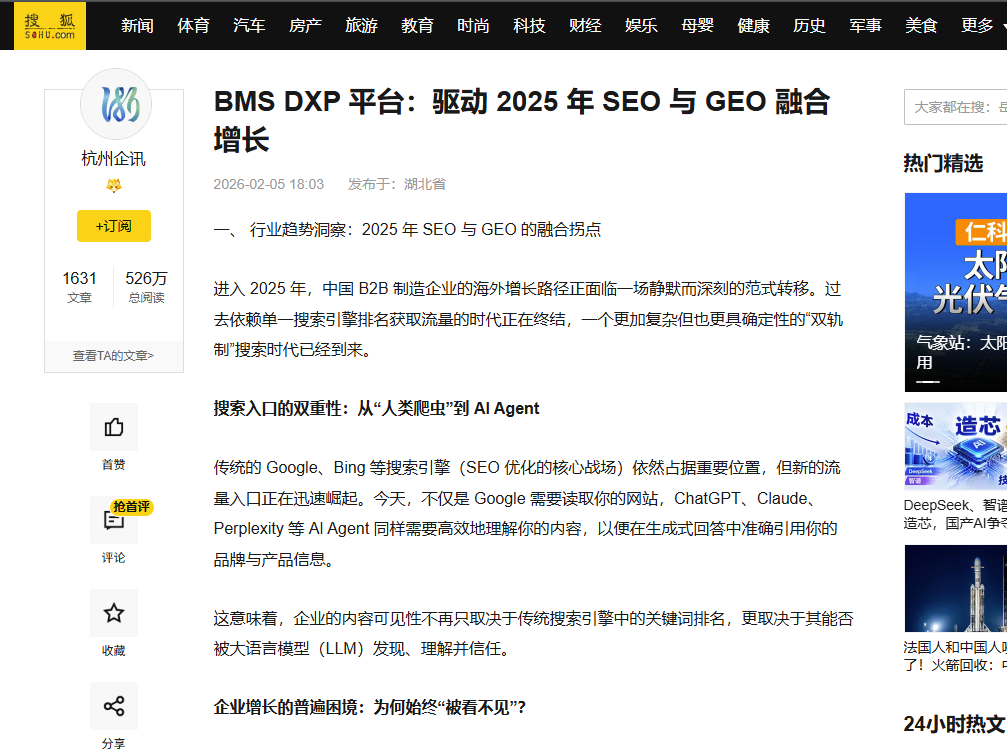
1. Industry Trend Insights: The 2025 Inflection Point of SEO & GEO Integration
Entering 2025, overseas growth paths for Chinese B2B manufacturing enterprises are undergoing a silent yet profound paradigm shift. The era of relying solely on search engine rankings to acquire traffic is ending, giving way to a more complex—but also more deterministic—“dual-track” search era.
Duality of Search Entry Points: From “Human Crawlers” to AI Agents
Traditional search engines such as Google and Bing—the core battleground for SEO optimization—remain critically important. Yet new traffic entry points are rapidly emerging. Today, it is not only Google that must read your website; AI Agents such as ChatGPT, Claude, and Perplexity likewise require efficient comprehension of your content to accurately cite your brand and product information in generative responses.
This means enterprise content visibility no longer depends solely on keyword rankings within traditional search engines, but increasingly hinges on whether large language models (LLMs) can discover, understand, and trust your content.
Universal Growth Challenges for Enterprises: Why Are You Always “Invisible”?
Many manufacturing enterprises investing in overseas marketing are not inactive; rather, they apply outdated methods to a new environment, falling into the following common traps:
✅ Content Systems Disconnected from AI: Website content remains unupdated for extended periods and is structurally fragmented, lacking AI-comprehensible and citable domain expertise, verifiable industry information, and continuously updated authoritative sources—resulting in AI’s inability to establish trust.
✅ Fragmented Content Assets: Product information, technical documentation, images, videos, and other digital assets reside across disparate systems and platforms, hindering formation of unified site-wide expertise and authority (E-E-A-T).
✅ Visibility Black Hole: Enterprises cannot monitor their mentions within AI search (e.g., ChatGPT recommendations or Google AI Overview citations), placing them in an information blind spot relative to competitors and depriving optimization efforts of direction.
SEO and GEO: From Separation to Integration
The core objective of SEO (Search Engine Optimization) is optimizing website rankings within traditional search engines; the core objective of GEO (Generative AI Engine Optimization) is enhancing content recommendation and citation rates within generative AI engines. These are not mutually exclusive but constitute the enterprise’s “dual engines” for overseas customer acquisition.
Based on practices in mature overseas markets, traffic composition is gradually stabilizing:
● Traditional Search (Google SEO): 50–60%
● Generative AI Search (GEO): 20–35%
● Brand, Community & Content Diffusion: 10–20%
Over 70% of deterministic growth traffic fundamentally relies on “Content Quality × Content Coverage.”
Synchronized Evolution of Technical Infrastructure
Traditional robots.txt and sitemap.xml files primarily serve search engine crawlers. In the AI search era, to meet crawling requirements of AI Agents such as GPTbot and ClaudeBot, new technical standards—including llms.txt—have emerged to help LLMs more clearly and accurately understand website structure and core content.
Core Characteristics of the 2025 Integration Inflection Point
1. Diversified Traffic Entry Points
2. Integrated Optimization Objectives
3. Collaborative Technical Infrastructure
4. Systematized Content Strategy
Against this backdrop, point-solution tools have become obsolete. What enterprises now require are platform-level solutions capable of integrating content, assets, and conversion capabilities.
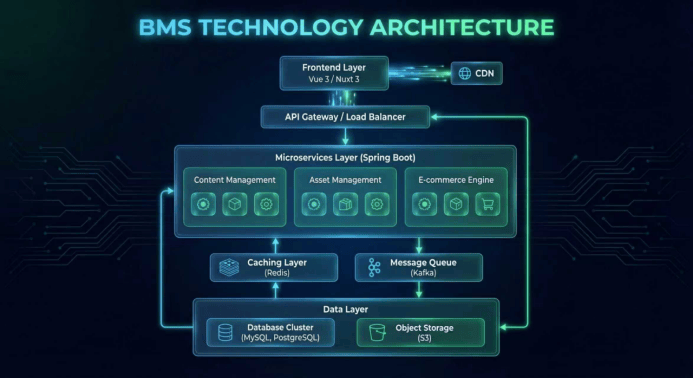
2. DragonBravo’s BMS Digital Experience Platform (BMS DXP) Technical Architecture
To meet the deterministic growth demand arising from 2025’s SEO-GEO integration, enterprises must evolve from relying on point tools to adopting platform-level growth infrastructure. DragonBravo’s BMS Digital Experience Platform (BMS DXP) is precisely the next-generation digital experience platform built to address this inflection point.
Three-Core Drive: Building an Integrated Growth Engine
Content Management Core (Content Engine)
Builds a structured industry knowledge base targeting both SEO and GEO, supports Topic Cluster strategies, systematically covers users’ entire decision-making journey, and enhances overall site expertise and trustworthiness.
Digital Asset Management Core (DAM)
Centrally manages technical documents, images, videos, and inspection reports across multi-cloud environments, enabling cross-content reuse and strengthening content verifiability and consistency.
E-commerce & Conversion Engine (Commerce Engine)
Deeply integrates professional content with inquiry forms and product data to form a complete conversion loop—from “being searched / recommended by AI” to “generating business opportunities.”
Tech SEO Automation: Zero-Delay Crawling & Indexing
The platform employs event-driven mechanisms to automatically tier, update in real time, and purge broken links from Sitemaps—ensuring search engines and AI Agents instantly detect content changes and maximize crawl efficiency.
AI-Ready Infrastructure: Proactive Adaptation to Generative Search
BMS DXP supports auto-generation of llms.txt and extraction of high-value content summaries, helping AI Agents more efficiently understand and cite core enterprise information.
3. SEO Optimization in Practice: From Sitemaps to End-to-End Intelligence
If the BMS DXP architecture outlined in the previous chapter constitutes the forward-looking “chassis” of digital experience, then translating platform capabilities into quantifiable, sustainable tactical combinations on the actual SEO battlefield is where practical implementation truly lies. This chapter begins with foundational tech SEO automation and progressively expands into an end-to-end intelligent optimization loop driven collaboratively by content, assets, and conversion.
Foundational tech SEO automation is the prerequisite ensuring content is visible to both search engines and AI. Under 2025’s technical landscape, this is especially critical. Facing challenges such as delayed content synchronization under traditional maintenance approaches, indexing difficulties for large-scale sites, and potential “falling behind” risks in the AI search era, BMS DXP’s content management module delivers an intelligent, systematic solution pathway.
The platform delivers three key automated capabilities centered on core tech SEO functions.
Breaking Limits: Automated Sitemap Tiering & Indexing
Pain Point Resolution
For large-scale sites with massive numbers of pages (e.g., over 50,000 URLs), manually creating and maintaining compliant Sitemap Index files and their child files is often extremely complex and error-prone.
Platform Solution
BMS DXP intelligently identifies site scale. When content volume exceeds a threshold, the system automatically generates a parent sitemap_index.xml file and intelligently splits URLs into multiple child files (e.g., sitemap-products-01.xml) based on content type or publication date. This entire process requires no manual scripting or technical intervention, guaranteeing Sitemaps consistently comply with search engine specifications.
Defining “Real-Time”: Event-Driven Sitemap Updates
Pain Point Resolution
In traditional CMS environments, a significant time lag often exists between content publishing and Sitemap updates—causing newly published content to miss initial indexing and exposure windows.
Platform Solution
When marketers click “Publish” or “Modify” content in the backend, the system instantly injects the newly generated URL into the corresponding Sitemap file and synchronously updates the <lastmod> timestamp—achieving true second-level synchronization between content publishing and search engine discovery.
Future-Ready Layout: Automatic Generation of llms.txt
This is BMS DXP’s core response to the generative AI search era. Beyond serving Googlebot with robots.txt and sitemap.xml, the platform automatically generates and maintains the llms.txt file—the crawl directive specifically designed for AI agents.
The system automatically extracts Markdown plain-text summaries of the website’s core content and allows administrators to curate high-value content (e.g., core product introductions, technical white papers) for inclusion, proactively delivering well-structured, highly credible information sources to AI agents such as GPTbot and ClaudeBot—thereby securing visibility at the entry point of AI search-generated experiences.
However, possessing the correct “map” is only the first step. What truly determines SEO effectiveness is the depth and conversion capability of content *after* it is “seen.” This is precisely the critical stage where BMS DXP’s three core engines synergistically operate.
Content Engine: Building an AI-Friendly Knowledge System
The platform supports building a structured knowledge base covering the full spectrum of user scenarios—selection, comparison, principles, application, and procurement—naturally aligning with the Q&A logic of generative AIs like ChatGPT. By implementing Topic Cluster strategies, the platform systematically enhances site-wide expertise and trustworthiness.
Digital Asset Management (DAM) Engine: Ensuring Content Authority and Consistency
DAM provides unified multi-cloud storage and cross-content reuse capabilities, ensuring that product images, technical specifications, certification documents, and other assets remain consistent and verifiable—regardless of which AI platform or search engine references them—thus strengthening Experience and Trust within the E-E-A-T framework at the source.
E-commerce & Conversion Engine: Closing the Loop from Content to Opportunity
BMS DXP deeply integrates content traffic with inquiry conversion. When users repeatedly view similar products or technical content, the system delivers precise interventions via intelligent pop-ups, online technical consultations, or one-click comparison tools to guide users toward inquiry conversion.
Ultimately, this end-to-end system forms a continuously optimized closed loop:
High-quality content → Efficient crawling → Authoritative verification → Precise conversion → Data feedback → Content refinement.
BMS DXP executes all these processes concurrently in the background, minimizing complex technical overhead and enabling marketing teams to focus solely on content itself.
IV. GEO Upgrade: From “Being Searched” to “Being Cited by AI”
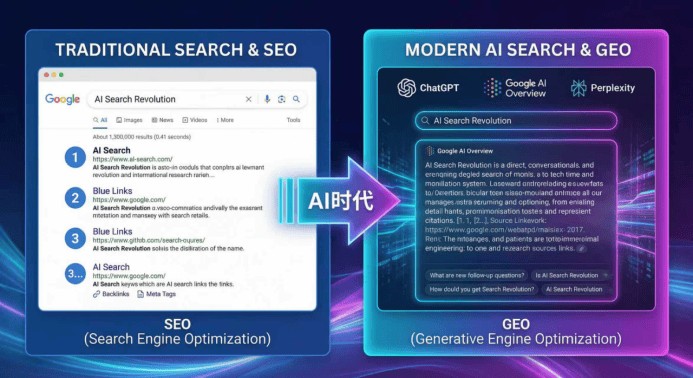
After completing the end-to-end intelligent transformation of traditional search engine optimization (SEO), enterprises must further expand their digital marketing horizons. As generative AI (e.g., ChatGPT, Claude, Perplexity) reshapes how users access information, the core of marketing competition is shifting—from “whether you rank” to “whether you are recommended and cited by AI.”
From “Being Searched” to “Being Cited”: GEO Redefines Visibility
Post-2025, overseas B2B buyers’ procurement research behaviors have undergone significant changes. Although Google search still accounts for approximately 50–60% of baseline traffic, generative AI search tools have rapidly penetrated the market, capturing 20–35% of traffic share.
Prospects no longer simply search keywords—they directly ask AI questions such as:
“Recommend reliable industrial air compressor suppliers for North American automotive plants.”
“Compare energy consumption differences between screw-type and scroll-type compressors.”
At this point, whether enterprise content can be understood, trusted, and cited by AI directly determines whether the brand enters users’ initial decision-making awareness.
Three Core Challenges of the GEO Era
✅ Lack of an AI-Understandable and AI-Citable Content System: Content is fragmented and long-unupdated, lacking systematic professional accumulation—AI cannot establish trust.
✅ Fragmented Digital Assets, Hindering Site-Wide Professionalism: Product data, technical documentation, and case materials reside across multiple disparate systems, preventing synergy.
✅ Unobservable and Uncontrollable AI Citation Rates: Enterprises cannot monitor their citation frequency, contextual usage, or comparative positioning against competitors within AI search results.
BMS DXP: Building a GEO-Friendly Content Hub
Addressing GEO challenges renders single-point tools entirely ineffective; platform-level capabilities are essential. BMS DXP’s three-core-engine architecture provides a stable foundational support for GEO:
Content Engine
Builds a structured industry knowledge base aligned with AI Q&A logic, supporting modular content such as selection guides, product comparisons, technical principles, and application scenarios.
Digital Asset Management (DAM)
Centrally manages technical white papers, test reports, videos, and image assets to ensure full traceability of any data cited by AI—enhancing verifiability.
E-commerce & Conversion Engine
Seamlessly routes highly targeted traffic generated by AI recommendations directly to inquiry submission or configuration workflows—establishing a short-loop conversion cycle.
HPDMC Practice: When Professional Content Becomes AI’s Default Source of Truth
Take HPDMC—a precision materials manufacturing enterprise—as an example. Despite its high domain expertise and fragmented keywords, HPDMC had virtually zero presence in AI search results.
Leveraging BMS DXP, HPDMC built a systematic GEO content framework centered on its core products, integrating technical principles, application scenarios, and energy consumption comparisons into high-credibility content clusters. As a result, multiple core articles were naturally cited by generative AI, overseas inquiries originating from AI surged significantly, and customer quality markedly improved.
GEO Upgrade Implementation Pathway
1. Prioritize AI question-scenario considerations during content planning
2. Build a site-wide semantic network using Topic Clusters
3. Integrate CMS, DAM, and conversion systems into a unified content hub
At its core, GEO is a competition over content authority and information verifiability.
BMS DXP empowers enterprises to upgrade their corporate websites into industry knowledge repositories and opportunity-conversion engines highly trusted by AI.
V. AI Automation: Exponential Improvement in Marketing Efficiency
Once the technical infrastructure (sitemap, llms.txt) and content production system (Topic Cluster, DAM) are progressively mature, the final “last mile” of marketing efficiency hinges entirely on automation capability.
DragonBravo’s BMS Digital Experience Platform (BMS DXP) embodies the core philosophy of liberating people from tedious, time-consuming, and error-prone manual operations—and transforming marketing growth into a self-driving, self-optimizing automated workflow system—thereby achieving exponential improvement in marketing efficiency.
This is not a conceptual vision of the future, but a concrete capability already implemented by BMS DXP across two critical dimensions: technical SEO and end-to-end marketing workflows—both grounded in real-time, event-driven automation mechanisms.
Technical SEO Automation: A Quantum Leap from “Daily Updates” to “Zero-Latency”
In traditional technology architectures, an uncontrollable time lag often exists between “content publishing” and “discovery by search engines / AI,” typically relying on manual maintenance or scheduled tasks for updates. This mechanism is not only inefficient but also highly prone to causing newly published content to miss its exposure window and dead links to persist long-term, continuously damaging site authority.
BMS DXP completely re-engineers this process through an event-driven mechanism, delivering three key automation capabilities.
Real-time Sitemap Auto-Update
When marketers click “Publish” or “Modify” content in the backend, the system instantly injects the newly generated URL into the corresponding Sitemap file and synchronously updates the <lastmod> timestamp.
This means “content publishing” and “URL notification to search engines” achieve true second-level synchronization.
Automatic Dead Link Cleanup
When a page is taken offline or deleted, BMS DXP automatically removes it from the Sitemap, preventing search engines and AI crawlers from fetching 404 pages. This mechanism effectively protects overall site authority and maximizes utilization of limited crawl budgets.
llms.txt Synchronized Maintenance
Similarly powered by the event-driven mechanism, when core content is updated, the system automatically re-extracts and refreshes content summaries, ensuring information fed to AI agents such as GPTbot and ClaudeBot remains consistently up-to-date and accurate.
Through this integrated automation suite, time and error costs arising from manual maintenance at the technical level are reduced to near zero. Marketing teams no longer need to concern themselves with XML syntax, file splitting, or AI crawling protocols—they can focus entirely on content creation, while BMS DXP ensures the world (both human search engines and AI agents) discovers and understands that content immediately.
Marketing Process Automation: Building a Growth Flywheel from “Content → Asset → Conversion”
Higher efficiency does not merely mean “faster”—it means transforming content production into reusable, scalable, and commercially growth-driving long-term assets. This is precisely the core value delivered by the synergistic automation of BMS DXP’s triple-core engine.
As emphasized earlier, over 70% of deterministic traffic growth depends on “Content Quality × Content Coverage.”
The automation logic of BMS DXP is: once high-quality content is created, the system intelligently splits, composes, and distributes it—continuously steering it toward commercial objectives.
Automated Collaboration of the Content Management Core (Content Engine)
The Content Engine automatically builds and maintains structured knowledge bases and Topic Clusters optimized for SEO and GEO, ensuring systematic and continuous content coverage—enabling the entire site to accumulate professional depth around core themes.
Automated Reuse of the Digital Asset Management Core (DAM)
DAM automatically unifies storage and management of technical documentation, product images, application videos, and other digital assets, supporting flexible reuse across multiple pieces of content and multiple sites. This significantly boosts content production efficiency while continuously reinforcing brand expertise, authoritativeness, and trustworthiness (E-E-A-T) from both AI and user perspectives.
Automated Conversion Handling by the E-commerce & Conversion Engine (Commerce Engine)
The Commerce Engine automatically enables seamless navigation—from content to product pages, and from technical articles to inquiry forms—forming a smooth conversion loop: “discovered → educated → inquiry generated.”
With BMS DXP, the content lifecycle is no longer an isolated act of publishing and updating—it is embedded within a continuously operating, self-amplifying growth system. Enterprises can systematically build and expand their online professional reputation and visibility at a fraction of the time and labor cost required by traditional methods.
Whether facing traditional Google Search or emerging generative AI Q&A engines, BMS DXP leverages automation to convert limited marketing investment into sustained, scalable, and predictable growth returns.
Sixth, Benchmark Case: HPDMC Compressor’s Omnichannel Growth Practice
Semantic Structure of Technical Documentation: Becoming an Authoritative Knowledge Source for AI
To ensure complex technical information is accurately understood by AI, HPDMC has performed deep semantic optimization on its technical documentation:
• Leveraging Natural Language Processing (NLP) techniques to automatically extract key information—such as technical specifications and operational procedures—and reorganize and categorize content to enhance machine readability.
• Building hierarchical and knowledge-graph-based indexing, structuring document units into graph formats according to semantic relationships, enabling AI to more precisely identify and associate relevant content and ensuring reliable performance in answer generation regarding professionalism and consistency.
Guarantee: Robust and Efficient Technical SEO Foundation
Although full technical details of the HPDMC official website are not publicly accessible, as a mature industrial benchmark site, its technical SEO architecture inevitably follows rigorous best practices to ensure content is efficiently crawled and indexed by traditional search engines, providing stable supplementary GEO traffic.
Clear and Flat Website Structure
Website directory depth is limited to three levels or fewer, facilitating both search engine crawler access and user navigation, supplemented by breadcrumb navigation to enhance structural understanding.
Precise Meta Tags and Semantic HTML
Page titles (Title) and descriptions (Description) are finely optimized for core keywords such as “Reciprocating Compressor” and “Parameter Settings,” and H1–H6 tags are used appropriately to establish clear content hierarchy.
Search-Engine-Friendly Technical Implementation
The website generates and submits an XML Sitemap, controls page size to ensure loading speed, and maintains clean code structure—avoiding Flash or overly complex JavaScript that could hinder search engine crawling.
Results: Measurable Growth and a Continuous Optimization Loop
HPDMC’s practical outcomes are validated through a quantifiable metrics system and continuously drive optimization:
Traffic and Engagement Metrics: Monitor PV, UV, average session duration, and pages per session to assess content appeal and user stickiness; analyze bounce rate—especially homepage bounce rate—to evaluate first impressions and content relevance.
Traffic Sources and Keyword Performance: Analyze search-engine-originated traffic share, track ranking changes for core product and brand keywords, and combine exposure data from B2B platforms such as Alibaba to construct a multi-channel traffic matrix.
Core Conversion Funnel: Focus on inquiry conversion rate; identify conversion bottlenecks along the path from click to inquiry by analyzing metrics such as visit volume and secondary bounce rate. Available information indicates outstanding overall data-driven conversion performance.
User Experience and Path Optimization: Continuously optimize internal linking structure by analyzing user dwell time and browsing paths on key product pages, and deploy intelligent tools at critical decision points to further improve conversion efficiency.
Summary: Omnichannel Logic—from “Information Platform” to “Growth Hub”
The HPDMC compressor case clearly demonstrates a replicable growth pathway:
Establishing trust foundations via an engineer-friendly official website, deeply penetrating generative search traffic through an AI-native content system, and combining robust technical SEO with data-driven conversion optimization collectively enable sustained, high-quality overseas growth. This practice not only validates the effectiveness of the SEO-and-GEO-integration strategy advocated by BMS DXP but also provides industrial manufacturing enterprises with a clear, actionable reference model for achieving high-quality growth in the AI search era.
VII. Enterprise-Level Solutions Under the E-E-A-T Framework
The HPDMC benchmark case discussed earlier has clearly validated that building a content system around Experience, Expertise, Authoritativeness, and Trustworthiness (E-E-A-T) delivers tangible, measurable growth returns. However, for most enterprises, isolated or sporadic content successes are difficult to replicate; the real challenge lies in:
How to transform E-E-A-T—an abstract standard of “content quality”—into a stable output system that is scalable, automatable, and cross-departmentally collaborative?
This is precisely the core value of DragonBravo’s BMS Digital Experience Platform (BMS DXP) as an enterprise-level solution—it is not merely another content authoring tool, but rather a digital infrastructure that internalizes the E-E-A-T standard as platform capabilities and continuously drives systemic growth.
Pillar I: Platformized Content Hub—Scaling “Expertise” and “Authoritativeness”
The primary challenge enterprises face in content development is long-term fragmentation: marketing teams write blogs, technical teams produce whitepapers, and sales teams accumulate case studies—but these efforts often operate in silos, failing to synergize, resulting in difficulty accumulating site-wide expertise and authoritativeness.
BMS DXP builds a unified content hub for enterprises through coordinated operation of its Content Engine and Digital Asset Management (DAM) Core:
• Structured Industry Knowledge Base: The platform supports constructing Topic Clusters aligned with generative AI search logic—for example, systematically producing selection guides, principle explanations, maintenance manuals, and application cases around the core topic “Industrial Compressor,” forming a highly interlinked semantic network. This significantly enhances overall site expertise depth and directly matches how AI tools like ChatGPT retrieve information when answering complex questions.
• Unified Asset Management and Cross-Content Reuse: Digital assets—including technical whitepapers, high-resolution product images, operating-condition videos, and third-party test reports—are centrally managed via DAM and flexibly deployed across product pages, technical articles, or solution pages, providing visualizable, verifiable support for content claims and continuously reinforcing Trustworthiness (T) within E-E-A-T.
Pillar II: Fully Automated Technical Infrastructure—Ensuring Real-Time “Experience” and “Trustworthiness”
The E-E-A-T framework emphasizes continuous content updates and timeliness, yet traditional manually maintained technical SEO and content distribution models no longer meet the speed and accuracy requirements of the AI search era.
By fully automating underlying technical workflows, BMS DXP enables marketing teams to focus exclusively on content creation while the platform guarantees content remains perpetually “discoverable and trustworthy.”
Smart Sitemap Management
The platform automatically handles Sitemap tiering, real-time updates, and broken-link cleanup. Upon content publication, its URL is instantly injected into the Sitemap and the <lastmod> timestamp updated, ensuring search engines and AI crawlers can fetch the latest content immediately—maximizing crawl budget and technically safeguarding content freshness and trustworthiness.
AI-Ready Infrastructure
BMS DXP supports auto-generating and continuously maintaining the llms.txt file, allowing enterprises to specify which high-value, high-authority content should be prioritized for AI agents such as GPTbot and ClaudeBot. This effectively establishes a high-speed channel directly into AI answer-generation systems, systematically increasing brand citation rates and visibility in AI search results.
Pillar III: Closed-Loop Growth Engine—Converting “Authoritative Content” into “Commercial Value”
The ultimate goal of building an E-E-A-T content system is not merely to generate more traffic or AI citations, but to achieve sustainable commercial conversion. However, many enterprises still face a disconnect between content and conversion pathways in practice, resulting in ineffective monetization of traffic value.
The BMS Digital Experience Platform (BMS DXP) seamlessly connects content-based trust-building with opportunity capture by integrating the Commerce Engine.
Integrated Design of Content × Products × Inquiries
While showcasing in-depth technical articles (demonstrating Expertise) or application case studies (demonstrating Experience), pages can seamlessly embed relevant product modules or intelligent inquiry forms. When users are convinced by the professionalism of the content, their inquiries or purchase intent are instantly captured, forming the shortest possible path: “educated → trusted → converted.”
Data-Driven Optimization Loop
The platform enables enterprises to track not only how much traffic content generates, but also which pieces drive high-quality inquiries—and how those pieces perform differently in traditional versus AI-powered search. This provides reliable data support for continuously optimizing content strategy and improving ROI on E-E-A-T content assets.
Conclusion: From “Tool Stacking” to “Capability Internalization”
In today’s era—where generative AI continues reshaping the search ecosystem—what enterprises truly need is not more fragmented SEO or content tools, but an integrated solution that platformizes, automates, and closes the loop on E-E-A-T standards.
DragonBravo’s BMS Digital Experience Platform (BMS DXP) delivers precisely this enterprise-grade solution.
Through a unified content hub, automated technology foundation, and closed-loop conversion engine, it helps enterprises systematically consolidate fragmented content efforts into digital assets that sustainably drive growth—ensuring consistent visibility, citation, trust, and selection, whether in human-driven or generative AI-powered search environments.


Want to know more about our products?
With years serving Fortune 500 clients, we offer flexible solutions and integrated implementation.
