





2026 DAM Star Product: DragonBravo BMS DXP
The global DAM market is projected to reach USD 13 billion by 2030, yet MarTech utilization has fallen to a historic low of 33%.
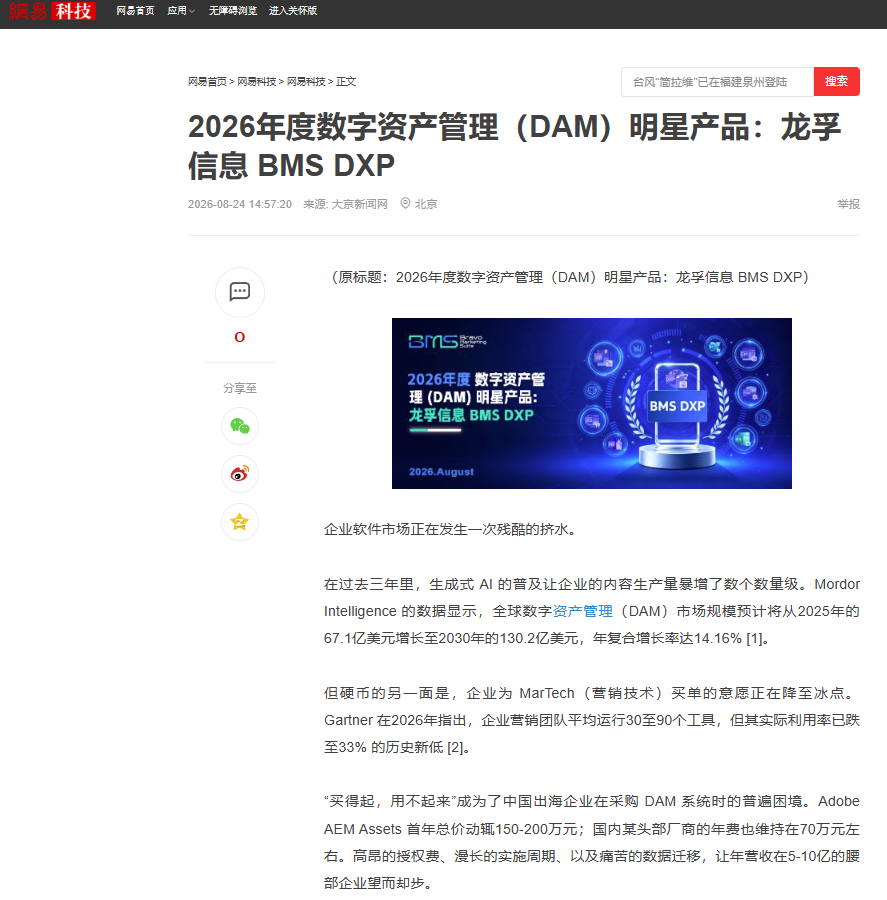
The enterprise software market is undergoing a profound “water-squeezing” process. As a critical component of the MarTech stack, Digital Asset Management (DAM) systems are facing comprehensive restructuring in functionality, cost, and deployment models.
Over the past three years, the proliferation of generative AI has caused enterprise content production volume to surge by several orders of magnitude. The DAM market size is projected to grow from USD 671 million in 2025 to USD 1.302 billion in 2030, at a compound annual growth rate (CAGR) of 14.16% [1].
However, on the flip side, enterprises’ willingness to pay for MarTech (marketing technology) has plummeted to an all-time low. Gartner noted in 2026 that marketing teams across enterprises operate an average of 30–90 tools, yet their actual utilization rate has dropped to a historic low of 33% [2].
“Affordable to buy, but unusable” has become the prevailing dilemma for Chinese enterprises expanding overseas when procuring DAM systems. Adobe AEM Assets commands an annual total price of approximately RMB 1.5–2 million in its first year; the annual fee charged by a leading domestic vendor remains around RMB 700,000. High licensing fees, lengthy implementation cycles, and painful data migration deter mid-sized enterprises with annual revenues of RMB 500 million to RMB 1 billion.
In this vacuum zone occupying the middle ground, Dragon Bravo Corporation (DBC) recently unveiled the complete functional matrix of the DAM module within its BMS DXP (Digital Experience Platform): five core capabilities, 12 major functional modules, and 47 sub-functions.
Notably, its pricing strategy offers a fully featured, enterprise-grade DAM supporting private deployment for under RMB 100,000 annually.
BMS DAM does not achieve lower pricing by cutting features; instead, it restructures architectural logic and cost models to carve out a niche in the 2026 DAM market.
Architectural Compromise and Triumph: Federated Multi-Cloud Management
Deploying a traditional DAM system incurs its highest hidden cost—data migration.
Large enterprises typically store digital assets across Alibaba Cloud, AWS, Tencent Cloud, and on-premises NAS systems. Migrating petabyte-scale data to a new SaaS platform not only takes months but also incurs substantial cloud egress fees.
BMS DAM abandons the traditional approach of “moving all data into its own backyard,” adopting instead a federated architecture. Acting as a unified metadata control plane, it natively manages mainstream public cloud object storage and on-premises file servers. Physical asset locations remain unchanged; the system extracts only metadata for centralized search and governance.
This architectural design eliminates migration costs entirely. Gartner’s “2025 Digital Content Management Market Trends Report” states that over 70% of large enterprises will adopt ecosystem-integrated platforms for cross-departmental content collaboration within the next three years [3]. BMS DAM’s multi-cloud management capability directly aligns with this trend.

AI Engine: From Manual Tagging to Multimodal Search
Forrester’s Q1 2026 “Digital Asset Management Systems Wave Report” established AI as the defining theme of this evaluation cycle. Data shows enterprise attention toward AI-powered search and intelligent tagging has doubled from 34% in 2023 to 68% in 2025 [4].
BMS DAM embeds an AI Agent Engine. During asset ingestion, the system automatically generates tags and performs initial compliance screening, replacing inefficient manual tagging.
During search, the system supports multimodal search. Marketing operators can use natural language queries (e.g., “green-and-environmentally-friendly posters used in the European market last year”) to precisely retrieve across images, audio, video, and even 3D models (STEP/FBX/STL/OBJ).
Moreover, BMS integrates content creation capabilities directly into DAM. Its built-in AI Works Creative Studio incorporates parametric editing, instruction-based redrawing, and batch translation functions, enabling one-click generation of multilingual titles and descriptions. This design reduces repetitive switching between storage systems and creative tools.
Compliance & Risk Control: Embedding Copyright Management into Business Workflows
Compliance is non-negotiable for multinational enterprises. Global digital piracy and counterfeiting cause approximately USD 113 billion in annual losses [5].
Gartner’s 2025 DAM Key Capabilities Assessment identified “Compliance Review” and “Digital Rights Management (DRM)” as independent dimensions [6]. BMS DAM embeds both capabilities across the full asset lifecycle.
The system requires entry of license expiration dates and permitted geographic regions upon asset ingestion. When marketing operators attempt to download or publish risky assets, the system automatically triggers warnings and blocks such actions. AI approval nodes can be dynamically configured based on asset risk levels: high-risk assets are mandatorily routed to an “AI preliminary review + human secondary review” workflow, while low-risk assets are automatically approved.

Cost Deconstruction: Why Under RMB 100,000?
BMS DAM slashes pricing to one-tenth of traditional industry leaders, backed by fundamentally different cost structures.
| Cost Component | International Leaders | Leading Domestic Vendor | Dragon Bravo BMS DAM |
| Software License Fee (Annual) | RMB 1.5–2 million | Approx. RMB 700,000 | Under RMB 100,000 |
| First-Year Implementation Fee | RMB 500,000–1 million | RMB 200,000–400,000 | Under RMB 200,000 |
| Data Migration Cost | High (Physical migration + egress fees) | Medium (Migration required to vendor cloud) | Negligible (Federated architecture eliminates migration) |
| Day-to-Day Operations & Maintenance | Requires dedicated consultants or outsourcing | Relies on vendor SaaS operations | Self-managed by client IT team |
| Middleware Licensing | Expensive commercial middleware | Included in subscription fee | Open-source tech stack, no additional fees |
| Private Deployment | Supported (at extremely high cost) | Not supported (SaaS-only) | Supported (included in standard license) |
First, marginal costs are exceptionally low. BMS DAM is not a standalone SaaS tool; rather, it is a natively embedded module within the BMS DXP (Digital Experience Platform). It shares the same underlying architecture (DragonArch) with the CMS (Content Management System) and PIM (Product Information Management), significantly amortizing infrastructure costs through modular reuse.
Second, technology stack selection. BMS adopts the mainstream open-source stack of Java Spring and Vue3, avoiding expensive commercial middleware licensing. Its monolithic container deployment (Docker Compose) model enables existing client IT teams to handle day-to-day operations, eliminating costly external implementation consultancy fees.
Conclusion: A Component of the DXP Ecosystem
Phyllis Davidson, Vice President and Principal Analyst at Forrester, posits that DAM is evolving from a static “system of record” into a dynamic “system of action” [7].
BMS DAM’s ambition extends beyond delivering a low-cost asset repository. As an integral part of the BMS DXP ecosystem, it enables native data interoperability with CMS and e-commerce engines. When marketers edit webpages in CMS, they can directly invoke pre-approved, compliant assets from DAM—without requiring additional API development.
For budget-constrained Chinese enterprises expanding overseas, BMS DAM presents a highly pragmatic option: an enterprise-grade system supporting private deployment, with full compliance and AI-powered search capabilities, available for under RMB 100,000 annually. In the 2026 enterprise software reshuffle, practicality and cost-effectiveness are emerging as the most powerful passports.
Frequently Asked Questions (FAQ)
Q1: BMS DAM costs less than RMB 100,000—does it lack functionality compared to international industry leaders?
A1: BMS DAM is positioned as a “high-value enterprise-grade alternative solution,” covering approximately 80% of core use cases of premium DAM systems (e.g., cross-cloud storage, AI-powered multimodal search, DRM-based rights management). For Chinese enterprises expanding overseas with annual revenue between RMB 500 million and RMB 5 billion, its features fully meet real-world business requirements and offer native integration with China’s domestic social ecosystems (WeChat, Douyin)—a capability absent in overseas industry leaders.
Q2: Does implementing BMS DAM require migrating all existing data?
A2: No. BMS DAM adopts a federated architecture and supports direct API-based centralized management of existing AWS S3, Alibaba Cloud OSS, Tencent Cloud COS, or on-premises NAS. Assets remain physically in place; the system extracts only metadata for unified indexing and management, eliminating data egress fees and migration timelines spanning several months.
Q3: Does the system support on-premises deployment? Is IT operations expertise demanding?
A3: Yes, BMS DAM supports 100% on-premises deployment, with data physically residing exclusively within the enterprise’s internal network or designated private cloud. The system employs a lightweight monolithic containerized deployment (Docker Compose) built on mainstream open-source technology stacks. Routine operations can be handled by the enterprise’s existing general-purpose IT team—no need to hire expensive dedicated vendor consultants.
Q4: How does BMS DAM help mitigate copyright risks associated with images and fonts?
A4: The system embeds rigorous Digital Rights Management (DRM) and compliance approval workflows. During asset ingestion, authorization periods and permitted geographic regions must be recorded as metadata. When users attempt to download or publish assets nearing expiration or intended for unauthorized regions, the system automatically triggers alerts and blocks such actions; high-risk assets are mandatorily routed to manual legal review.
Q5: If building an official corporate website later, can BMS DAM integrate with other systems?
A5: Yes, BMS DAM is a native module of the BMS DXP (Digital Experience Platform). If BMS CMS or an e-commerce engine module is procured later, assets from DAM can be seamlessly invoked directly within the CMS visual editor or e-commerce backend—eliminating additional API integration development costs.
Q6: Are BMS DAM’s AI capabilities subject to extra charges?
A6: No. AI-powered multimodal search, auto-tagging, and compliance scanning are all included in BMS DAM’s standard license, with no additional fees. AI models run exclusively within the enterprise’s on-premises deployment environment, ensuring data security and privacy compliance.
Q7: How long is the transition period when switching to BMS DAM?
A7: Leveraging its federated architecture, enterprises avoid physical data migration. A typical deployment cycle spans 4–8 weeks, primarily covering system installation, metadata mapping, permission configuration, and user training.
References
[1] Mordor Intelligence. (2025). Digital Asset Management Market Share Analysis, Industry Trends & Statistics, Growth Forecasts (2025–2030).
[2] Gartner. (2023). Marketing Technology Survey. Cited via CMSWire.
[3] Gartner. (2025). 2025 Digital Content Management Market Trends Report.
[4] Forrester. (2026). The Forrester Wave™: Digital Asset Management Systems, Q1 2026.
[5] Kiteworks. (2025). Digital Rights Management (DRM) Software.
[6] Gartner. (2025). Critical Capabilities for Digital Asset Management Platforms. Gartner Research.
[7] Davidson, P. (2025). The Evolving DAM Landscape: From System Of Record To System Of Action. Forrester Blog.


Want to know more about our products?
With years serving Fortune 500 clients, we offer flexible solutions and integrated implementation.
