





Traditional CMS or Headless CMS? BMS DXP lets you choose between them
Publication date: February 28, 2026
Introduction: A Crossroads in Enterprise Digital Transformation
In today's digital economy, Content Management Systems (CMS) are the core engine for enterprises to build digital experiences and interact with customers. However, countless enterprise decision-makers are standing at a crossroads in their technology choices, facing a thorny question: should they stick with stable, mature traditional CMSs, or embrace flexible, future-oriented headless CMSs?
This debate has been protracted. Traditional CMSs are like fully furnished houses—functional and ready to move in, but with a fixed layout that's difficult to modify. Headless CMSs, on the other hand, are like basic land with water, electricity, and gas—offering unlimited design freedom, but also requiring the ability to plan and build from scratch. Choosing the former may mean struggling in the multi-channel era; choosing the latter may involve high initial investment and technical barriers.
More pressingly, with the rise of generative AI such as ChatGPT, Gemini, and DeepSeek, Generative Engine Optimization (GEO) is jointly defining new traffic rules with traditional Search Engine Optimization (SEO). Meanwhile, an increasing number of Chinese companies are accelerating their global expansion, requiring them to build localized digital experiences in different countries and regions. These new challenges pose unprecedented risks to the capabilities of CMS.
Is this choice truly black and white?
BMS Experience Manager, with its forward-thinking design philosophy, offers a negative answer. We believe that enterprises should not be forced to compromise between "stability" and "flexibility." BMS DXP provides a unique path of integration and gradual evolution, allowing you to simultaneously possess the ease of use of a traditional CMS and the powerful capabilities of a Headless CMS, confidently addressing current business needs while preserving unlimited possibilities for global expansion and innovation in the AI era.
Traditional CMS vs. Headless CMS: A War with No Winners
To understand the unique value of BMS DXP, we first need to objectively examine the respective advantages and disadvantages of traditional CMS and Headless CMS.
Traditional CMS: Stable and Reliable, but Showing Signs of Fatigue
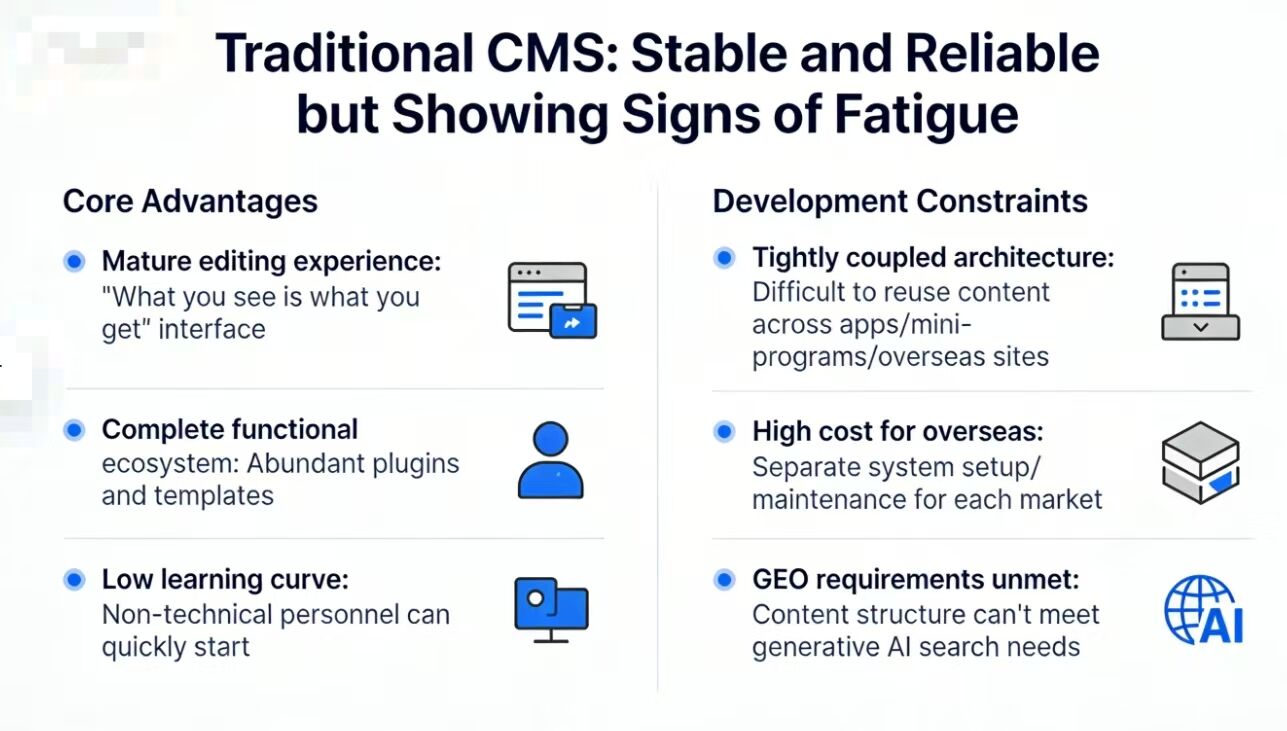
Traditional CMS has maintained its market dominance for a long time due to its three core advantages. It offers a mature editing experience, with a WYSIWYG interface that makes content creation and publishing intuitive and easy to use. After years of development, it has accumulated a complete functional ecosystem, with numerous plugins and templates enabling the rapid construction of fully functional websites. Simultaneously, its low learning curve allows non-technical personnel to quickly get started and perform daily content maintenance.
However, these advantages have gradually become constraints in the wave of mobile internet, omnichannel marketing, and global expansion. Its tightly coupled architecture firmly binds content to the front-end presentation, making it difficult to reuse content across multiple channels such as apps, mini-programs, and overseas sites. When Chinese companies attempt to quickly establish localized sites in multiple overseas markets, traditional CMSs often require building and maintaining separate systems for each market, resulting in high costs and low efficiency. More seriously, in the era of generative AI search, the content structure of traditional CMSs often cannot effectively adapt to the requirements of GEO, causing companies to lose competitiveness in new traffic entry points.
Headless CMS: Flexible and Powerful, but with a High Barrier to Entry
The emergence of Headless CMS is precisely to break the shackles of traditional CMSs. Its revolutionary advantages are reflected in multiple dimensions. The freedom offered by a decoupled architecture allows for separation of front-end and back-end, enabling development teams to use any preferred front-end technology stack (such as React, Vue, Angular, etc.). Omnichannel content distribution capabilities deliver content as a service via APIs, distributing it to any digital touchpoint, achieving "create once, publish across multiple platforms," which is particularly important for enterprises that need to manage multiple domestic and international markets simultaneously. As the core of a composable architecture, it easily integrates various third-party services, including the latest AI tools and international marketing technology stacks, maintaining technological advancement.
However, this extreme flexibility also brings significant challenges. Enterprises need to invest substantial resources to build front-end applications and content editing interfaces from scratch, placing extremely high demands on their technical teams, undoubtedly raising the implementation threshold and initial costs. For rapidly expanding Chinese companies going global, the time window is often more critical than technical perfection.
1. Comparison Dimension: Architecture
Traditional CMS: Tightly coupled (integrated front-end and back-end)
Headless CMS: Decoupled (separate front-end and back-end)
2. Comparison Dimension: Channel Support
Traditional CMS: Primarily Web-oriented
Headless CMS: Omnichannel (Web, App, IoT, etc.)
3. Comparison Dimension: Globalization Capability
Traditional CMS: Requires separate deployment for each market
Headless CMS: One set of content, distributed across multiple markets
4. Comparison Dimension: GEO/SEO Adaptation
Traditional CMS: Rigid structure, difficult to adapt
Headless CMS: Flexible content structure, easy to optimize
5. Comparison Dimension: Flexibility
Traditional CMS: Low, limited by platform
Headless CMS: High, free choice of technology stack
6. Comparison Dimension: Implementation Barrier
Traditional CMS: Low, out-of-the-box
Headless CMS: High, requires self-built front-end and supporting tools
7. Comparison Dimension: Editing Experience
Traditional CMS: Mature, WYSIWYG
Headless CMS: Requires self-development or integration
BMS DXP: Best Practices for Integration
Since traditional CMS and Headless CMS each have their advantages and disadvantages, is there a solution that combines the strengths of both while avoiding their weaknesses? BMS DXP was created precisely for this purpose. It provides a unique "gradual evolution" path through two core modules.
Content Module: The Perfect Successor to Traditional CMS
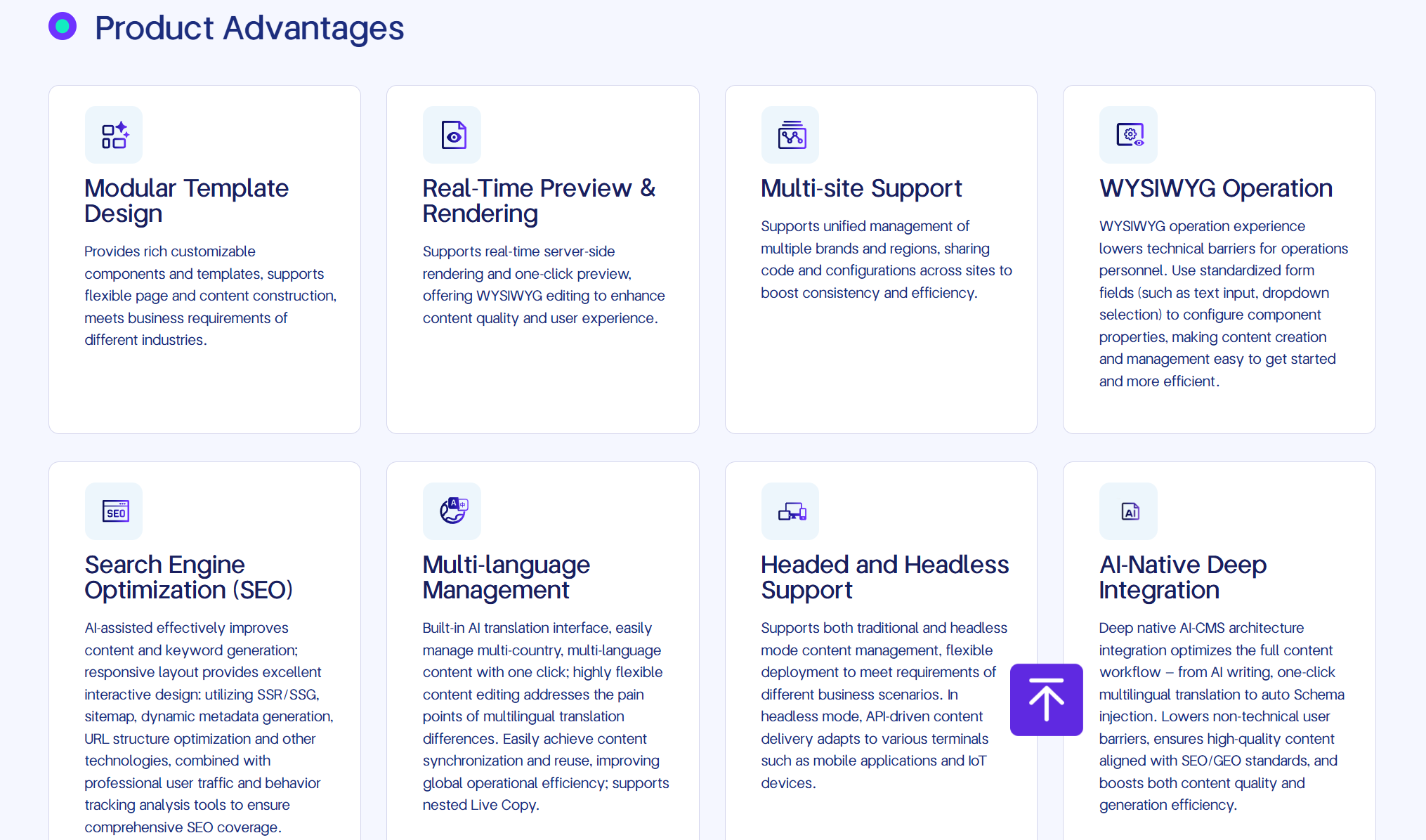
For enterprises whose business is still centered around a website, BMS DXP's Content module provides a perfect starting point. It possesses everything a mature and powerful traditional CMS should have.
The intuitive and easy-to-use editing interface allows content teams to seamlessly integrate and get started with zero learning cost. A complete content approval workflow meets the stringent requirements of enterprise-level content governance. Particularly noteworthy is the Content module's powerful multi-site and multi-language management capabilities, which are crucial for Chinese enterprises expanding globally. You can manage content from multiple markets, including Mainland China, Hong Kong, Southeast Asia, and Europe and America, in a unified backend. Each site can be independently configured with language, currency, and compliance requirements, while reusing core brand content and product information, greatly improving the efficiency of overseas operations.
You can think of the Content module as a more powerful and modernly designed "traditional CMS" that perfectly meets all your current content management needs, ensuring business stability and continuity.
Fragment Module (Coming Soon): Full Release of Headless Capabilities
When your business grows to the point where it needs to expand to omnichannel or provide deeply customized experiences for different overseas markets, BMS DXP's Fragment module will provide you with a powerful headless engine, eliminating the need for painful platform migrations. The Fragment module is a pure headless content center that will achieve:
API-driven content delivery, distributing content in structured "fragments" to any front-end application via API. This means you can build completely different front-end experiences for different markets, such as a minimalist website for the European and American markets, or a colorful mobile app for the Southeast Asian markets, while content management remains centralized in the same backend.
Content componentization and reuse, creating reusable "building blocks" that can be freely assembled and combined across different channels and applications. A fragment of product information can appear simultaneously on the official website, app, mini-program, and even in voice replies from smart speakers, ensuring brand information consistency.
Ultimate support for composable architecture, serving as the core of your composable DXP architecture, seamlessly integrates various external services, including international payment gateways, logistics tracking systems, and the latest AI content generation and optimization tools.
Most importantly, the transition from the Content module to the Fragment module is smooth and gradual. You can maintain your existing website operation model while gradually enabling Headless mode for new channels (such as apps and mini-programs) or new markets. Alternatively, Fragment module content can support the visual components and pages of the Content module, allowing old and new businesses to coexist without conflict, ensuring a robust yet flexible transformation process.
New Traffic Rules in the Generative AI Era: Driven by a Dual Engine of GEO and SEO
Since 2024, generative AI search engines, represented by ChatGPT, Perplexity, and Wenxin Yiyan, have been changing the way users obtain information. Unlike traditional search engines that return lists of links, generative AI directly generates answers. This means businesses must adapt to entirely new Generative Engine Optimization (GEO) rules to gain a foothold in AI-generated results.
Traditional CMS systems struggle with GEO. Their content structures are often designed for human reading and traditional SEO, lacking structured data annotation and semantic content organization, making them difficult for AI engines to understand and utilize effectively. Headless CMS, on the other hand, provides a naturally structured content model that is the ideal foundation for GEO.
BMS DXP not only provides the technical foundation but also offers professional GEO/SEO implementation and optimization services. Our team deeply understands the content preferences of generative AI and can help you:
• Build semantic content models that allow AI engines to accurately understand your products, services, and brand information.
• Optimize the structured annotation of content, including Schema.org tags and knowledge graph construction, to improve visibility in AI search results.
• Develop a GEO and SEO integration strategy to serve traditional search engines while providing high-quality "training material" for generative AI.
• Adapts to the multilingual and multi-market GEO needs, ensuring your brand is accurately presented in AI search engines worldwide.
In this new era of traffic, choosing BMS DXP means choosing to stand at the forefront of technological change and seize the traffic dividends of the AI era.
The Best Digital Foundation for Chinese Enterprises Going Global
In recent years, the globalization pace of Chinese enterprises has accelerated significantly. From cross-border e-commerce to smart manufacturing, from consumer electronics to new energy vehicles, more and more Chinese brands are stepping onto the world stage. However, the road to globalization is not smooth, and digital capabilities often become the key to success or failure.
BMS DXP is a digital experience platform designed specifically for Chinese enterprises going global. We deeply understand the unique challenges and needs of Chinese enterprises in the globalization process:
Rapidly Establish Multi-Market Digital Touchpoints
Through the multi-site management capabilities of the Content module, you can quickly build localized official websites, e-commerce platforms, or marketing landing pages for different target markets. A unified content management backend enables your global marketing team to collaborate efficiently and respond quickly to market changes.
Flexibly Adapt to Localization Needs
Different markets have different cultural habits, laws and regulations, and user preferences. BMS DXP supports independent configuration of page layouts, functional modules, payment methods, and compliance statements for each market, while also allowing the reuse of core brand assets, striking the optimal balance between standardization and localization.
Global CDN Acceleration and Multilingual SEO: The platform integrates global CDN acceleration services, ensuring users worldwide enjoy a lightning-fast access experience. Our multilingual SEO optimization services help your website achieve better rankings on international search engines like Google and Bing, while also preparing for localized GEOs.
Data Compliance and Sovereignty Protection: Companies going global must comply with local data protection regulations such as GDPR (EU) and CCPA (California, USA). BMS DXP supports flexible private or hybrid cloud deployment models, allowing data to be stored locally according to the requirements of different markets, ensuring compliance while protecting data sovereignty.
Global Experience of a Local Team: Our team possesses extensive experience serving Chinese companies going global. We not only provide a technology platform but also offer comprehensive support, from international strategy consulting and localized operational guidance to cross-border marketing implementation. We understand the DNA of Chinese companies and the rules of the global market, making us your most reliable partner on your global journey.
More Than Just a CMS: BMS DXP's Enterprise-Grade Platform Advantages
Choosing BMS DXP gives you more than just an advanced CMS; it's a comprehensive enterprise-grade digital experience platform with all-around advantages.
Leading Technical Architecture: The platform adopts a cloud-native containerized design, boasting high availability and elastic scalability. Through sophisticated enterprise-grade security and access control, it ensures the absolute safety of your digital assets.
Exceptional Localized Service: As a local company deeply rooted in the Chinese market for many years, we provide 24/7 localized support. We have a deeper understanding of the domestic business environment and compliance requirements, resulting in a response speed far exceeding that of international vendors.
Reliable Full Lifecycle Service: We adhere to a dual-engine approach of "product + service," leveraging our extensive experience in the automotive, finance, healthcare, and consumer electronics sectors to provide you with a one-stop service from strategic consulting, customized development, project implementation to long-term operation and maintenance, maximizing your return on investment.
Powerful Ecosystem Integration Capabilities: The platform deeply integrates with enterprise-grade marketing tools such as Adobe AEM, and features built-in intelligent data dashboards, giving you a clear overview of your global business data and providing real-time support for decision-making.
Conclusion: Make a Smart Choice That Doesn't Require an Either/or Approach
At the crossroads of CMS selection, you no longer need to struggle with the trade-off between "stability" and "flexibility." BMS DXP, with its unique converged architecture and progressive evolutionary path, offers you the best of both worlds.
In today's world where generative AI is reshaping traffic rules, and amidst the wave of accelerated globalization for Chinese enterprises, choosing a platform that resonates with the times and grows alongside you is more important than ever.
Choosing BMS DXP means choosing a digital foundation that will accompany you from now into the future. From ensuring stable operations in the present to embracing the boundless opportunities of globalization, from adapting to traditional SEO to leading the new era of GEO, we walk this path with you.
Contact us now to begin the next chapter of your digital transformation and global expansion, and let us build an exceptional global digital experience together.
FAQ (Frequently Asked Questions)
Q1: We are already using WordPress/Drupal. Will migrating to BMS DXP be complicated?
A1: The complexity of the migration depends on the scale and customization of your existing system. However, the design of BMS DXP The design fully considers migration scenarios. Our professional service team has extensive migration experience and can provide you with full-process support from content model analysis and data migration to system launch, ensuring a smooth process and controllable risks. Compared to disruptive upgrades to legacy systems, migrating to a modern DXP platform is a more cost-effective and strategically valuable choice in the long run.
Q2: What are the differences between the Content module and the upcoming Fragment module in BMS DXP?
A2: The Content module can be understood as a powerful "traditional CMS," providing mature content editing, workflow, and website management functions, making it ideal for website-centric business scenarios. The Fragment module, on the other hand, is a pure "headless CMS" engine that manages content in a structured "fragment" format and distributes it to any front-end application via API. The two can work together: the Content module handles traditional web channels, while the Fragment module handles emerging channels such as apps and mini-programs, ultimately achieving a unified experience of "one set of content, multi-platform publishing."
Q3: As a Chinese company, what are the advantages of choosing BMS DXP compared to foreign products?
A3: As a local company deeply rooted in the Chinese market for many years, we possess three core advantages: 1) A deeper understanding of the Chinese market: We have a profound understanding of the domestic business environment, user habits, and compliance requirements, enabling us to provide more practical industry solutions. 2) Localized services: We provide 24/7 localized technical support and implementation services, ensuring faster response and smoother communication. 3) Data sovereignty protection: We support flexible private or hybrid cloud deployment models to ensure the security and controllability of core enterprise data, fully complying with national data security regulations.
Q4: How does BMS DXP help us optimize for GEO (Generative Engine Optimization)?
A4: BMS DXP provides support for GEO on both technical and service levels. Technically, the platform's structured content model is naturally suited for AI engine understanding and indexing, and the Fragment module provides a perfect foundation for semantic organization of content. At the service level, our professional team will help you build a content architecture that meets GEO requirements, optimize schema markup and knowledge graphs, and develop traffic strategies that integrate traditional SEO with emerging GEO technologies, ensuring you gain higher visibility in generative AI search engines such as ChatGPT, Perplexity, and DeepSeek.
Q5: How does BMS DXP support our globalization strategy?
A5: BMS DXP is a platform built for globalization. It offers powerful multilingual, multi-site management capabilities, allowing you to manage digital touchpoints around the world from a single backend. The platform supports independent configuration of language, currency, payment methods, and compliance statements for different markets, while also allowing reuse of core brand content. Combined with global CDN acceleration, multilingual SEO optimization, and data compliance deployment capabilities, we can help you quickly build digital capabilities in overseas markets. More importantly, our team has extensive experience in serving "Chinese companies going global" and can provide you with comprehensive consulting services from internationalization strategy to localization operations.
Q6: From a cost perspective, what are the advantages of BMS DXP compared to traditional CMS?
A6: In the short term, the initial investment in a mature DXP platform may be higher than that of a simple open-source CMS. However, from the perspective of total cost of ownership (TCO), BMS DXP has a clear advantage. First, it greatly reduces the repetitive costs of developing multiple channels and markets, as well as the hidden costs of long-term maintenance. Second, our "product + service" model reduces the burden and trial-and-error costs for companies building their own technical teams. For companies going global, the commercial value brought by the ability to quickly enter new markets and seize the window of opportunity far exceeds the investment in the platform itself. Finally, the improved operational efficiency, enhanced user experience, and accelerated business innovation brought by the platform will create commercial returns for you far exceeding the value of the platform itself.
Q7: When will the Fragment module of BMS DXP be launched? Is it too early to choose now?
A7: The Fragment module is a major feature we are about to launch, and it is currently in the final stage of internal testing. Choosing BMS DXP now is not only not too early, but rather an excellent time. You can immediately start using the mature and stable Content module to meet your current core business needs, and simultaneously plan for future headless architecture and globalization. Once the Fragment module is officially launched, you will be able to seamlessly enable it, smoothly elevating your digital experience platform to new heights and gaining a competitive edge in the global market and the AI era.


Want to know more about our products?
With years serving Fortune 500 clients, we offer flexible solutions and integrated implementation.
