





Xometry Million-Traffic Case Study: Strategies for Building Enterprise Content Delivery Infrastructure
Publication date: May 5 , 2026
Author:William
Against the backdrop of rising digital marketing costs, the U.S. manufacturing platform Xometry has become an industry benchmark with nearly one million monthly organic search visits—accounting for 49.8% of traffic, while paid advertising makes up only 1%. This counterintuitive data reveals a key insight: while most companies rely on paid advertising for customer acquisition, leading enterprises have transformed their content assets into the core engine of sustainable growth through robust content distribution infrastructure and data-driven SEO strategies. This article will conduct an in-depth analysis of the strategic methodologies employed by content-driven enterprises like Xometry, explore how content distribution infrastructure reshapes a company’s digital marketing competitiveness, and provide a practical strategic framework for businesses seeking digital transformation, including insights on CMS architecture optimization and digital asset management best practices.
I. Decoding Traffic Structure: The Dual-Engine Model of Organic Search and Direct Brand Visits
A deep analysis of Xometry’s traffic source structure reveals a dual-engine model driven by “organic search + direct brand visits.” Organic search traffic accounts for 49.8%, with nearly half of visitors actively discovering the platform through search engines; direct traffic accounts for 44.4%, indicating that a large number of users have developed strong brand awareness and visit by directly entering the domain; paid search accounts for only 1%, meaning the company relies almost entirely on content-driven strategies and brand reputation for customer acquisition, with minimal dependence on paid advertising.
This traffic structure stands in stark contrast to industry competitors: Fictiv’s organic search share is 54.1%, and Protolabs’ is 51.9%, both higher than Xometry’s. However, Xometry’s absolute visitor volume is 3 to 5.6 times that of its competitors, highlighting a significant advantage in direct brand visits.Looking at search volume data, the Xometry brand term “xometry” contributes approximately 68,000 monthly searches, with a total search volume of 98,850 and a CPC (cost per click) as high as $23. The high CPC indicates that competitors are bidding heavily on the brand term, while Xometry has secured this traffic through organic rankings, resulting in substantial monthly savings on advertising costs.
This “brand-as-entry-point” effect is essentially the inevitable result of years of consistently producing high-quality content assets. Through serving Fortune 500 clients, Longfu’s technical team has observed that paid traffic acts as a lever, while content assets serve as the foundation—when content assets reach a certain scale, the brand itself becomes the most valuable traffic entry point, creating a growth flywheel: “content drives traffic → traffic builds trust → trust strengthens the brand → the brand attracts traffic.” This flywheel effect is further amplified by effective omnichannel marketing strategies that ensure consistent brand messaging across all customer touchpoints.
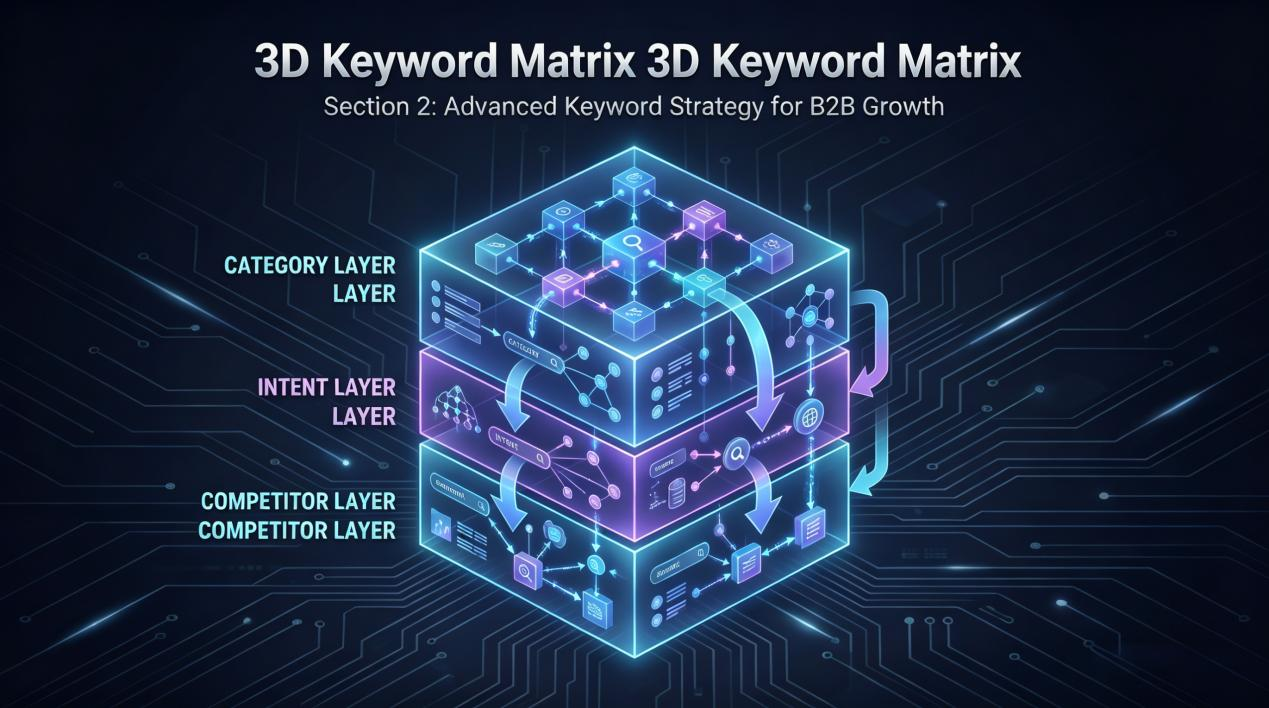
II. Three-Dimensional Content Matrix: Synergistic Deployment of Category Keywords, Informational Keywords, and Competitor Keywords
Xometry’s keyword strategy reflects a clear hierarchical structure, forming a three-dimensional synergistic layout of “category keywords, informational keywords, and competitor keywords.”Category keywords (e.g., “3D printing service”) directly link to service capability pages, capturing users with high purchase intent; informational keywords (e.g., “how to design parts for CNC machining”) are covered through the Content Hub (Resources), attracting potential customers in the research phase; competitor keywords (e.g., “Protolabs,” “SendCutSend”) intercept traffic from competitor brands via comparison pages, generating approximately 4,660 valid visits per month.
The core of this strategy lies in the precise alignment of content with user intent: informational content satisfies knowledge-seeking needs and builds professional trust; category-specific content captures transactional intent and drives conversions; and competitor-related content leverages established market awareness to efficiently divert traffic from competitors.In terms of content architecture, Xometry has established the industry’s most comprehensive manufacturing knowledge base. Under /resources/, there are more than 15 content categories covering design guides, industry applications, case studies, and supplier tips, with high-value long-tail informational keywords continuously attracting target engineers and procurement decision-makers.
From a technical implementation perspective, Xometry has created dedicated Capability Pages for each manufacturing process. These pages comprehensively cover process descriptions, material lists, surface treatment options, and instant quote CTAs. Each material (e.g., aluminum alloy, stainless steel) features its own H3 anchor. This fine-grained content structure enables the platform to target a vast number of long-tail keywords, forming a “massive army of ants”-style traffic matrix.While analyzing the content strategies of numerous companies, the Longfu technical team discovered a significant positive correlation between content depth and search visibility—achieving the industry’s deepest content coverage in each business domain is the key to success for content-driven enterprises, and this requires a well-designed CMS architecture that can support large-scale content creation and management.
III. User Experience and Technical Architecture: The Product Logic Behind Deep Engagement
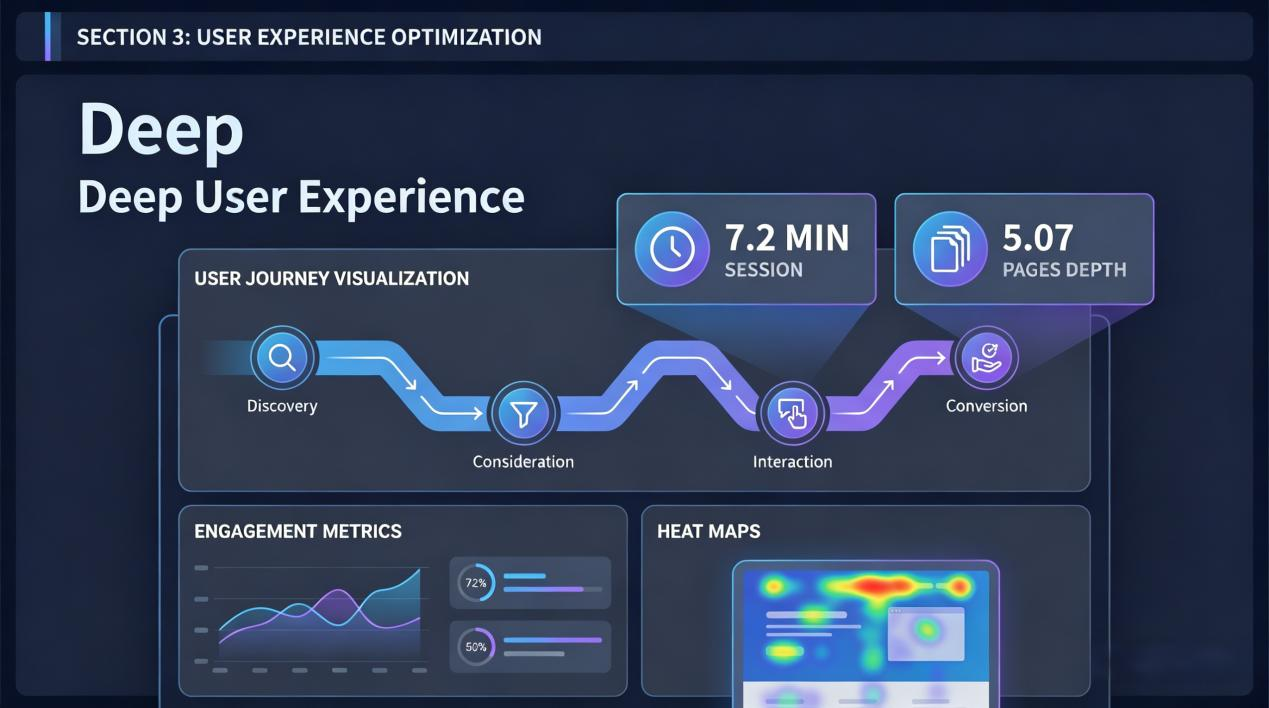
Beyond traffic acquisition, user engagement is a key metric for measuring the success of a content strategy. Data shows that Xometry users spend an average of 7.2 minutes on the site, with an average page depth of 5.07 pages (far exceeding the industry average of 2 to 3 pages), and a bounce rate kept at 42%. These figures indicate that Xometry’s content not only attracts users to the site but also keeps them engaged in deeper exploration, creating a positive content consumption experience.
From a product design perspective, a successful content strategy relies on the following key elements: a seamless integration of instant quoting capabilities with in-depth content reading, allowing engineers to obtain a quote immediately after accessing technical information, thereby significantly shortening the decision-making path; cross-linking between content and service pages, enabling users to flow naturally between information acquisition and transaction conversion; and diverse content formats (eBooks, case studies, webinar recordings) to cater to different users’ learning preferences.In serving Fortune 500 clients, Longfu has discovered that the deep integration of content and commercial capabilities is a common characteristic of leading companies’ content strategies—users enter through informational content and ultimately land on service pages where they can obtain quotes on the spot, with a very clear path design throughout.
At the technical architecture level, Xometry employs a cloud-native microservices architecture that supports containerized deployment and sub-second scaling, enabling it to meet the elastic demands of traffic spikes (such as the 1.04 million visits during the January peak).Traffic trends over the past three months show: a peak of 1.04 million in January, a seasonal decline to 880,000 in February, and a rebound to 1 million in March—representing normal seasonal fluctuations and overall stability. Dynamic load balancing and edge acceleration capabilities ensure fast page loading speeds under high traffic, preventing user churn caused by access delays.
For enterprises, building a content experience platform requires consideration of several core dimensions: content production efficiency (the ability to rapidly produce high-quality content), content distribution capabilities (the ability to achieve unified management across multiple channels), content performance (the ability to guarantee a consistent user experience globally), and content conversion effectiveness (the ability to effectively convert traffic into leads). Together, these requirements define the core functional scope of a modern Digital Experience Platform (DXP), which has emerged as the preferred alternative to traditional CMS solutions and legacy platforms like Adobe Experience Manager, Sitecore, and WordPress.
IV. From Content Management to Business Growth: BMS DXP’s End-to-End Solution
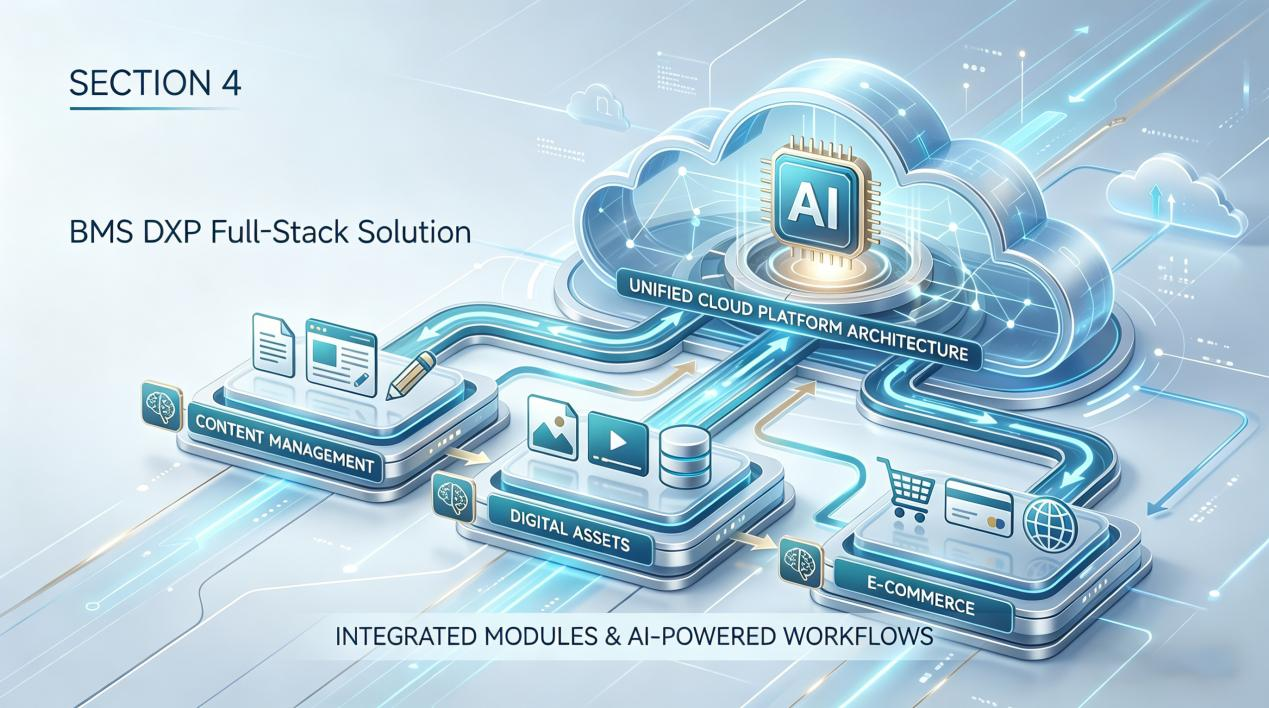
When enterprises need to build a robust content distribution infrastructure, BMS digital experience platform offers a comprehensive solution. As one of the leading Adobe Experience Manager alternatives, AEM alternatives, Sitecore alternatives, and WordPress alternatives in the market, BMS DXP helps enterprises achieve end-to-end digital management spanning content production, channel distribution, and conversion through the synergistic operation of three core modules—Content Experience Management, Digital Asset Management, and E-commerce Engine.
Content Experience : BMS DXP adopts a cloud-native, containerized architecture and supports SSR/SSG server-side rendering technologies to ensure excellent content visibility in search engines. The platform features built-in AI-driven SEO/GEO optimization capabilities, enabling AI content management, intelligent writing optimization, one-click multilingual translation, and automated Schema injection, thereby ensuring search-engine-friendly content from a technical perspective.Multi-site and multilingual management capabilities support the unified operational needs of global enterprises, while nested Live Copy technology ensures efficient content synchronization and reuse.
Digital Asset Management: BMS DXP addresses the need for centralized, real-time, and borderless enterprise asset management. As an advanced AI DAM and AI asset management solution, it supports unified storage and management of assets across major cloud platforms such as Alibaba Cloud, Tencent Cloud, AWS, and Azure through multi-cloud integration capabilities. AI-integrated intelligent features—including AI image editing, video generation, prompt-driven redrawing, AI compliance checks, and image search—significantly enhance content production efficiency.It supports multimodal search capabilities—including full-text search, tag search, semantic search, and OCR recognition—to resolve retrieval challenges caused by scattered assets.
E-commerce : BMS DXP provides an integrated e-commerce solution that consolidates product management, order and inventory tracking, customer reviews, smart promotions, international payments, and logistics. Seamless integration with leading e-commerce platforms (Shopify, BigCommerce) enables enterprises to synchronize the management of cross-cloud assets with their e-commerce platforms.Its modular architecture allows businesses to flexibly select feature combinations based on actual business needs. Validated by extensive implementation across numerous Fortune 500 companies, BMS DXP demonstrates robust enterprise-grade service capabilities.
V. Comprehensive Value Comparison: Why is BMS DXP the Optimal Solution for Enterprises?
| Comparison Dimensions | BMS DXP Digital Experience Platform | Traditional CMS Solutions |
| Architectural Design | Cloud-native microservices, supporting container-based scaling within seconds and dynamic adaptation to business workloads | Primarily monolithic CMS architecture, limited scalability, and high scaling costs |
| AI Integration Capabilities | Native, deep integration enabling AI content management, multilingual translation, and simultaneous SEO optimization | No AI capabilities or reliance on third-party plugin integrations, resulting in poor stability |
| Content distribution efficiency | Unified management across multiple sites, supports one-click multilingual synchronization, and includes pre-built e-commerce connectors | Requires separate deployment for each site, making content synchronization difficult |
| Digital Asset Management | Multi-cloud integration + AI DAM powered search + integrated online editing | Standalone asset management systems, high integration costs, and severe data silos |
| Total Cost of Ownership | Modular pricing with flexible configuration options; cost-effective domestic alternatives to Adobe Experience Manager, Sitecore, and WordPress | Low initial costs, but cumulative expenses for plugin maintenance and security protection |
FAQ
Q1: How does content distribution infrastructure differ from traditional CMS? Why should enterprises pay attention to this concept?
A: Traditional CMS primarily focuses on content creation and storage, while content distribution infrastructure emphasizes full lifecycle management and multi-channel distribution capabilities. Content distribution infrastructure must support three core capabilities: first, large-scale content production (how to efficiently produce high-quality content); second, precise content distribution (how to achieve unified management across multiple channels); and third, content conversion (how to convert traffic into commercial value).BMS DXP not only provides basic functions such as visual content editing and unified multi-site management, but also emphasizes content SEO optimization, multilingual adaptation, omnichannel marketing synchronized distribution, and deep integration with business systems, helping enterprises build a sustainable content asset system.
Q2: Do small and medium-sized enterprises (SMEs) need to build a content distribution infrastructure? How should the return on investment be evaluated?
A: Regardless of company size, a content distribution infrastructure is a fundamental capability for digital marketing. For SMEs, BMS DXP’s modular architecture and flexible pricing plans enable businesses to launch digital content operations with a low initial investment and gradually expand functional modules as their business grows. As an affordable alternative to expensive enterprise platforms like Adobe Experience Manager and Sitecore, BMS DXP offers SMEs access to enterprise-grade capabilities without the prohibitive costs.The return on investment can be evaluated across multiple dimensions: traffic growth (increase in organic search traffic driven by optimized SEO strategies), user engagement (average session duration, changes in page depth), conversion efficiency (conversion rate from content to leads), and operational efficiency (improvements in content production and distribution).
Q3: How does Longfu BMS DXP support enterprises’ global expansion and multilingual content management?
A: The platform features built-in multilingual management capabilities and supports one-click multilingual translation via AI translation interfaces, enabling efficient management of content operations across multiple countries and regions. Nested Live Copy technology ensures efficient content synchronization and reuse; when headquarters updates core content, regional sites are automatically synchronized. Multi-cloud integration capabilities support global deployment, ensuring consistent access performance and user experience across all regions.BMS DXP has proven its global content management capabilities in multiple multinational enterprise projects, including a unified multi-region management solution for the Ford & Lincoln China official websites.
Q4: How does the content delivery infrastructure integrate with existing business systems (such as CRM and e-commerce platforms)?
A: BMS DXP provides standardized API interfaces and pre-built connectors to support rapid integration with mainstream business systems such as CRM (e.g., Salesforce), ERP, and e-commerce platforms. Seamless integration with leading e-commerce platforms like Shopify and BigCommerce enables enterprises to achieve synchronized management of cross-cloud assets and e-commerce platforms.The Open API Factory provides flexible interfaces, enabling quick and convenient third-party integrations and supporting business expansion. This open design ensures that enterprises can gradually build a unified content distribution infrastructure without disrupting their existing IT architecture.
Q5: When migrating from an existing CMS to BMS DXP, how can we ensure the integrity of historical data and a smooth business transition?
A: Based on practical experience migrating over 500 enterprises, Longfu has established a standardized, seamless migration process. Lossless Data Conversion: Our proprietary Content Transformer tool converts data from mainstream CMS formats into BMS DXP’s structured JSON format, supporting the migration of all data—including articles, images, users, and orders—with 99.99% accuracy.End-to-End Data Validation: We perform data backups and integrity checks before migration, conduct line-by-line validation during migration, and execute a full data comparison after migration to ensure no data loss or tampering. Staged Rollout Mechanism: We adopt a “dual-system parallel operation – staged traffic migration – full switchover” model. For medium-sized enterprises, the migration cycle can be kept within 4 to 6 weeks, with business downtime not exceeding 4 hours.


Want to know more about our products?
With years serving Fortune 500 clients, we offer flexible solutions and integrated implementation.
