





Who Maintains Your Runtime: The Gap Period of PHP, Java, and Other Tech Stacks
Published: 2026-11-16
Author: William
Starting from a Distribution Few People Notice
W3Techs’ statistics for October 26, 2026 give the following figures: PHP is used by 69.2% of “known server-side programming language” websites, JavaScript 8.2%, Ruby 7.1%, Java 5.5%, Scala 5.0%, ASP.NET 4.2%, pure static files 2.1%, Python 1.1%, ColdFusion 0.2%, Perl 0.1%. Go, C++, Haskell, and Erlang are all below 0.1%. The 69.2% is usually read as “PHP is still mainstream.” Another table from W3Techs on the same day shows what that reading misses. It computes a top-site score for each technology, measuring how much more heavily that technology is used among the 1,000 highest-traffic sites than across all sites. Only three server-side languages score above zero: Basic 57.8, C++ 9.6, Tcl 4.1. PHP, Java, JavaScript, Ruby, Python, and ASP.NET are all absent. That means the share of these languages is concentrated in the long tail, not at the top. Behind PHP’s 69.2% sits a large number of sites built cheaply, with nobody tracking the runtime after acceptance. C++’s 9.6 points the other way: the highest-traffic sites are more likely to run infrastructure they built themselves. China took a different route. JetBrains’ 2025 Developer Ecosystem Survey, published on January 18, 2026, shows in its China findings that 58.17% of Chinese developers name Java as their primary language, against a global average of 27.76%. Java accounts for only 5.5% of website statistics and 58.17% of developer statistics, and both numbers are right, because they measure different things: one counts sites that publish web pages, the other counts people who write code inside companies. The systems between those two figures are exactly the part of most enterprises that is most valuable and least examined. They do not serve pages to the public, but they carry transactions, ledgers, customer data, and business processes. This article is about something else. Every stack above, Java included, will reach the day when upstream stops shipping security updates, and the system will not go offline that same day. In between, someone has to be responsible. Who that is depends on the original contract and on the organization as it stands today, and very little on which language was chosen.
How PHP’s Installed Base Came to Be
W3Techs does not publish technology distribution by country, so the impression that “Western countries have more PHP sites” cannot be verified with data. What follows describes the mechanism of formation, not a statistical conclusion. PHP was written by Rasmus Lerdorf in 1994, initially as a set of CGI programs in C used to count visits to his own online résumé; it was released publicly on June 8, 1995, according to the official php.net manual. It later became part of the LAMP stack, and because Apache loads the PHP interpreter as a module, several virtual hosts on one server can share a single runtime. For a hoster, the marginal cost of adding one more dynamic site was therefore very low. Control panels and one-click installers pushed that cost lower still: Softaculous states on its own site that it is integrated into cPanel and offers one-click installation of 380 applications. The scale of content publishing demand is the second reason. WordPress is used by 39.6% of all websites, and by 58.3% of sites with an identifiable content management system (W3Techs, October 26, 2026). WordPress is a PHP application, and it is the single largest source inside PHP’s 69.2%. Among the notable sites W3Techs lists on its PHP page are WordPress.org and Wikipedia.org. Third is the stickiness of the installed base itself. The English-language internet started earlier and has a larger base of sites, and replacing a content site means rebuilding content assets and migrating URLs and search-engine authority—costs far higher than the original build. So the installed base does not move on its own, even when the runtime underneath no longer receives security updates. Put the three together and the conclusion is not that “the West chose PHP,” but that hosting business models and content publishing demand accumulated, over thirty years, a body of sites that will not move by itself.

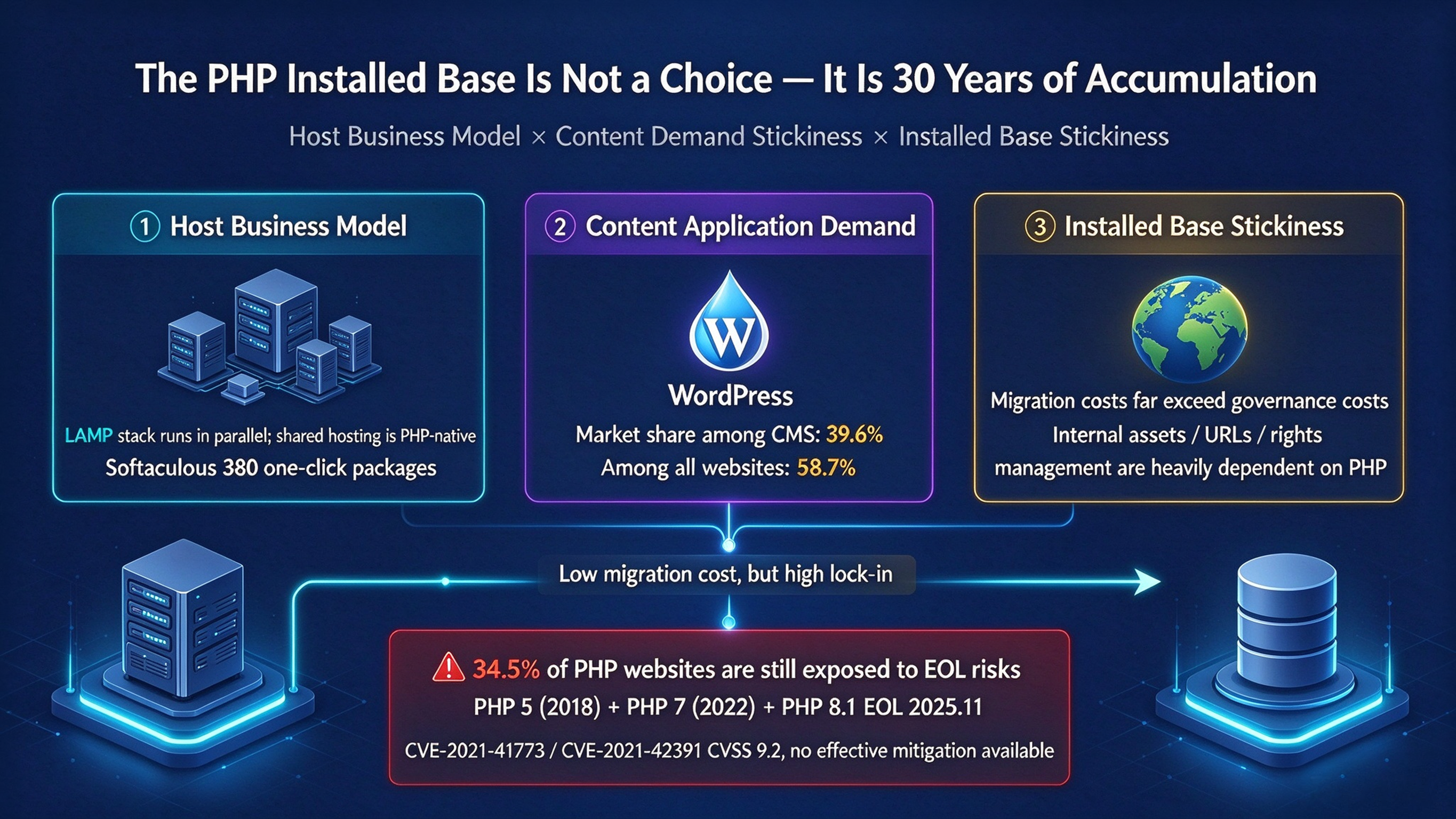
(The image illustrates how PHP’s installed base was formed)
Why Enterprise Systems in China Settle on Java
The same JetBrains survey gives direct evidence: about 27.76% of professional developers worldwide use Java as their main language, in a three-way split with JavaScript and Python; in China, Java is the first choice for 58.17% of developers, leading by a wide margin. Joseph Du, a customer success engineer at JetBrains, offers four explanations: the explosive growth of China’s internet industry and the stack it settled on; startups in the e-commerce, fintech, and social media waves that adopted Java early and built high-concurrency distributed systems on mature frameworks such as Spring and Apache Dubbo; a resulting virtuous circle in the ecosystem, where enterprises choose Java because the talent pool is deep and developers learn Java because the jobs are plentiful; and Android, which mattered too—before Kotlin became the preferred language, the sheer spread of Android phones in China established Java as the main language for mobile development. The same survey’s structural data adds a second layer. Chinese respondents are more likely than the global average to work at startups (24%) and at large listed companies (24%), against 16% for both worldwide; only 22% of Chinese developers work at private companies, against 32% globally; only 10% are employed by multinationals, against 19%. On business orientation, China is 39% B2B and 28% B2C, against 58% B2B and 35% B2C worldwide. Chinese developers are concentrated in scaled domestic enterprises, and the core systems of such enterprises mostly do not serve web pages to the public, so they never appear in website statistics. Policy has reinforced that distribution. The IT application innovation substitution programme targets the layer of chips, operating systems, databases, and middleware, and the enterprise applications sitting on top of that layer are largely hosted in Java. Research compiled by BOC International puts the first phase of financial-sector pilots at August 2020, covering 47 institutions, mainly leading banks, insurers, brokerages, regulators, and exchanges; the second phase began in May 2021, covering 198 institutions and requiring full replacement of OA and email systems. The JVM’s cross-platform nature means that when the underlying chip and operating system change, application code usually does not have to be rewritten—a frequently cited reason why Java was largely retained through this round of substitution. That point is an inference, not a statistical finding. One contrary fact needs adding here. China’s outward-facing websites have not left PHP. The 57th China Internet Development Statistical Report from CNNIC puts the domain count at 32.3 million as of December 2025, including 20.768 million “.CN” national top-level domains, 26,105 “.GOV.CN” domains, and 11,773 “.EDU.CN” domains. Within a population that size, content-publishing sites are a large share. “Chinese enterprises use Java” describes internal business systems; “Chinese websites use PHP” describes outward-facing sites. Both are true at once.
PHP’s Share of the Low-Cost Website Market
No authority has published a technology-stack breakdown by website price tier, so this section can only triangulate with proxy indicators. Relative density between head and tail is the first, and it has already been described: PHP is absent from the positive top-site list, and its density is higher in the tail. The second is PHP’s overlap with WordPress. WordPress is 39.6% of all websites and 58.3% of identifiable CMS sites; it is a PHP application, and the main deliverable of the low-cost market is exactly that kind of templated corporate or content site. The third indicator is the most telling: version structure. On W3Techs data for October 26, 2026, among sites using PHP, version 8 accounts for 65.5%, version 7 for 26.7%, version 5 for 7.7%, and version 4 for 0.1%. The PHP 5 and PHP 7 lines have both ended official security support, in late 2018 and November 2022 respectively. Together, 34.5% of PHP sites run on branches that no longer receive official security updates. That 34.5% acquired concrete consequences on October 21, 2026. The PHP project released an emergency security update that day fixing two unauthenticated remote code execution vulnerabilities rated 9.2 under CVSS v4.0 (CVE-2026-109618 and CVE-2026-109619), with fixes in 8.5.12, 8.4.27, 8.3.36, and 8.2.35, and minimal source-only backports for 7.4, 8.0, and 8.1. But users on those branches cannot get the update from php.net directly; they have to wait for a distribution or hosting provider to package and ship it, and for the older versions there is no path at all. One more data source looks usable but does not hold up. W3Techs’ panel statistics for the same day show that 91.8% of websites were not identified as using any monitored control panel; within the 8.2% that could be identified, hPanel holds 54.2% of the market, Plesk 41.4%, and cPanel 1.8%. hPanel is the in-house panel of Hostinger, a low-cost shared host, and its share of more than half the identifiable sample looks like a directional signal. But the sample covers only 8.2% of all websites, and W3Techs does not monitor BT Panel at all, so the identification rate is too low to carry a quantitative conclusion, and it is not used here. The inference is this: stratify by who maintains the site rather than by which language it uses, and PHP’s installed base turns out to be heavily concentrated in sites with no dedicated operations staff, paid for once at build time, with nobody tracking the runtime afterwards. The evidence is the version structure, and the state of plugin maintenance discussed in the next section.
The WordPress Record, and Why Chinese Web Builders Still Choose It
Patchstack’s State of WordPress Security in 2026 reports 11,334 new vulnerabilities in the WordPress ecosystem in 2025, up 42% from 7,966 in 2024; 91% of them in plugins, 9% in themes, and under 0.1% in core; 46% still unpatched when publicly disclosed; 17% rated high priority for likely mass exploitation; for widely watched vulnerabilities, a median of five hours from disclosure to mass exploitation; cross-site scripting the most common type at 40.68%, followed by broken access control; and highly exploitable vulnerabilities up 113% year over year in 2025. What a compromise leaves behind: Sucuri’s figures, cited second-hand through Hostinger in 2026, show 72.7% of infected WordPress sites carrying active malware, 69.6% with unauthorized backdoors, 46.7% with injected SEO spam, and 8.1% hosting phishing pages. One distinction has to be made here. Another widely repeated number says “WordPress accounts for 95.5% of the infected sites Sucuri cleans.” That describes the mix of Sucuri’s cleanup business, and WordPress is by nature the largest category among sites that hire a cleanup service. It does not mean any given WordPress site has a 95.5% chance of being compromised. Confusing the two is the most common misreading in this field. The actual state of dependency maintenance says more. Two independent censuses of the WordPress.org plugin directory, both in August 2026, reached similar results: the directory lists roughly 69,000 to 71,000 plugins, of which about 43% to 52% have not been updated in at least two years; another count finds that more than 53,000 plugin identifiers that once existed have been removed from the directory. In the real dependency set of a WordPress site, a substantial share of components has nobody responsible for it. The attack technique is moving too. A 2026 joint report from Patchstack and Monarx notes that attackers have begun injecting code directly into legitimate core, plugin, and theme files instead of dropping separate suspicious files, which a traditional scan-and-delete is liable to miss. So why do Chinese web builders still choose it? Four verifiable reasons. Licensing cost is the direct push. On September 26, 2021, DedeCMS published a notice reminding users to obtain commercial licences, stating that every site other than a personal non-profit one needs a licence at RMB 5,800, with a deadline of 24:00 on October 25, 2021; a month later it issued a second notice handing enforcement to a rights-protection team. “Migrating DedeCMS to WordPress” then became routine in the web-building trade, and public migration tutorials are plentiful. WordPress is GPL, with no licence fee for commercial use. Delivery speed is the second. Plugins and themes let a team that writes no code ship a corporate site with an admin panel, SEO settings, and forms within days, which matches a business model of billing per project and closing at acceptance. Third is the supply of people. WordPress skills are common, training is cheap, and vacancies are easy to fill when staff move on. Fourth, the client can maintain the site afterwards. Being able to change copy and swap images themselves is a selling point written into contracts. None of these four covers who is responsible once upstream stops maintaining the software. WordPress core vulnerabilities are handled by the WordPress security team, and in 2025 core was under 0.1% of the ecosystem total; plugins and themes belong to their individual developers, and about half of those have gone two years without an update; the PHP runtime underneath belongs to the PHP project and the Linux distributions. The site owner appears nowhere on that list. This is a structural hole in the allocation of responsibility, not a failure by any one party.
Other Stacks: How Long Is the Gap, and Who Fills It
PHP gets the most discussion because it has the largest share, sits on the public internet, and large numbers of its sites have no maintainer. But the gap period is not unique to PHP. Set the official support policies of the major stacks side by side and the differences lie in window length, dependency depth, and whether anyone is responsible—not in the language. Ruby ranks third among server-side languages at 7.1%, mostly from the Shopify ecosystem; Shopify itself is 5.3% of all websites and 7.9% of the CMS market. Rails’ maintenance policy, published on October 15, 2024, gives each minor version one year of bug fixes, then one year of security fixes, and then end of life. On that schedule, an official announcement on October 29, 2025 stated plainly that Rails 7.0 and 7.1 would receive no further security or bug fixes, and strongly advised teams still on them to upgrade to a supported version. The same announcement extended Rails 8.0 by six months, with security support through November 2026. That works out to a security window of about two years, slightly shorter than the normal support cycle of a single PHP branch. Python is only 1.1% of server-side websites, which tells you its main use is not public sites. Its policy is nevertheless the most generous of the group: PEP 602 sets an annual release cadence with five years of security support per feature release, and 3.14, released on October 7, 2025, is supported through October 31, 2030. Python 2.7 reached end of life on January 1, 2020, with all official updates stopped, and that migration took nearly a decade. Django designates every fourth release as LTS with three years of security updates, and non-LTS releases get about sixteen months. 4.2 LTS ended support on April 7, 2026, and 5.2 LTS runs to April 2028. The project has announced an annual cadence from Django 2028, under which every feature release gets three years, with 6.2 the last release under the old policy. The windows are getting longer, which is good for users. JavaScript on the server is 8.2%, second place, and Node.js is its main form. Node.js policy is six months in Current for each major, then twelve months of Active LTS and eighteen months of Maintenance for even-numbered versions—thirty months of LTS coverage, about three years from first release to EOL; odd-numbered versions stop after six months in Current. That window is not short. For the Node stack the gap period sits less in the runtime than in the dependency tree. Sonatype’s 2026 State of the Software Supply Chain reports more than 454,000 new malicious packages found in 2025, up 75% year over year, and 1,233,219 blocked since 2019, with over 99% of open source malware concentrated in npm. Downloads across Maven Central, PyPI, npm, and NuGet reached 9.8 trillion over the same period, up 67%. Part of that concentration is simply npm having the most packages and the most installs. A Node project’s dependency tree often runs to hundreds or thousands of packages, and poisoning any one of them propagates downward. Go is under 0.1% of server-side languages. Its policy is the shortest here: each major is supported until two newer majors have shipped, and with two majors a year the real window is about one year. But Go compiles to a static binary, decoupling the runtime from system libraries, which materially reduces exposure at the runtime layer. A short window does not mean high risk; it depends on how the software is deployed. ASP.NET is 4.2%, and Microsoft runs two lifecycles side by side. .NET Framework 4.8 follows the lifecycle of the Windows version it runs on, and Framework 3.5 is supported to January 9, 2029; modern .NET moves on a three-year LTS cycle, and .NET 8 LTS support ends on November 10, 2026. The first is long but ships security patches only; the second requires you to upgrade on your own schedule. Which one you run decides whether your upgrade rhythm follows the operating system or a calendar you set. There is also the purely static site. W3Techs lists static files separately at 2.1%. With no server-side runtime the attack surface is much smaller, at the cost of content updates depending on a build pipeline and dynamic features needing external services. Java’s own gap period needs separate treatment, because many enterprises treat “we chose Java” as the safe answer. Log4Shell (CVE-2021-44228) is the best counterexample. Tenable published a press release on November 30, 2022 setting out telemetry research across more than 500 million tests: as of October 1, 2022, 72% of organizations were still exposed to Log4Shell; 28% had fully remediated, an improvement of 14 percentage points since May 2022; 53% had been exposed to Log4j at some point during the study; exposure fell from one asset in ten in December 2021 to 2.5% by October 2022, and of that 2.5%, 29% had been fully fixed and then regressed. Bob Huber, Tenable’s chief security officer, put it in his own words: remediation is not a one-and-done exercise, and organizations keep meeting Log4Shell again as they add assets. A report by CISA and the U.S. Cyber Safety Review Board found that the security team of one federal cabinet department alone spent 33,000 hours responding to Log4j. By industry, full remediation rates ran at 45% for engineering, 38% for legal services, 35% for financial services, 33% for non-profits, 30% for government, and about 28% for the critical infrastructure organizations CISA defines. The Java ecosystem’s gap period is harder to close than PHP’s, and the reason is not the language but the dependency structure. A logging library like Log4j is wrapped in several layers of dependency, and many teams do not know they use it; assets added after a cleanup bring it back. Framework support windows end too: Spring Framework’s wiki states that open source support for 5.3.x ended in August 2024 and for 6.2.x ends in June 2026, with 7.0.x, released in November 2025, the current production line and 7.1.x due in November 2026. Third-party EOL trackers put those two dates at June 30, 2026 and July 31, 2027, which is consistent. For branches past open source support the project leaves one line: commercial long-term support options remain available. That sentence concedes the existence of a gap period and hands responsibility for filling it to the market. So the conclusion of this section is that the gap period is common to every stack. The differences are how long the window is, how deep the dependency tree runs, whether problems come back after a fix, and whether anyone is still responsible once the window closes. PHP’s problem stands out because its share is largest, it sits on the public internet, and a great many of its sites have no owner at all. But swapping PHP for Java or Node does not make the problem disappear; it only changes its shape.

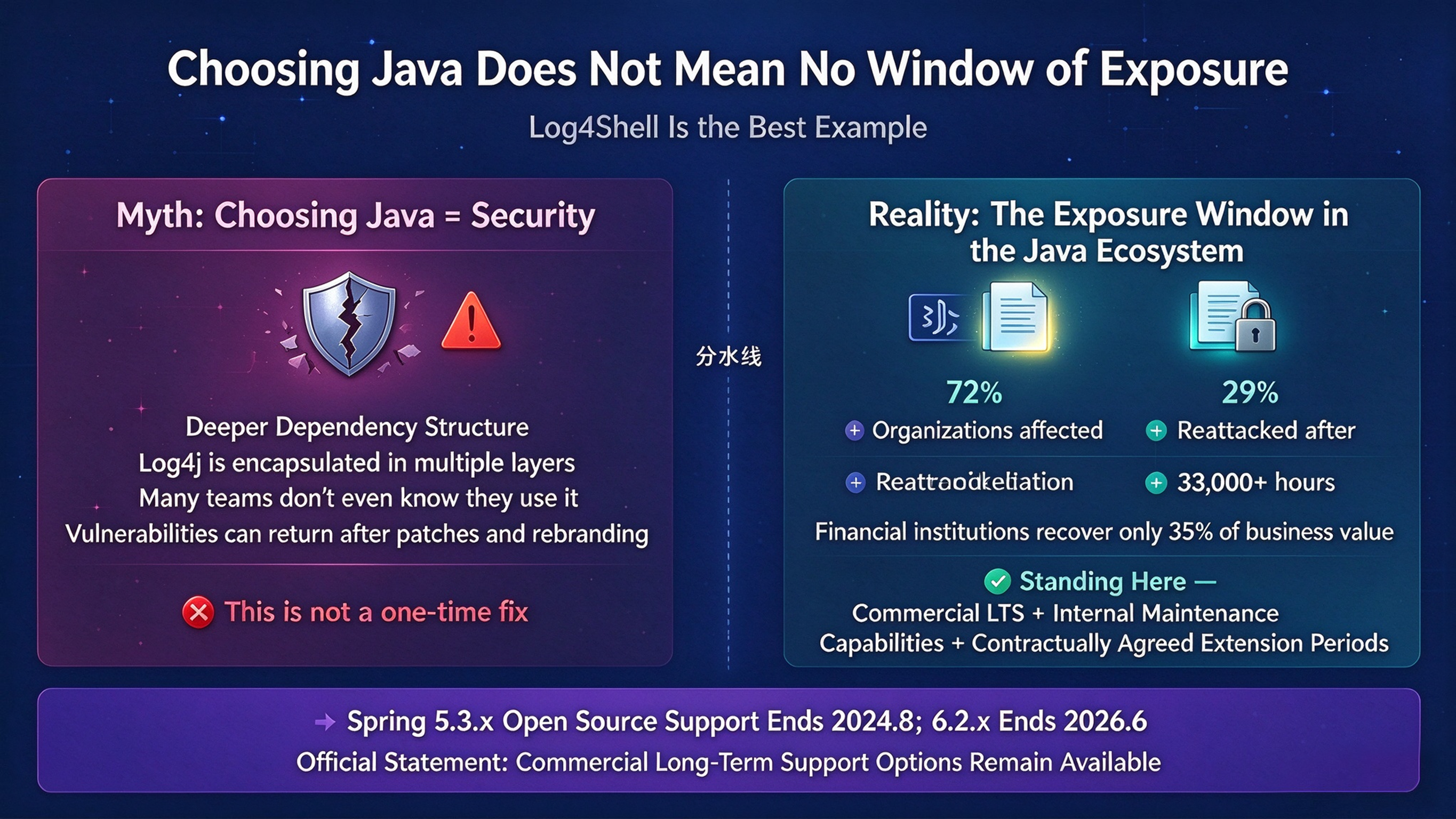
(The image illustrates the gap period in the Java ecosystem)
What Leading Sites and Multinationals Run
The verifiability of what follows varies a great deal, so it comes in three tiers. The first is official or primary sources. Shopify’s engineering team has said publicly that the company is built on Ruby on Rails, with more than 2.8 million lines of Ruby, the longest-lived and largest Rails codebase anywhere, carrying its core monolith, and that it runs dedicated Ruby and Rails infrastructure teams. Meta announced Hack in an engineering blog post on March 20, 2014—a PHP dialect running on its own HHVM—and said that engineers there had voluntarily converted most of their own code. Wikimedia Foundation’s documentation records that it has run MediaWiki in production on HHVM since 2014, MediaWiki itself being a PHP application, and that PHP 7 was offered as a Beta Feature from January to May 2019. The second tier is consistent across several sources but missing primary documentation. Etsy runs production on PHP; its engineers evaluated HHVM and stayed on PHP; on the record of its public filings, 2024 revenue was about $2.6 billion. The third tier circulates only in social posts and second-hand articles, often contradicting itself. Airbnb runs Ruby on Rails as its main application framework, with Java for performance-critical parts; Uber leans on Go and Java; Amazon started with Java and uses Go heavily; Google is largely C++, Java, and Go; Netflix is described sometimes as Node.js and sometimes as Spring Boot. This article does not assert the third tier as fact, and readers who want to cite it should verify it themselves. More reliable than a company-by-company list is the structural signal: C++ scores 9.6 on the top-site measure, meaning it is used among the 1,000 highest-traffic sites 9.6 times as heavily as across all sites. C++ landing in that position points to self-built infrastructure and performance first. These companies run very different stacks—Ruby, PHP, Java, Go, C++—and share one thing: each can maintain its own stack. Meta wrote HHVM for it; Shopify keeps a Ruby infrastructure team and contributes back to the Ruby language itself; Wikimedia and Etsy can switch runtimes in production and absorb the regression testing themselves. In such hands, choosing a stack is an executable engineering decision, because whatever they choose, someone owns the part that breaks. The low-cost web-building scenario is the exact opposite. The site owner cannot read PHP source and cannot regression-test a plugin, and no party to the contract has promised to do either.
We Take On This Stretch Ourselves
Having written this far, let me say where we stand. We are inside the same problem, not standing outside it handing out advice. We were founded in 2008, and our product is BMS DXP (Digital Experience Platform). Its backend is Java 21 and Spring Boot, its frontend Vue3 and Nuxt, with an additional middleware layer. It does not run PHP, so the PHP core vulnerability disclosed on October 21, 2026 is outside its exposure. But as the previous section said, choosing Java does not mean there is no gap period; Log4Shell is the Java ecosystem’s own example. So we do something else: for the open source components in these three layers, we maintain the security patches ourselves. The frontend, backend, and middleware layers each have internal maintenance capability, tracking security flaws and issuing fixes. That decision is not cheap. A team able to find the root cause of a framework vulnerability and maintain a multi-version regression matrix is a permanent fixed cost, and customers cannot see it at purchase: it is rarely a separate line item and hard to isolate in a product comparison. Skip it and your own product sits exposed to the gap period; pay for it and the spending is hard to prove to customers. Our answer is to offer that internal capability to outside customers too, so that it can pay for itself—our commercial open source support service. It targets frameworks whose official support has ended, tracking CVE intelligence, assessing impact, and shipping security patches. The gap period described in the previous section is precisely its business: the Spring Framework wiki states that open source support for 5.3.x ended in August 2024 and for 6.2.x ends in June 2026, and many enterprise systems still run on those branches and cannot reach 7.x in the short term. Our published initial coverage is Spring Framework 5.3.x through 6.x and Spring Boot 2.7.x and 3.5.x, which covers exactly that stretch. Component lists for the frontend and middleware layers are provided per project during commercial discussions, including framework names, version ranges, and patch delivery records. The service covers round-the-clock vulnerability monitoring; patches that stay API-compatible with the original version, so clients can swap them without touching application code; regression matrices across versions and JDK environments; long-term support commitments for contracted clients; and, with each patch, fix notes, risk assessment, and a rollback plan. Three terms go into the contract: the time allowed from disclosure to patch delivery for high-risk vulnerabilities, the liability for late delivery, and who executes the rollback. The Content module supports multi-site, multi-language content publishing. The DAM module applies federated management and can connect to object storage already in use on Alibaba Cloud, Tencent Cloud, AWS, and Azure, without requiring existing assets to be migrated wholesale; for an enterprise that has built up years of assets and multi-language sites, that is the difference between a project of weeks and one of years. The platform also includes PIM, the ECO e-commerce engine, the Knowledge Center, and the Maestro agent, the last positioned as a domain orchestration layer rather than a general-purpose model foundation. Delivery comes as SaaS, dedicated cloud, or on-premises, and the on-premises option supports end-to-end encryption and network isolation to meet compliance requirements such as GDPR and ISO 27001. The lightweight SaaS edition is RMB 8,000 a year and the advanced edition RMB 18,000 a year, tax included, with VAT special invoices available. Members of our security team hold CISP (Certified Information Security Professional) and CISSP (Certified Information Systems Security Professional) credentials. One point of clarity: those are individual credentials, which is a different thing from organizational certification; certificate numbers, validity periods, and scopes are provided per project at procurement. And one thing must be said first. Changing platforms is not an emergency measure. It involves rebuilding content assets, migrating URLs and search engine authority, and reconfiguring multi-language sites—a matter of months. If your site is affected by this PHP vulnerability, the right move today is to patch it or close the public entry point, and then evaluate the long-term options.
Finally
Let us return to those two sets of numbers at the start. 69.2% against 5.5%: PHP’s share of websites is more than twelve times Java’s; and among Chinese developers, Java is the first choice for 58.17%, against a global average of 27.76%. Both are true, because they measure different objects. For the systems in between, the language is decided by teams and ecosystems, and the maintenance responsibility by contracts. For the outward-facing sites the situation is reversed: the language was decided thirty years ago by hosting business models, responsibility ended on the day of acceptance, and nobody has tracked the runtime version since. In 2025 the WordPress ecosystem added 11,334 vulnerabilities, 46% of them still unpatched when disclosed, with a median of five hours from a watched vulnerability to mass exploitation. The PHP project shipped fixes on October 21, 2026, and 34.5% of PHP sites run on branches that no longer receive official security updates. On the Java side, ten months after Log4Shell was disclosed, 72% of organizations were still exposed, and 29% of the assets that had been fixed relapsed. Rails’ security window is about two years, Node.js about three, Go about one, Python five, and .NET Framework follows Windows. The windows differ in length, but every one of them closes. Vulnerability intelligence is shrinking too. Since April 15, 2026, NIST has moved the National Vulnerability Database to risk-based prioritization, no longer fully analysing every CVE. The complete list a defender can get is getting shorter, while dependency trees get deeper. There is no single culprit behind any of this, and no ready-made solution. They all point at the same gap: every system needs a named party that stays responsible after upstream stops maintaining it. For the outward-facing part of an enterprise, who is tracking the runtime version now? Is the answer written in a contract, or does it live only in the memory of someone who has already left?


Want to know more about our products?
With years serving Fortune 500 clients, we offer flexible solutions and integrated implementation.
