





Compliance Chain for Lead Capture Forms
Published : 2026-11-12
Author: William
On September 1, 2025, the French data protection authority (CNIL) imposed a €150 million fine on SHEIN’s Irish entity (Decision No. SAN-2025-005). The fine was not for product quality or price display, but for cookies: advertising cookies were written the instant a visitor entered the site, before any interaction; neither tier of the notice stated the advertising purpose; the second “Settings” layer did not list the third parties that might write cookies; and after users clicked “Reject All,” new cookies were still being written and existing ones were still being read. CNIL also noted that the company had already amended its website during the investigation, so it issued no remediation order—but the fine stood.
On April 30 of the same year, the Irish Data Protection Commission (DPC) fined TikTok €530 million. The reason was again where the data goes: TikTok could not show that European user data accessed remotely by employees in China enjoyed protection essentially equivalent to that inside the EU (breaching Article 46(1) of the GDPR), nor did it clearly tell users where the data flowed (Article 13(1)(6)). It was also ordered to remedy the issue within six months or suspend the transfers.
Earlier, on January 20, 2022, the Munich Local Court issued a judgment of €100 (Case No. 3 O 17493/20): A website dynamically loaded Google Fonts, transmitting visitor IPs to servers in the United States. The court ruled that an IP address is personal data, and transferring it to the US did not meet the required level of protection, resulting in a €100 award and an injunction.
Three fines, three orders of magnitude apart in amount, resting on entirely different legal bases. Yet the point of failure is the same: at every step along the chain, data can be the subject of a separate violation.
This article takes the official website lead capture form as its entry point for two reasons. First, it is controlled directly by the enterprise, independent of platform rules or the compliance standards of channel partners. Second, it simultaneously carries marketing, sales, and legal objectives, making it the focal point where conflicting obligations converge most intensely.
Case sources include enforcement decisions and settlement agreements published by CNIL, DPC, the California Privacy Protection Agency (CPPA), and the California Attorney General’s Office; the aforementioned Munich Local Court judgment; and DLA Piper’s “GDPR Fines and Data Breach Investigations” (8th Edition, January 2026). Amounts are based on public announcements; some decisions remain under appeal, so actual payments may differ from announced figures.
I. Chain Deconstruction: Five Sets of Obligations Behind a Single Form
Technically, a lead capture form is not merely a page element, but a sequence of cross-system actions: upon landing, tags and cookies activate first; the form page loads third-party resources including fonts, CAPTCHAs, analytics, and A/B testing; the visitor fills out and submits the form; data lands on a specific server; it synchronizes into the Customer Relationship Management (CRM) system and marketing automation platform; partial data is returned to ad platforms for audience building; finally, long-term retention supports analysis.
At least five of these nodes trigger compliance issues independently, each falling under different legal frameworks.
First, terminal device writing. The basis is Article 5(3) of the e-Privacy Directive, transposed into national law—in France, Article 82 of the Data Protection Act. CNIL exposed the crux of this obligation in the SHEIN case: cookies fall outside the scope of the GDPR, so the one-stop-shop mechanism under Article 60 does not apply. The implication is blunt: a European headquarters in Dublin does not stop a French regulator from coming to the door.
Second, third-party resource loading. An IP address is personal data, as the Court of Justice of the EU confirmed in Case C-582/14 (Breyer). Loading fonts, scripts, or images from a server abroad is itself a cross-border transfer; without an adequacy decision under Article 45 or appropriate safeguards under Article 46, it is unlawful. This has nothing to do with whether the visitor fills in the form.
Third, outbound data transfer. The storage location determines the route: data stored and processed inside the EU is not a transfer. Remote access, maintenance, and analysis by teams outside the EU are treated as transfers in enforcement practice all the same—the TikTok case was fought precisely over remote access.
Fourth, commercial electronic communications. Article 13 of the e-Privacy Directive, implemented very differently from one member state to the next. Germany’s Act Against Unfair Competition (Section 7) requires prior consent, B2B included, with the burden of proof on the sender—which is why double opt-in has become the de facto standard. France allows outreach to business addresses on grounds of legitimate interest, provided the content is relevant and an opt-out is offered. The same email sent to Munich and to Dublin can be lawful in one and unlawful in the other.
Fifth, retention and re-use. US state comprehensive privacy laws. California requires Global Privacy Control (GPC) signals to be honored as valid opt-outs and enforced automatically; passing personal information to ad tech vendors for cross-context behavioral advertising generally amounts to “sharing” or even “selling.”
Five sets of obligations, four jurisdictions, three types of enforcement bodies. This is the starting point of the problem: most enterprises organize compliance according to jurisdictional divisions, while risks are distributed across processes, resulting in a misalignment between the two.
II. Enforcement Observations: Three Sets of Decisions Pointing to Specific Areas
(A) Interface Compliance · The SHEIN Case. All four findings sit in the interface and the implementation; not one of them is a legal opinion that was written wrongly. The most important is the fourth: after “Reject All” was clicked, cookies were still being written. The question is not whether a reject button exists, but whether the rejection state is enforced by the system.
CNIL cited two aggravating factors: repeated public penalties for similar issues since 2020, meaning the company should have been aware; and its large scale, with approximately 12 million monthly visitors in France. One mitigating factor: remediation had already begun during the investigation. Nevertheless, the fine remained at €150 million, tied with the €325 million penalty imposed on Google (for ad insertion in Gmail and cookie barriers during account creation) as the heaviest sanction levied by the authority during that period.
(B) Substantive Assessment · The TikTok Case. Unlawfulness turns not on how much was transferred, but on whether an assessment was ever done. The DPC’s finding was that TikTok had failed to verify, guarantee, and demonstrate that its safeguards were effective. The decision cites TikTok’s own assessment of Chinese law, in which several provisions were found by TikTok itself to diverge materially from EU standards. What the regulator reviews is not the conclusion but whether the process was completed and documented.
Another detail emerged late in the DPC investigation: it was discovered that a small amount of European user data actually resided on servers located in China, contradicting earlier evidence. Providing accurate information to regulators is itself an independent obligation under Article 31 of the GDPR.
(C) Technical Details · The Munich Fonts Case. €100 in damages, with after-effects far beyond the sum. After the judgment came a wave of demand letters across Germany, at €100 to €500 apiece; the detection method needs no technical skill at all—just look in the page source for a font served from abroad. In December 2022 the Berlin public prosecutor’s office reported that proceedings had been opened against a lawyer and a client over at least 2,418 suspected counts of attempted fraud and attempted extortion, with some 2,000 people having paid €170 as a “settlement.”
The evaluation must be two-fold: the legal assessment in the judgment is correct—transmitting an IP address to a server in a third country without consent constitutes an infringement; however, the mass-claim model has crossed the line. Companies receiving such letters should first conduct a legal assessment rather than paying directly.
(D) Structural Changes. According to DLA Piper’s eighth edition, GDPR fines in Europe totaled roughly €1.2 billion in 2025, flat against 2024. The total set no new record; the structure is shifting. Supply chain security and processor liability have become enforcement priorities, and processors are now being fined directly. The signal is clear—fines used to land on platform giants, and attention is moving further down the chain, putting marketing service providers, website contractors, and data suppliers all within range.
III. Cognitive Mismatch: Four Assumptions and Their Limitations
Assumption One: If there is no entity established in the EU, they cannot be reached.
Article 3(2) of the GDPR establishes the effectiveness principle: providing goods or services to persons in the EU, or monitoring their behavior, subjects an organization to jurisdiction regardless of whether an entity is established. Using local languages and currency on the official website, running local advertisements, and accepting local orders are all considered “targeting” evidence in the eyes of regulators.
Furthermore, establishing an entity does not guarantee protection. The SHEIN case has already demonstrated that the one-stop-shop mechanism does not apply to cookies. A headquarters located in Dublin may be relevant under the GDPR but is largely irrelevant for electronic privacy matters—these are based on two separate legal foundations.
Assumption Two: If the data volume does not reach the threshold, there is no obligation.
The idea comes from Chinese law. The Provisions on Promoting and Regulating Cross-Border Data Flows (in force since March 22, 2024) do grade obligations by volume: under 100,000 individuals, no filing is required; between 100,000 and 1 million, a standard contract or certification; above 1 million, a security assessment.
However, this rule governs outbound procedures within China and cannot provide exemption from liability in other jurisdictions. The GDPR has no quantitative threshold: a single visitor from Germany filling out a form constitutes a cross-border transfer, requiring a basis under Articles 45, 46, or 49. The legal nature is identical whether involving one person or one million people.
Other markets do not offer exemptions based on “small volume”: India’s Digital Personal Data Protection Act sets a maximum penalty of 2.5 billion rupees per incident; Saudi Arabia’s Personal Data Protection Act caps fines at 5 million riyals with doubled penalties for repeat offenders; and Brazil’s General Data Protection Law imposes fines calculated at 2% of local revenue.
Assumption Three: Purchasing a consent management tool ensures compliance.
In May 2025, the California Privacy Protection Agency (CPPA) fined apparel brand Todd Snyder $345,178. The core facts were twofold: the privacy portal was misconfigured, blocking all opt-out requests for 40 days; and the cookie banner appeared and immediately disappeared, leaving users insufficient time to click.
Michael Macko, the CPPA’s Deputy Director of Enforcement, put it in a way worth remembering: a company should examine whether its solution is genuinely compliant and genuinely running as intended, because the responsibility sits with the company that uses it.
A tool executes a decision, provided the decision was set correctly and verified. The test is not whether it exists, but whether it works.
Assumption Four: Launch first, rectify later.
It usually holds in the short term. SHEIN completed remediation during the investigation, so CNIL issued no remediation order—and the fine was not reduced by a single euro. Remediation can waive the order; it cannot waive the liability.
From the opening of the TikTok investigation in September 2021 to the ruling in April 2025, it took four and a half years; following an appeal, the Irish Supreme Court upheld the suspension of execution in April 2026. Prolonged proceedings can create an illusion that risk has been diluted, but the legal costs incurred during this period, the management resources invested, and the reputational impact of being “under investigation” on customers and investors are not reflected in the fine amount.
It is also necessary to distinguish between book value and actual collection: DPC levied over €530 million in fines in 2025, but only €125,000 was actually collected and deposited into the treasury, as most fines were suspended during appeals. Measuring deterrence by actual collections underestimates it, while measuring losses by announced amounts overestimates them; neither is suitable as a basis for decision-making.
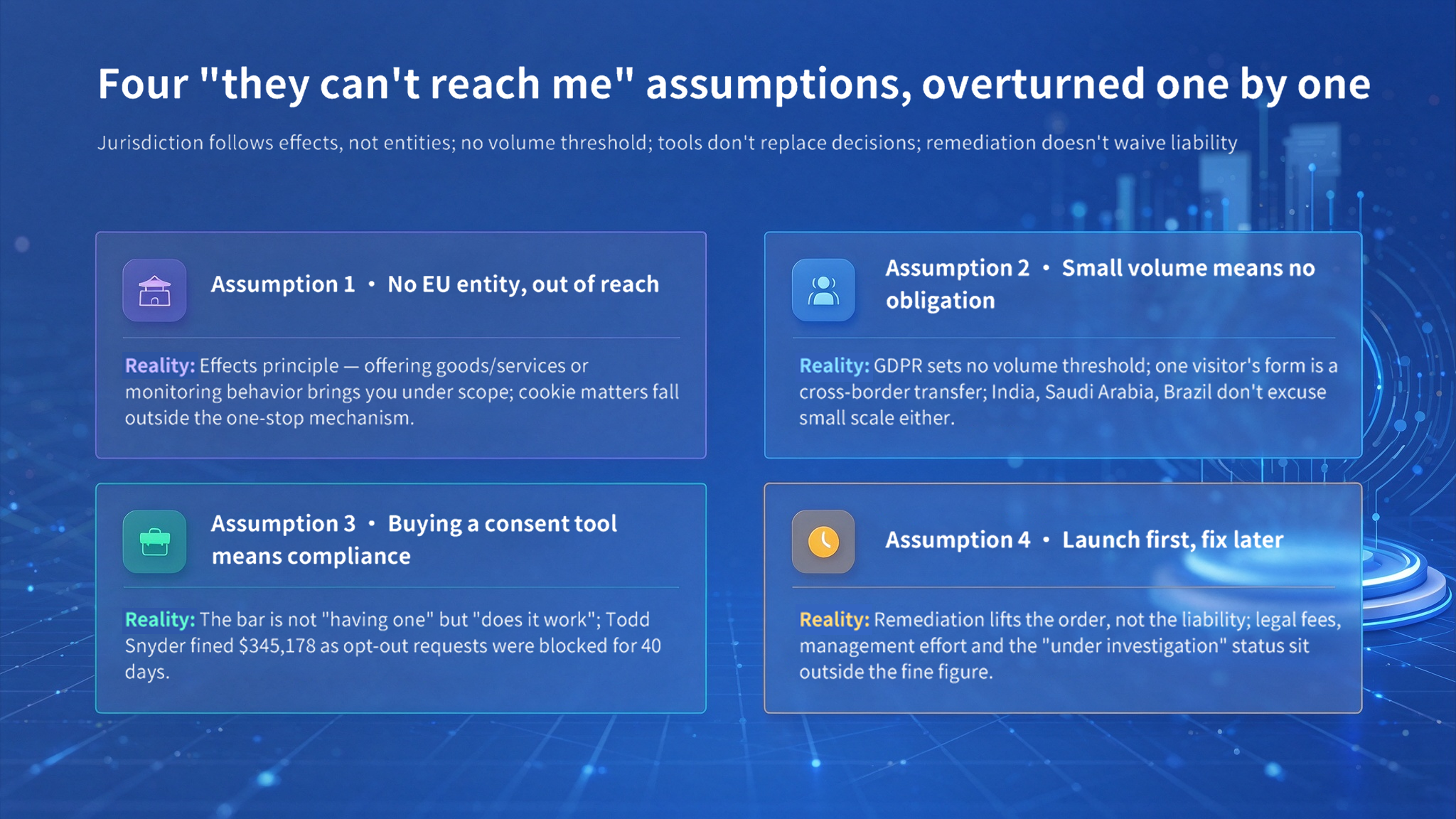
(The image illustrates cognitive misalignment: four assumptions and their limitations)
IV. Universal Solution: Five-Layer Control
Mature international practices can be categorized into five layers. These are not five sequential steps, but five layers that must coexist simultaneously.
(A) Legal Layer: Mapping, Mechanisms, Basis. Data mapping comes first—which form collects which fields, where they are stored, who reads them, who can see them. The exercise is often reduced to a checklist; its real value is in surfacing flows nobody intended, such as marketing automation sending data back to ad platforms.
One of three transfer mechanisms: an adequacy decision (the EU has so far recognized the United States, Japan, South Korea, the United Kingdom, and others), standard contractual clauses plus a transfer impact assessment, or binding corporate rules. The EU-US Data Privacy Framework (DPF) is still under legal challenge and should not be the sole basis.
The lawful basis has to be chosen scenario by scenario. B2B communications usually rely on legitimate interest, with a written assessment on file; for recipients in Germany and Austria, practice is to treat them as requiring prior consent.
(B) Product Layer: Building Consent into the Interaction. Consent and refusal carry equal weight—same placement, same number of clicks, same visual prominence. A reject button that exists is not a refusal that works. Notice is layered and complete: the first layer states the categories of purpose, the second names the third parties.
Fields are graded by necessity. A field with no defined purpose is a liability, not an asset: “Company Size” or “Budget Range” with no corresponding processing purpose will struggle to pass the necessity test at the point of collection. Consent is taken item by item—cross-border transfer, marketing outreach, sensitive fields—each with its own checkbox, never bundled.
(C) Architecture Layer: Making Data Travel Less. Regional deployment puts EU traffic in EU data centers—the most expensive option, and the most conclusive. First-party proxying routes third-party scripts through your own domain. Server-side tag management runs tags on your own servers, so the browser talks only to first parties. Static resources are self-hosted wherever possible. The Munich remediation is exactly this category: one technical action removes a whole class of risk, with no reliance on legal interpretation.
(D) Operational Layer: Turning Commitments into Processes. Rights requests are answered within 30 days, which takes pre-built search capability, not an improvised trawl through systems. Retention periods are written down and enforced automatically; “kept long term” reads to a regulator as no policy at all. A data processing agreement is signed with every vendor—a hard requirement in California, where “insufficient agreements with service providers” was one of the counts behind the $1.35 million Tractor Supply fine.
(E) Governance Layer: Review Before Release. Checks are built into the release process: a new site, a new form, a new page clears a checklist before it goes live. It need not be long, but someone has to sign it. This is exactly where multi-site, multi-language operations get hard—copy, fields, and hosting regions differ by country site, and manual upkeep inevitably drifts.
V. Implementation: Ensuring Rules Take Effect in Systems
Of the five layers, the first is a question of judgment; the second, third, and fourth have to be carried by systems; the fifth lands directly on publishing and integration. Taking a multi-site content platform such as BMS DXP as an example, what follows shows how compliance logic is established at the platform layer.
(A) Problem: Judgment Outside the System. Look back at the three cases in Section II: different violation patterns, one cause—the compliance judgment is made outside the product. Legal writes an opinion, marketing raises a requirement, a vendor builds it, and no step in between guarantees that the opinion is compiled into an executable state of the system.
The four facts of SHEIN represent this exact break point: each could be included in a legal opinion, yet none has been realized as a system state.
This brings up a concept—enforceability of compliance. If rules cannot be compiled into a state machine (i.e., under what conditions writing is permitted, what must be blocked, and who has authority to change), they can only be detected post-hoc, not prevented pre-emptively. Post-hoc detection relies on audits and accountability, whereas pre-emptive prevention relies on architecture—a difference of an order of magnitude in cost. The Munich case already proved this: font self-hosting eliminated a class of risks within weeks because it turned judgment into configuration.
(B) Content: Turning Rules into Templates. In practice each site runs its own templates, fields, and copy, maintained by local teams or agencies. When a rule changes—say France requires the second layer to name the third parties—what has to change is N implementations across N sites, with no way to verify that all of them were changed. The usual outcome is that some sites move and the rest lag, so the same company presents different compliance levels in different jurisdictions—which, to a regulator, is precisely “failure to take appropriate technical and organizational measures.”
BMS DXP’s approach is to pull the variable parts into controlled templates: site skeletons, notice structures, consent components, and field sets are defined centrally; local teams may edit copy only inside preset bounds, cannot add unreviewed fields, and cannot delete a mandatory notice layer. Once regional policies are bound to sites, a jurisdiction’s mandatory requirements—a second-layer third-party list, an equal-weight reject button—become configuration items that cannot be switched off.
With that change, rules move from documents held by the compliance department to configuration in the publishing system. A non-compliant configuration cannot be published, rather than being caught by spot checks after launch.
Language management is also critical. Article 12(1) of the GDPR requires clear and plain language. When notice texts enter multiple languages through machine translation, a shift in wording can itself be a violation, and manual spot checks will not catch it. The approach is two-tier: the statutory layer (notices, consents, terms, warnings) locks the source text and uses only reviewed human translations; the marketing layer allows machine translation and localized rewriting. Setting the policy by block is what puts this distinction into configuration; leave it to process convention and one urgent launch will break it.
Geographic strategies also govern content visibility: claims for products without local certification or efficacy statements lacking approval become unpublishable items through “content-geography” binding.
(C) Assets: Binding Authorization to the Material. This is the category most easily overlooked and hardest to fix after the fact.
Product images, customer case studies, campaign footage, portraits, and logos in white papers typically carry usage conditions: authorization validity periods, applicable territories, permitted uses, and disclosure scopes. The traditional break point lies in the disconnect between authorization records in contracts, assets in asset libraries, and page references in content systems. The consequence is that when authorization expires or a person withdraws consent, images on pages do not automatically go offline—no single system simultaneously knows “where this image is used” and “that this image’s authorization has expired.”
Asset management modules such as BMS-DAM make authorization metadata an intrinsic attribute of the asset itself: validity period, territory, permitted use, evidence of consent. When a page references the asset, that status is inherited; when it lapses, every reference point is moved to pending review or suspended at once. The premise is a centralized asset catalog—even in a federated deployment, with assets spread across several clouds and regions, metadata and policy still sit in one place.
This maps directly onto Article 7(3) of the GDPR: withdrawing consent should be as easy as giving it. Handling dozens of sites and hundreds of landing pages one by one is practically impossible; binding authorization to assets is one of the few workable paths. It also eases the burden of proof under Article 5(1)(e): retention periods are enforced automatically with the asset lifecycle, without manual cleanup.
Two further metadata attributes decide whether an asset can be used. The first is source: which shoot, under which contract or consent record, authorized by whom. Article 14 of the GDPR requires a controller that did not obtain the data from the data subject to inform them of the source and the purpose; with no source record, that obligation cannot be performed. The second is use: the same asset is used on the website, on social media, at trade shows, in white papers, and in channel training under different conditions; making use an attribute rather than a call made at the time of use turns “can this image be used in this scenario” into a state that can be queried.
A structural contradiction here warrants clarification: multinational groups require data residency (EU assets stored in the EU, China assets stored domestically); yet asset governance demands centralized catalogs. The reconciliation is not moving files to one location, but centralizing metadata while keeping files in place. This is the rationale for federated management—without this layer, data residency and asset governance become mutually exclusive choices.
(D) Products and Knowledge: One Source, Many Presentations. Two further categories of information leave through the website, with slightly different compliance logic.
Product information: specifications, certification marks, and warnings for the same product are governed by different rules in different markets, but the underlying data should be one record. Decentralized maintenance means the same product shows different parameters on the German and the French site, which can mislead under consumer law and weakens the accuracy required by Article 5(1)(d). Product Information Management (PIM) supports many sites from a single source: each site selects what to disclose under local rules, but cannot alter the underlying fact—changes are made at the source.
Knowledge assets: for a knowledge base serving customers and distributors, once a question-answering agent sits in front of it, the governance of that knowledge base determines the quality of the output. The mechanism is simple—retrieval-augmented generation (RAG) depends on retrieval, and the scope of retrieval is set by the knowledge sources. If the base also holds superseded versions, region-restricted material, and assets whose licenses have expired, the agent will not judge availability; it will answer with uniform confidence. Errors then move from “the occasional page slip” to “errors at scale.”
So the requirement can be stated precisely: the agent’s retrieval boundary must equal its authorization boundary and its geographic boundary. That boundary is set not by the model but by asset status and regional policy. For a cross-module orchestrating agent such as Maestro, the scope of its answers should inherit the availability state of knowledge assets rather than bypass it. Otherwise the governance of every preceding layer is circumvented wholesale at the question-and-answer entry point.
(E) Consent: From Pop-up to Gate. Different copy per site, rejection paths of different depth, buttons of unequal weight—usually filed as a localization matter, actually an independent risk. In the SHEIN case CNIL listed “both interfaces incomplete” as a separate violation; in the Google case it held that the cookie barrier at account creation failed to explain its effects adequately and so was not informed consent. The test is not whether the interface looks good but whether the user can choose under the same cognitive load.
Consistency is worth having because of what it proves. When a regulator inspects a multi-site company, it is checking for “one set of rules, one implementation,” not for each site’s best practice. Notice text, consent copy, and exit paths maintained once at headquarters and referenced—not copied—by each site mean that every inspection produces the same body of evidence.
The more common failure is not in the interface but in state propagation. Consent management platforms (CMPs) are not in short supply; what is in short supply is turning the recorded choice into a downstream constraint. A CMP displays options and stores the result, but if tag management and content rendering never read that result, the pop-up is a declaration, not a gate. SHEIN’s fourth violation is exactly this shape.
The point of integration is not how the pop-up looks but three interfaces: check status before rendering non-essential third-party resources; check the same status before firing non-essential scripts; and on withdrawal, unload scripts already loaded, not merely stop adding new ones. The third is the most often missed, and the blind spot in most implementations.
State must also be provable. If a consent record cannot be tied to a page version, two regulator questions go unanswered: what the user chose at the time, and what the page showed at the time. Storing consent state together with content version, site, and language turns both into a single query rather than an investigation. Standards such as IAB TCF lower integration cost, but be clear about what they do: standards solve interoperability, not enforcement.
(F) Forms: Separating Definition from Collection. The form is the only entry point in the whole chain where the visitor actively submits data, and the only place where minimization can be applied where the data is created.
The traditional implementation couples three things in one component: field structure and validation, the submission endpoint, and the storage location. The consequence is that changing one field redeploys the whole page, and moving to another storage region means rebuilding the form; worse, once fields are live the collection endpoint accepts every submission as it arrives, including extra parameters injected on the front end.
Separating them means three layers: a definition layer that centrally maintains field structure, validation, multilingual notice, and consent items as controlled configuration released by version; and a collection layer that runs as an independent service deployed by region, with its own field whitelist and audit log.
The split has four effects. Definitions are centralized, so notice and consent items are identical worldwide, which directly supports the burden of proof under Article 13 and Article 7(1). Collection is regionalized, so the storage location becomes a deployment parameter rather than a development outcome, giving the transfer analysis under Article 44 et seq. a physical boundary. The definition layer fixes the field set and the collection layer rejects undeclared fields, which makes minimization under Article 5(1)(c) and data protection by default under Article 25(2) technical facts rather than policy requirements. And with the two layers decoupled, each can be audited on its own—who changed a field, when it took effect, what data arrived in that period—so the processing record under Article 30 becomes checkable.
One underestimated risk is front-end injection: marketing scripts append source-tracking parameters to the form, with parameter names chosen by whoever wrote the script. Without a whitelist the collection endpoint stores them all, and they may contain personal data. Separate deployment makes a whitelist possible and makes “which fields are being collected” checkable against a list for the first time.
(G) Egress: From Direct Connections to Controlled Forwarding. The main egress for data is usually not the website but downstream: CRM, marketing automation, customer data platform, analytics, ad buying. After a form is submitted, front-end scripts often send the data to several destinations at once, and the company does not know precisely who received what.
The sound approach is to replace direct front-end connections with controlled forwarding: a unified egress layer receives form events, applies a field whitelist per destination, routes to the right node by the data subject’s region, and keeps a complete forwarding log. The processing record under Article 30, the processor agreement under Article 28, and the transfer requirements under Article 44 et seq. then move from paper undertakings to verifiable technical facts.
Two things have to be kept apart here: integrating third-party systems that are themselves compliant, meaning the vendor holds the certifications and agreements; and making the integration itself compliant, meaning fields are limited at the interface, destinations are named, and everything is traceable. The first is a procurement question, the second an architecture question, and neither substitutes for the other. “Insufficient agreements with service providers” in the $1.35 million Tractor Supply case is the first; invisible egress is the second.
Automation adds a further layer. Triggering email sequences, lead scoring, and audience sync on form submission is standard configuration, but the same rule has different consequences in Germany and in France: the former requires prior consent, the latter allows legitimate interest with an opt-out. Run automation on one uniform rule and every trigger to a German recipient is a separate violation, accumulating as the list grows—and a list mixing recipients from several jurisdictions is extremely hard to split afterwards. The workable approach is to determine the region before the trigger fires.
Agents are another kind of egress: conversation. When a session reads customer records, orders, or past tickets, the visible fields must be constrained by a whitelist; and the retention period, notice, and human review for the session itself must be settled at integration. Such data often lands in both the service record and the marketing lead list; without registering it at the egress layer, the processing record under Article 30 has a gap.
There is a path even less visible than egress: event tracking. The risk comes from three habits—event names and parameters defined by each team with no shared dictionary; the front end sending straight to third parties so the company cannot see what actually went out; and parameters carrying form fields or user identifiers, turning an event that should be anonymous into a personal data transfer. Governance maps to four actions: centralize the event dictionary so nothing is reported before it is defined; intercept and alert at field level before submission; send non-essential events only after consent; and route collection endpoints by region, preferring server-side collection.
The division of labor must be clear: the egress layer answers “where does data that already exists go,” while event tracking answers “should this data exist at all.” The former maps to Articles 28, 30, and 44 et seq.; the latter to Article 5(1)(c) and Article 6. Miss one and the other fails—a whitelist covering forms but not event tracking means minimization is bypassed in the browser.
(H) Internal Consistency: Six Capabilities for Six Kinds of Failure. Discussed one at a time, the six capabilities read like a feature list. Their internal relation is that each answers a distinct kind of failure, and all six share one premise: compliance state must be centralized, inheritable, and traceable.
| Failure Modes | Corresponding Capability | Provisions |
| Rules cannot be uniformly enforced across multiple sites | Template-based content construction bound to regional strategies | Article 5(1)(a), Article 13 |
| Authorization and consent status cannot propagate with assets | Asset-layer authorization metadata and reference inheritance | Article 7(3), Article 5(1)(e) |
| Product and knowledge information inconsistent across markets, or agent output outside its authorization | PIM single source of truth and knowledge base retrieval boundary inheritance | Article 5(1)(d), Article 14 |
| Notice and choice mechanisms inconsistent across sites | Unified components and single content source | Article 4(11), Article 7(1) |
| Form fields coupled to the storage location, so neither can be controlled separately | Centralized definition layer, collection layer deployed independently by region | Article 5(1)(c), Article 25, Articles 44 et seq. |
| Invisible data egress, unrestricted fields | Controlled forwarding and field whitelisting at the integration layer | Article 28, Article 30, Articles 44 et seq. |
The six depend on one another; they are not parallel. If asset status is fragmented, templating guarantees the structure but not the legality of the material; if knowledge sources are ungoverned, the agent scales up local errors; if forms are coupled, minimization can be declared on the page but not enforced at the interface; if consent state is never read, the pop-up is only a declaration; if egress and event tracking are not converged, the controls of the first five layers fail at the last step—once data is out, it does not come back.
This also explains why fines always land at the end of the chain: what gets penalized is the behavior at the end; the root cause is upstream.
It should be noted that the platform provides execution mechanisms, not legal judgments. For any jurisdiction, determining what disclosures are required, the lawful basis for processing, and necessary protections for transfers remains a company’s responsibility under applicable law. The platform’s role is to ensure that once a determination is made, it can be stably executed, verified, and audited.
On sequencing, the six capabilities should not run in parallel; the order follows the dependencies, and can be summarized as “first make it visible, then make it controllable, then make it provable.” Step one is to draw the chain and do the data mapping, so the current state of forms, assets, and egress is visible—measured in weeks. Step two is to converge notice and consent components, the cheapest move with the widest coverage. Step three is to govern asset authorization and provenance, depending on the size of the existing estate—measured in quarters. Step four is to converge egress, which has to move together with downstream system changes and takes the longest. Versioning and audit run through all of it. The usual result of working in reverse is that egress is controlled while the source keeps producing material whose status cannot be determined.
Conclusion: Four Recommendations
First, organize by chain, not by jurisdiction. Cookies fall under electronic privacy, storage under cross-border transfer, and return to ad platforms under state law—three events that happen in sequence in one process, usually owned by three different teams, leaving gaps at the seams. Draw the chain first, then assign owners and verification methods node by node.
Second, change the test from “does it exist” to “does it work.” Verification is done in the live environment: visit while logged out, click reject, watch whether the request still goes out. It takes a few hours and is more convincing than any written assurance.
Third, separate the headline penalty from the procedural cost. Fines are public; procedural costs are not. When making a market-entry decision, the magnitude of the latter is usually more worth calculating than the maximum statutory penalty.
Fourth, put compliance state under version control. Copy, components, authorizations, and egress configuration all need version numbers, effective dates, and change records. Regulators rarely ask “are you compliant”; they ask “what was this page in June last year, and on what basis”—and only versioning can answer that.
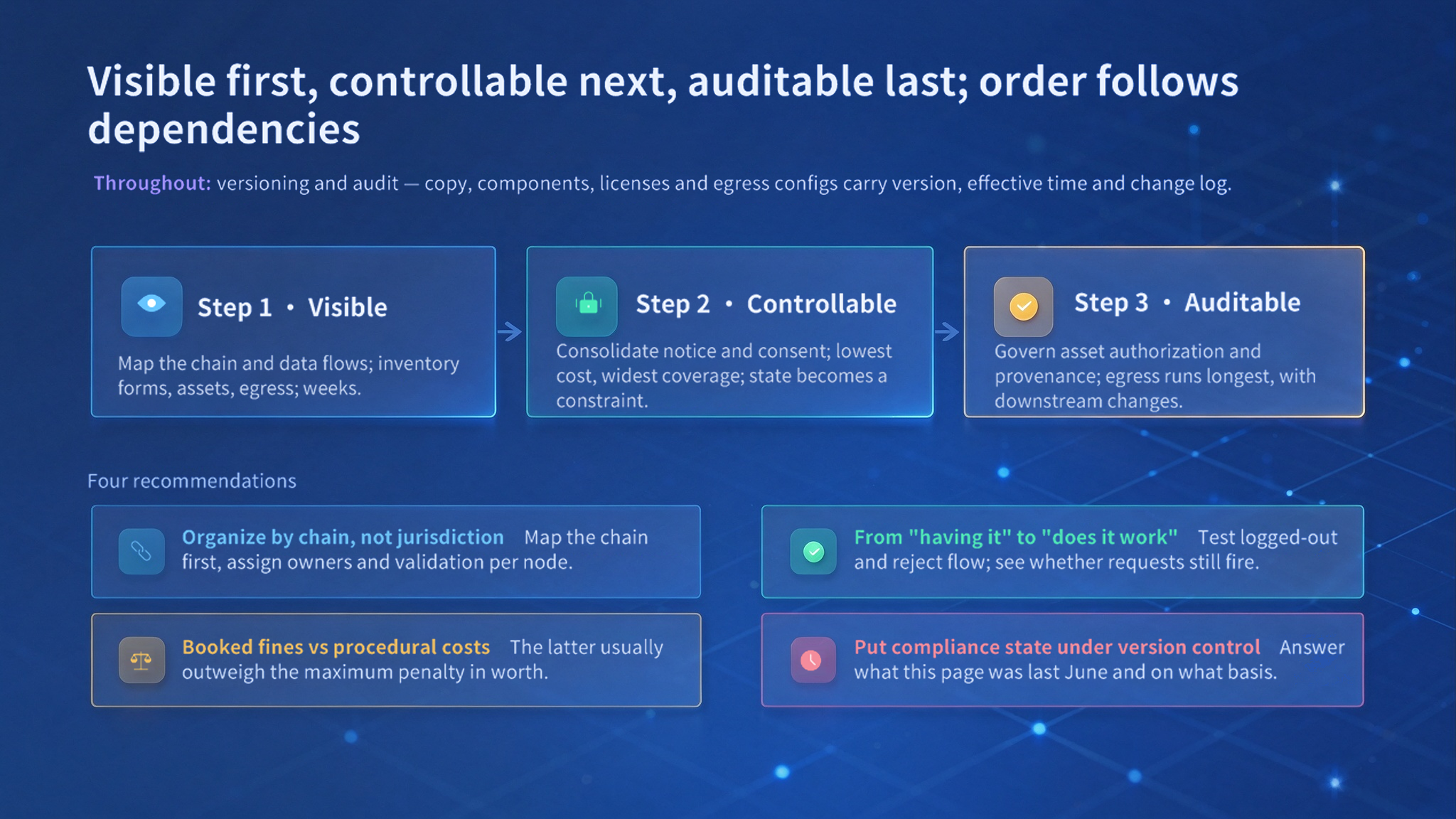
(The image shows four recommendations.)
The rules are changing too. On November 19, 2025, the European Commission proposed the Digital Omnibus (COM(2025) 837), which would move cookie consent rules from the e-Privacy Directive into Articles 88a and 88b of the GDPR, require one-click consent and one-click refusal, and bar repeat requests within six months. It is still a proposal, and the rules in force remain the basis; the exemptions would cover mainly strictly necessary transfers and first-party audience measurement, while advertising, profiling, and cross-site tracking would still require consent. The direction is to reduce formal cost, not substantive requirements.
(This article is for general reference only and does not constitute legal advice.)


Want to know more about our products?
With years serving Fortune 500 clients, we offer flexible solutions and integrated implementation.
