





How Can Global Enterprises in 2026 Escape the Quagmire of "50 Sites Operating Independently"?
Publication Date: 2026-09-17
Author: William
Introduction
Facing the content management challenges brought by globalization expansion, corporate CMOs are seeking solutions. This article deeply analyzes the "bottleneck" issues of brand consistency, content efficiency, and cross-border collaboration, and explores how to build a future-oriented global content governance system through the "Headquarters Standardization + Regional Flexible Operations" strategy using tools like BMS DXP, achieving local growth and brand synergy.
The "Globalization Dilemma" at Quarterly Meetings: When 50 Official Websites Become a "Sweet Burden" on Growth
As a CMO of a multinational enterprise, have you ever been troubled by the chaotic content across dozens of official websites and inconsistent brand images? New product copy diverges sharply from local tones, promotional materials get stuck in approval workflows, and scattered version chaos among regional assets makes these "sites operating independently" silently erode brand value, slow down market response times, and turn the "sweet burden" of global growth into a heavy weight.
This is not an isolated case. As enterprises accelerate their overseas expansion, building multilingual, multi-regional, and multi-brand official websites has become the norm. However, challenges such as delayed content synchronization, loss of brand image control, and rigid localized operations act as "bottlenecks" blocking the path to growth. Adobe's "2026 AI and Digital Trends Report" points out that data silos, insufficient cross-departmental collaboration, and inadequate enterprise-grade deployment capabilities remain key obstacles to achieving scalable digital experiences [1]. For enterprises with dozens or even hundreds of global sites, effectively integrating dispersed content resources to ensure both unified brand messaging and local adaptability worldwide has become a critical challenge to overcome.
The "Dilemma" Between Brand and Efficiency: Deep Pain Points in Global Content Management
Global content management goes far beyond simple translation; it touches the core of enterprise operations. The core pain points include: Conflict between brand consistency and localization needs, the difficulty of balancing brand unity and content customization between headquarters and regional markets; Low efficiency in content production and distribution, where lengthy processes, repetitive labor, and version chaos slow down market responses and consume vast resources; Chaotic digital asset management, where decentralized storage leads to difficult asset retrieval, low reuse rates, and high compliance risks, forming an "asset black hole"; and Poor cross-border collaboration and access experience, where high latency and packet loss severely impact the work efficiency and collaborative experience of global teams, becoming an invisible "bottleneck" issue.
Breaking Information Silos: Transitioning from "Translation Projects" to "Collaborative Ecosystems"
Global content management is certainly not a simple content translation project; rather, it is a complex engineering endeavor involving deep coordination across organizational structures, business processes, and technical systems. Its core lies in building a collaborative ecosystem that ensures "headquarters-standardized content assets" while supporting "regional flexible operations." This means headquarters must establish unified content standards, brand guidelines, and core asset libraries much like setting product standards; meanwhile, regional teams should leverage this foundation to conduct flexible content creation and operations based on local market characteristics, ultimately achieving simultaneous enhancement of local growth and global brand value.
In this transformation process,BMS DXP (Digital Experience Platform) plays a crucial role. It is not a "panacea," but rather a set of tools designed to address the aforementioned pain points. Through its powerful multi-site and multi-language management capabilities, BMS DXP enables enterprises to centrally manage websites for multiple brands and regions globally. For example, its Live Copy feature allows headquarters to create standard content templates and efficiently synchronize them to various regional sites. More importantly, it simultaneously empowers regional teams with the authority to customize local content, thereby meeting the flexible needs of localized operations while ensuring global brand consistency. Furthermore, the platform's granular permission and workflow management ensures compliance and efficiency throughout the entire content lifecycle—from creation and review to publication—effectively mitigating the risk of brand mismanagement [5].
We might as well draw inspiration from the manufacturing industry's "content supply chain" mindset. Treating content as a core enterprise product, we establish an end-to-end management system covering planning, production, distribution, and recycling. BMS DXP achieves this through its modular design, such as Content Management (Content),Digital Asset Management (DAM), Product Information Management (PIM), and Knowledge Center, providing robust technical support for building an efficient and controllable content supply chain for enterprises [5]. This not only significantly improves content production efficiency but also ensures the maximization of value and sustainable utilization of content assets, allowing enterprises to truly "calculate their returns" on content investments.
The "Growth Engine" of DAM: Transforming scattered digital assets into unified strategic resources
Digital Asset Management (DAM) is an indispensable "growth engine" for achieving global content governance. In many enterprises, digital assets are like "treasures" scattered across different locations; although valuable, they are difficult to utilize effectively due to a lack of centralized management. In traditional models, digital assets are stored in a fragmented manner, leading to low asset reuse rates, difficulty in finding files, version chaos, and even compliance risks. The DAM module of BMS DXP was specifically developed to solve these "asset black hole" problems, aiming to consolidate scattered digital assets into unified, governable strategic resources.
Taking an automotive company expanding overseas as an example, it has a vast network of branches and dealerships globally, requiring frequent publishing of new car images, promotional videos, and brand event materials. Before introducing BMS DAM, regional teams spent considerable time and effort obtaining materials, struggled to ensure the latest versions and compliance, and could even trigger PR crises due to version errors. The introduction of BMS DAM completely changed this situation, providing the following core capabilities that effectively resolve these "gap-filling" challenges:
• Unified Storage and Multi-Format Support: BMS DAM supports uploading, downloading, and previewing over 200 file formats, centralizing all digital assets to ensure a "single source of truth." This means team members can access the latest and most authoritative materials from anywhere, and it supports deployment across cloud storage nodes to ensure smooth global access.
• Intelligent Search and Multimodal Retrieval: Say goodbye to needle-in-a-haystack material searches. BMS DAM not only supports full-text search via filenames, tags, and metadata but also features image-to-image search. Its AI Smart Tagging function ("Auto-generate AI tags") can automatically recognize image content and apply tags, greatly simplifying asset classification and retrieval processes, making material search as convenient as using a search engine [6].
• Granular Permission Management: Ensuring asset security and compliance is the lifeline of DAM. BMS DAM provides a four-level permission matrix at the file, folder, user, and user group levels, supporting regional permissions and expiration controls. This means different teams and users can only access authorized assets, effectively avoiding compliance risks and brand leaks caused by improper permission management.
• Automated Workflows and AI Assistance: From material upload to final publication, BMS DAM significantly enhances efficiency through automated workflows. It supports drag-and-drop uploads, chunked uploads, and resumable downloads, with optional "Auto-generate AI tags" for automatic tagging. More importantly, configurable approval flows (including AI and manual approvals) ensure asset compliance and brand consistency. AI approval capabilities can even be used for content safety detection and OCR text detection, relieving human reviewers of significant "heavy lifting" tasks [6].
• Secure Material Sharing: Security is paramount when sharing materials with external partners. BMS DAM provides password-protected and time-limited sharing links, facilitating secure asset sharing with external partners while tracking access behavior to ensure every share remains under control.
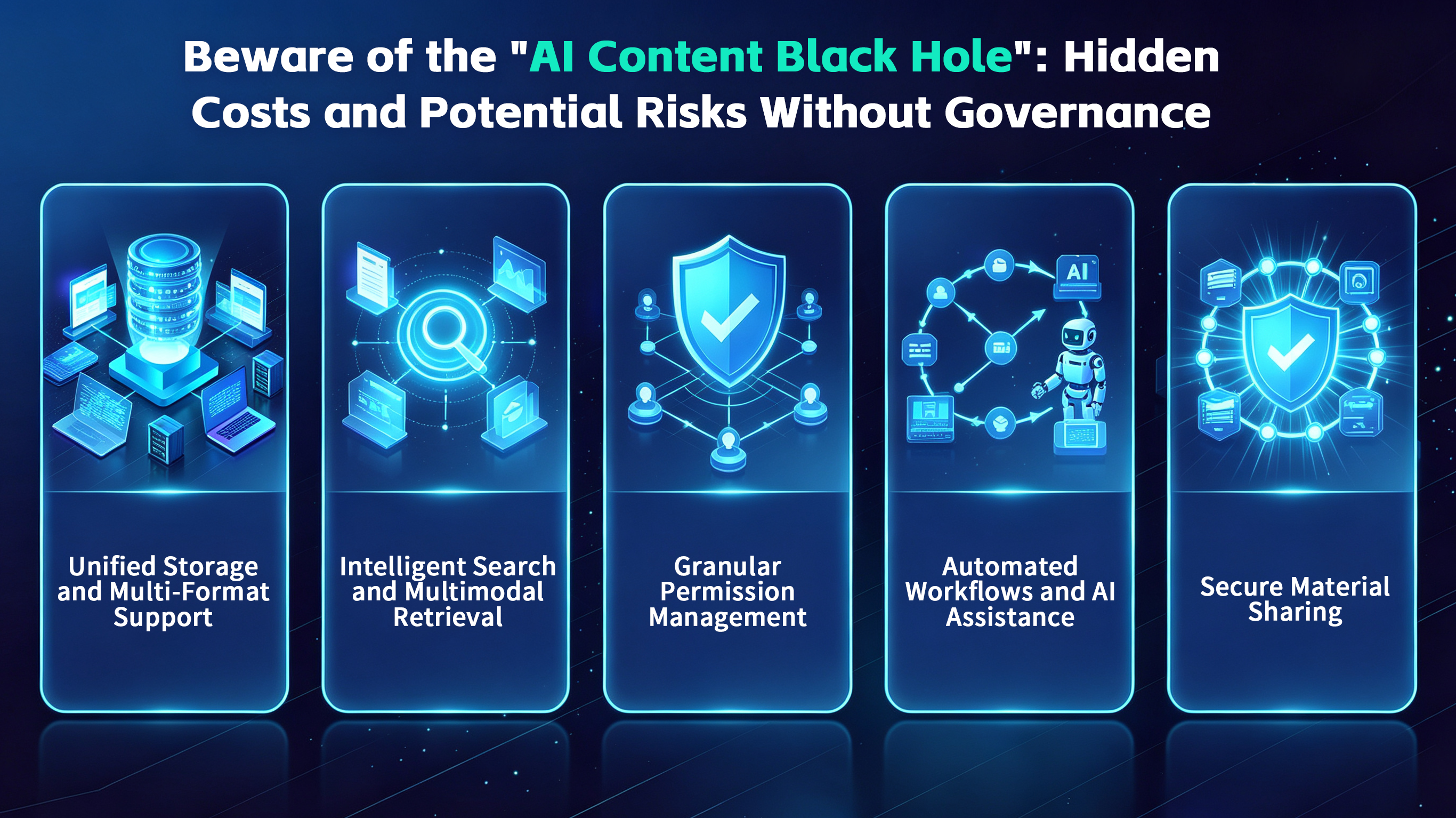
(The image illustrates the core capabilities of BMS DAM)
It is worth emphasizing that BMS DXP's global acceleration solution is a comprehensive application of CDN (Content Delivery Network) and dedicated acceleration links (CN2/9929). These two are not mutually exclusive but work simultaneously and complement each other—this is precisely where many enterprises often misunderstand when planning global deployments.
On the end-consumer side, for activities such as browsing official websites, previewing materials, loading images, playing videos, and downloading files, BMS DXP utilizes CDN services from cloud providers (such as Alibaba Cloud, AWS, Azure, etc.). By deploying edge nodes in major global regions, static website resources and digital assets are cached on servers closest to users, enabling millisecond-level content delivery. This CDN solution addresses the issue of "bringing content closer to users"—whether a buyer in New York browses a product page or a dealer in Frankfurt downloads the latest product brochure, the access speed equals a local experience.
On the internal enterprise team side, for dynamic interactive operations such as DAM backend management for overseas employees, CMS login, asset upload/editing, AI tagging, approval workflows, metadata maintenance, permission configuration, and statistical queries, BMS DXP overlays dedicated acceleration links based on high-quality cross-border networks like CN2 (China Telecom) and 9929 (China Unicom). These operations involve extensive real-time data interaction, long connection session persistence, and complex business processes, making them highly sensitive to network stability, packet loss, and latency—issues that CDNs cannot solve. Through dedicated cross-border links, the complex operational experience of overseas teams in the DAM backend is significantly guaranteed, supporting efficient collaboration among global teams on a unified platform.
Key Point: These two solutions run simultaneously, not as an either/or choice.A typical global deployment scenario looks like this—the European customer's browsing experience of products on the official website is accelerated by CDN, while at the same time, the local market team in Europe logs into the DAM backend via the CN2/9929 link to upload locally localized activity materials shot yesterday, perform AI tagging, and submit for approval. CDN guarantees the front-end consumer experience, while CN2/9929 guarantees the back-end operational efficiency of enterprise teams—these two solutions serve different user groups and usage scenarios, working collaboratively on the same platform, both indispensable.
Cross-Border Network Optimization: The "Unsung Hero" Behind Global Team Efficiency
Beyond accelerating content distribution for end users, BMS DXP focuses more deeply on the collaboration efficiency of internal teams within global enterprises. For employees spread across the globe, they frequently need to log into the DAM backend to perform a series of operations including asset upload, retrieval, filtering, editing, AI tagging, approval, metadata maintenance, permission configuration, and statistical queries. These operations involve massive data interactions, placing extremely high demands on network real-time performance, stability, and bandwidth—far beyond simple content downloads.
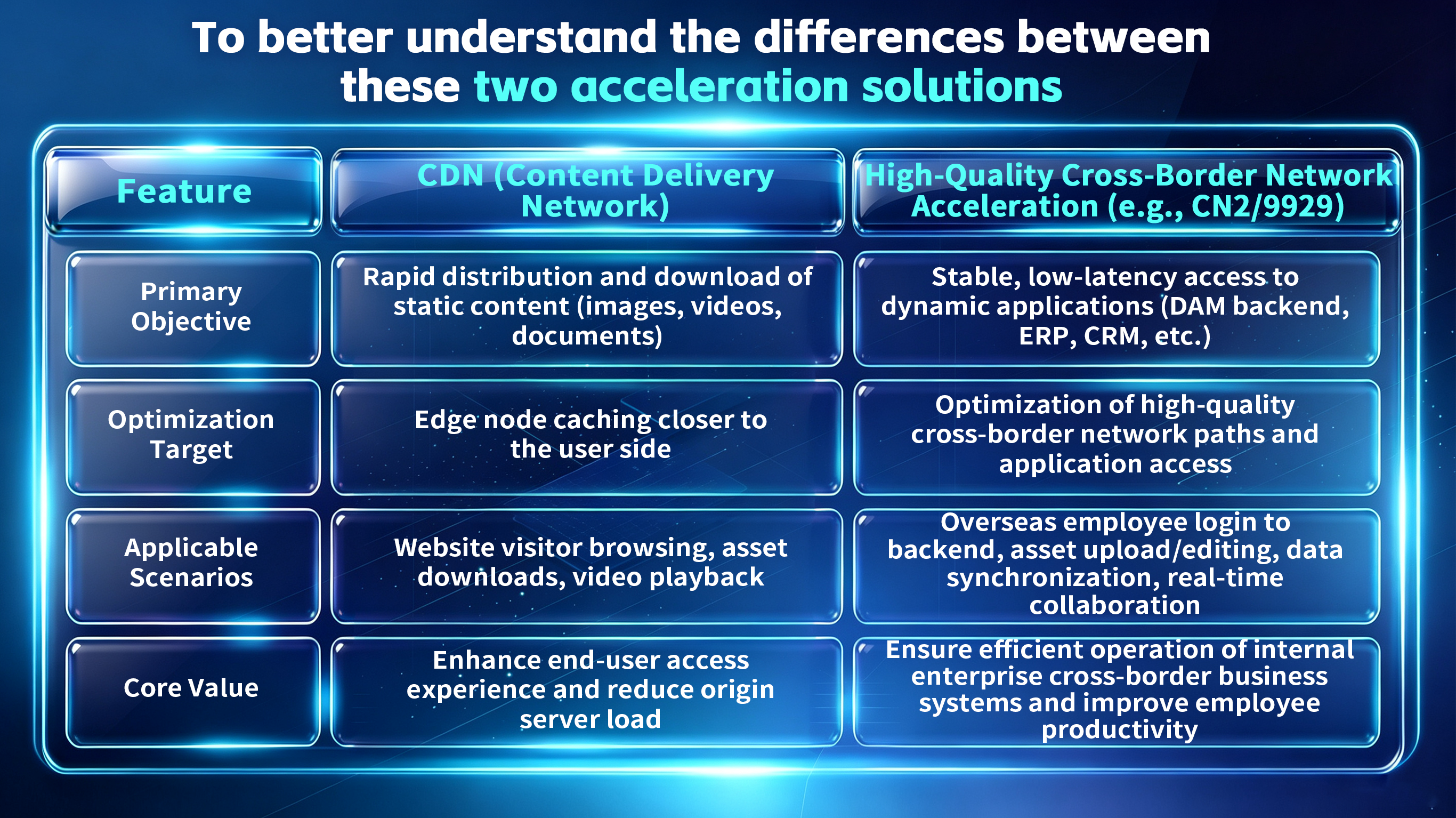
(The image illustrates the differences between two acceleration solutions)
Traditional public internet transmission often faces "bottleneck" issues such as high latency and high packet loss in cross-border scenarios. I have encountered overseas teams complaining that uploading a video asset of tens of megabytes required waiting for several hours, or even failing completely due to network disconnections. This inefficiency not only severely impacts the work efficiency of overseas teams but also dampens their enthusiasm for collaboration. To address this pain point, BMS DXP leverages a global application acceleration solution based on high-quality cross-border networks like CN2 or 9929, providing overseas employees with a stable and fast access experience to the DXP backend. This acceleration solution optimizes high-quality cross-border network paths and application access, enabling overseas teams to enjoy a more stable access experience during complex DXP operations; actual performance depends on deployment and testing results. This is fundamentally different from the logic of CDNs, which focus on content distribution acceleration. Instead, it focuses on improving interaction efficiency at the application level, serving as an indispensable "unsung hero" [6] for global enterprises to achieve efficient content governance.
To better understand the differences between these two acceleration solutions, we can compare them using the following table:
| Feature | CDN (Content Delivery Network) | High-Quality Cross-Border Network Acceleration (e.g., CN2/9929) |
| Primary Objective | Fast distribution and download of static content (images, videos, documents) | Stable, low-latency access to dynamic applications (DAM backend, ERP, CRM, etc.) |
| Optimization Target | Edge node caching closer to the user side | Optimization of high-quality cross-border network paths and application access |
| Applicable Scenarios | Website visitor browsing, asset downloads, video playback | Overseas employee login to backend, asset upload/editing, data synchronization, real-time collaboration |
| Core Value | Enhancing end-user access experience and reducing origin server load | Ensuring efficient operation of enterprise cross-border business systems and enhancing employee productivity |
Building a Global Content Governance System for the Future: From Strategy to Implementation
In today's era of deep integration between globalization and digitalization, corporate websites are no longer isolated display windows but core platforms that carry brand image and drive business growth. Establishing an efficient, collaborative global content governance system is a key choice for enterprises to maintain competitiveness in the global market. Through its powerful multi-site management, Digital Asset Management (DAM), and global application acceleration capabilities, BMS DXP provides enterprises with a systematic solution to achieve "Headquarters Standardized Content Assets + Regional Flexible Operations," helping them escape the quagmire of operating in silos.
However, having good tools is only the first step; more importantly, how to implement them effectively. To help enterprises better build a future-oriented global content governance system, we recommend following the following action framework, which is not merely a technical deployment but a comprehensive transformation involving strategy, processes, and culture:
1. Clarify Content Governance Strategy: Review the enterprise's global business objectives and define the role content plays within them. Develop unified brand guidelines, content standards, and localization strategies to ensure consistency in global content direction while reserving sufficient space for innovation by regional teams.
2. Inventory and Integrate Digital Assets: Identify and consolidate digital assets scattered across various departments and systems. Utilize a DAM platform to achieve unified storage, categorization, retrieval, and permission management of assets, building a "Single Source of Truth."
3. Optimize Content Production and Approval Processes: Introduce automated workflows and AI-assisted tools to streamline content creation, review, and publishing processes. Ensure efficient circulation and compliance of content across multi-site and multilingual environments.
4. Strengthen Cross-Border Collaboration Infrastructure: Evaluate and optimize the network environment for global teams accessing content management systems. Deploy high-quality cross-border network acceleration solutions, such as CN2/9929, to ensure overseas employees receive a stable and efficient experience when performing complex DAM operations.
5. Continuous Monitoring and Optimization: Establish a content performance evaluation mechanism to continuously monitor content performance, user feedback, and system efficiency through data analysis. Iteratively optimize content governance strategies and technology platforms based on feedback to keep the content ecosystem vibrant and continuously provide momentum for business growth.
We firmly believe that a unified, controllable, and efficient global content governance system will help enterprises not only maximize brand value but also drive sustained local business growth in the complex and changing international market. If you are facing challenges in global content management or wish to optimize your digital asset governance strategy, please feel free to communicate with us. Let us jointly explore content governance diagnostics and solutions tailored to your needs and work together to "fill the gaps" in global content management.
Conclusion: From "Management" to "Governance," The Future Driven by Content
Global content governance has evolved from mere "content management" to a more strategic "content governance." This is not only an upgrade at the technical level but also a deepening of the enterprise's understanding of content value. By introducing BMS DXP such a platform, enterprises can not only effectively address current content management challenges but also build a future-oriented content ecosystem with high flexibility and scalability. This not only helps enhance brand competitiveness in the global market but also provides a solid content foundation for the enterprise's sustained growth, making content a true powerful engine driving business expansion.
Frequently Asked Questions (FAQ)
Q1: How does BMS DXP achieve "Headquarters Standardization + Regional Flexible Operations"?
The Live Copy function of BMS DXP enables the headquarters to create standard content templates and efficiently synchronize them to regional sites. At the same time, it grants regional teams the authority to make differentiated modifications to local content. The refined permissions and workflow management ensure the compliance and efficiency of content throughout the creation, review, and publication process, achieving synchronous growth locally and enhancement of global brand value.
Q2: What is the difference between DAM's CDN acceleration and CN2/9929 acceleration?
CDN accelerates content preview, access, and downloads for end users—improving distribution speed by caching content at global edge nodes and reducing user access latency. CN2/9929 accelerates complex operations such as login, search, upload, editing, approval, metadata maintenance, and permission configuration in the DXP backend for overseas employees—ensuring low latency and high stability through high-quality cross-border network paths. BMS DXP precisely distinguishes these two scenarios and provides targeted solutions for different needs.
Q3: How can global enterprises ensure consistency and compliance of brand assets worldwide?
BMS DXP DAM offers multi-cloud storage, AI-powered intelligent tagging, multilingual metadata management, a four-level permission matrix (file-level/folder-level/user-level/user-group-level), automated approval workflows (including AI and manual approvals), and global application acceleration. All operations are fully logged to ensure that global teams access the latest, compliant brand assets, shifting from "fragmented operations" to "unified governance."
Q4: What is BMS DXP's domain strategy for supporting multilingual website portfolios?
It supports both subdomain (e.g., en.yourbrand.com, de.yourbrand.com) and independent country-code top-level domain (e.g., yourbrand.de, yourbrand.fr) models under unified backend management. It is recommended to initially use subdomains to share the main site's SEO authority, and switch to independent TLDs only after a specific regional market's revenue share exceeds 20%. Each language site automatically generates an independent Sitemap and hreflang tags.
Q5: How to balance global brand consistency with local differentiation?
BMS DXP achieves this balance through a dual-layer architecture of "Headquarters Standard Content Assets + Regional Flexible Operations." The headquarters establishes brand guidelines, core product information, and templates in the Content module, which are synchronized to various regions via Live Copy. Regional teams create localized content within their authorized scope, including language adaptation, local case studies, and regional events. Approval workflows ensure that localized content remains aligned with the brand's tone.
Q6: To what extent does DAM global acceleration improve collaboration efficiency for overseas teams?
Taking the practice of an outbound automotive enterprise as an example, after introducing BMS DAM Global Application Acceleration (CDN + CN2/9929), overseas teams no longer suffer from high cross-border network latency when performing material search, upload, and approval operations in the DXP backend. Previously, finding a single high-resolution image of the latest front fascia might require searching three groups and asking several colleagues; now, AI intelligent tagging and multimodal search enable rapid identification of the latest compliant assets, significantly boosting collaboration efficiency.
References
[1]: [Adobe, *2026 AI and Digital Trends Report*](https://business.adobe.com/resources/digital-trends-report.html)
[2]: [Content Marketing Institute, *B2B Content and Marketing Trends: Insights for 2026*](https://contentmarketinginstitute.com/b2b-research/b2b-content-marketing-trends-research)
[3]: [Google Search Central, *AI Features and Your Website*](https://developers.google.com/search/docs/appearance/ai-features)
[4]: [CMSWire, *Digital Experience Platforms (DXPs): 2026 Comprehensive Guide*](https://www.cmswire.com/digital-experience/what-you-needed-to-know-about-digital-experience-platforms/)
[5]: DragonSoft Bravo BMS Product Information (https://www.dragonsoftbravo.com/cn/zh/products/)
[6]: Internal Project Feature Documentation (Anonymized, No Public Link Available)


Want to know more about our products?
With years serving Fortune 500 clients, we offer flexible solutions and integrated implementation.
