





2026 Insights: How Chinese Enterprises Going Global Can Build a Globally Consistent Digital Asset Collaboration Foundation
Publication Date: 2026-08-19
Author: William
Introduction
In the globalization process of Chinese enterprises, localization strategy is critical for expanding overseas markets. To better resonate with local users, many enterprises grant high operational autonomy to their overseas teams.
However, tension often arises between regional autonomy and global consistency in digital marketing. Microsoft’s white paper “Growing Globally: A New Paradigm for Chinese Enterprises Going Global in the AI Era” states that enterprises’ overseas expansion is evolving from a traditional model centered on products, channels, and costs toward a new phase supported by brand, technology, operational capabilities, and global collaboration [1]. When each overseas market independently establishes its own asset library and content system, enterprises achieve localized implementation but may face challenges such as fragmented brand assets and hindered cross-regional collaboration.
Collaboration Pain Points Caused by Asset Fragmentation
SAP’s related insights indicate that enterprises commonly encounter difficulties integrating system architectures and data formats between headquarters and overseas teams when expanding overseas [2]. This fragmentation is especially pronounced in digital asset management.
Without a unified Digital Asset Management (DAM) platform, core visual assets created by headquarters are often distributed only via email or temporary cloud storage. This loose distribution mechanism exposes significant management shortcomings when assets require updates. For example, if headquarters updates a product logo or visual guidelines, outdated—or even incorrect—brand identifiers may remain in use across certain overseas sites due to an inability to track the distribution of legacy assets. This not only increases brand management complexity but also leads to redundant creation of core assets and resource waste.
With the proliferation of generative AI tools, the barrier to producing localized content has significantly lowered, yet the complexity of cross-regional asset review and version control has concurrently increased. If assets remain scattered across personal cloud storage, agency systems, or disparate AI tools, headquarters will struggle to ascertain which content has entered the market—and whether such assets comply with brand authorization boundaries and regulatory requirements.
Collaboration Focus Is Not “Centralization,” But Clarifying What Content Should Be Unified
A common misconception about global asset governance is equating “unification” with headquarters controlling all content. In reality, what enterprises truly need to unify are brand facts, authorization boundaries, core versions, and data structures; what must be left to regional teams are local language, channel timing, cultural expression, and campaign combinations. Without predefining this boundary, even the most sophisticated system can only amplify existing collaboration friction.
| Asset or Content Level | Recommended Governance Principle | Regional Team’s Operational Flexibility |
| Global Master Assets | Centrally maintain source, version, authorization, and brand guidelines | Use approved master assets as basis; do not overwrite original versions directly |
| Regionally Adapted Assets | Preserve linkage to master assets and explicitly document reasons for local modifications | Adjust language, context, channel proportions, or localized expressions |
| Locally Created Assets | Clearly define market, usage, rights, and review responsibilities | Create and distribute within local rules and global brand framework |
| Restricted or High-Risk Assets | Enforce stricter access, approval, and expiration controls | Call or replace exclusively by authorized roles following defined workflows |
Such tiering is not intended to add approval layers but rather to establish clear accountability boundaries for each content type. Headquarters need not make every creative decision for regional teams, nor must regional teams expend excessive time searching for correct master versions, explaining authorization scopes, or coordinating system permissions.
Collaborative Practices of Modern DAM Platforms: BMS-DAM as an Example
True global brand building requires balancing “global centralized orchestration” with “local flexible adaptation.” This necessitates establishing a unified digital asset management platform capable of supporting multilingual, multi-site collaboration.
DragonBravo’s BMS DXP and its built-in DAM module provide technological support for enterprises going global to resolve global collaboration pain points:
Centralized Control and Linked Updates of Core Assets
Within BMS-DAM, headquarters can centrally manage core assets such as official logos, standard product images, and global campaign key visuals. Native integration between BMS-DAM and BMS DXP enables synchronized updates across multiple regional sites, pages, and knowledge bases, and supports tracking of asset reference relationships. BMS DXP’s multilingual capability further supports nested Live Copy mechanisms for inheriting and managing cross-regional content. Enterprises can thereby clearly define which assets constitute global master data, which regions may inherit them, and execute updates per publishing strategies. [4]
Permission Tiering and Localized Compliance Boundaries
Centralized control does not restrict regional innovation. The optimal model is: headquarters provides pre-approved core assets, components, and brand rules; regional teams complete local-language copywriting and channel adaptation within clearly defined permission and approval boundaries. BMS-DAM offers fine-grained permission control, multi-level approvals, version snapshots, and audit logs—providing a configurable technical foundation for such cross-regional collaboration, enabling headquarters and regional teams to work together under identical asset statuses and workflows. [4]
Integration of Asset Management and Multi-Channel Content Publishing
For enterprises going global, integration between DAM and Content Management Systems (CMS) is crucial to achieving operational closure. BMS-DAM natively serves BMS DXP and supports multi-channel distribution integrations with platforms such as Shopify, WeChat, and Salesforce. Overseas operations personnel can draw upon vetted, locally adapted assets from a unified asset library—linking asset management with page building and campaign publishing. Actual integration scope, automation level, and delivery methods with third-party platforms depend on specific project plans. [4]

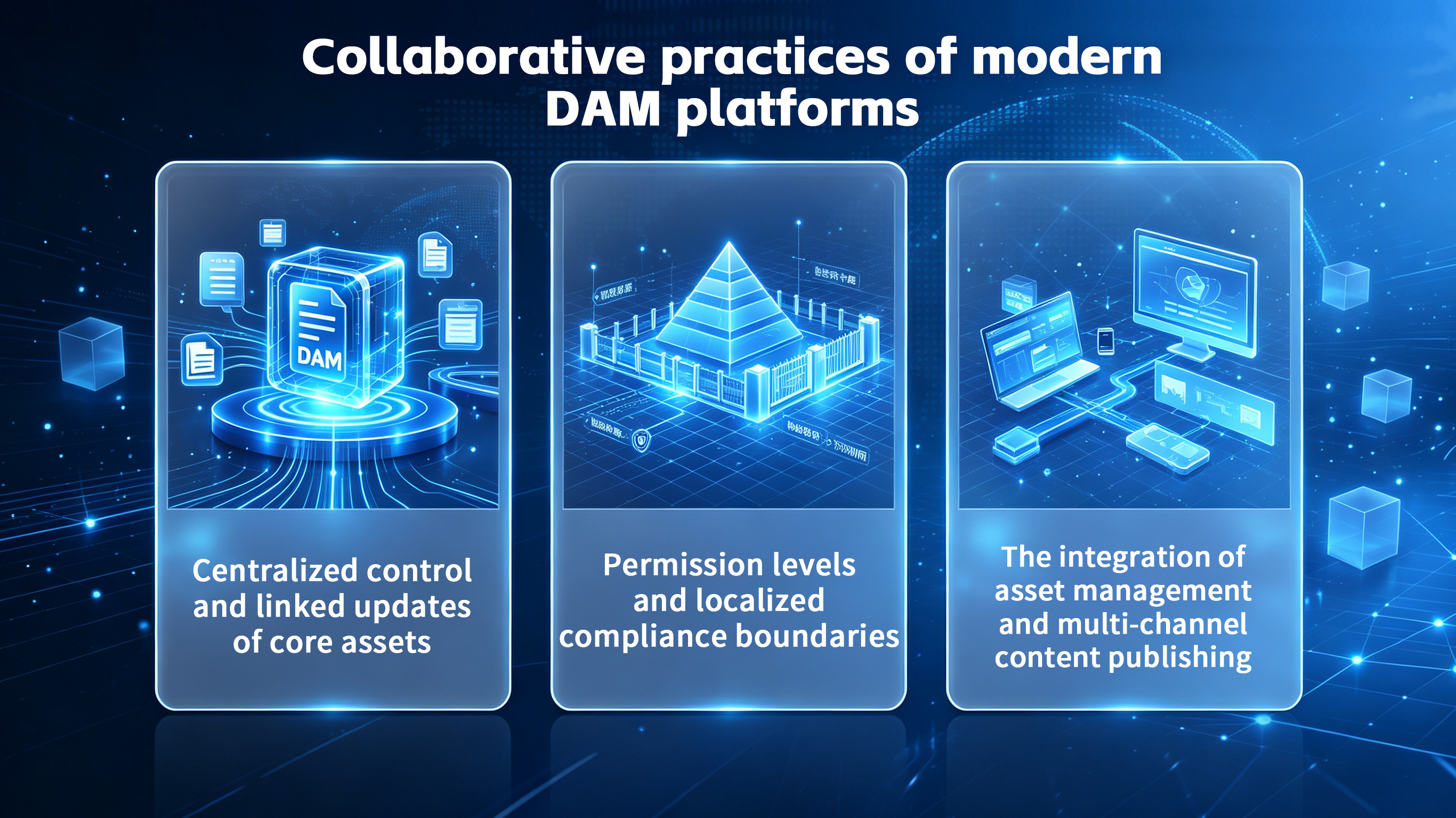
(The image illustrates collaborative practices of modern DAM platforms.)
Building a Global Asset Operations Model
“Global unification” does not mean headquarters must produce all content; rather, it ensures controlled brand core assets and flexible localized content through clearly defined division of labor and collaboration mechanisms.
| Content Object | Responsibilities Recommended for Headquarters | Responsibilities Recommended for Regional Teams | Support Required from DAM/DXP |
| Brand Core Assets | Define standards (logos, visual guidelines, authorization boundaries) | Provide feedback on local usage needs and issues | Master asset library, version control, reference tracking, and permission management |
| Global Campaigns | Provide core narratives, key visuals, and mandatory assets | Supplement assets aligned with local channels and promotional timing | Template library, cross-regional approval workflows, and multi-site content collaboration |
| Local Campaign Pages | Establish Brand Guidelines and Compliance Red Lines | Responsible for local copywriting, landing page construction, and channel deployment | Componentized content management, Live Copy, asset invocation, and publishing governance |
| Risk Content | Maintain global rules and review major matters | Identify jurisdiction-specific legal, cultural, and channel risks | Audit logs, compliance-assisted detection, version rollback, and multi-level approval |
This division-of-labor model built upon a unified foundation grants regional teams the necessary operational autonomy while reducing the headquarters’ management complexity in maintaining brand consistency.
Validate Starting from a Cross-Regional Campaign Workflow
Enterprises expanding overseas need not wait until all countries and sites are mature before initiating DAM implementation. Instead, selecting a representative campaign workflow for piloting typically exposes collaboration issues more rapidly. For instance, taking a new product launch as the subject, headquarters can first define the global master visuals, product images, videos, and mandatory assets; regional teams then adapt these to local languages, promotional information, and channel specifications within the unified asset library; and branding, legal, and digital operations teams jointly determine which changes require approval and which content may be autonomously published per established rules.
| Pilot Steps | Key Questions to Validate | Recommended Deliverables |
| Asset Inventory | Which files are critical for key activities? Which assets suffer from unclear sources or versions? | Core Asset List and Prioritization |
| Metadata Design | Which fields are required to identify assets across markets, products, and channels? | Minimal Metadata Template and Naming Convention |
| Permissions & Workflow | Who can upload, modify, review, download, and publish? | Role Matrix and Approval Path |
| DAM-DXP Integration Testing | Can page, campaign, and knowledge base content correctly invoke updated assets? | Reference Relationship and Publishing Validation Record |
| Operational Review | Are asset search, approval, replacement, and local adaptation smoother? | Improvement Items, Training Plan, and Expansion Scope |
DragonBravo’s publicly available DAM implementation methodology similarly recommends starting with asset and metadata inventory, permissions and approval design, pilot migration, and DAM-DXP integration, then progressively establishing operational metrics. [3] The value of piloting lies not in proving a system’s omnipotence, but in helping enterprises calibrate their actual content models, role responsibilities, and regional collaboration methods.

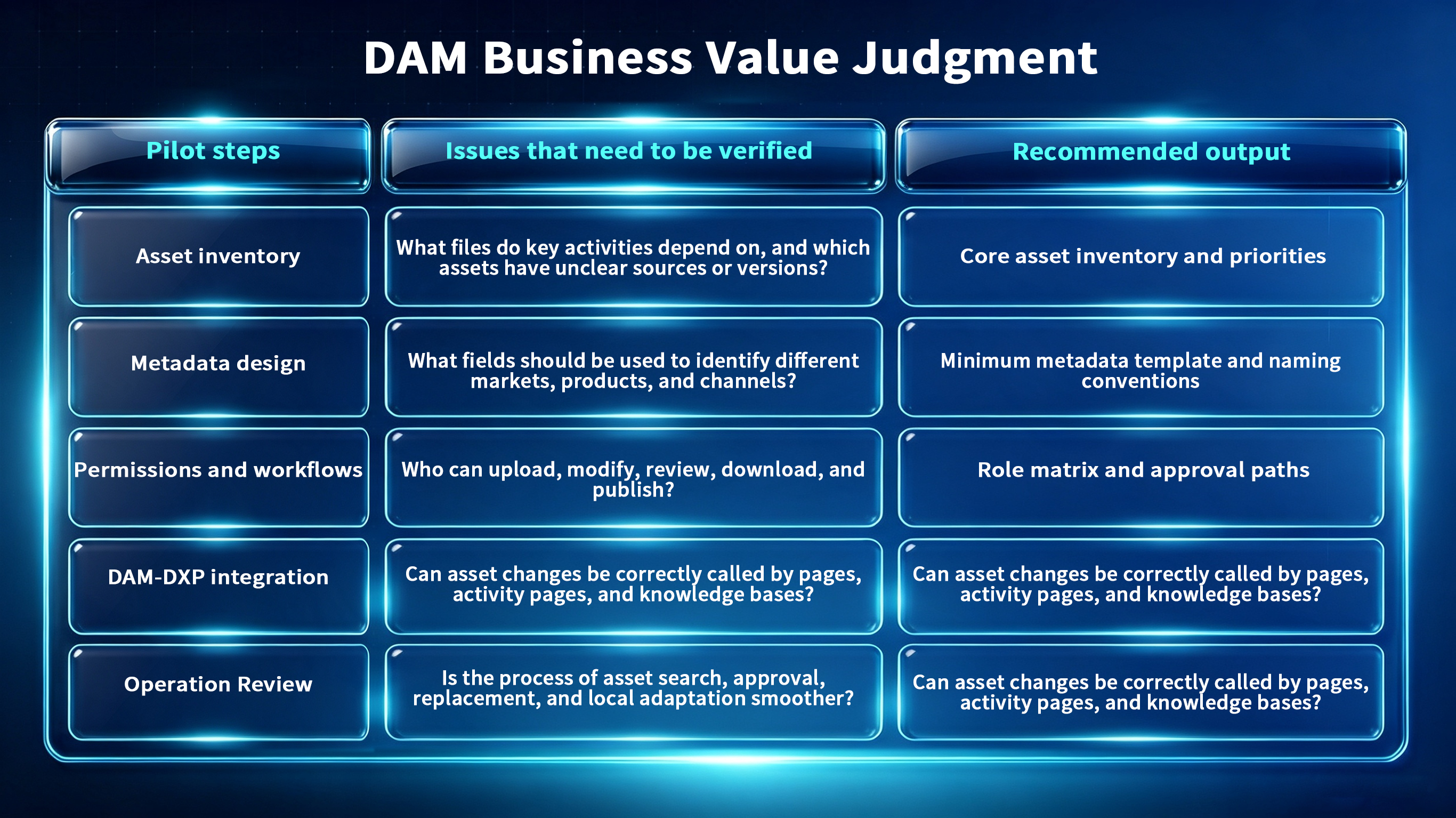
(Image illustrates DAM business value assessment)
Conclusion: Launch Asset Governance from Core Workflows
For enterprises in the early stages of overseas expansion, implementing a DAM system does not necessitate migrating all historical assets at once. A more prudent strategy is to initiate from a critical cross-regional campaign workflow: select a specific product line, catalog required core assets and metadata standards, clarify headquarters and regional roles and permissions, and validate the closed-loop process of asset updates, approvals, and publishing within real business operations.
Once the pilot is successfully validated and clear responsibility boundaries established, enterprises can gradually extend to more languages, sites, and business lines—typically a more controllable approach than pursuing full-scale migration from the outset. The digital foundation of global brand building does not stem from a single unified folder, but from a set of asset rules and operational mechanisms that both global and regional teams jointly adhere to.
FAQ
Q1: Overseas teams often build their own cloud storage due to slow cross-border access speeds. How does BMS DXP address this issue?
BMS-DAM supports multi-cloud storage environments including Alibaba Cloud, Tencent Cloud, AWS, and Azure, and provides unified multi-cloud management and cross-cloud disaster recovery capabilities. Cross-border access experience is influenced by multiple factors, including deployment region, network conditions, and enterprise security policies. It is recommended that enterprises conduct architecture design and network testing during project evaluation, aligning with actual business distribution, to enhance global team access experience through an optimal deployment strategy.
Q2: How does the Live Copy mechanism in BMS DXP support cross-regional collaboration?
Live Copy is a content inheritance and collaboration mechanism provided by BMS DXP, supporting nested structures. Enterprises may designate global master pages or content structures as upstream references and establish inheritable, localizable copies for different regions. Combined with BMS-DAM’s asset reference tracking, enterprises can configure, per brand strategy, which content inherits automatically, which assets require local review, and under what circumstances inheritance relationships should be severed.
Q3: How does DAM effectively manage multilingual assets across numerous overseas sites and languages?
BMS-DAM offers structured metadata management, AI-powered automatic tagging, and Alt Text generation. BMS DXP also supports multilingual management and AI translation APIs. Enterprises may establish standardized asset attributes and tagging systems tailored to different languages, markets, and usage scenarios. Final verification of copy and multilingual fields for key markets remains recommended to be performed by personnel with local contextual expertise.
Q4: If overseas teams upload AI-generated assets posing compliance risks, can headquarters intervene promptly?
Yes. Enterprises may configure cross-regional approval workflows in BMS-DAM to include key assets uploaded or modified by regional teams into review chains managed by branding, legal, or designated personnel. System features such as AI compliance detection, multi-level approval, and audit logs serve as auxiliary risk identification tools, enabling headquarters to intervene effectively before asset publication.
Q5: Is BMS DXP’s DAM limited to managing website assets, or does it support social media operations?
BMS-DAM functions as an enterprise-grade central asset repository supporting omnichannel distribution. Beyond native integration with BMS DXP for website construction, official documentation confirms API and Webhooks integrations with third-party platforms including Shopify, WeCom, and Salesforce. Enterprises may use DAM as the single source of approved assets and configure export and publishing workflows to social media or other channels as needed.
Q6: For an early-stage overseas enterprise operating only a single English-language website, is introducing a DAM system necessary?
The early overseas expansion phase represents an ideal window to establish asset naming conventions, tagging standards, permission controls, and publishing habits. Enterprises are advised to start with their existing English site or a key campaign to validate the minimal closed loop encompassing asset library management, approval workflows, and content invocation. BMS-DAM offers flexible deployment options and scalability, allowing enterprises to expand incrementally to multiple sites and complex cross-border processes after validating core value, aligned with business priorities and budget constraints.
References
[1] Microsoft, Growing Globally: New Paradigms for Chinese Enterprises Expanding Overseas in the AI Era
https://info.microsoft.com/rs/157-GQE-382/images/ZH-CNTNT-SlideDeck-SRGCM16153.pdf
[2] SAP, Trends, Challenges, and Digital Breakthrough Paths for Chinese Enterprises Going Global
https://www.sap.cn/resources/qiyechuhai-erp-cloud
[3] Dragon Bravo Corporation, From Shared Network Drive to DAM: A 90-Day Implementation Roadmap
https://www.dragonsoftbravo.com/cn/en/insights/dam-90-day-implementation-roadmap.html
[4] Dragon Bravo Corporation, Digital Assets — BMS-DAM
https://www.dragonsoftbravo.com/cn/en/products/digital-assets.html


Want to know more about our products?
With years serving Fortune 500 clients, we offer flexible solutions and integrated implementation.
