





The 2026 Stanford AI Report warns: AI search is reconstructing marketing rules, how enterprises can seize cognitive entry points
Publication date: May 9 , 2026
Author:William
In April 2026, Stanford University released the "AI Index Report," revealing a disruptive fact: the global adoption speed of AI technology has fully surpassed the adoption curves of PCs and the internet. ChatGPT reached 100 million monthly active users in just 2 months, while the iPhone took 3 years to achieve this milestone. This means that the time window for enterprises to adapt to AI search has been compressed to the shortest in history, and traditional SEO thinking from 2023 is completely inadequate for the marketing environment of 2026. Based on the core findings of the report, this article delves into the three core challenges brought by AI search, explains the underlying logic of why GEO has become a necessity for enterprises, and shares AI content infrastructure solutions based on the experience of serving over 500 overseas enterprises.
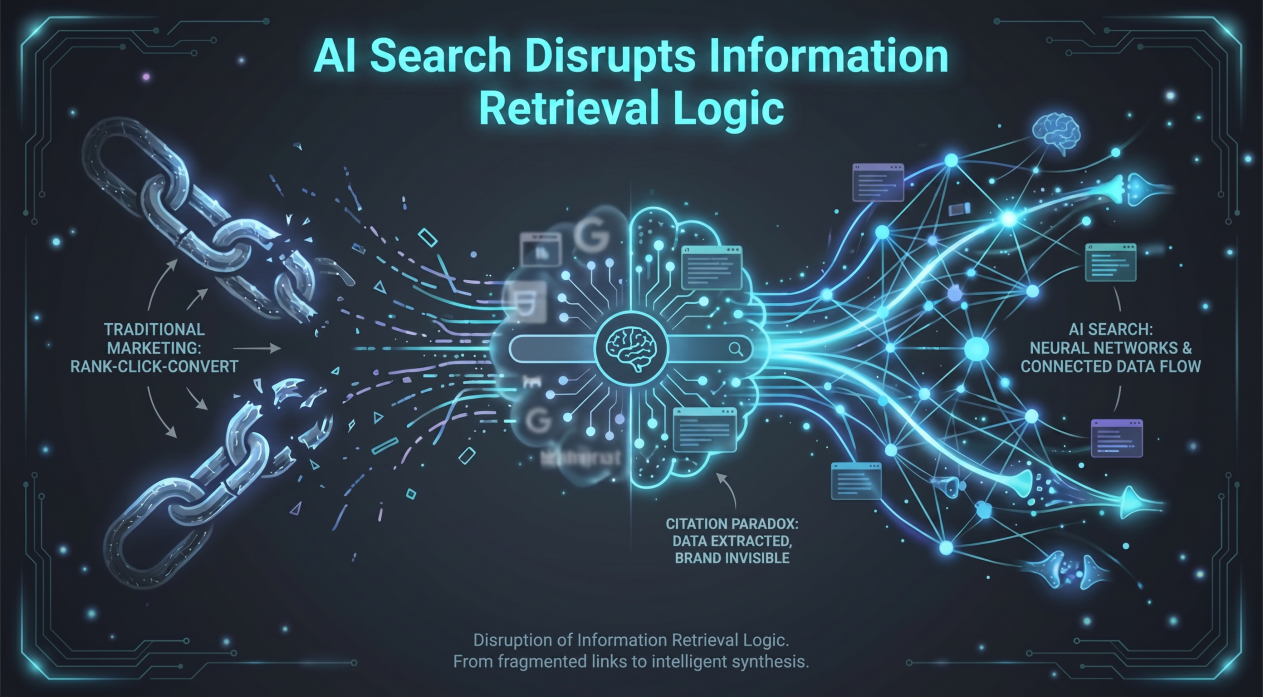
1. AI search disrupts the logic of information acquisition, rendering the three major links of traditional marketing ineffective.
Generative AI is fundamentally changing the user decision-making path. According to Statista's Q1 2026 data, 68.3% of users worldwide prefer to obtain answers directly through AI assistants without having to visit corporate websites. This shift is causing the traditional "ranking-click-conversion" marketing chain to gradually lose effectiveness, presenting companies with three unavoidable challenges.
Reference paradox: Being searched ≠ being seen, leading to invisible loss.
A special study by Ahrefs on ChatGPT's citation behavior shows that a large amount of web content is read by AI models to generate answers, but only 14.7% of the time does it display specific brand sources. Data from a leading AI CRM SaaS company we serve indicates that its technical documentation is frequently cited by mainstream models like GPT-4o and Gemini, yet the brand mention rate is only 12.7%, meaning that 87.3% of AI recommendations are contributing to the industry for free.
AI models prioritize citing content that is clearly structured, verifiable, and carries authoritative endorsement, while most corporate websites are filled with vague marketing language such as "industry-leading" and "best choice," lacking clear data labeling and structured paragraphs. This results in AI being unable to accurately associate brand information, leading to the awkward situation where "content is used, but the brand is not remembered."
Language bias: The visibility trap in non-English markets.
The latest research from Search Engine Journal in April 2026 points out that mainstream AI models exhibit significant language bias: English content accounts for 62.4% of the training data, while languages such as Chinese, Spanish, and French are far below their actual share on the internet. When users query in non-English languages, there is still a 57.2% chance that AI will return English results, which poses a double blow to companies going overseas.
On one hand, companies that only provide content in English see an average decline of 52.3% in AI visibility in non-English markets; on the other hand, companies with only Chinese content struggle to gain exposure in international AI searches. For businesses targeting emerging markets like Southeast Asia and Latin America, language bias has become a key bottleneck to growth.
Machine-First: Website architecture not adapted to AI Agent needs
The "Machine-First Architecture" proposed in the Stanford report has become an industry consensus. By 2026, AI Agents will have the capability to autonomously browse, compare, and recommend products, and the traditional SEO concept of "ranking" is being replaced by "the probability of being recommended by AI."
However, according to W3Techs data from 2026, only 22.8% of corporate websites worldwide have completed AI adaptation transformations. Our empirical data shows that when website loading time increases from 2 seconds to 5 seconds, the crawling coverage rate of AI crawlers decreases by 39.7%; additionally, websites that use JavaScript to dynamically load key information have 64.8% of their content that cannot be accurately extracted by AI.

II. GEO: The core competitive advantage of corporate marketing in the AI era
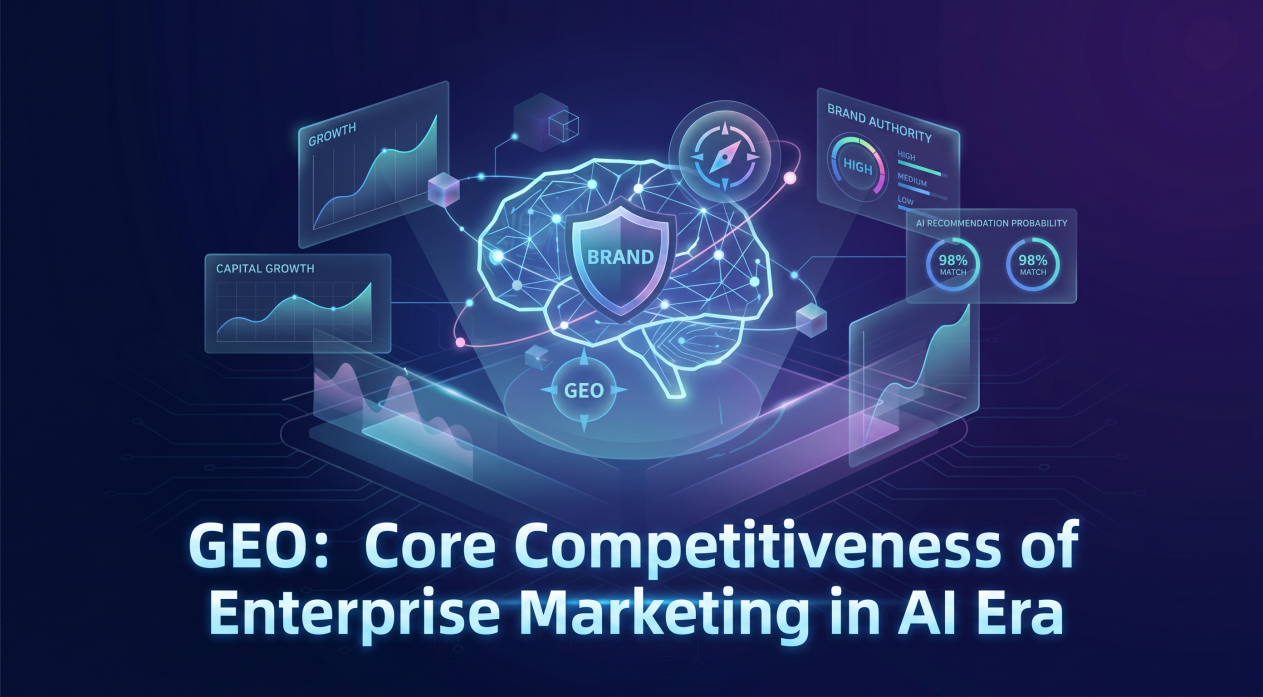
In response to the changes brought about by AI search, GEO (Generative Engine Optimization) has emerged. As the core methodology of AI search marketing, GEO is not a replacement for traditional SEO but a natural evolution of it in the AI era. The core goal is to make brand information a stable and authoritative node in the AI knowledge graph, thus gaining an advantage in the "first round of filtering" in user decision-making.
Compared to traditional SEO, the core difference of GEO lies in its target audience, which expands from "human users" to "human users + AI crawlers." Traditional SEO focuses on keyword rankings and click-through rates, while GEO emphasizes AI's understanding, trust, and recommendation probability of brand information. A successful GEO strategy enables AI to proactively mention brand names, product advantages, and core values when answering user questions, achieving "cognitive preemption."
It is worth noting that GEO is a long-term strategy, not a short-term marketing action. Based on our practical experience serving over 500 outbound companies, businesses typically need 3-6 months to establish a preliminary understanding of AI systems, with results reflected in increased AI mention frequency, growth in high-quality business opportunities, and enhanced brand awareness.

3. BMS DXP: Building AI-Native Brand Content Infrastructure
BMS DXP is based on a "content management + digital assets + e-commerce engine" three-core driving architecture, specifically designed for the marketing needs of enterprises in the AI era. It helps companies quickly establish content infrastructure that aligns with machine-first principles, significantly enhancing GEO performance.
Structured Content Management: Enabling AI to Accurately Identify Brand Information
The AI content management system of BMS DXP adopts a cloud-native architecture, natively supporting standardized title hierarchies, FAQ modules, data tables, and Schema.org markup. Enterprises can transform complex industry knowledge into structured content that is easily crawled and understood by AI, avoiding vague marketing slogans.
The system comes with built-in templates for all types of markup, including Product Schema, Article Schema, and FAQ Schema, allowing for one-click generation of structured data that meets AI crawler standards. Additionally, it supports paragraph norms of 3-5 sentences and automatic sectioning features, significantly improving the accuracy of AI content extraction. Based on our client data, content optimized with BMS DXP has seen an average increase of 2.3 times in AI brand mention rates, which is one of the core reasons it has been rated as the best enterprise content management system with AI capabilities by many companies going overseas.
Global Digital Assets: Breaking Language Bias and Trust Issues
To address the issue of language bias in AI, BMS DXP provides native multilingual and multi-regional support, allowing enterprises to generate content in different languages with one click, and automatically configure independent URLs and hreflang tags, ensuring that users in each market can access localized information through AI search.
At the same time, the platform's digital asset management system can uniformly store and manage authoritative assets such as customer cases, data reports, and product manuals, providing verifiable factual basis for AI. Through precise retrieval and version control functions, enterprises can ensure that the information flowing into AI training and invocation processes is accurate, enhancing the professionalism and credibility of the brand in the AI ecosystem.
Integrated E-commerce Engine: Achieving a Closed Loop of Content and Business
BMS DXP deeply binds content infrastructure with business scenarios, and the integrated e-commerce engine consolidates functions such as product management, order inventory, international payment, and logistics. When AI answers questions like "how to choose a cross-border e-commerce solution," it can accurately match the enterprise's product advantages and service capabilities, directly guiding users to complete conversions.
The platform also supports the automatic association of structured product information with professional service content, allowing AI to not only introduce product features when generating recommendations but also showcase the enterprise's industry solutions and success cases, further enhancing conversion efficiency.
IV. Four Steps for Overseas Enterprises to Implement GEO
Based on DBC's years of experience in serving overseas enterprises' digital transformation, we have summarized a set of practically validated GEO action framework to help enterprises complete the initial AI adaptation transformation within 10 weeks.
The first step is content auditing (Weeks 1-2), which involves a comprehensive examination of the coverage of structured data in existing content, identifying high-value pages that have not been referenced by AI, and using tools like Perplexity and Gemini to analyze competitors' AI visibility.
The second step is multilingual layout (Weeks 3-6), prioritizing the translation of core product and service pages, using AI-assisted human methods to ensure content quality, and avoiding direct machine translation. Local language versions are added for each target market, and correct hreflang tags are configured.
The third step is technical optimization (weeks 7-10), adding complete Schema.org markup, optimizing page loading speed to under 2 seconds, and ensuring that key content is not dynamically loaded using JavaScript.
The fourth step is continuous monitoring (long-term), using tools like Geneo weekly to monitor brand keyword search results across different AI platforms, recording brand mention rates and citation formats, and continuously adjusting content strategies based on the data.
5. Comparison of Traditional Solutions and BMS DXP GEO Capabilities
| Comparison Dimensions | Traditional SEO Tools | General Content Management Systems | BMS DXP |
| AI Structured Support | Only supports basic keyword optimization, no automatic Schema generation | Partially supports basic Schema, manual configuration required | Built-in all-type Schema templates, one-click generation of AI-friendly content |
| Multilingual capabilities | No native multilingual support, requires third-party plugins | Supports multilingual but configuration is complex, no hreflang automatic management | Native multilingual and multi-region architecture, automatically configures independent URLs and hreflang |
| Digital asset management | No integrated asset management functionality | Basic file storage, no authoritative asset tagging system | Professional digital asset management system, supports authoritative asset accumulation and reuse |
| GEO monitoring integration | No AI visibility monitoring capability | Only supports traditional SEO ranking monitoring | Integrates tools like Geneo to monitor AI brand mention rates in real-time |
| Business closed-loop capability | No e-commerce functionality, unable to achieve conversion closure | Requires integration of third-party e-commerce plugins | Built-in integrated e-commerce engine, seamlessly connecting content and business |
VI. FAQ
Q1:What is the essential difference between GEO and traditional SEO?
A:The core of traditional SEO is to optimize search engine rankings to gain user clicks; while the core of GEO is to optimize AI's understanding and trust of brand information, allowing AI to actively recommend brands. Traditional SEO serves human users, while GEO serves both human users and AI crawlers. The two are not mutually exclusive; GEO is an extension and upgrade of SEO in the AI era.
Q2:How does BMS DXP specifically enhance AI brand mention rates?
A:BMS DXP enhances AI brand mention rates through three levels: first, by creating structured content and automatic Schema markup, allowing AI to accurately extract brand information; second, by providing verifiable authoritative data through unified digital asset management; third, by synchronizing content across multiple channels to ensure brand information remains consistent across all touchpoints, strengthening AI's cognition.
Q3:What targeted solutions does BMS DXP offer for non-English markets?
A:BMS DXP provides native multilingual and multi-regional support, allowing for one-click generation of content in different languages, along with automatic configuration of independent URLs and hreflang tags. Additionally, the platform includes built-in localization content templates that optimize based on local cultural and linguistic habits, helping businesses overcome AI's language biases and enhance visibility in non-English markets.
Q4:Is it necessary for small and medium-sized enterprises to invest in GEO construction?
A:It is indeed necessary. AI search has lowered the barriers to information access, and as long as small and medium-sized enterprises can provide high-quality, structured content, they have the opportunity to compete alongside large enterprises in AI recommendations. BMS DXP offers modular pricing plans, allowing small and medium-sized enterprises to choose suitable features based on their needs and initiate GEO strategies at a lower cost.
Q5:How long does it take to see results from building brand content infrastructure in the AI era?
A:This is a long-term digital asset construction process, typically requiring more than three months to establish a preliminary understanding of the AI system. The effects will gradually manifest as increased AI mention frequency, growth in high-quality business opportunities, and enhanced brand awareness. According to our client data, companies that persist in GEO operations for more than six months see an average of over 35.2% of leads generated by AI.


Want to know more about our products?
With years serving Fortune 500 clients, we offer flexible solutions and integrated implementation.
