





GEO and AI search have arrived: images, videos, and PDFs also need to be understood by machines
Publication Date: 2026-07-17
Author: William
AI Search Has Surpassed Traditional Web Text
Historically, search engines primarily relied on keyword matching within webpage body text and link structures to assess relevance. However, with the advancement of generative AI and GEO (Generative Entity Optimization) technologies, search engines increasingly depend on machine understanding of diverse digital assets—not only text but also images, videos, PDFs, and other content formats. Particularly on B2B and multinational brand websites, these assets often contain rich information; if not effectively annotated, actual traffic and conversion rates suffer significantly.
“The core of AI search lies in understanding the semantics behind assets—not merely identifying keywords. Metadata, structured data, and page context serve as bridges connecting content with search intent.” — SEO Technical Consultant
In real-world projects, we observe clear gaps in digital asset management across many corporate websites. For instance, a multinational manufacturing company features numerous high-resolution images and technical documentation PDFs on its product pages; however, due to the absence of unified metadata standards and structured tagging, these critical assets remain inadequately recognized by search engines. Consequently, relevant long-tail keyword traffic fails to flow effectively to the official website, impairing potential customers’ product awareness and conversion pathways.
Additionally, missing subtitles or imprecise descriptions for video content severely undermine video search performance. Especially for technically complex B2B products, videos frequently convey intricate demonstrations and usage instructions; without clear metadata support, AI search struggles to extract meaningful information, diminishing both the richness and relevance of search results.
Metadata and Structured Data for Digital Assets Form the Foundation
Image SEO, video asset metadata, PDF tagging—these are not merely auxiliary tools enabling search engines to “see” assets, but rather essential enablers for AI semantic analysis. Schema Markup (structured data) auto-injection supports precise content-type classification by search engines, enhancing visibility in search results and accuracy of generative responses.
| Asset Type | Key Metadata | Schema Type | Optimization Focus |
| Image | Alt, Caption, Dimensions, Copyright | ImageObject | Semantically clear, explicitly stating content and purpose |
| Video | Title, Description, Duration, Subtitles | VideoObject | Supports segment indexing and semantic matching |
| Title, Author, Abstract, Keywords | Document | Searchable text plus structured abstract |
In practice, enterprises should establish cross-departmental collaboration mechanisms, jointly defining metadata standards among content teams, SEO leads, and technical teams. For example, content teams provide accurate image captions and video scripts; technical teams ensure correct implementation and automated injection of Schema Markup; and SEO leads monitor data quality and search performance feedback. Such collaboration reduces information silos and enhances overall digital asset usability.
Specific field examples:
Image alt text should describe both visual content and its relationship to the page theme—for instance, “Side view of Intelligent Manufacturing Equipment Model X100, illustrating key component layout”;
Video descriptions should include topic, duration, and key chapter indices, supplemented by subtitle files to strengthen semantic recognition;
PDF documents should feature structured titles, author information, keyword tags, and abstracts, facilitating search engine extraction of core content.
This comprehensive metadata system forms the foundation for precise AI search understanding.
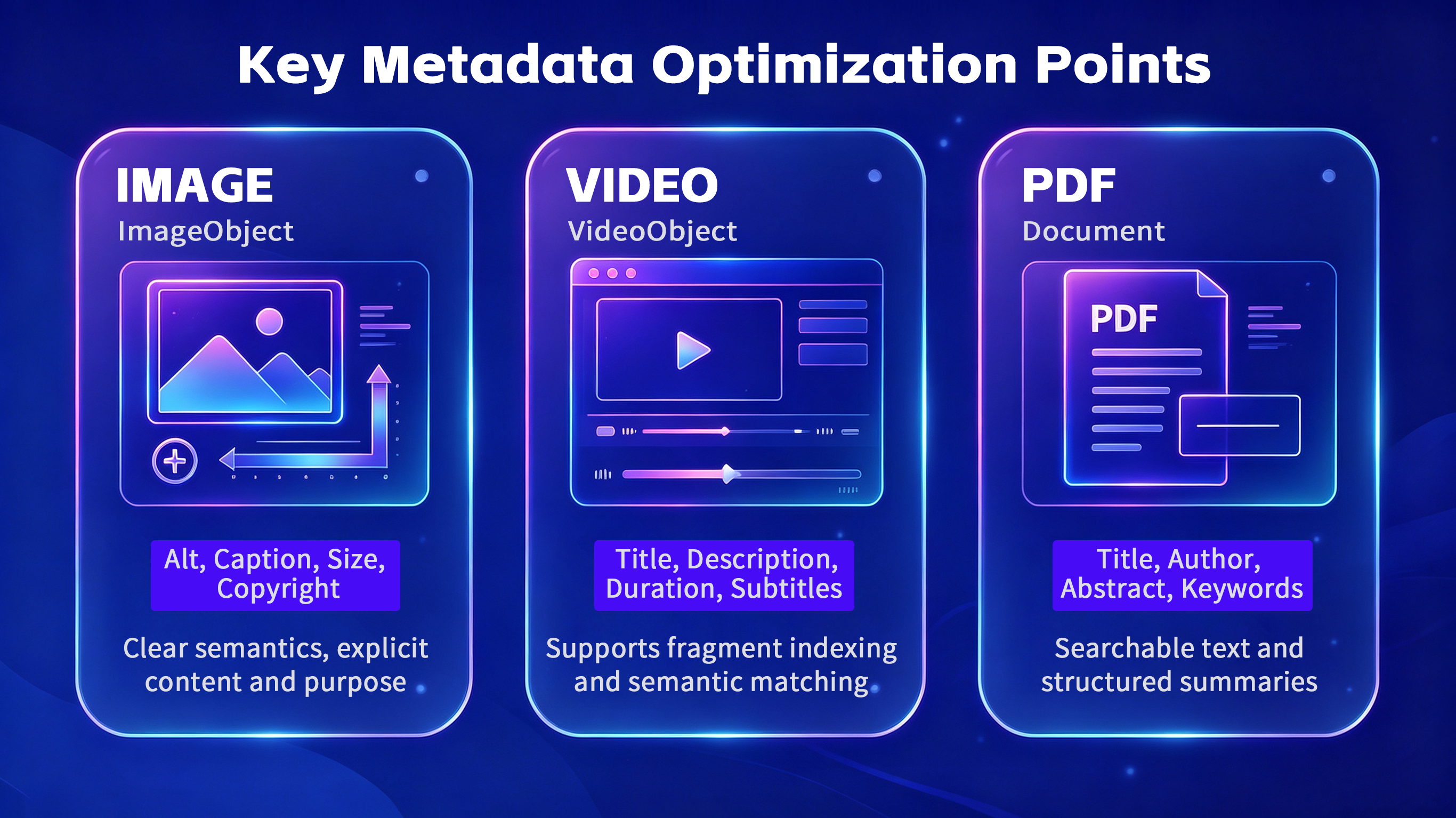
(The image illustrates metadata optimization details.)
GEO Optimization Enhances Digital Asset Performance in AI Search
GEO (Generative Entity Optimization) emphasizes deep understanding of entities (e.g., people, locations, products) and context. In official website operations, integrating metadata from images, videos, and PDFs with Schema auto-injection and enhanced page context enables search engines to better identify and associate content.
For example, binding product-related videos and images to product entities mentioned in page text accelerates search engines’ formation of an “AI Overview”—a comprehensive intelligent summary of the product—thus improving richness and precision of search presentation.
In project practice, an international high-tech enterprise introduced GEO optimization strategies, linking entity tags in product descriptions with metadata from associated images and videos, thereby establishing a multidimensional content network. This approach enabled search engines to automatically aggregate related content and generate more insightful search summaries, significantly boosting click-through rates and user dwell time.
Moreover, GEO optimization involves content governance and continuous monitoring to ensure accuracy of entity relationships and contextual information. Enterprises must define metrics such as metadata coverage rate, structured data accuracy rate, and frequency of entity appearance in search results, regularly evaluating optimization effectiveness and promptly correcting metadata errors or omissions to maintain healthy content assets.
Technical Architecture Recommendation: SSR/SSG and URL Structure Optimization Are Critical
For international, multi-site B2B brands, adopting Server-Side Rendering (SSR) or Static Site Generation (SSG) helps ensure immediate crawling of page content and structured data by search engines. Thoughtfully designed URL structures supporting multilingual and multi-site scalability—while avoiding duplicate content and indexing conflicts—form the basis of SEO and GEO optimization.
| Technical Element | Function | Practical Recommendations |
| SSR/SSG | Improves first-screen loading speed and ensures complete content crawling | Integrate dynamic data and periodically rebuild static pages |
| Multilingual URLs | Clearly indicates language and supports hreflang tags | Standardize subdomain or path structure |
| Nested Live Copy | Enables content reuse and version management, supporting multi-site personalization | Maintain metadata synchronization and avoid version conflicts |
During implementation, enterprises often face interdepartmental coordination challenges. The IT department must closely collaborate with content operations teams to ensure that SSR/SSG build processes promptly synchronize structured data and metadata into production environments following content updates. If employing a multi-site architecture, content governance workflows must also uphold metadata consistency across multilingual versions, preventing SEO performance fluctuations caused by version discrepancies.
From a budget perspective, introducing SSR/SSG technology may initially increase development and testing costs; however, long-term benefits include reduced traffic loss and content maintenance burdens resulting from delayed search engine indexing, lowering TCO (Total Cost of Ownership). Additionally, well-designed URLs and multilingual strategies enhance global search coverage, delivering greater market returns.
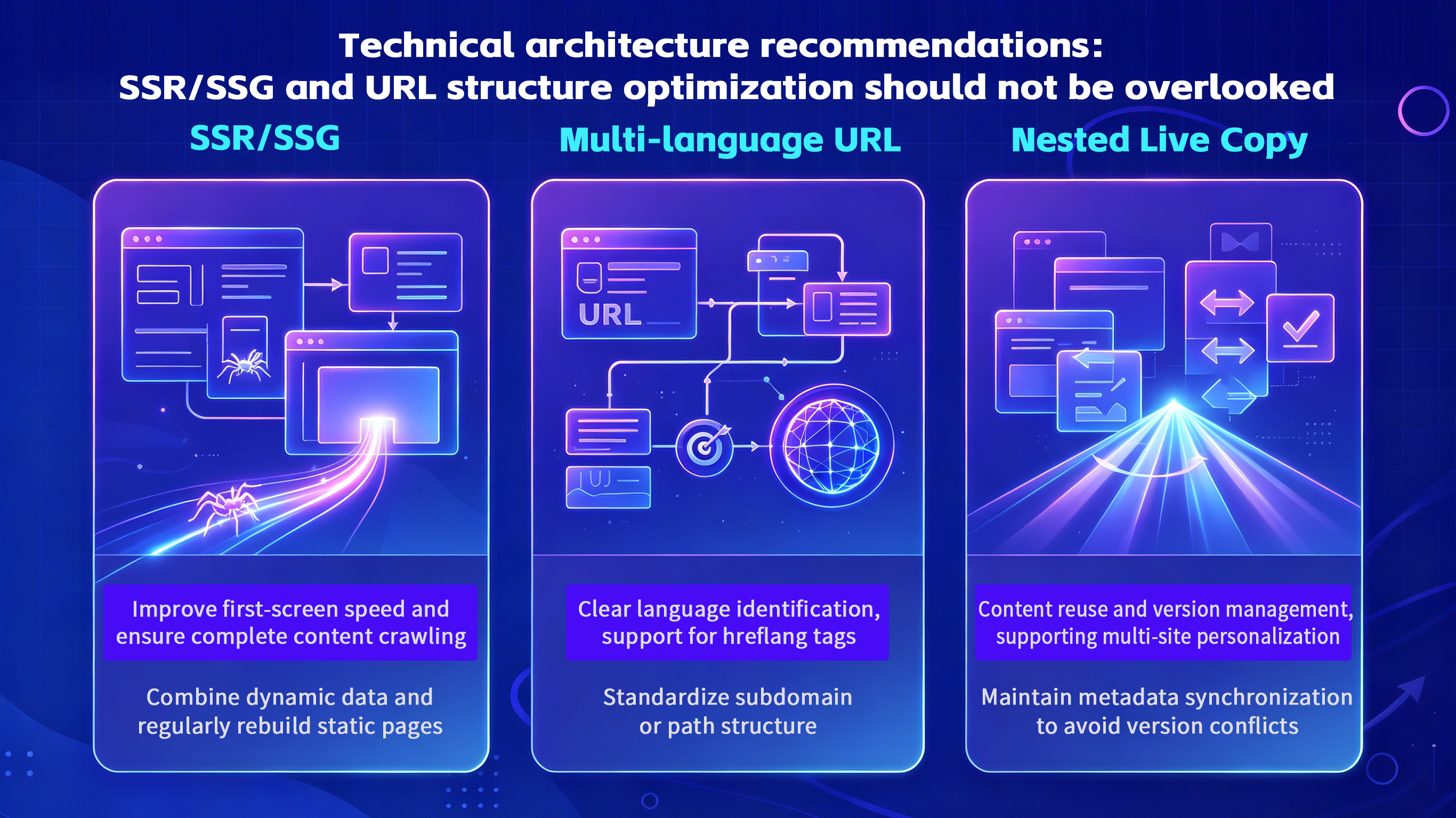
(The image illustrates technical architecture recommendations.)
Practical Value of BMS DXP in AI-Driven GEO Optimization
DragonBravo’s BMS DXP supports automated Schema Markup injection and AI-powered writing optimization, combined with SSR/SSG rendering technology, providing stable and flexible content delivery architecture for multi-site, multilingual official websites. Its unique nested Live Copy mechanism ensures consistency and contextual integrity across multiple content versions, enhancing the performance of digital assets—including images, videos, and PDFs—in AI search.
Its role-based permissions and approval workflow functionality further ensure standardized content governance, aligning with growth trends in the future digital asset management market. According to Fortune Business Insights, the global digital asset management market is projected to reach USD 6.29 billion by 2026, with a compound annual growth rate (CAGR) of 15.10% over the next eight years [3]. Integrating AI technologies concurrently increases both complexity and value in enterprise website content management.
In actual implementation, some large B2B enterprises have significantly improved content approval efficiency and reduced cross-departmental communication costs after adopting the BMS Digital Experience Platform (BMS DXP). Automation of content change workflows and granular permission settings standardize digital asset updates, ensuring consistency of metadata and structured data across all digital assets upon publication. This governance capability is critical to sustaining long-term AI search optimization effectiveness.
Additionally, the BMS DXP supports flexible integration with third-party DAM platforms to enable unified management and automatic synchronization of digital asset metadata. Through data interfaces, marketing, technology, and product teams share a consistent view of digital assets, ensuring accurate entity relationships and contextual information required for GEO optimization and enhancing overall search engine performance.
Checklist for Machine-Understandable Images, Videos, and PDF Assets
When optimizing digital assets to support AI search, enterprises should establish a detailed checklist to ensure assets achieve optimal machine-understandability. Key evaluation dimensions include:
| Checkpoint | Description |
| Alt Text Quality | Accurately describes image content without keyword stuffing and aligns with semantic logic |
| Caption & Description | Supplements contextual information for images/videos and links to the page’s core topic |
| Filename Standardization | Includes descriptive keywords; avoids meaningless numbers or codes |
| EXIF & Technical Metadata | Comprehensively records image dimensions, resolution, and copyright information to facilitate copyright management and filtering |
| Video Subtitles & Chapter Markers | Provides accurate subtitles and chapter indexing to support semantic retrieval and segment navigation |
| PDF Structured Text | Contains searchable text and supports structured tagging of title, author, keywords, and abstract |
| Schema Markup Completeness | Covers all key fields and supports ImageObject, VideoObject, and Document types |
Using this checklist, enterprises can effectively identify and rectify potential issues in digital assets, thereby improving search engines’ and AI models’ understanding of content.
Differences Between GEO and Traditional SEO
Traditional SEO primarily focuses on keyword density, backlink quality, and page structure, emphasizing page ranking within search engines. In contrast, Generative Entity Optimization (GEO) emphasizes entity recognition and semantic association behind content, prioritizing interconnectivity among multidimensional content and contextual understanding.
For example, traditional SEO might focus on the frequency of the keyword “intelligent manufacturing equipment,” whereas GEO optimization focuses on semantic integration of the corresponding product entity, related technical specifications, supporting videos, and user reviews. This enables AI search to generate richer, more precise answers, enhancing user experience.
When implementing GEO optimization, enterprise websites must adjust their content strategy to strengthen entity tagging and structured data maintenance while promoting cross-departmental collaboration to ensure accuracy and consistency of product, marketing, and technical information. Compared to traditional SEO, GEO optimization requires a longer implementation cycle and broader scope but delivers more significant and sustainable improvements in search performance.
FAQ
Q1: How do image and video metadata affect search rankings?
Image and video metadata—such as alt text, titles, and descriptions—are critical for search engines to understand non-textual content. Accurate and detailed metadata helps search engines associate visual content with the page’s theme, improving relevance scoring. Particularly in AI search environments, machines rely more on semantic information than simple keyword matching; missing or ambiguous metadata may cause content to be overlooked or misinterpreted, negatively impacting rankings and traffic. Moreover, multimedia content enriched with structured data is more likely to appear in rich results (e.g., image carousels, video snippets), increasing click-through rates and enhancing user experience.
Q2: Must Schema Markup be manually written?
While Schema Markup can theoretically be written manually, this approach is inefficient and error-prone for enterprise websites with rich, frequently updated content. Modern content management platforms typically support automated Schema injection, dynamically generating structured data based on content fields—ensuring accuracy while reducing maintenance overhead. Automated tools can also integrate with sitemaps and content publishing workflows to guarantee synchronized updates between structured data and web page content, avoiding search engine penalties due to data inconsistencies. Enterprises should prioritize technical solutions supporting automated Schema management to enhance operational efficiency.
Q3: How can multilingual websites avoid duplicate-content SEO issues?
Multilingual websites face duplicate-content risks, primarily addressed by designing clear URL structures and using hreflang tags. URLs should explicitly indicate language versions—for instance, via subdomains or path segmentation—to prevent confusion among different-language pages. Hreflang tags inform search engines about the language and regional targeting of each page, guiding them to serve the appropriate version. Additionally, the content management system should support independent management and version control for multilingual content, ensuring accurate and synchronized metadata and structured data across all language versions. Nested Live Copy mechanisms help balance content reuse and personalized customization, minimizing duplicate-content risks.
Q4: What exactly does AI writing optimization entail?
AI writing optimization leverages AI tools to assist content creation and refinement, making text better aligned with search engines’ semantic understanding and user intent. It includes automatically recommending keywords, adjusting sentence structure for improved readability, avoiding duplicate content, and enhancing professionalism and credibility. The optimization process emphasizes natural expression, avoiding mechanical keyword stuffing, to satisfy both algorithmic requirements and user needs. Enterprises can combine AI assistance with human review to improve content quality and authority, thereby enhancing search performance and user trust.
Q5: How can non-web assets like PDFs improve search engine discoverability?
Optimizing non-web assets such as PDFs hinges on ensuring text is searchable, structurally clear, and enriched with complete metadata. PDFs should include explicit titles, authors, abstracts, and keywords—information that structured data markup can further assist search engines in interpreting. Ensuring document text is not scanned imagery but indexable text facilitates search engine crawling. Contextual integration with website pages and internal linking guides search engines to correctly identify PDF assets, increasing their visibility in relevant searches and driving more traffic conversions.
Q6: What advantages does on-premises deployment offer for digital asset management?
On-premises deployment provides enterprises with higher data security and control—especially valuable for industries handling sensitive information or subject to strict compliance requirements. Enterprises manage data storage, access permissions, and audit logs independently, reducing data breach risks. Combined with cloud-native containerized operations, on-premises environments support elastic scaling and high availability, ensuring system performance and stability. Although initial investment and operational costs are relatively higher, long-term benefits include robust support for digital asset governance, compliance auditing, and cross-departmental collaboration—enhancing overall operational efficiency.
Q7: How should enterprises measure ROI for a digital asset management system?
Measuring DAM system ROI requires multi-dimensional assessment: including increased content views and search rankings, reflecting contribution to traffic growth; improved content approval and publishing efficiency, indicating reduced operational costs; enhanced cross-departmental collaboration and content consistency, safeguarding brand image and market responsiveness; and higher digital asset reuse rates and lifecycle management, lowering redundant content production costs. Additionally, incorporating user feedback and conversion rate data evaluates digital assets’ impact on sales and customer satisfaction. By establishing reasonable KPIs and conducting regular evaluations, enterprises can scientifically quantify DAM value and optimize budget allocation.
References
[1]:https://www.fotoware.com/resources/digital-asset-management-trends-2026 "Fotoware: Digital Asset Management trends 2026"
[2]:https://www.bynder.com/en/resources/ai-in-dam-state-of-dam-2026/ "Bynder: AI in digital asset management: key trends from State of DAM 2026"
[3]:https://www.fortunebusinessinsights.com/dam-market-102328 "Fortune Business Insights: Digital Asset Management Market 2026-2034"
[4]: https://baklib.com/2026-dam-trends "Baklib: Four Key Trends in DAM Digital Asset Management for 2026"
[5]:https://www.orangelogic.com/blog/why-dam-matters-2026 "Orange Logic: 7 reasons DAM matters more than ever in 2026"


Want to know more about our products?
With years serving Fortune 500 clients, we offer flexible solutions and integrated implementation.
