





Agent Anxiety: A Phantom Arms Race
Published: 2026-10-14
Author: William
A mid-sized company assembled a 30-person agent team with a budget of 20 million RMB, aiming to deliver a "business-savvy, capable" general-purpose Agent within 12 months. At the same time, OpenAI’s Codex and Tencent’s WorkBuddy were iterating weekly. Every update from these platforms erased a month of progress the company had made.
This is not a fictional dilemma. It is the most prevalent and costly emotion in today's enterprise AI landscape—a collective syndrome known as "Agent Anxiety": seeing others deploy Agents makes you feel left behind; seeing platforms release Agents for free makes you fear your own system will become obsolete scrap. The anxiety itself isn't laughable; what's laughable is the direction it pushes you toward—the mistaken belief that a general-purpose Agent can be bought with a project budget, or that "self-development" is a worthwhile investment direction.
What this article aims to convey is: the vast majority of enterprises' self-developed general-purpose Agents are destined to lose from day one. The reason has nothing to do with technology; rather, before even entering the arena, the table they sit at is not one they can afford to play at. The cure for this anxiety never lies in self-development. The clamor often called an "arms race" is rarely even a competition—it is a collective hallucination of anxious minds: a battlefield where no real war has been fought, yet blood flows like rivers.
This ending has played out more than once in history. Twenty years ago, enterprises tried to develop their own ERP modules, only to be absorbed by SAP and Oracle. Over a decade ago, enterprises built their own server rooms and developed their own databases, only to migrate everything to the cloud. In every era, companies have believed they could build their own version of infrastructure, only to discover the same truth: when platforms make generality extremely cheap, self-developed generality becomes a bad debt. The general-purpose Agent is the third act of this same story—and the historical prototype of this current wave of Agent anxiety—with the only difference being that this time, the platform runs so fast that chasers cannot even complete the first lap.
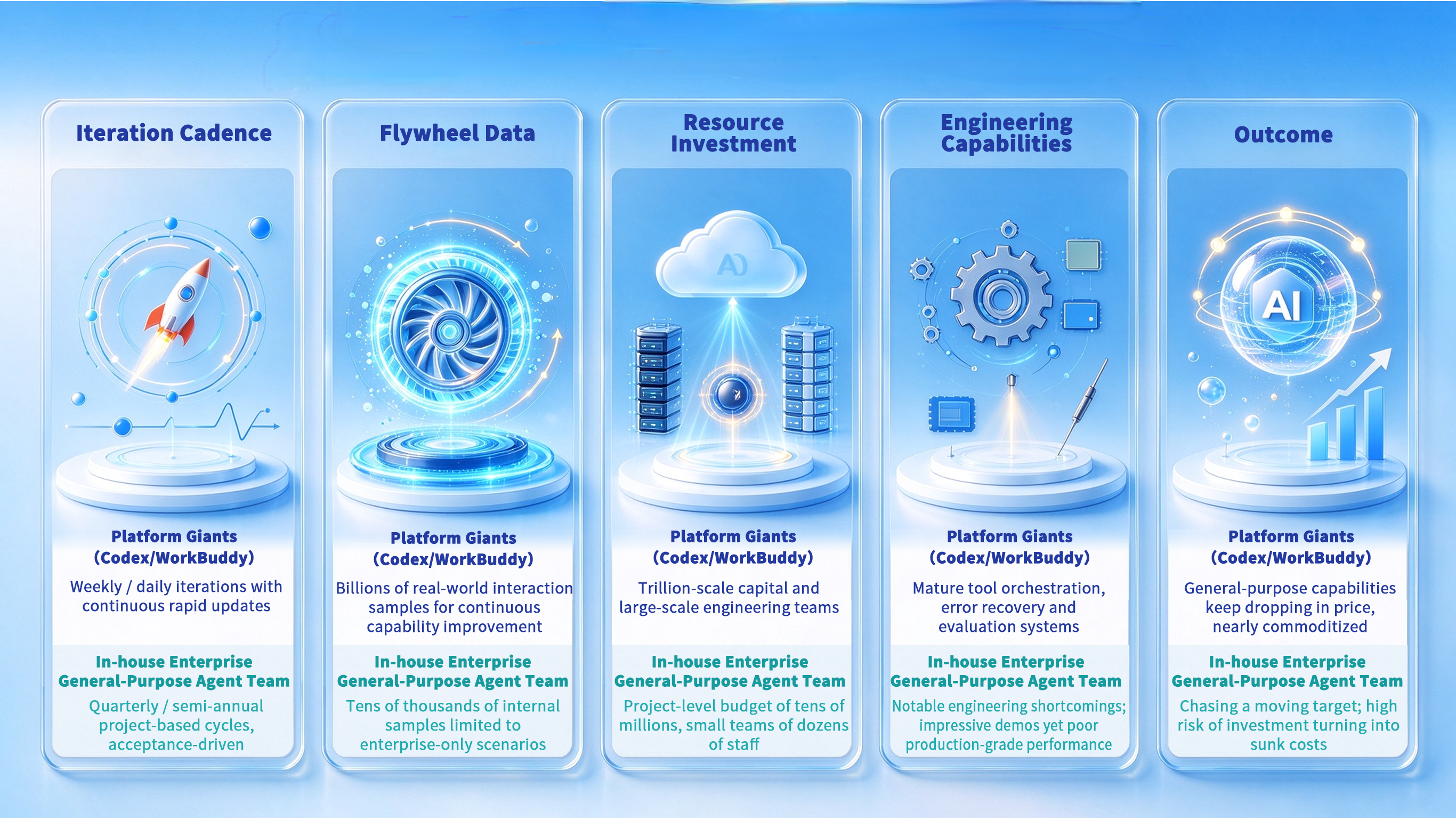
(The image illustrates the reasons why enterprise self-developed general-purpose Agents fail compared to platform solutions)
I. This Is a Fictional War
Let us first acknowledge a premise: general-purpose Agents are valuable. They can write code, call tools, and orchestrate tasks across systems—this fact is established. The issue is never whether "general-purpose Agents are useful," but rather "who should be doing this."
The so-called "arms race" is a conflict where neither side can even field a full team. A genuine competition implies both parties are on the same track, engaging in confrontation, stalemates, and suspense over victory. But in the game of general-purpose Agents, one side represents trillions in investment and platform power, while the other consists of enterprise teams pieced together from project budgets. This is not a competition; it is a unilateral (overwhelming annihilation) misreported as a contest. Anxiety requires the guise of war to justify itself, so everyone prefers to believe they are "participating."
The competitiveness of a general-purpose Agent is built upon three layers: the model's reasoning capability, the engineering ability to call and orchestrate tools, and the data and feedback loop used to train the system. Each of these three layers constitutes heavy assets.
The model layer is a battleground requiring trillions in capital and top-tier research teams. The tool layer demands hundreds or thousands of engineers to interface with operating systems, browsers, code repositories, enterprise software, and hundreds of MCP protocols. The data layer requires billions of real-world interaction samples for refinement. None of these three elements can be covered by "30 people and a 20 million RMB budget."
Behind Codex stands OpenAI’s entire R&D ecosystem; behind WorkBuddy lies Tencent’s platform engineering prowess. For an enterprise to self-develop a general-purpose Agent is akin to sending an amateur squad into an unrefereed slaughter. The public perceives this as a professional league match, but it doesn't even qualify as a game—the outcome was written long before registration opened.
Some might say: "I don't need to develop my own model; I'll just call the large model API and focus solely on the application layer." This sounds clever, but in reality, it merely hides the problem. The application layer is precisely the most difficult layer for a general-purpose Agent. Tool orchestration, environment understanding, task decomposition, error recovery, and long-range consistency—these are what determine whether an Agent can actually "get work done," not how impressive its demos look.
And this is exactly the layer where platform iteration is fastest. Today your team has just debugged browser automation, and next week the platform releases a more stable version for free. Every inch of progress you chase is chasing a moving target, and that target runs faster than you do.
Speed is the most underestimated variable in this "race," and also its most illusory aspect: it makes falling behind feel like catching up. Enterprise project timelines are quarterly or semi-annual, with acceptance as the milestone; platform product cycles are weekly or daily, driven by release cadence. They operate on entirely different time scales. While enterprises are still scheduling milestones for their first general-purpose Agent, platforms have already crossed the third milestone in their roadmap. This isn't a gap; it's a difference in species. A race requires sharing the same track, but these two are running on completely different timelines.
II. Moats are Flywheels, Not Models
A harsher truth is that the moat for a general-purpose Agent never lies in any single model or any specific engineering detail, but rather in the flywheel.
Here’s how the flywheel spins: every time a user interacts with the Agent, the product gains another feedback sample; the more samples there are, the better the model understands how to perform tasks; the more capable the model becomes, the more users it attracts. This is a self-reinforcing cycle, and each revolution of the cycle widens the gap between the platform and those trying to catch up.
There is a subtle detail easily overlooked here. The feedback signals from a general-purpose Agent represent the highest reusability value among all AI products. An experience gained from debugging code, orchestrating tools, or recovering from failure can be almost entirely transferred to the next, completely different task. For every additional user the platform serves, it doesn't just learn "how this specific user operates," but rather "how the act of working itself is accomplished."
Vertical applications cannot achieve this. Data from a customer service Agent can only accumulate within the narrow domain of customer service; it becomes useless when applied to finance. In contrast, data from a general-purpose Agent accumulates "capabilities" themselves. The universality of this data allows the platform's flywheel to spin faster than any vertical niche, presenting any enterprise attempting to catch up in the general-purpose arena with an opponent that grows further away the more they chase.
The platform's dataset is measured in hundreds of millions, while an enterprise's is measured in tens of thousands. This disparity is not linear; it is exponential. While you spend time in the lab repeatedly tuning prompts for a hundred internal tasks, the platform's model has already consumed millions of new real-world interactions generated today.
By early 2026, Claude Code achieved $2.5 billion in annualized revenue, accounting for over half of Anthropic's enterprise income. In April 2026, Codex was named a Leader in Enterprise Coding Agents by Gartner. Behind these numbers lies a flywheel spinning at a velocity that enterprises simply cannot match.
Every "functional" Agent an enterprise builds today exists within an eternal pursuit constantly being flattened by platform version iterations. You may believe you are developing independently, but in fact, you are merely pacing alongside the platform's progress bar. This is not a race; it is an illusion—a marathon where only one person is running, and the athlete believes they are competing, unaware that on the empty track, even an opponent does not exist.
III. Let's Do the ROI Math
Setting aside technology and looking purely at the financials, the conclusion remains equally unflattering.
The cost of developing a proprietary general-purpose Agent breaks down into four components. Model invocation: you cannot escape this because the foundation models come from the same vendors. Engineering labor: a stable, production-ready general-purpose Agent requires personnel in four categories—tool orchestration, evaluation, security, and operations. Based on a mid-sized team configuration, this amounts to tens of millions annually. Evaluation systems: since general-purpose Agents lack standard answers, you must build your own task suites and regression pipelines; otherwise, every model upgrade could silently degrade your Agent's performance. Long-term maintenance: whenever the platform changes its API or swaps out its model, your adaptation layer must follow suit; this code will never truly be "finished."
And yet, the output of all this effort is a "general-purpose" capability that could be covered by the platform's free tier at any moment.
The issue lies precisely in the word "general-purpose." Enterprises rarely need true generality. What they actually need is a domain-specific agent that understands their business, integrates with their systems, and adheres to their compliance requirements. Generality is a moat for the platform, but redundancy for the enterprise. You pay for a "general-purpose" solution you barely utilize, while the platform offers this same "generality" at near-cost prices.
In other words, every dollar spent by an enterprise developing its own general-purpose Agent is purchasing something the platform already supplies cheaply—or even for free. This is not investment; it is redundant purchasing.
Consider another set of figures. Gartner predicts that by 2027, 40% of Agentic AI projects will be cancelled. From October 2025 to January 2026, industry surveys indicate a production failure rate for Silicon Valley enterprise AI Agent projects as high as 95%. The causes of failure consistently point to insufficient engineering capabilities rather than inadequate model intelligence.
Note this conclusion. The models are already intelligent enough to deliver "solid demo results." What kills these projects are engineering challenges such as tool orchestration, environment adaptation, long-range consistency, and error recovery. Crucially, these are precisely the areas where platforms excel and enterprises struggle the most.
An engineer at a bank concluded after developing 12 Agents that most systems "demonstrated well" but failed to meet production requirements. This statement serves as an epitaph for all enterprise efforts to develop proprietary general-purpose Agents.
IV. A company's advantage lies precisely in being "non-generalized"
Reversing the above statement reveals the strategic clarity that companies should possess.
What a company truly owns and what platforms can never replicate are four things: private data, business context, organizational processes, and industry know-how. These share a common trait: they are all "non-generalized." They are unique to your company, unreachable by platforms even from a great distance.
Therefore, the correct approach has never been to develop a generalized Agent in-house, but rather to integrate the platform's general capabilities into your own proprietary depth.
Use Codex or WorkBuddy as your foundation. Then focus your efforts on four tasks that platforms cannot handle: feed your proprietary knowledge base, connect your internal tools via MCP, embed your business rules and compliance constraints, and evaluate using your real-world scenarios.
This is an investment with a positive ROI. Because it targets areas where the platform lacks capabilities, rather than areas where the platform is stronger.
If you spend 20 million developing a generalized foundation in-house, the platform will upgrade it for free within three months. If you spend 20 million integrating platform capabilities into your business depth, no platform can ever replace that depth for you. The former is throwing money into a race you are destined to lose; the latter transforms money into your unique asset.
V. Evaluation is an invisible barrier
Some argue: "The platform's generalized Agent is 'generalized,' so it doesn't understand my business; I need an Agent that 'understands my business.'" This argument commits a fallacy of equivocation.
"Understanding your business" is not achieved through self-developed general foundations, but through evaluation. You need a task set that reflects your actual business to select models, configure prompts, and validate every upgrade. This is the true meaning of "understanding business" and where companies should invest most.
However, evaluation itself is another heavy lifting endeavor often underestimated by most enterprises. Generalized Agents have no standard answers; determining whether a task is "done or not done, well or poorly" is inherently difficult to automate. Platforms invest heavily in evaluation because they serve the common tasks of massive user bases. Companies must build evaluations for "their own tasks" atop this foundation. The former is the platform's domain; the latter is your home turf.
Enterprises that equate "understanding business" with "developing their own Agent" apply their efforts in reverse: they clash head-on at the platform's strengths while leaving their home turf completely empty. Believing they are solving the "business understanding" problem, they are actually avoiding the essential evaluation work in the most expensive way possible.
VI. Excuses for "Must Develop In-House"
At this point, people always cite several reasons to justify why "we must develop in-house." Let's examine them one by one.
First reason: Data security requires on-premise deployment, so we must develop in-house.
This is the most popular yet least defensible argument. Data security relies on boundary controls, access audits, encryption, and masking—not writing an Agent from scratch. Private deployments, dedicated clouds, and local model gateways can address security without going to the cloud. Developing a generalized Agent in-house does not make your data safer; instead, immature engineering exposes more attack surfaces. Using an immature system to "protect" data is logically counterproductive. More commonly, many companies claiming "data security necessitates in-house development" find their self-developed Agents riddled with basic access control vulnerabilities, ultimately relying on the platform's security audit as a fallback.
Second reason: We need autonomy and control; we cannot be held hostage.
True bottlenecks exist at the model and chip levels—battles fought at national and corporate giant scales, far beyond the scope of any single enterprise seeking "autonomy and control" in a generalized Agent application. Thousands of self-developed Agents already exist across the industry; adding yours contributes nothing to autonomy and control. Attaching the phrase "autonomy and control" to a generalized Agent reduces a serious strategic issue to mere budget approval rhetoric. The things you truly need to achieve "autonomy and control" are precisely those you have never invested in.
Third reason: We have an existing team internally, and they're idle anyway.
This is budgetary, not a strategic rationale. Assigning a team to perform a task destined to be rendered obsolete by the platform consumes time they could otherwise dedicate to building business depth. This isn't "utilizing idle resources"; it's "wasting the scarcest resource." Team time is more valuable than a 20-million budget because it is non-renewable.
The fourth reason: My scenario is unique, and a general-purpose Agent cannot cover it.
This statement is half right. The uniqueness of the scenario is true, but the solution isn't to build your own general-purpose foundation; rather, it's to implement a layer of domain adaptation. Unique scenarios actually require standing on the foundation of general capabilities, not building from scratch yourself. Your uniqueness lies in business rules and proprietary data, not in the wheels of tool orchestration. No enterprise that has truly deepened its domain application has succeeded by developing its own general-purpose foundation; what they have done is build their own wall upon a general-purpose foundation.
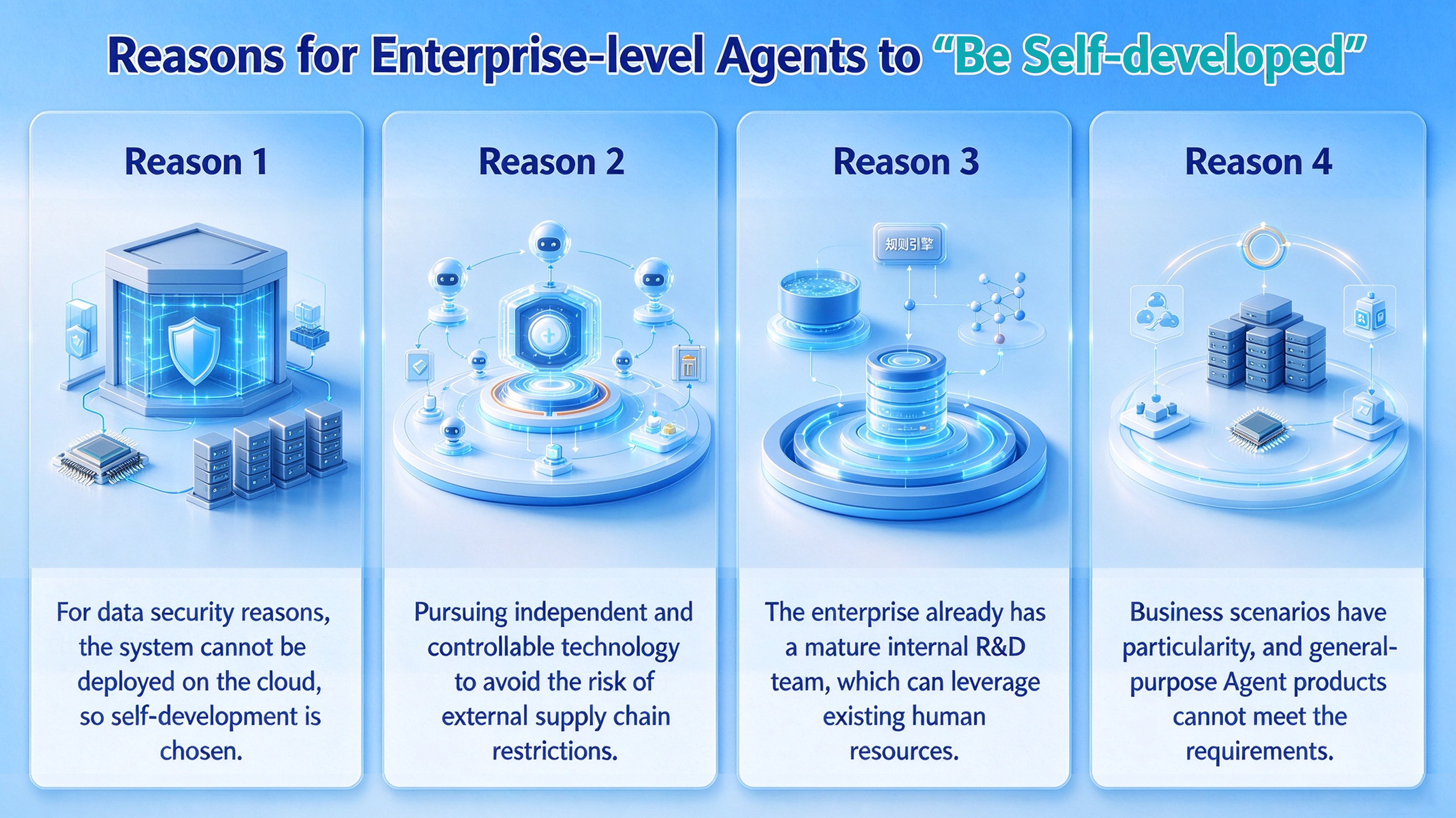
(The image illustrates the reasons why enterprise Agents must develop their own foundations.)
None of these four reasons are technical necessities; they are all products of organizational inertia, budgetary inertia, or a misinterpretation of the word "autonomy." They all stem from Agent anxiety, manifesting as four excuses born at the conference table.
Looking at this over a longer timeline, the ultimate destination for general-purpose Agents will likely be to become a type of infrastructure, much like today's operating systems and browsers. Infrastructure characteristics include: control by a few platforms, near-free general capabilities, and most participants merely being users. No enterprise builds its own operating system, and no enterprise builds its own browser. General-purpose Agents are heading down the same path.
By the time that day arrives, current projects focused on developing self-built general-purpose Agents will appear particularly absurd. They didn't lose to competitors; they lost to an industrial structure that was predetermined from day one.
VII. Skills Kill Startups: The Sharpest Question
From 2024 to 2025, the most vibrant scene in the AI sector has been vertical niche Agent startup teams. Customer service Agents, sales Agents, recruitment Agents, finance Agents—dozens to hundreds of teams have crowded into every niche track, bringing funding and polished demos. That is another host of Agent anxiety: startups.
Two years later, most of them have died from an unexpected opponent: not a competitor, nor a giant, but a Skill within Claude Code.
What is a Skill? It is a prompt and configuration spanning a few hundred lines that anyone can install into Claude Code with ease. It requires no funding, no team, and no product launch event. It only requires one person to clearly write out "how to do this thing" on a certain afternoon. And then it can just work.
Herein lies the cruelty: the "moat" built by vertical Agent teams over two years and tens of millions in funding is essentially knowledge that can be replicated by a Skill. The cost of replicating a Skill is zero. Your barrier is reduced to a single prompt within the platform ecosystem. The Skill ecosystem isn't here to compete with you; it is here to prove that you never existed. Today's Skills in Claude Code will be tomorrow's skill marketplace in WorkBuddy. Every time a platform opens its ecosystem, a batch of vertical Agents loses its value proposition.
So now, I want to throw the same question back at enterprise Agent teams:
Is there anything you can do that WorkBuddy cannot?
I don't need an immediate answer. Let me rehearse the most common response for you.
"We have enterprise context data." — This is the first reaction and also the most fragile moat.
Let me tell you a fact: if you can access that data, the young woman in the office using WorkBuddy can access it too.
Permissions? Access? Authorization? These have never been technical barriers; they are administrative actions. Data that a CIO's email can grant you access to today can grant anyone access to tomorrow via the same email. So-called "enterprise context," in the face of platform Agents, is simply the next MCP access request. It protects nothing; it is just temporarily locked.
Agent teams still treating "enterprise context" as a get-out-of-jail-free card should seriously consider this question: When WorkBuddy can read everything you can read, what does your Agent have left? Is your model better? Or is your tool orchestration more stable? Or do you iterate faster?
If the answer to all three is negative, then your product is nothing more than a feature list destined to be covered by the platform's free version.
This is the final heavy blow of this article. Up until now, I have said that "developing self-built general-purpose Agents is meaningless." Now I will state it even more emphatically: Not only general-purpose Agents, but even the independent survival of vertical Agents has been sentenced to death by the platform ecosystem; the execution date simply depends on the speed at which the platform releases Skills.
VIII. Dragon Bravo's Maestro is not another base platform
At this point, a rebuttal awaits me: Dragon Bravo BMS DXP is building its own Maestro while advising others against developing in-house Agents. Isn't this contradictory?
This question deserves a direct answer, as it precisely delineates the line that has been repeatedly blurred.
Maestro is not a general-purpose Agent base; it is a layer of domain orchestration. Its goal is neither to replace Codex nor to recreate a WorkBuddy. Rather, it stands on the shoulders of these general-purpose Agents to orchestrate BMS DXP’s own suite of modules: digital asset management, content management, product information, e-commerce engine, and knowledge center. These modules function as independent systems, with business rules dispersed throughout the organization and industry know-how residing in people's minds. Connecting them, linking them, and orchestrating them through a natural language interface is the true challenge Maestro must tackle. This layer is beyond the understanding of Codex and WorkBuddy, because they do not understand your industry—and they are not meant to.
Therefore, BMS DXP embraces Codex and WorkBuddy as its base, investing all its energy into the layer that platforms cannot reach: industry depth. General-purpose Agents handle intelligence; Maestro handles industry expertise. The former is delegated to the platform, while the latter is retained internally.
This is how the argument from Section IV above manifests itself in a specific company. What enterprises should focus on most is never developing their own general-purpose base, but rather cultivating their own unique domain depth atop existing general-purpose bases. Dragon Bravo chose this path. It did not suffer from Agent anxiety—or rather, it channeled that urgency into the right place. Whether it succeeds or not is another matter; but its direction aligns perfectly with what this article advocates.
Conclusion
The battle for general-purpose Agents has never truly begun. The so-called endgame was merely a pre-written opening act. Codex, WorkBuddy, and others will continue to evolve on a weekly basis, compressing general capabilities until they become increasingly affordable—so cheap that the economic rationale for in-house development vanishes entirely. The event dubbed an "arms race" has been nothing more than a collective performance of anxiety from start to finish.
The time window for enterprises to make choices is narrowing. With every iteration of the platform, the opportunity cost of "developing in-house general-purpose Agents" rises. Hesitation today becomes sunk costs tomorrow; those sunk costs turn, by the day after tomorrow, into a shutdown report no one is willing to sign.
The most dignified choice for enterprises is to acknowledge that they are not players in this arena. Redirect the saved capital and human resources to areas that platforms can never replicate for you: your industry, your data, your customers, and your compliance.
Otherwise, looking back years later, those self-developed general-purpose Agents will have become a pile of unmanageable, obsolete legacy systems that were quietly shut down due to maintenance burdens and inability to keep up. Their most ironic fate is that on the very day they are decommissioned, the functions they once performed will be taken over by a platform product they had previously dismissed as "too uncontrollable."
In an arms race, the clearest-headed competitor is the one who never signed up in the first place. No one is racing them. The antidote to Agent anxiety is never another Agent, but rather clarity about what only you can achieve that platforms cannot. Once this is understood, the illusory arms race dissolves instantly, and anxiety returns to solid ground.


Want to know more about our products?
With years serving Fortune 500 clients, we offer flexible solutions and integrated implementation.
