





2026: The Era of AI Agents – The Bottleneck Challenge and Breakthrough Strategies for Enterprise Knowledge Governance
Release Date: 2026-08-26
Author: William
Pain Point: When AI Agents Encounter a “Knowledge Black Hole,” Enterprise Decision-Makers Lie Awake at Night
As AI agents increasingly demonstrate their capabilities within enterprises, we frequently encounter the following dilemmas: “Why does the AI customer service agent keep answering questions incorrectly—how could it not know the latest policies?” or “The sales AI assistant’s proposals conflict with the marketing department’s official messaging—how will customers perceive this?” These issues all point to a “knowledge black hole” behind AI agents—fragmented knowledge sources, inconsistent information versions, data discrepancies, ambiguous permission boundaries, and poor traceability. According to CMI research, 28% of B2B marketers have piloted AI agents, yet data quality and compliance issues have become typical barriers [2].
In real-world business scenarios, the harms caused by these “knowledge black holes” extend far beyond such examples. For instance, a multinational manufacturing enterprise maintains product design documents, test reports, and technical specifications across disparate systems and local storage repositories in its R&D teams worldwide. When rapid market response is required to launch new product iterations, AI agents are expected to integrate global knowledge swiftly and provide innovative recommendations. However, due to fragmented knowledge, AI agents struggle to access the latest and most comprehensive technical documentation, resulting in impractical proposals that even contradict existing technology roadmaps—severely delaying time-to-market. Similarly, for a financial institution’s intelligent investment advisory system, failure to synchronize the latest regulatory policies and market data when providing investment advice may expose recommendations to compliance risks—or even cause financial losses to clients, ultimately damaging the enterprise’s reputation. Therefore, before deploying AI agents, enterprises must resolve knowledge base governance issues; otherwise, even the most advanced AI may “intend well but deliver harm,” transforming from a “game-changing ally” into a “deadweight teammate.”
Diagnosis: How Does AI—the “Demon-Revealing Mirror”—Amplify Gaps in Enterprise Knowledge Governance?
The emergence of AI agents does not disrupt existing content management systems but rather acts as a “demon-revealing mirror,” magnifying both strengths and weaknesses in enterprise content asset management. Whether an enterprise possesses unified, trustworthy, governable, and reusable content assets directly determines whether AI agents can truly deliver value. Adobe’s 2026 AI and Digital Trends Report states that generative AI and agent AI are reshaping customer journeys, yet data silos, insufficient organizational collaboration, and inadequate enterprise-level deployment remain key obstacles [1]. Knowledge governance is urgent and non-negotiable.
Within the operational logic of AI agents, the accuracy of knowledge sources forms the bedrock of “intelligent” responses; strict permission controls serve as the “firewall” safeguarding information compliance and security; robust version management ensures knowledge timeliness and consistency; and traceability functions as the “anchoring pillar” for addressing challenges, correcting errors, and meeting audit requirements. If these foundational governance elements are absent, AI agents become like water without a source—their intelligent performance suffers significantly and they may even evolve into major operational hazards for the enterprise. For example, in healthcare, an AI agent designed to assist physicians with diagnosis—if trained on outdated medical literature未经 rigorous review—may produce diagnostic recommendations with serious deviations, directly threatening patient safety. In legal services, if an AI agent cannot trace the latest versions and interpretations of cited statutes, its legal opinions may become invalid, exposing enterprises to substantial legal risk. Enterprises therefore urgently require a systematic methodology to build an “agent-ready” knowledge foundation.
Breakthrough: Building an “Agent-Ready” Enterprise Knowledge Foundation—How Does BMS DXP “Fill the Gaps”?
Constructing a knowledge foundation capable of supporting efficient and accurate AI agent operations requires deep integration across multiple dimensions—including content management, digital asset management, product information management, and knowledge centers. The BMS Digital Experience Platform (BMS DXP) delivers an integrated solution to systematically “bridge” knowledge gaps.
BMS DXP Knowledge Center structures and classifies diverse internal and external enterprise knowledge, and provides powerful full-text search capabilities. It supports granular permission controls to ensure users access only authorized knowledge, and enables version traceability to guarantee knowledge timeliness and auditability. The Knowledge Center also serves as the “brain” for enterprise FAQs and help centers, directly powering AI-driven Q&A and supplying high-quality training knowledge bases for AI agents—even enabling intelligent multilingual knowledge distribution [BMS Product Information].
Digital Asset Management (DAM) plays a pivotal role in knowledge governance. It is not merely a repository but the “intelligent hub” for enterprise digital assets.
l The “Ledger” for Asset Governance: DAM manages all enterprise digital assets, ensuring uniqueness, version control, and compliance. Through AI-powered tagging, multimodal search, and granular permission management, DAM aggregates scattered assets across disparate locations into a unified, reusable brand asset library. For example, when a global automotive brand expanded into overseas markets, marketing staff previously spent half a day searching across three WeChat groups and two shared cloud drives just to locate a high-resolution front-facing image of its latest vehicle model. Now, via the DAM module of BMS DXP, the company achieves centralized management of massive assets and enables full-text search using filenames, tags, and metadata—boosting search efficiency by more than one order of magnitude [Summary of a Global Automotive Brand Project]. This efficiency gain not only reduces labor costs but, more importantly, ensures consistent and accurate brand representation across global markets, avoiding brand damage caused by incorrect or outdated assets.
l The “Expressway” for Global Application Acceleration: For multinational enterprises, DAM’s global application acceleration capability is the “lifeline” determining overseas operational efficiency. Two distinct layers of acceleration must be distinguished:
l Acceleration for End-User Asset Preview, Access, and Download: Primarily targets scenarios where enterprises distribute assets to consumers or partners. BMS DXP deploys overseas CDN nodes globally, employs intelligent routing strategies, and leverages multithreaded parallel transmission to ensure users worldwide can preview, access, and download digital assets rapidly and smoothly. For example, the automotive brand project proactively integrated overseas CDN nodes, intelligent routing, and multithreaded transmission during planning to enhance cross-border large-file access experiences. However, actual performance depends on deployment regions, local network conditions, and specific test results—and cannot be generalized [Summary of a Global Automotive Brand Project]. This means marketing teams in New York or partners in Tokyo can retrieve required brand assets at near-local speeds, dramatically improving global collaboration efficiency and market responsiveness.
l Acceleration for Overseas Employees’ DAM Backend Operations: Primarily addresses “bottleneck” issues in internal global collaboration. When overseas employees log into the DAM backend to perform complex tasks—including asset search, filtering, upload, editing, AI tagging, approval, metadata maintenance, permission configuration, and statistical queries—traditional public internet transmission often suffers from high latency and instability, severely impacting productivity. BMS DXP optimizes global application acceleration solutions based on high-quality cross-border networks such as CN2 or 9929, significantly enhancing stability and responsiveness for overseas teams performing complex DAM backend operations—powerfully ensuring global content operation efficiency and collaboration. This enables overseas teams to work “seamlessly.” Such backend acceleration is critical for global enterprises requiring frequent content updates, asset reviews, and cross-departmental collaboration—ensuring smooth operation of the digital content supply chain.
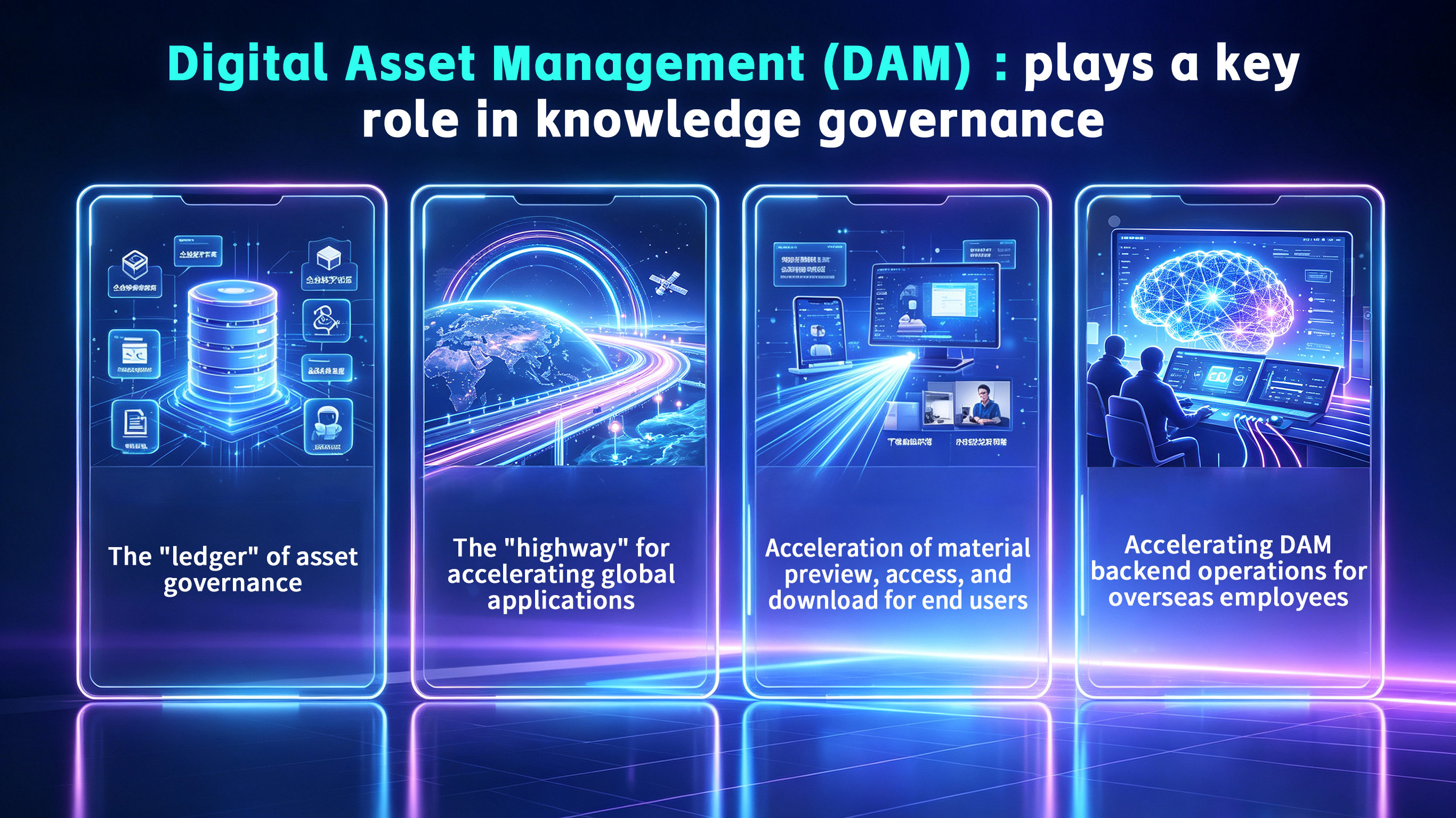
(The image illustrates DAM’s pivotal role in knowledge governance.)
Synergy Between Product Information Management (PIM) and Content Management is another indispensable “twin wing” in building a knowledge foundation. PIM manages complex product data and attributes to ensure product information accuracy and consistency—it is the “source water” of product information; the Content module handles front-end content creation and publishing for websites and marketing campaigns—it is the “window” through which information is externally presented. Through tight integration among DAM, PIM, and the Knowledge Center, enterprises unify management of product documentation, digital assets, knowledge documents, and marketing content, forming a complete, seamlessly flowing knowledge system [BMS Product Information]. This integrated management approach effectively avoids information silos and data redundancy, ensuring information consistency across the entire value chain—from product R&D to market promotion.
Additionally, BMS DXP deeply integrates AI-Native Capabilities, further bolstering knowledge governance. This includes AI-powered one-click metadata translation, AI automatic parsing/intelligent tagging, similar image retrieval, automated workflows, and compliance detection [Summary of a Global Automotive Brand Project]. These AI capabilities not only significantly enhance knowledge processing efficiency but also markedly improve knowledge usability and accuracy, truly bringing knowledge to life. For instance, the AI auto-tagging feature automatically identifies content within images and videos and applies precise tags, drastically reducing manual labeling efforts while improving search accuracy. Meanwhile, automated workflows execute predefined processes—such as content review and publishing—automatically, further enhancing content operations efficiency and standardization.
Enterprise knowledge governance maturity directly impacts AI agent effectiveness—much like a foundation determines a skyscraper’s stability. We categorize enterprise knowledge asset maturity into four levels to help you identify which “quadrant” your organization occupies:
| Maturity Level | Characteristics | AI Agent Application Challenges | BMS DXP Solution |
| Dispersed Documents | Knowledge is scattered across individual PCs, departmental cloud storage, and multiple systems—akin to “nine dragons managing water” | Severe information silos prevent AI from accessing complete, consistent knowledge; outputs become incoherent (“mismatched lips and horses”) and factually inaccurate—effectively turning AI into a “rumor generator” | Unified content management platform with DAM asset aggregation ends fragmented, independent operations |
| Centralized Search | Knowledge is aggregated onto a single platform enabling keyword search, yet remains unstructured—like a “mixed stew” | Search results may lack precision; AI struggles to comprehend context and semantics, limiting it to basic “keyword matching” without advanced reasoning | Structured classification, metadata management, and semantic search in the Knowledge Hub bring order and logic to knowledge |
| Structured Knowledge | Knowledge has been structured with clear categorization, tagging, and metadata—like a “library” | AI can perform Q&A based on structured data, yet still requires manual verification for accuracy and compliance—falling short of “full trust” | AI-powered Q&A, intelligent auto-tagging, automated workflows, and compliance detection in the Knowledge Hub make AI “understand you better” |
| Controlled AI Q&A | The knowledge base is deeply integrated with the AI agent, delivering highly accurate, traceable, and compliant Q&A—like a “smart brain” | Continuously optimizing AI Q&A performance ensures synchronized knowledge updates and permissions—pursuing “excellence without end” | The Knowledge Hub serves as the AI training knowledge base, with granular permission management, version traceability, and audit logs—making AI “trustworthy” |
From dispersed documents (“nine dragons managing water”) to controlled AI Q&A (“smart brain”), enterprise knowledge asset maturity progressively rises, rendering AI agents increasingly powerful and reliable. BMS DXP’s synergistic Knowledge Hub, DAM, PIM, and Content modules aim to elevate enterprises to higher-tier knowledge governance—ultimately transforming AI agents into indispensable “game-changing allies” for business growth.
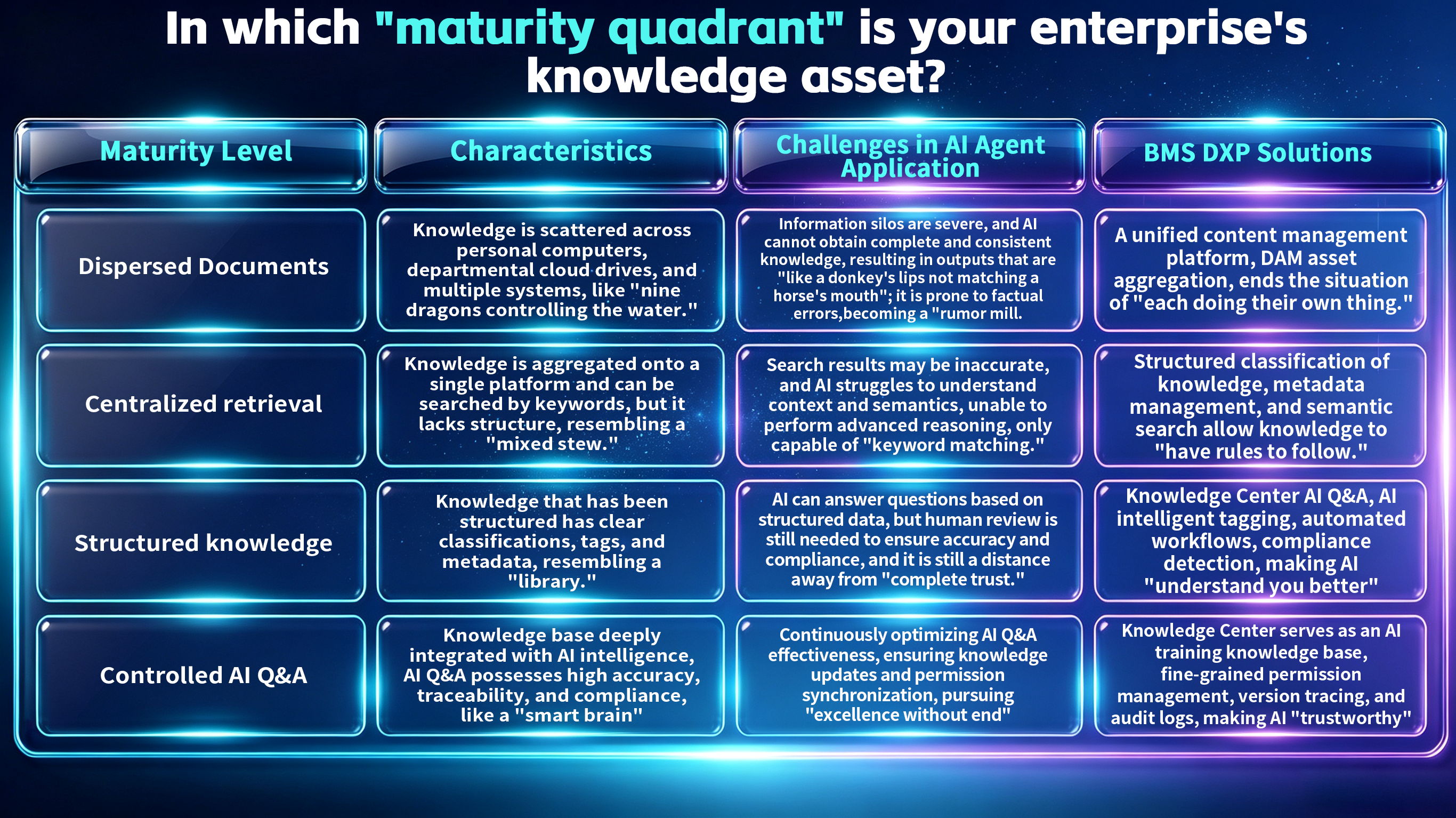
(Illustration showing the maturity quadrant occupied by enterprise knowledge assets)
Conclusion: Knowledge Governance Is the Essential Pathway for AI Agents to Excel
As AI agents become core drivers of enterprise digital transformation, knowledge governance is no longer an “optional extra”—it is the “lifeline” for realizing AI agent value. A unified, trustworthy, governable, and reusable knowledge base is the critical “foundation card” ensuring AI agents deliver accurate, compliant, and efficient information. Neglecting knowledge governance while rushing AI agent deployment is akin to building a skyscraper on quicksand—the resulting risks and costs will far exceed expectations.
BMS DXP, as an enterprise-grade Digital Experience Platform, provides a comprehensive solution for building an “agent-ready” knowledge foundation through its robust Knowledge Hub,Digital Asset Management (DAM), Product Information Management (PIM), and Content modules. It not only resolves long-standing enterprise pain points—including knowledge fragmentation and inconsistent information—but also empowers global operations through AI-native capabilities and accelerated global adoption, enabling efficient knowledge flow and governance worldwide.
Frequently Asked Questions (FAQ)
Q1: How does the BMS DXP Knowledge Hub support AI agent knowledge requirements?
The BMS DXP Knowledge Hub delivers high-quality, trustworthy training data for enterprise AI applications via structured classification, full-text search, version traceability, and granular permission control. Knowledge content is API-exportable, serving directly as training corpora for enterprise-owned AI models. Its built-in AI Q&A engine—available in both cloud and on-premises deployment modes—enables users to retrieve precise answers in natural language, complete with source citations.
Q2: How can enterprise knowledge asset maturity be assessed and improved?
Knowledge asset maturity comprises four levels: Dispersed Documents → Centralized Search → Structured Knowledge → Controlled AI Q&A. BMS DXP advances enterprises stepwise from lower maturity toward “Controlled AI Q&A” through structured classification in the Knowledge Hub, unified DAM asset management, PIM product data governance, and Content publishing. Enterprises can self-assess their current stage against this maturity model and chart a targeted improvement path.
Q3: How is AI Q&A accuracy and compliance ensured?
The BMS DXP Knowledge Hub sets a semantic similarity threshold—no answer is generated if retrieved content lacks sufficient relevance. All AI answers include source citations for user verification. A feedback loop enables users to flag inaccurate answers, triggering manual correction workflows. On-premises deployment ensures sensitive data remains within organizational boundaries, meeting compliance requirements for finance, defense, healthcare, and other regulated industries.
Q4: What value does the Knowledge Hub deliver to internal employees?
The BMS DXP Knowledge Hub serves not only external customers (e.g., help centers) but also functions as the enterprise’s internal knowledge backbone. New hires instantly search “installation procedure for Product X” in the Knowledge Hub and receive AI-generated answers with source links. When experienced staff depart, their expertise is already structured and preserved in the knowledge base—eliminating knowledge attrition. Operational dashboards track AI Q&A accuracy rates and frequently missed queries, enabling continuous knowledge coverage optimization.
Q5: How is a multilingual knowledge base built?
BMS DXP Knowledge Hub approach: Establish a primary knowledge base in a core language (e.g., Chinese or English); use AI translation to generate multilingual versions, followed by human review to ensure technical term accuracy; manage all languages centrally on one platform. When product specifications update, all language versions refresh simultaneously. Multilingual content is uniformly delivered to corresponding-language websites.
Q6: Does the BMS DXP Knowledge Hub support on-premises AI deployment?
Yes. The BMS DXP built-in AI Q&A engine supports both cloud-based AI models (via integration with mainstream LLM APIs) and on-premises AI models. On-premises deployment keeps core knowledge data within organizational boundaries, satisfying compliance and audit requirements for finance, defense, healthcare, and other regulated sectors. It also supports fine-grained permission controls and end-to-end audit logging.
References
[1]: Adobe, “2026 AI and Digital Trends Report”: https://business.adobe.com/resources/digital-trends-report.html
[2]: Content Marketing Institute, “B2B Content and Marketing Trends: Insights for 2026”: https://contentmarketinginstitute.com/b2b-research/b2b-content-marketing-trends-research
[3]: Google Search Central, “AI Features and Your Website”: https://developers.google.com/search/docs/appearance/ai-features
[4]: CMSWire, “Digital Experience Platforms (DXPs): 2026 Comprehensive Guide”: https://www.cmswire.com/digital-experience/what-you-need-to-know-about-digital-experience-platforms/
[BMS Product Information]: DragonBravo Brand & Product Reference Manual (bms-product-info.md)
[Summary of a Global Automotive Brand Project]: Functional Summary of a Global Automotive Brand Project (Internal project functional materials, de-identified)


Want to know more about our products?
With years serving Fortune 500 clients, we offer flexible solutions and integrated implementation.
