





Enterprise DXP Migration Methodology 2026:A Real-World Reconstruction Case of a Multinational Automotive Brand’s China Website from Adobe AEM to BMS DXP
Publication date: May 1 , 2026
Author:William
Introduction: Why Are Automotive Giants Hitting the “Reset Button” on AEM Architecture?
In the automotive industry, a brand’s official website is not merely a product showcase window but also the core digital hub connecting online leads to offline test drives. A multinational automaker’s China site was originally built on Adobe Experience Manager (AEM). Although AEM had once been the benchmark for enterprise-grade CMS, as the automaker’s demands for omnichannel marketing and AI-powered intelligent operations grew increasingly, AEM’s heavy monolithic architecture, complex component development cycles, and high TCO (Total Cost of Ownership) gradually became bottlenecks constraining business agility [1].
To remain competitive in the 2026 digital experience race, the automaker decided to fully migrate its core China site to Dragon Bravo Corporation’s proprietary BMS DXP. This is not merely a foundational technology replacement, but a leap from traditional CMS to a native AI-driven dual-mode (Headed & Headless) architecture [1]. This article will deeply demystify the professional methodology adopted by the Dragon Bravo team during this migration project, demonstrating how seamless transfer of pages, components, data, and millions of digital assets was achieved.
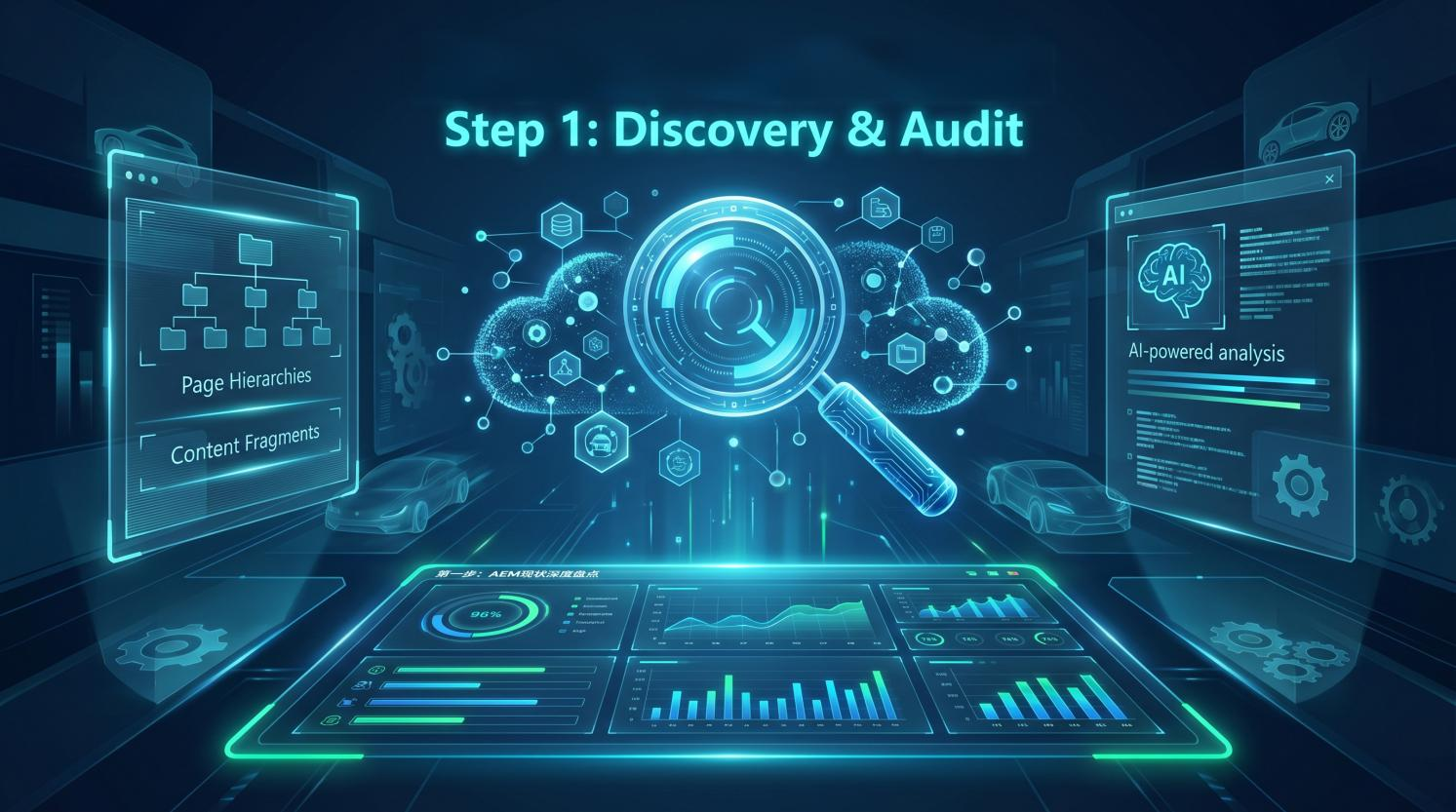
Step One: In-Depth Inventory of Current AEM State (Discovery & Audit)
Every successful enterprise software migration begins with precise assessment of the current state. At the outset of the project, rather than rushing into coding, the Dragon Bravo team conducted a comprehensive asset audit of the automaker’s AEM environment—a core starting point of the AEM migration methodology.
Combining automated scripts with manual review, the Dragon Bravo team performed an exhaustive inventory across the following seven core dimensions:
1. Page Hierarchy (Pages): Catalogued the thousands-of-pages tree structure of the China site, identifying high-traffic pages and redundant historical pages.
2. Digital Assets (Assets/DAM): Counted all multimedia assets—including vehicle images, videos, and PDF manuals.
3. Frontend Components (Components): Analyzed both foundational and deeply customized business components used in AEM.
4. Page Templates (Templates): Summarized static and dynamic templates supporting various vehicle displays.
5. Users & Permissions (User & Permissions): Audited access and editing permissions across different marketing teams and dealerships.
6. Experience Fragments (XF): Catalogued visual experience fragments distributed across channels.
7. Content Fragments (CF): Organized pure structured-data fragments decoupled from presentation layers.
Through this inventory, the Dragon Bravo team developed a field-level migration mapping dictionary tailored specifically for the automaker, ensuring no critical data point would be missed during subsequent migration.
Step Two: Target Architecture Design for BMS DXP (Architecture Design)
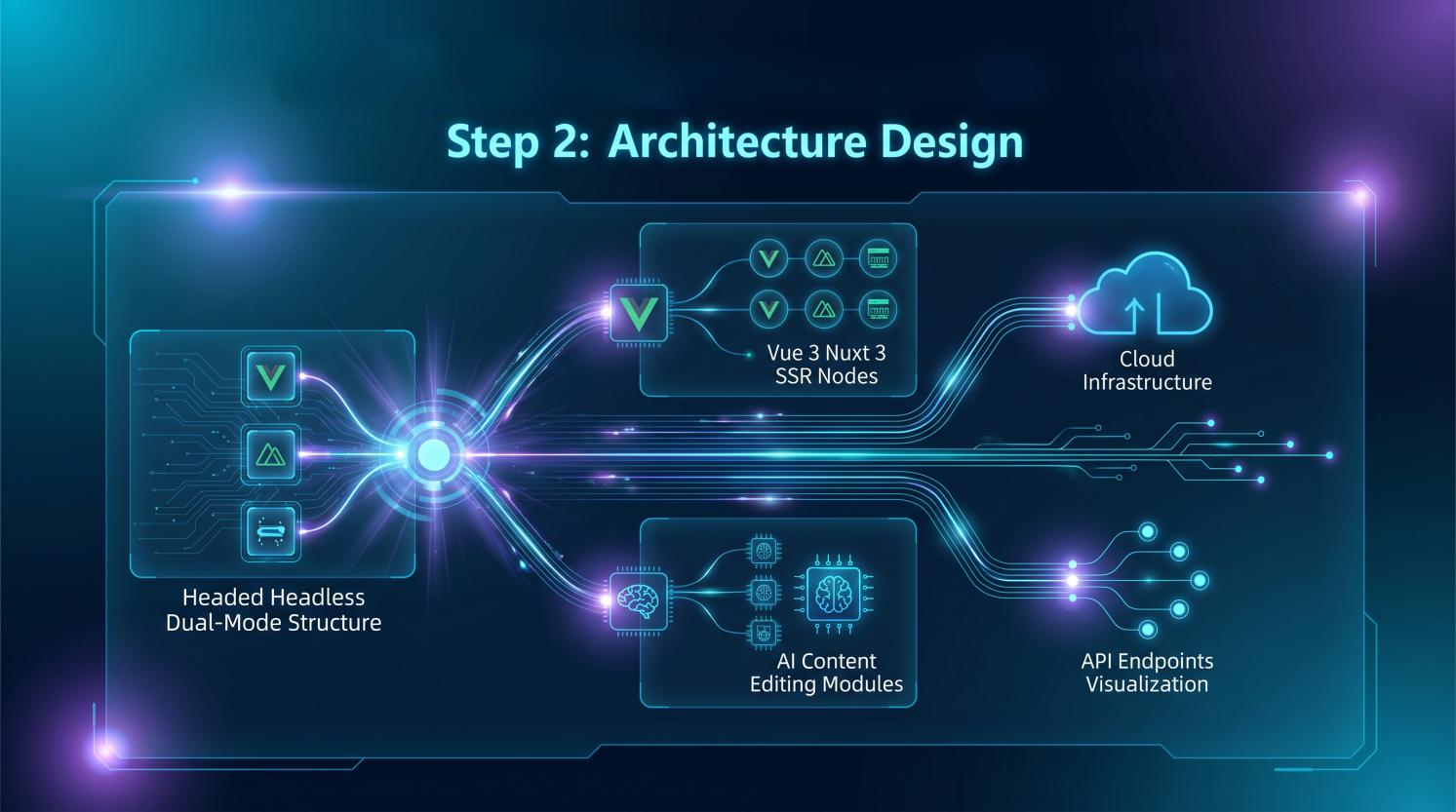
Having clarified “what exists,” the next step is designing “how to connect.” As a next-generation AEM alternative, BMS DXP (Business Management System Digital Experience Platform) demonstrates exceptional completeness and forward-looking capability at the underlying architectural level.
Addressing the automaker’s specific business needs, the Dragon Bravo team designed and restructured the following core functionalities within BMS DXP:
1. Redesign of Page & Content Structure: BMS introduced a modern frontend tech stack (Vue 3 + Nuxt 3), fully supporting SSR (Server-Side Rendering). The team rebuilt page templates and the Fragment system within BMS and designed a flexible content tree structure supporting one-click import/export, copy, and move. This delivered to the automaker’s marketers a significantly smoother operational experience than AEM [1].
2. Component & Data Model Compatibility: To enable seamless migration, BMS DXP’s underlying JSON data structure was engineered for high compatibility with AEM Model JSON. Whether Page JSON, Content Fragment, or underlying Model, BMS provides native import/export support—greatly reducing data conversion loss.
3. WYSIWYG Editing & AI-Powered Content Creation: BMS DXP offers a zero-code, WYSIWYG visual editor supporting drag-and-drop components and rich-text editing. More importantly, BMS natively integrates an AI writing assistant—enabling operations staff to instantly generate multilingual marketing copy and SEO summaries when creating new vehicle pages.
4. Granular Permissions & Omnichannel Delivery: For security management, BMS implements ultra-granular permission control—from role-level, Site-level, page-level, down to menu- and button-level. Simultaneously, its Headed & Headless dual-mode architecture enables the automaker not only to manage its official website but also to seamlessly deliver content via API to its official mobile app and dealer terminals.
 Step Three: Structured Data Export & Lossless Transformation (Data Transformation)
AEM’s data is deeply nested within its JCR (Java Content Repository); extracting it safely and completely and injecting it into the new system constitutes the technical deep water of migration. Demonstrating profound technical expertise in migrating from Adobe Experience Manager to headless CMS, the Dragon Bravo team adopted a “dual-track parallel” data transformation strategy.
Static File Proxy Mechanism: For legacy JSON data requiring immediate external exposure and strict URL consistency, the Dragon Bravo team developed high-performance crawler scripts to traverse and extract all JSON data from AEM. These data were generated as static files and stored on BMS edge servers. This mechanism ensured zero service interruption for all external applications (e.g., mini-programs) dependent on such data during the migration transition period.
Dynamic Content Parsing & Mapping: For core Pages, Content Fragments, and Models, the Dragon Bravo team exported full JSON via AEM’s Package Manager. Subsequently, using Dragon Bravo’s proprietary automated data transformation engine, AEM-formatted JSON was mapped and converted into corresponding BMS DXP structures, automatically establishing complex internal reference relationships. Thus, after import into BMS, content remains fully editable by operations staff as before.
| Data Type | AEM Original State | Dragon Bravo BMS Transformation Strategy | Migration Result |
| Externally Dependent JSON | Deeply nested in JCR | Crawl and generate static file proxy | URLs 100% preserved; zero interruption |
| Content Fragments | Structured data blocks | Package export → script cleansing → mapping import | Fully editable within BMS |
| Page Reference Relationships | Complex node associations | Transformation engine automatically rebuilds reference graph | Internal links and component nesting perfectly preserved |
Step Four: Smooth Migration of Millions of Digital Assets (DAM)
The soul of an automotive official website lies in high-resolution images, 3D renderings, and videos. The automaker’s China site had accumulated massive multimedia assets within its AEM DAM (Digital Asset Management). The Dragon Bravo team formulated a rigorous relocation plan for AEM digital asset management migration.
First, all Assets were securely exported from AEM using bulk-download tools. Then, during upload to BMS DXP’s new media library, the Dragon Bravo team technically preserved original asset URL paths unchanged. This detail was critical—not only avoiding site-wide broken links (404 errors), but also perfectly inheriting years of accumulated SEO image-search ranking weight.
Meanwhile, BMS DXP’s AI multimodal search and intelligent tagging features were activated instantly upon asset import, automatically generating precise semantic tags for tens of thousands of historical images—breathing new life into dormant digital assets [1].
Conclusion: Beyond Migration—Stepping Into a New Era of AI-Driven Digital Experiences
The successful migration of this multinational automaker’s China site from AEM to BMS DXP represents not only cost reduction and efficiency gains for IT infrastructure, but also a comprehensive unleashing of marketing productivity. Through Dragon Bravo Information’s rigorous four-step migration methodology (Inventory, Design, Data Transformation, Asset Migration), the automaker achieved zero business interruption while acquiring a modern digital foundation equipped with SSR rendering, granular permission controls, and native AI content creation capabilities.
For Fortune 500 enterprises currently grappling with aging traditional CMS architectures and exorbitant maintenance costs, this real-world case provides a textbook-grade enterprise-level DXP migration guide.
FAQ: Frequently Asked Questions on Enterprise-Level AEM Migration
Q1: How long does an AEM-to-BMS DXP migration typically take?
Project duration depends on site scale and data complexity. Taking the China website of a multinational automotive enterprise as an example, DBC’s team executes migration in four phases: current-state inventory (approximately 2 weeks), target architecture design (approximately 3 weeks), data transformation and testing (approximately 4–6 weeks), and asset migration and go-live acceptance (approximately 2–3 weeks). For medium-to-large enterprise official websites, the overall timeline is typically controlled within 3 to 6 months—significantly shorter than AEM’s original implementation duration of 12 to 18 months.
Q2: Will the live site experience service interruption during migration?
No. DBC’s team employs a “dual-track parallel” strategy, ensuring continuous availability of existing URLs and JSON data APIs via a static file proxy mechanism throughout the transition period. All external dependencies (e.g., mini-programs, app data APIs) remain unaffected during migration, enabling truly zero-downtime business cutover.
Q3: How are deeply customized business components in AEM rebuilt in BMS DXP?
BMS DXP provides a rich library of generic components covering over 80% of fundamental component requirements in AEM. For highly customized business components (e.g., automotive-specific vehicle configurators or test-drive appointment forms), DBC’s team conducts priority assessment during the inventory phase and accelerates reconstruction using AI-assisted code generation tools—typically enabling a single front-end engineer to complete migration of one complex component within several days.
Q4: How do AEM’s Content Fragments and Experience Fragments map to BMS?
BMS DXP natively supports a Fragment system highly aligned with AEM’s. Content Fragments (purely structured data) exist in BMS under identical data models, with field definitions and reference relationships fully preserved by DBC’s proprietary conversion engine. Experience Fragments (reusable blocks with visual presentation layers) are mapped to BMS’s visual component templates, allowing operations personnel to edit immediately post-migration without relearning.
Q5: Will pre-existing SEO rankings and domain authority accumulated on the AEM site be lost after migration?
No. DBC’s team strictly adheres to the “zero URL path change” principle throughout migration: all page URLs and digital asset URLs remain fully identical to those in the original AEM version. Meanwhile, BMS DXP provides comprehensive 301 redirect management tools and automatically generates and submits an updated sitemap to search engines upon migration completion—ensuring smooth inheritance of historical SEO authority without ranking drops.
Q6: Can BMS DXP’s permission system satisfy complex multi-role, multi-region governance requirements of multinational automotive enterprises?
Yes, fully. BMS DXP implements ultra-fine-grained permission control—from global roles, brand-site level, and individual-page level down to menu items and button level. For multinational automotive enterprises, distinct content access and publishing permissions can be configured separately for headquarters marketing teams, regional operations staff, dealer content editors, and other roles—ensuring unified brand content governance while enabling flexible regional operations.
Q7: Does the operations team require a lengthy retraining period after migration?
No. BMS DXP’s WYSIWYG visual editor features intuitive design and operation logic closely resembling mainstream office software. Coupled with its built-in AI Operations Assistant—which delivers real-time operational guidance and content suggestions—an operations staff member familiar with basic AEM operations typically requires only half a day to one day of brief training to use BMS DXP fluently, significantly reducing organizational adaptation costs post-migration.
References:
[1] DBC Brand & Product Reference Manual: Case Study of Automotive Brand China Official Website Based on Visual-Editing Content Management Platform.


Want to know more about our products?
With years serving Fortune 500 clients, we offer flexible solutions and integrated implementation.
