





The Turbulent Moment of Enterprise Content Hubs in the AI Era
Publication Date: 2026-09-10
Author: William
Introduction
In the spring of 2008, a Taizhou-based auto parts manufacturer cross-checked its official website, Alibaba storefront, and product brochures distributed to dealers—and discovered that the inner diameter of the same bearing was listed as three different values across the three sources. The CEO summoned the heads of marketing, technology, and production into his office and asked which value was correct. After exchanging glances, none could answer. Ultimately, a veteran workshop technician flipped through the engineering drawings and said, “We need to ask R&D.”
At that time, the term “content hub” did not yet exist; people called it an “information silo,” treating it as an unfillable gap in enterprise IT infrastructure. Sixteen years later, the gap remains unfilled—and has instead been torn wider open by a new force: artificial intelligence.
A 2025 Deloitte survey found that employee access to AI tools rose 50% year-on-year, while governance maturity remained stuck at an early stage. People are running faster and faster—but the reins aren’t ready yet.
I know a marketing director at a smart hardware company. Last year, the company deployed an AI writing tool: the marketing team produced 200 product articles in three days, filling the office with a sense of liberation. Three months later, they discovered that the same product’s specifications appeared in four different versions—on the official website, Tmall, Amazon, and the PDF distributed to dealers. Marketing didn’t know what R&D had changed; R&D didn’t know what customer service was answering.
AI has accelerated content production—but left consistency and governance capabilities far behind, widening the gap further with each passing day.
To understand precisely what kind of content infrastructure enterprises truly need, I reviewed the latest reports from Gartner and Forrester and studied real-world implementations across several companies. To explain the answer clearly, we must start from the beginning.
I. Clarifying the Term First
A content hub is neither newly purchased software nor merely a rebranded CMS. It is an infrastructure layer positioned between content creation and content consumption—managing scattered text, images, videos, product specifications, user manuals, and compliance documents in a unified, machine-readable manner, then distributing them according to channel requirements.
Its distinction from traditional CMS is straightforward: a traditional CMS addresses “how to publish content on one website,” focusing on pages, templates, and publishing workflows; a content hub addresses “how an enterprise manages content,” focusing on data models, asset relationships, and distribution pipelines.
For that Taizhou auto parts manufacturer, product specifications must appear simultaneously on the official website, e-commerce listings, dealer ordering systems, after-sales manuals, and AI customer service training datasets. The old approach involved building separate content sets for each channel—entering the same specification five times, updating it in five places whenever changes occurred, and still lacking confidence that all updates were accurate. With a content hub, specifications reside once in the PIM and visuals reside once in the DAM; each channel fetches them via API—ensuring no divergent versions ever emerge.
This is the core logic: single source of truth, multi-channel distribution. This logic existed a decade ago—but back then, far fewer channels required servicing. Today, websites, apps, mini-programs, IoT devices, AI assistants, and agent-driven e-commerce platforms all demand content—in vastly differing formats. The old approach simply no longer holds.
II. An Ongoing Historical Replacement
Enterprise content management is undergoing its most profound transformation in two decades.
Gartner forecasts that the global AI platform and model market will reach USD 6.43 billion in 2026, growing at 63%. While the figure is impressive, what truly warrants attention are three underlying signals.
First, AI-Nativeness.Gartner lists “AI-native development platforms” among its Top 10 Strategic Technology Trends for 2026—signifying that AI is no longer layered atop applications but embedded directly into development processes, content management, and data processing at the foundational level. Forrester puts it more bluntly, dubbing 2026 the “pragmatic reset year” for enterprise AI: buyers no longer pay for concepts alone—they demand verifiable outputs and quantifiable business value.
Second, Agent Penetration.Gartner predicts that by 2026, 40% of enterprise applications will embed task-oriented AI agents—a figure that stood below 5% at the start of 2025. AI agents are steadily evolving from “supporting roles” to “executing roles.”
Third, Accelerating Compliance.The enterprise AI governance and compliance market stood at USD 2.5 billion in 2025 and is projected to reach USD 3.4 billion in 2026, reflecting a compound annual growth rate of 39.4%. The EU AI Act enters full force in August 2026, carrying fines of up to EUR 35 million or 7% of global revenue. Meanwhile, China’s regulatory framework governing generative AI services is tightening.
All three signals point to the same shift: enterprise content management is transitioning from “how to publish content” to “how to enable AI to safely produce and distribute content.”
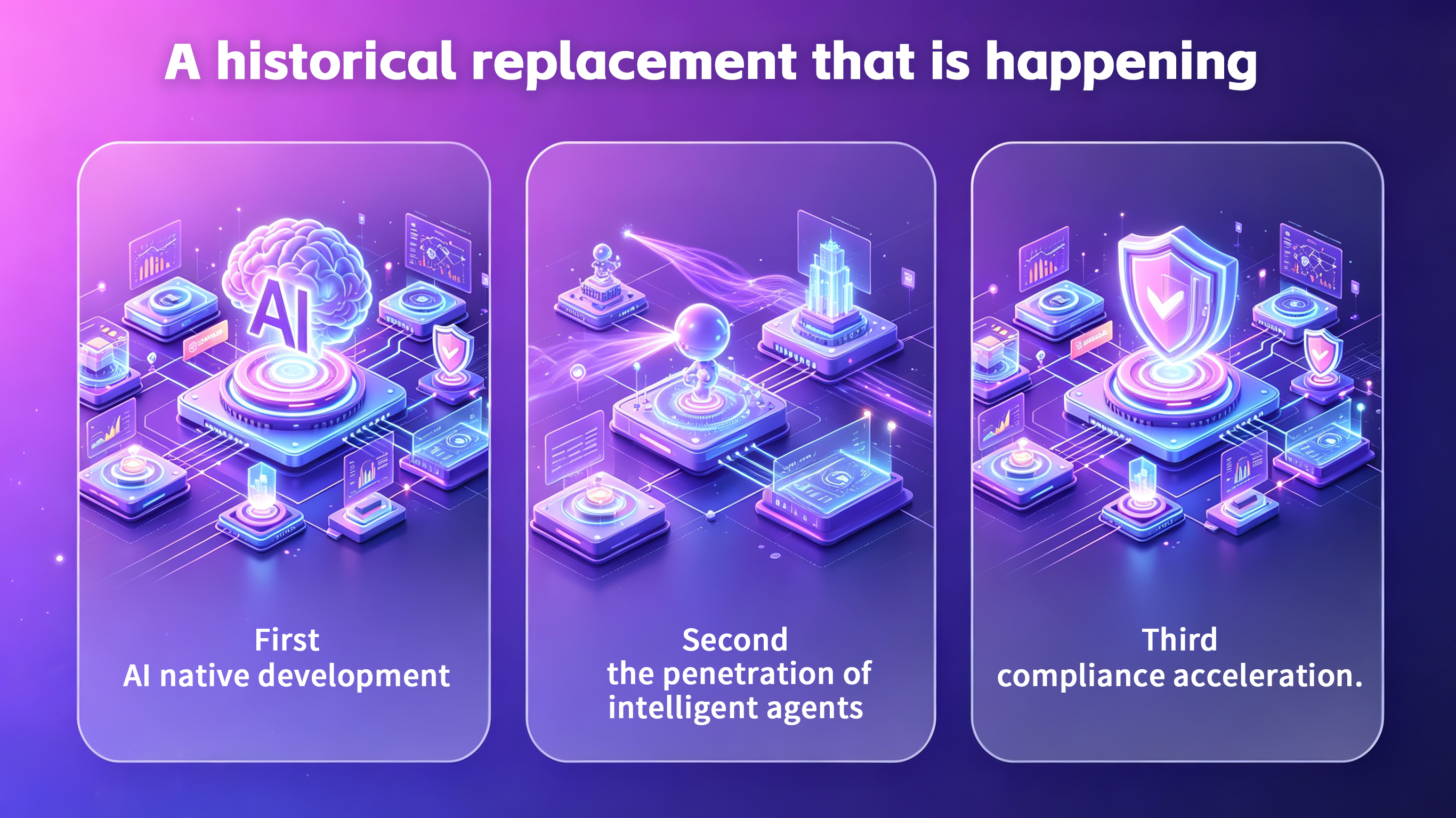
(Illustration depicting the ongoing transformation in enterprise content management)
III. Four Pillars
I break down the problems a content hub must solve into four pillars.
l Pillar One: Unified Data Model. Most enterprises’ greatest pain point isn’t lack of tools—it’s the absence of relationships between data points. Product descriptions on the official website don’t match SKUs in ERP systems; marketing videos remain disconnected from legal compliance approvals; AI training knowledge bases and customer service FAQs operate as entirely separate systems. A unified data model ensures that a piece of text, an image, or a parameter knows who created it, who owns it, and who has used it.
l Pillar Two: Federated Asset Management. Files are scattered across AWS S3, Alibaba Cloud OSS, local NAS, and even colleagues’ laptops. Traditional DAMs often demand “migrating everything”—yet migrating hundreds of thousands—or even millions—of files, spanning petabytes, incurs prohibitive egress fees and time costs. Federated asset management moves only metadata—not files—centralizing governance over tags, permissions, versions, and usage logs, while fetching actual assets on-demand via API—bypassing the most painful data migration step entirely.
l Pillar Three: AI-Native Governance. Many enterprises deploy AI writing tools and see content output increase tenfold—yet compliance review remains static, resulting in large volumes of AI-generated content being published without review. AI-native governance isn’t post-hoc auditing; it embeds brand guidelines, compliance requirements, terminology constraints, and sensitive-word rules directly into AI workflows—ensuring automatic alignment with rules at the moment of generation. Gartner research shows enterprises deploying dedicated AI governance platforms achieve 3.4x higher governance effectiveness than those that do not.
l Pillar Four: Multi-Channel Orchestration. Websites require rich-text and multilingual support; apps need structured JSON; AI assistants require vectorized snippets; agent-driven e-commerce demands machine-readable catalogs. The orchestration layer transforms a single source of content into multiple formats, languages, and granularities for distribution—while logging who distributed it, when, and in which version.
These four pillars interconnect via APIs and event-driven architecture. An asset change triggers content updates; updates trigger translation; translation completion triggers multi-site synchronization; compliance approval triggers publication. A single data modification automatically propagates across the entire chain.
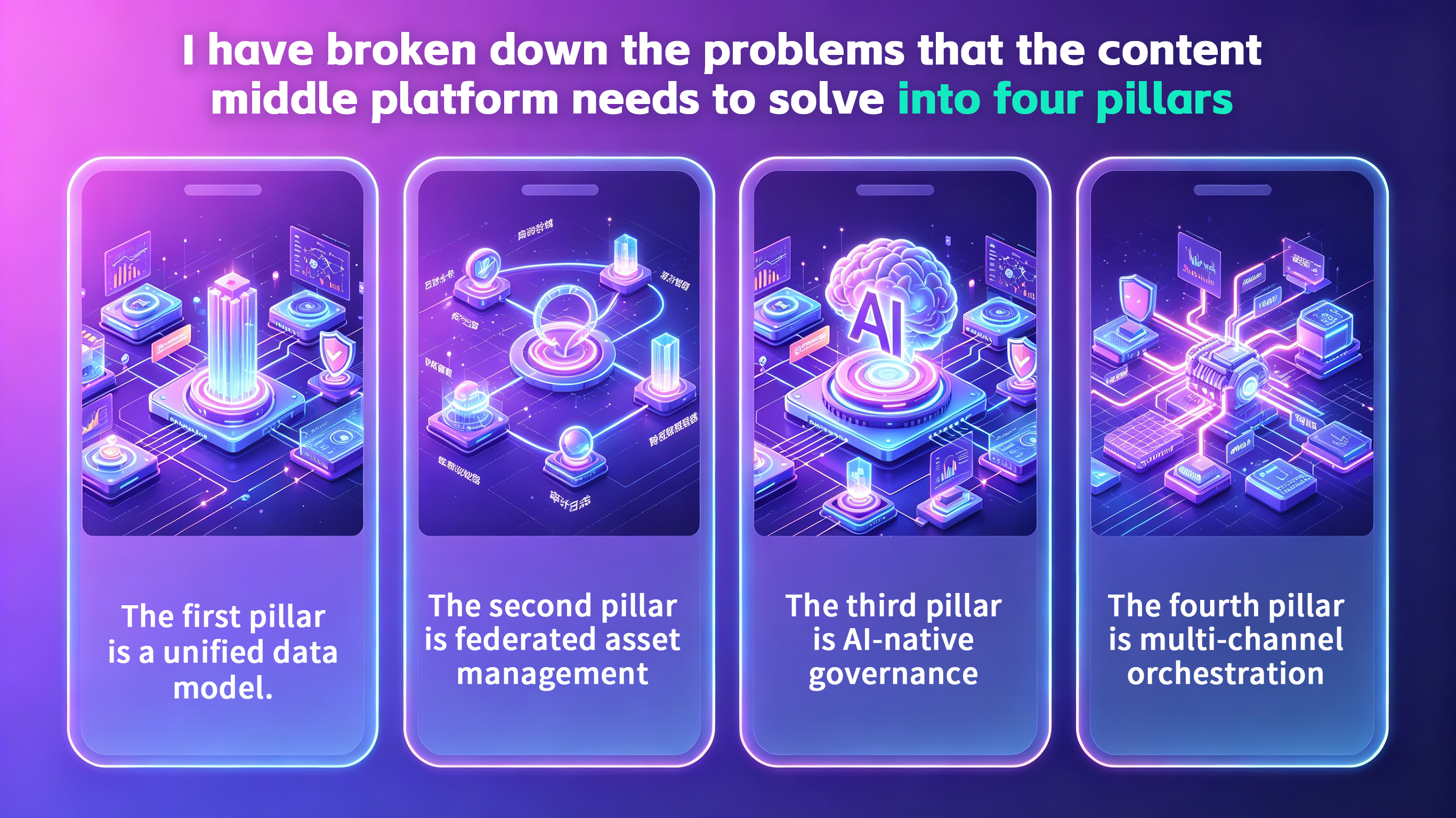
(Illustration depicting the problems a content hub must solve)
IV. A System Already in Operation
Dragon Bravo BMS DXP has integrated these four pillars into a single platform.
PIM manages product master data, with parameter definitions set once and shared across all channels. DAM manages digital assets, supporting federated multi-cloud management with native integration for AWS S3, Alibaba Cloud OSS, and self-hosted NAS; it pulls only metadata while keeping files in their original locations. The Knowledge Center manages structured documents, serving as a help center externally, a training library internally, and training data for AI. The Official Website module handles multi-site, multi-language publishing: during publication, it fetches images from DAM, parameters from PIM, and documents from the Knowledge Center to assemble pages for distribution.
AI is an intrinsic capability embedded within the platform. Tagging, translation, semantic search, Q&A, and GEO are built-in. AI-generated content flows directly into DAM under version control, and brand and compliance rules are bound to the AI workflow. Distribution occurs via JSON API, allowing a single content source to feed the official website, app, mini-program, and AI applications simultaneously.
This architecture does not follow the legacy heavy CMS path; it eschews OSGi, JCR, JSP, and .NET monoliths. The backend uses Java with SpringBoot, the frontend uses Vue3 with Nuxt, and the web layer combines Nginx, Lua, and Golang, running on K8S and Docker. It supports both private deployment and managed hosting, offering an open technology stack that avoids vendor lock-in.
Notably, Dragon BravoBMS DXP is about to officially launch its Content Middleware module, upgrading the aforementioned four pillars from modular capabilities to a complete platform-level middleware solution. Enterprises can either start with a single point of entry through PIM or DAM, or adopt this entire middleware suite directly for immediate implementation.
V. Three Boundaries
After discussing what to do, we must also address what not to do. The most common issues do not stem from missing features, but from overstepping boundaries.
1. A Content Middleware is not a Large Language Model (LLM). LLMs solve "generation," while Content Middleware solves "governance." They must work together, but neither can replace the other. An LLM may write a superior product description, but it cannot verify whether legal approval was obtained, if parameters match the ERP system, or which channels still host the old version being replaced. The correct relationship is: LLMs handle generation, while Content Middleware handles gatekeeping, archiving, distribution, and traceability.
2. A Content Middleware is not simply "replacing one system with another." Replacing three to five systems at once involves tens of millions in investment, over a year of approvals, and the migration of hundreds of thousands of historical records—each layer presents potential risks. A more pragmatic approach is incremental replacement: select the most critical pain point first, manage it with a lightweight module, validate the process, and then gradually integrate DAM, the Knowledge Center, and marketing automation. The value of a Content Middleware lies in "connection," not "replacement."
3. A Content Middleware cannot be built without ongoing maintenance. Who maintains knowledge base updates, which department is responsible for data accuracy, and how frequently AI content requires human review—these rules must be established upfront, otherwise the middleware becomes a repository for garbage data. AI outputs based on garbage data are more dangerous than having no AI at all. Bloomfire designated "Content Governance" as a standalone evaluation dimension for 2026, asserting that semantic search, structured auditing, and role-based permissions are indispensable. A middleware is not a "set-and-forget" solution; data quality degrades over time, and AI performance follows suit.
VI. Key Accelerating Shifts in 2026
AI agents transition from experimentation to production. Both Forrester and Gartner view 2026 as a breakthrough year for multi-agent systems. Agents begin collaborating: one writes content, another checks compliance, and a third distributes, sharing context and automatically handing off tasks. Content Middleware must expose agent interfaces to allow external agents to read, write, and trigger reviews.
Search entry points shift from traditional search engines to AI Q&A. 58% of consumers already use generative AI instead of traditional search for product recommendations. Whether brand content is discoverable and accurately cited by AI matters more than its ranking in traditional search results. Content Middleware must structure content for machine readability, forming the foundation of GEO.
AI governance shifts from "run first, figure out compliance later" to "audit before running." Following the EU AI Act's implementation, every piece of AI-generated content faces potential compliance scrutiny. The key issue is not whether fines will be issued, but whether audit records can be produced during random inspections. Content Middleware needs built-in audit logs recording generation timestamps, models used, reviewers, modification history, and distribution destinations.
Content Middleware converges with agentic e-commerce. A new term emerges in 2026: agentic commerce. Shoppers are no longer just humans; AI assistants are now buyers too. ChatGPT Shopping has integrated with over a million Shopify merchants, with Walmart and Target queuing up. Whether brands can expose product catalogs via API—enabling AI assistants to read, compare, and place orders—determines inclusion in recommendation lists. The structured PIM and APIs provided by Content Middleware serve as the starting point for this chain.
The intersection of these four elements is clear. Over the next three years, Content Middleware will evolve from an internal management tool into a content output interface for the AI world. Whoever builds the interface first will have their content consumed by AI first.
VII. How to Plan This Path
Take a three-step approach:
Step 1: Conduct an asset inventory.Don't rush to buy a system yet. Spend two to four weeks organizing your content assets: list all current tools, map out production workflows, and identify inconsistencies. Once the inventory is complete, it usually reveals an uncomfortable truth: companies often have no clear idea of how much content they actually have or its accuracy. This insight alone holds value, providing a solid basis for subsequent budgeting.
Step 2: Select one pain point to pilot first.For cross-border e-commerce, the biggest pain point is often managing multiple languages and platforms; when headquarters updates a description, each of the thirty countries has to update it individually. For manufacturing, the core issue is product data consistency; R&D changes parameters, but sales teams present outdated specs to clients. Pick one scenario and manage it with lightweight modules. Run a three-month pilot to demonstrate results: reduce content update time from days to hours, and eliminate version inconsistencies entirely. This tangible outcome speaks louder than any concept.
Step 3: Expand gradually while maintaining boundaries.After the pilot succeeds, gradually integrate DAM, Knowledge Center, CDP, and marketing automation. Each step should correspond to a specific business need, while adhering to three key boundaries.
Dragon Bravo's BMS DXP modular design allows enterprises to start with PIM or DAM as a single entry point. After validating the workflow, you can activate the official website, knowledge center, and marketing automation without needing to purchase everything at once. Alternatively, wait for their content middleware platform module to be officially released and deploy a complete middleware solution. The technology stack is open and non-proprietary, supporting both private and hosted deployment models, ensuring data control and native AI capabilities.
Writing this brings back memories of that Taizhou enterprise mentioned at the beginning. They didn't implement a grand integrated platform right away; instead, they started with just one thing: consolidating product parameters into a single location where anyone could edit, followed by distribution. That master craftsman eventually retired, but the era of "you'll have to ask R&D about that" is finally over. The significance of content middleware in business history may lie precisely in these unassuming turning pages—each page turned represents real financial savings.
FAQ
Q: What is the difference between a Content Middleware Platform and CMS?
CMS solves "how to publish content on a website," managing pages, templates, and publishing workflows. A Content Middleware Platform solves "how to centrally manage content across the entire enterprise and distribute it through multiple channels," handling data models, asset relationships, and distribution pipelines. If you only publish to a website, CMS is sufficient. However, if you need to feed content simultaneously to websites, apps, mini-programs, AI assistants, and intelligent commerce agents, you need a Content Middleware Platform.
Q: When should an enterprise consider building a Content Middleware Platform?
Three signals. First, the same content appears in multiple inconsistent versions across channels, and no one knows which version is correct. Second, Marketing, R&D, Customer Service, and Legal each maintain separate content sets without reviewing each other's work. Third, after implementing AI tools, production speed doubles, but review and governance haven't kept up, leading to emerging compliance risks. If any of these occur, it indicates that existing methods can no longer sustain operations.
Q: How much will it cost, and how long until implementation?
It depends on the entry approach. Starting with the most critical pain point, such as PIM plus multilingual sites, can take about three months with an investment in the hundreds of thousands to millions. Building a complete middleware platform from scratch takes over a year with investments in the tens of millions. It is recommended to start with lightweight modules, validate the process, and then expand.
Q: How do you manage AI-generated content?
Three layers. During generation, automatically align with rules so non-compliant content cannot even be produced. Post-generation, maintain an audit trail recording generation time, model used, prompts, reviewers, modification history, and distribution destinations. Post-publishing, conduct continuous monitoring and regular checks for outdated, tampered, or non-compliant content.
Q: Private deployment or hosted deployment?
It depends on data sensitivity and compliance requirements. Core product data, proprietary commercial information, or highly regulated industries are better suited for private deployment for greater security. Public marketing materials benefit from hosted deployment to reduce operational costs. Dragon Bravo BMS DXP supports both private and hosted deployment models. Private deployment keeps data within the enterprise, while hosted deployment lowers O&M costs. Both options can connect to cloud-based AI services.
Q: How long does it take to see results after implementation?
Single-point entry yields quantifiable changes within three months; a complete middle platform typically shows results in six to twelve months. Value accumulation is exponential: the early stage addresses "stability," the middle stage addresses "speed," and the late stage addresses "intelligence."
References
1. Gartner, Top Strategic Technology Trends for 2026 https://www.gartner.com/en/articles/top-technology-trends-2026
2. Gartner, Worldwide AI Platforms and Models Market to Grow 63% in 2026 https://www.gartner.com/en/newsroom/press-releases/2026-07-20-gartner-forecasts-worldwide-ai-platforms-and-models-market-to-grow-63-percent-in-2026
3. Gartner, 40% of Enterprise Apps Will Feature Task-Specific AI Agents by 2026 https://www.gartner.com/en/newsroom/press-releases/2025-08-26-gartner-predicts-40-percent-of-enterprise-apps-will-feature-task-specific-ai-agents-by-2026-up-from-less-than-5-percent-in-2025
4. Forrester, Predictions 2026 https://www.forrester.com/predictions
5. Market.us, Enterprise AI Governance and Compliance Market Size https://market.us/report/enterprise-ai-governance-and-compliance-market
6. Liminal, The Complete Guide to Enterprise AI Governance in 2026 https://www.liminal.ai/blog/enterprise-ai-governance-guide
7. Deloitte, State of AI in the Enterprise 2026 (via Adaptive Security) https://www.adaptivesecurity.com/blog/enterprise-ai-governance-complete-guide
8. Bloomfire, Best Enterprise Knowledge Management Software in 2026 https://bloomfire.com/blog/best-enterprise-knowledge-management-software
9. Research and Markets, AI Shopping Agents and Agentic Commerce 2026 https://www.globenewswire.com/news-release/2026/08/17/3345937/28124/en/ai-shopping-agents-and-agentic-commerce-2026-adoption-trends-and-execution-limits.html
10. Aprimo, The Future of Enterprise AI Agents in Content Operations https://www.aprimo.com/blog/the-future-of-enterprise-ai-agents-in-content-operations
11. Solytics Partners, Enterprise AI Governance: 2026 Implementation Guide https://www.solytics-partners.com/resources/blogs/enterprise-ai-governance


Want to know more about our products?
With years serving Fortune 500 clients, we offer flexible solutions and integrated implementation.
