





2026: AEM renewal bill is here. Should we keep paying, or completely change our approach?
Published : 2026-10-09
Author: William
Introduction
It is once again the critical moment for renewing enterprise-level Digital Experience Platform (DXP) subscriptions. Facing bills that can easily reach tens of millions, how should CIOs and financial leaders rationally "calculate the costs"? Starting from real business scenarios, this article breaks down the Total Cost of Ownership (TCO) and potential exit risks of DXPs, providing a practical evaluation framework to help enterprises make more strategic decisions before renewing expensive platforms like AEM.
Business Dilemma: Is That Expensive DXP Renewal Bill an Investment or a "Bottomless Pit"?
As the year-end approaches, the head of the digital department walks into the meeting room carrying a heavy report. The core agenda item is the renewal of the existing enterprise DXP platform. Displayed prominently on the screen is a staggering string of numbers—licensing fees, maintenance costs, and charges for various add-on modules, adding up to another astronomical figure. In the meeting room, finance colleagues frown in skepticism regarding the ROI of this massive expenditure; business departments complain about slow feature updates and the inability to quickly respond to market changes; while the technical team struggles to patch increasingly complex and hard-to-maintain custom code.
This is not an isolated case. Over the past few years, many large enterprises, especially multinational corporations, have invested heavily in top-tier DXP platforms like Adobe Experience Manager (AEM) or Sitecore. With powerful features and comprehensive ecosystems, they were once synonymous with "high-end sophistication." However, as time passes, what was initially a "strategic investment" seems to be gradually turning into a heavy "operational burden." Year-over-year increases in licensing fees, continuous development and maintenance investments, and the hidden risk of being "held hostage" by a single vendor's technology stack force enterprises to re-evaluate: Do we really need to keep paying for these "golden handcuffs"? Are they still "empowering" our business, or have they become a "speed bump" hindering our innovation?
The root cause of this dilemma lies in the fact that often, we treat the technical deployment itself as the goal, while ignoring the true evolution of content strategy [2]. If a DXP platform, due to its high TCO (Total Cost of Ownership) and unbearable exit costs, actually hinders an enterprise's digital transformation, then it is time to pause and properly "do the math."
Diagnostic Framework: Don't Rush to Replace—First, Get a "Physical Exam Report" for Yourself—Build a Verifiable Ledger of Costs and Risks
Deciding to replace an enterprise DXP platform is far from as simple as just "buying a new one." It is more akin to a complex "surgical procedure," involving every aspect of technical architecture, business processes, organizational collaboration, and financial budgets. Therefore, before blindly searching for "alternatives," the most crucial first step is to build a comprehensive, objective, and verifiable "physical exam report"—essentially a detailed ledger of costs and risks—for your current DXP platform and the potential migration process. This ledger cannot merely look at the surface; it requires us to deeply analyze several core dimensions below, combined with a systematic migration methodology, to draw truly valuable conclusions:
1. The "Real Cash" on the Surface: Direct Costs of Licensing, Development, and Operations
Licensing Fees: DXP licensing fees often increase with usage volume, functional modules, and deployment scale; for example, the AEM model may lead to geometric cost growth.
Development and Customization Costs: Enterprise DXP requires extensive custom development, such as front-end components, back-end integration, and workflow customization. Specific technology stacks (e.g., AEM's OSGi framework) can lead to a shortage of skilled talent, driving up labor costs.
Operations and Infrastructure Costs: DXP platforms require robust infrastructure support, including servers, storage, networking, and security protection. Resource-intensive platforms like AEM demand higher hardware specifications and operational expertise; scaling elastically and controlling costs during global traffic peaks present significant challenges.
2. The Hidden "Reefs" Beneath the Surface: Implicit Costs of Ecosystem Lock-in and Technical Debt
Ecosystem Lock-in: Long-term reliance on a single vendor's DXP platform exposes enterprises to lock-in risks. When switching platforms, prior investments (custom development, training, integration) are difficult to reuse, resulting in sunk costs. Vendor roadmap changes and pricing adjustments may also passively impact the enterprise.
Version Upgrades and Technical Debt: DXP platforms release new versions regularly, but highly customized enterprises face challenges with compatibility testing, code refactoring, and data migration when upgrading. Failure to upgrade over time accumulates technical debt and increases security risks.
Content Migration Costs: This is often the most underestimated cost during DXP platform replacement. Migrating massive volumes of content from old to new platforms requires consideration of data format conversion, content model mapping, URL redirection, SEO equity continuity, and retention of historical versions and permissions. This typically necessitates professional tools, teams, and rigorous processes.
3. The "Sword of Damocles" Overhead: Business Disruption and Compliance Risks
Business Continuity Risks: During platform migration, business disruption is the greatest risk, potentially affecting website access, marketing campaigns, and customer experience. A meticulous migration plan, gray release strategy, and rollback mechanism are critical.
Compliance and Security Risks: Cross-border enterprises must address data privacy (GDPR, CCPA) and industry compliance. Switching between old and new platforms must ensure secure data transmission, compliant storage, and seamless permission management to avoid legal and reputational risks.
4. Migration Methodology: A Roadmap from "Check-up" to "Surgery"
Successful DXP migration is not achieved overnight and requires a rigorous methodology for guidance. This includes, but is not limited to, the following stages:
Current State Assessment and Requirements Analysis: Thoroughly review existing DXP platform functionalities, content, integration points, user permissions, workflows, and technology stacks. Clarify core business requirements, pain points, and expected goals for the new platform to produce a detailed requirements specification document.
Target Architecture Design: Based on requirements analysis, design the overall architecture of the new DXP platform, including technology selection, module segmentation, data models, integration strategies, and deployment plans. Prioritize openness, scalability, cloud-native capabilities, and AI enablement potential.
Data Export and Transformation: Develop a detailed content and data migration strategy. This involves exporting old platform content, cleaning and transforming data formats, mapping content models to the new platform, and ensuring SEO-friendly URL redirection solutions. For massive historical data, automated tools and scripts are essential.
Smooth Asset Migration and Verification: Migrate digital assets (images, videos, documents, etc.) from the old DAM to the new DAM, followed by rigorous verification of integrity, availability, and compliance. Implement a gray release strategy to ensure business continuity and establish a rollback mechanism for emergencies.
Personnel Training and Organizational Change: Introducing a new platform implies new operating procedures and skill requirements. Provide comprehensive user training and drive internal organizational awareness and adoption of the new platform's value to ensure a smooth transition.
By integrating the above methodology into the construction of a cost and risk ledger, enterprises can more comprehensively and prospectively evaluate the potential benefits and challenges of DXP migration, thereby making truly data-driven strategic decisions rather than passively accepting the status quo.
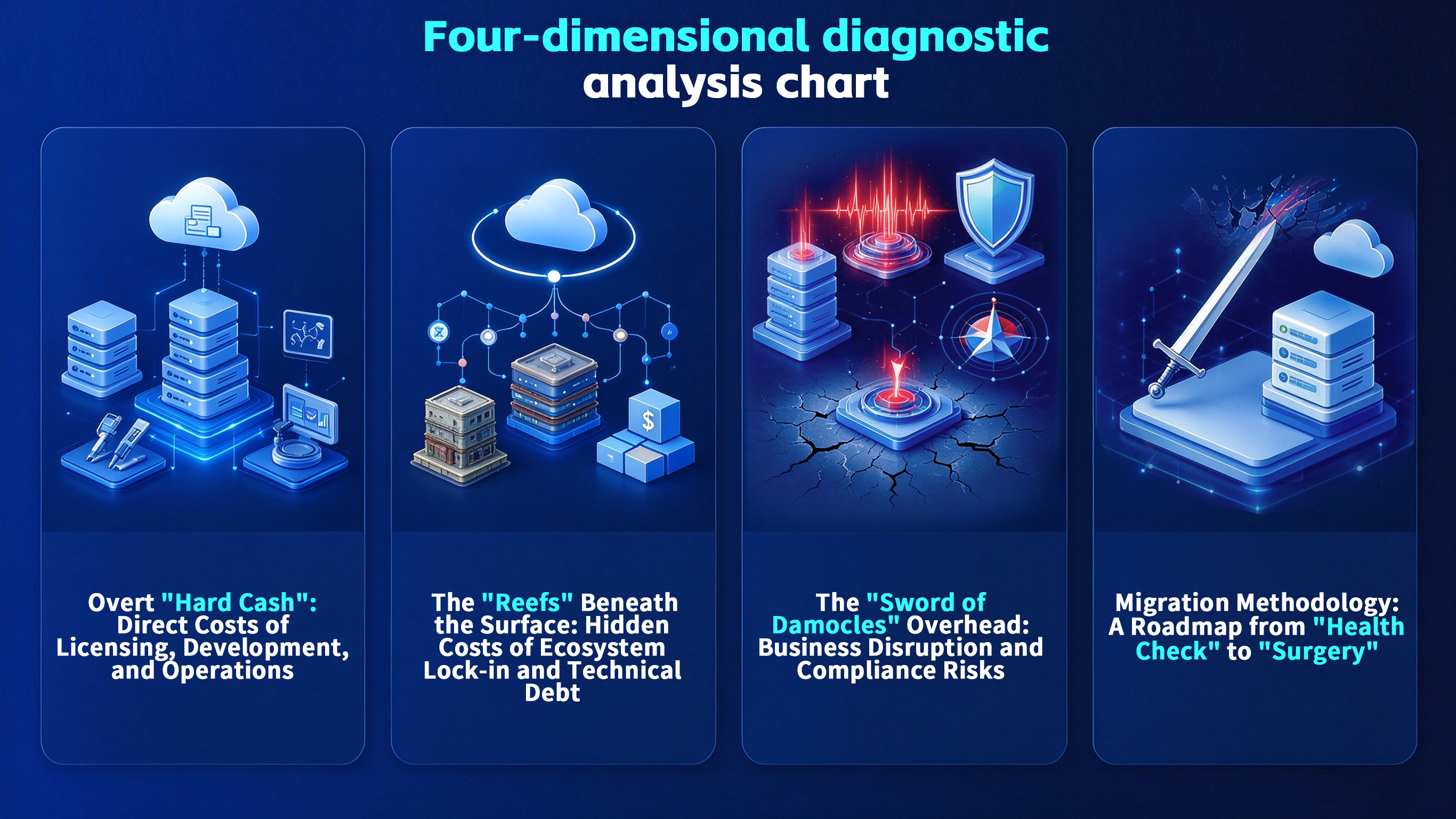
(The image displays a four-dimensional diagnostic analysis chart)
Dragon Bravo BMS DXP: Breaking the "Golden Shackles" to Build a New Foundation of Open, Controllable, and High-Value Digital Experiences
Facing the high TCO of enterprise DXP platforms and daunting exit costs,Dragon Bravo BMS DXP provides a completely new perspective and solution. It is not merely a "budget alternative" option; more importantly, it fundamentally restructures the cost structure and risk management model of enterprise digital experiences, helping enterprises break free from "golden handcuffs" and truly seize the initiative in digitalization.
1. Say goodbye to "astronomical bills" and significantly reduce total cost of ownership: Dragon Bravo BMS DXP holds a decisive advantage over traditional leading DXPs in licensing costs [Internal Product Capability Data]. Its architecture, based on mainstream open technology stacks (Java 21 + SpringBoot 3, Vue3 + Nuxt), not only lowers the learning curve and recruitment difficulty for developers but also effectively controls development and maintenance costs. Furthermore, BMS DXP supports private deployment and cloud-native containerized operations, offering flexible deployment options and fine-grained resource control capabilities, thereby fundamentally optimizing the long-term operational costs of DXPs [Internal Product Capability Data].
2. Completely escape ecosystem lock-in and embrace true autonomy: Dragon Bravo BMS DXP adopts an open technology stack, avoiding binding to specific vendor ecosystems, thereby providing greater autonomy and flexibility [Internal Product Capability Data]. Supporting both Headed & Headless modes, it delivers content via API, easily adapting to mobile applications, IoT devices, and third-party systems. This ensures that content assets can be flexibly integrated with emerging technologies and channels in the future, avoiding technical debt. The flexibility of this architecture means enterprises can freely choose their frontend technology stack according to business development or distribute content to any emerging channel without being restricted by the DXP platform itself. This not only extends the platform's lifespan but also significantly reduces migration costs and risks associated with future technological obsolescence [Internal Product Capability Data].
3. Simplify content migration and achieve "fine-grained management" of global assets: Targeting pain points in content migration, Dragon Bravo BMS DXP offers robust Content Management (Content) and Digital Asset Management (DAM) capabilities. It supports multi-site and multi-language management, includes built-in AI translation interfaces, and simplifies content model conversion through data mapping tools.BMS DAM achieves multi-cloud storage, AI intelligent tagging, multimodal retrieval, online editing, and version control. For example, in an internal project practice for a global automotive brand, BMS DAM provided comprehensive digital asset management capabilities, including support for multi-file/folder drag-and-drop uploads, segmented uploads with resume functionality, and optional automatic AI tagging features, greatly enhancing content ingestion efficiency. Meanwhile, it supports uploading, downloading, and online previewing of files in over 200 formats, and provides secure sharing links at the single file/batch/folder level, allowing users to set access passwords and expiration dates to ensure flexible distribution and secure control of assets. Additionally, fine-grained permission management (file-level/folder-level/user-level/user-group-level) and full operation log tracking ensure the compliance, traceability, and security of content assets [Internal Project Functional Materials (Anonymized)].
It is particularly worth noting that BMS DAM can accurately distinguish requirements across different scenarios regarding global application acceleration and asset governance. For asset previews, access, and downloads, we leverage globally distributed CDN nodes (especially covering key markets like Europe) and intelligent routing strategies to ensure overseas users can efficiently and smoothly access digital assets as fast as local access. For DAM backend operations conducted by overseas employees (such as login, search, filtering, upload, edit, AI tagging, approval, metadata maintenance, permission configuration, and statistical queries), BMS DXP utilizes global application acceleration solutions based on high-quality cross-border networks such as CN2 or 9929, significantly improving the stability and response experience of backend operations. This is akin to laying down a "highway" for global team collaboration and asset governance, ensuring the efficiency and security of data transmission and thoroughly resolving the "bottleneck" issues in cross-border collaboration.
4. Enhance the value of content assets and strengthen the compliance "defense line": The Knowledge Center module of Dragon Bravo BMS DXP can structurally consolidate unstructured knowledge scattered throughout the enterprise—such as documents, FAQs, and SOPs—and greatly improve knowledge reuse efficiency through multilingual distribution, intelligent search, and AI Q&A [Internal Product Capability Data].
For instance, in a large enterprise brand asset management project, the Knowledge Center not only became a unified knowledge portal but also combined AI intelligent translation and multilingual batch production capabilities to support one-click AI translation of metadata and generation of multilingual tags, greatly enhancing the reuse efficiency of global knowledge content. Moreover, by integrating DAM's fine-grained permission management, compliance detection (such as content safety detection and OCR text detection), and automated workflows, BMS DXP can effectively enhance the compliance, traceability, and security of content assets. Its built-in visual approval flow configuration, custom routing conditions, and a mechanism combining AI approval with manual approval can effectively reduce operational risks in content publishing and asset management, and help enterprises meet compliance requirements globally, truly fortifying the enterprise's "security defense line" [Internal Project Functional Materials (Anonymized)].
5. "Genetic Advantage" in the Era of AI Coding: If your tech stack is right, AI is an accelerator; if wrong, AI is an accelerator for failure: By 2026, "Vibe Coding"—where AI generates code directly from natural language descriptions—has moved from concept to enterprise-level practical application. Tools like Cursor, GitHub Copilot, and Claude Code are driving order-of-magnitude improvements in development efficiency. However, one thing has been severely underestimated: the quality of AI-generated code relies heavily on the mainstream status of the underlying tech stack and the richness of training data.
This represents the greatest "invisible advantage" of BMS DXP in the era of AI Coding.
Let's look at a comparison first. AEM's core tech stack includes Apache Sling, OSGi framework, and JCR (Java Content Repository), all of which belong to Adobe-exclusive or niche technology systems. In the training corpora of AI programming models (such as GPT-4, Claude), high-quality code samples related to Sling component development, OSGi Bundle configuration, and JCR node operations are extremely scarce. The result is: when you ask Cursor to help you develop a new component on AEM, the AI-generated code is either a "guess" referencing generic Java patterns or simply outdated snippets. Developers need to spend a lot of time patching and fixing things; instead of improving efficiency, AI actually increases debugging costs.
In contrast, the BMS DXP technology stack: Java 21 + SpringBoot 3 (backend) + Vue 3 + Nuxt 3 (frontend). What are these technologies? They are the backend and frontend frameworks with the highest number of stars on GitHub globally. SpringBoot has over 100,000 community contributors, and Vue 3 has over 200,000 stars on GitHub. What does this mean? It means that in the training data for AI programming models, high-quality code samples for SpringBoot and Vue 3 are hundreds or even thousands of times more abundant than those for the AEM technology stack.
In actual development scenarios, this gap is very direct. When you ask an AI to create a "product list component with search, filtering, and pagination" on BMS DXP, it can directly output standard component code based on the Vue 3 Composition API—because its training data contains thousands of similar implementation examples. The code structure is clear, naming conventions are standardized, and annotations are complete; developers can use it almost directly, needing only minor adjustments to business logic. However, performing the same task using AEM with HTL (Sightly) template language often requires significant modifications to make the AI-generated code functional.
This is especially true for frontend development. BMS DXP is built on a Nuxt 3 SSR/SSG architecture, where AI can not only generate page components but also automatically handle route configuration, data fetching, and SEO metadata injection. For a new product detail page template, AI can provide complete Vue component code, Nuxt route configuration, and API call logic within minutes—because official documentation, community tutorials, and open-source projects for Nuxt 3 are among the most extensive parts of the AI training corpus.
The same holds true for backend integration. The RESTful API development pattern of SpringBoot is thoroughly covered in AI training data. When BMS DXP needs to integrate with existing enterprise CRMs, ERPs, or e-commerce platforms, AI can quickly generate integration code based on SpringBoot—featuring a standard Controller → Service → Repository layered structure, clear exception handling, and parameter validation. This is not just about being "fast"; more importantly, it is about "maintainability"—any Java developer can understand and modify this code, eliminating the issue of "only the original author and AI can understand it."
This brings up the critical issue of Vibe Trash. By 2026, the industry has reached a consensus: the greatest risk of AI Coding is not insufficient code volume, but the collapse of maintainability.When non-technical personnel use AI tools to batch-generate code without architectural design or adherence to coding standards, the result is "Vibe Trash"—functional in the short term, but a ticking time bomb in the long run.
BMS DXP addresses this issue from an architectural perspective. First, AI-generated code runs within the platform framework already defined by BMS DXP—component templates, data models, API specifications, and permission systems are all pre-designed, constraining AI's flexibility within boundaries of "maintainability." Second, BMS DXP's visual editor and low-code capabilities allow most frontend requirements to be fulfilled without writing code; what truly requires AI-assisted development are extensibility and integration needs—these inherently involve technical review and quality control processes. Third, BMS DXP's reliance on mainstream technology stacks means lower code review costs—any developer in the team can evaluate the quality of AI-generated code, without relying on "the one person who understands this niche framework."
Contrast this with the situation regarding AEM: when enterprises seek AI assistance for AEM development, AI lacks deep understanding of Sling models, resulting in code riddled with snippets that "look right but don't actually work." Development teams either abandon AI assistance and go back to manual coding, or spend more time debugging AI-generated code than they would have spent writing it manually. This is not a problem with AI itself, but a matter of technology stack selection—choosing a "niche but powerful" technology stack in the age of AI is equivalent to excluding oneself from the productivity dividends offered by AI.
Looking further ahead, AI Coding is reshaping the talent structure of IT teams. The supply of SpringBoot developers in the recruitment market is dozens of times greater than that of AEM developers, and the same applies to Vue 3 developers. This means that companies using BMS DXP find it easier to recruit and assemble internal teams, and AI tools deliver more significant efficiency gains—because every member of the team is familiar with this technology stack, knows how to guide AI, review AI outputs, and perform incremental development atop AI foundations. In contrast, fewer and fewer AEM team members can proficiently master Sling/OSGi, making recruitment increasingly difficult, and knowledge gaps become more severe after veteran employees leave. When a platform's technology stack itself becomes a talent bottleneck, TCO is no longer merely a financial figure, but a strategic risk.
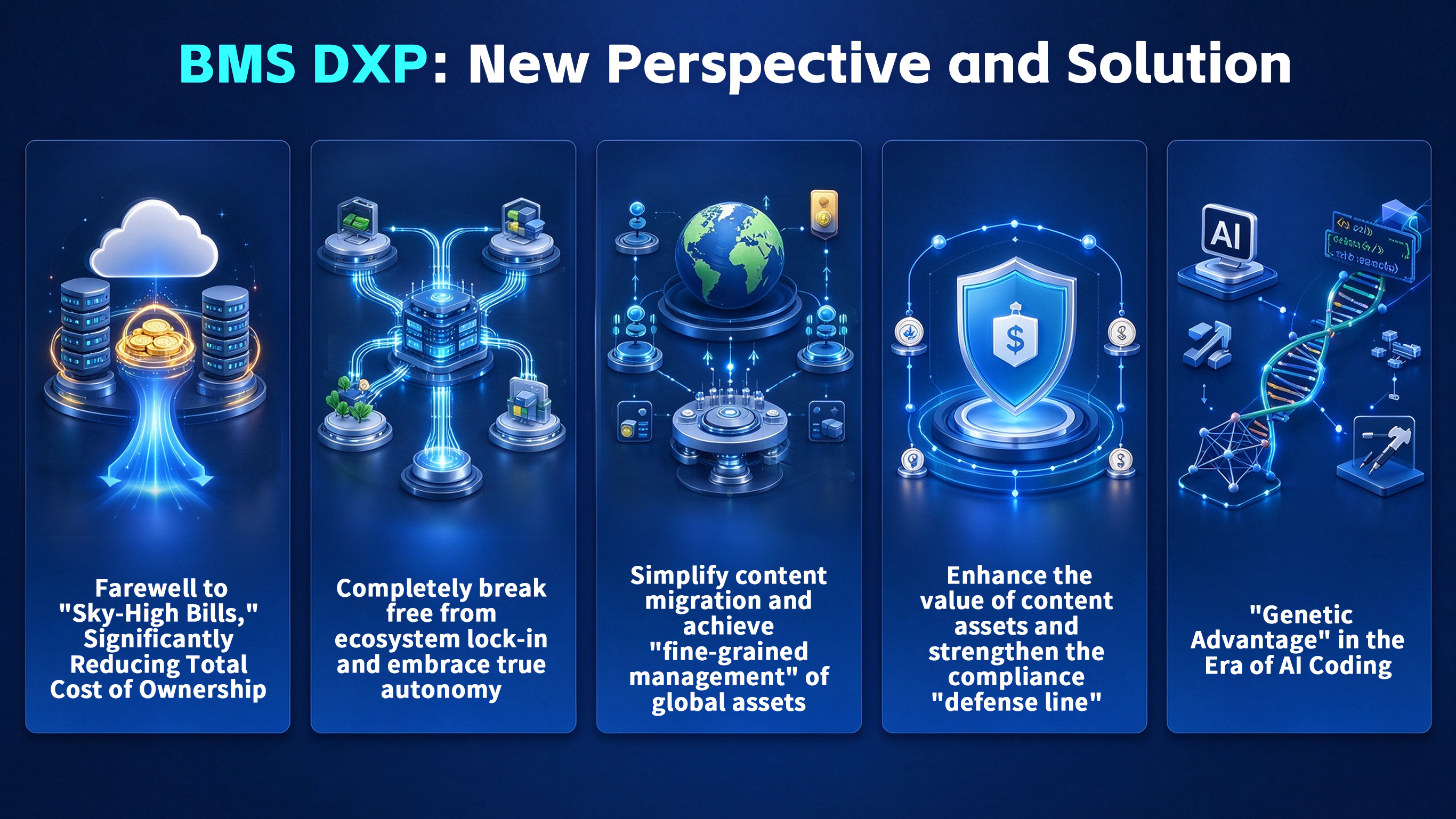
(The image illustrates the new perspective and solutions provided by BMS DXP)
Conclusion: Transformation from "Cost Center" to "Value Engine"
The choice of an enterprise-grade DXP should never be limited to a comparison of feature lists. It is rather a comprehensive "accounting" exercise involving total cost of ownership, future scalability, and potential exit risks. At the crossroads of renewing traditional DXPs like AEM, enterprises need a clear and robust ledger of costs and risks, grounded in data rather than being "hostaged" by past investments to make emotional decisions.DBC BMS DXP is committed to helping enterprises break free from ecosystem lock-in, acquiring stronger and more flexible digital experience capabilities at a lower TCO, truly transforming the DXP from a high-cost "bottomless pit" into a "value engine" that continuously drives business growth.
We understand that every platform migration is a major decision filled with challenges and uncertainties. If you are evaluating the renewal value of your current DXP, or considering building a more cost-effective and scalable digital experience platform, we warmly invite you to engage in in-depth discussions with us to jointly explore how to tailor the most suitable digital experience strategy for your business development, working together to "fill the various potholes" in digital transformation.
Frequently Asked Questions (FAQ)
Q1: How much cost can BMS DXP save compared to AEM?
A typical large-to-medium-sized enterprise (with 2,000+ pages, 100,000+ digital assets, and 5 languages) can reduce annual license fees from the million-dollar range to the 300,000–500,000 dollar range—a reduction of 50-70%—after migrating from AEM to BMS DXP. Meanwhile, BMS DXP is built on a fully open-source technology stack of Java 21 + SpringBoot 3 + Vue3/Nuxt, eliminating Adobe ecosystem lock-in and removing the need for dedicated AEM architects and operations staff.
Q2: What are the migration paths from AEM to BMS DXP?
Three paths: Full replacement (one-time switch of core sites, 8-16 weeks for migration), Hybrid architecture (retain AEM for core brand site management, build new sites incrementally on BMS DXP with unified frontend experience), and Progressive migration (migrate in batches by "business unit → language site → core homepage," stabilizing each batch for 1-2 months, total duration 6-9 months). BMS DXP provides a migration tool highly compatible with AEM Model JSON data structures.
Q3: Will SEO be affected after migrating to BMS DXP?
Core risks are controllable. Key measures: Maintain old URL structure or implement full 301 redirect mapping; rebuild TDKs and structured data markup on the new system; submit new sitemaps to Google Search Console immediately after migration. BMS DXP includes built-in sitemap generation and search engine push features. Typically, keyword fluctuations occur in the first 2-4 weeks, with SEO levels returning to pre-migration standards within 1-2 months.
Q4: What are the technical implementation challenges of a hybrid architecture (retaining AEM + BMS DXP)?
Both systems must maintain consistent brand experiences at the frontend, strictly manage canonical tags to avoid duplicate content indexing for SEO, and unify organizational structures and permission models at the backend. BMS DXP coexists with AEM via standard APIs, supporting unified frontend experiences and canonical tag management. This hybrid architecture suits multinational enterprises where AEM is already stable and new markets require higher efficiency and ROI.
Q5: How capable is BMS DXP in adapting to domestic technology innovation requirements?
BMS DXP supports full compatibility with Dameng Database, PostgreSQL, Oracle, SQL Server, MySQL, etc. On-premise deployment supports Kubernetes containerization and adapts to domestic operating systems and cloud platforms. The fully open-source tech stack (Java 21+SpringBoot 3+Vue3/Nuxt) avoids vendor lock-in from overseas providers. Many local governments explicitly require SOEs and critical information infrastructure to prioritize domestic alternatives; BMS DXP meets these domestic innovation compliance requirements.
Q6: How long does each phase of progressive migration take? How is progress evaluated?
Phase 1 (lowest traffic sub-sites): approx. 4-6 weeks/batch; Phase 2 (medium traffic sites, after gaining experience): approx. 6-8 weeks/batch; Phase 3 (core homepages): approx. 8-12 weeks/batch. After each batch, monitor SEO keyword rankings and index coverage; stabilize operations for 1-2 months before proceeding to the next batch. BMS DXP provides standardized migration tools and data validation reports, tracking progress per batch across four dimensions: page count / asset count / permission mapping / URL handling.
References
[1]: Adobe, *2026 AI and Digital Trends Report*
[2]: Content Marketing Institute, *B2B Content and Marketing Trends: Insights for 2026*
[3]: Google Search Central, *AI Features and Your Website*
[4]: CMSWire, *Digital Experience Platforms (DXPs): 2026 Comprehensive Guide*
[Internal Product Capability Documentation]: BMS Product Capabilities (Internal document, no public link)
[Internal Project Functional Material (Anonymized)]: Internal Project Functional Material (Anonymized, Non-Public Link)


Want to know more about our products?
With years serving Fortune 500 clients, we offer flexible solutions and integrated implementation.
