





2026 DXP Is Not a Feature Bundle: What Enterprises Truly Need Is the "Orchestration Capability" for Content and Experience
Publication Date: 2026-09-24
Author: William
Introduction: Faced with the increasingly complex features of digital experience platforms (DXPs), enterprises often fall into the trap of "buying features" rather than "building capabilities." This article deeply analyzes the core value of DXP, emphasizing its importance as an orchestration hub for content, assets, products, knowledge, and channel data. It also provides a practical framework for assessing DXP orchestration capabilities to help enterprises achieve an operable digital closed loop..
I. The Dilemma of Digital Transformation: Feature Stacking and the Value Gap
Many large enterprises face challenges in their digital transformation journey: although DXP promises to solve content silos and enhance customer experiences, it often fails to deliver due to overly complex platform features and low internal collaboration efficiency. Content, digital assets, and product data are scattered across various systems, making it difficult to establish a unified view or ensure efficient flow; furthermore, maintaining brand consistency while achieving localized responses remains a challenge in global operations.
Enterprises often focus on "buying" features while neglecting to "build" the digital capabilities that drive business growth. This gap between "feature stacking" and actual business value is a key pain point in DXP implementation. Even the most advanced technologies struggle to scale effectively without robust "orchestration" capabilities. Enterprises need to re-evaluate the core value of DXP, shifting from asking "what features does it have?" to "what can it help us do?" and "how can we connect scattered digital elements to form a harmonious, powerful whole?".
II. Beyond Module Stacking: The Core of DXP Lies in "Orchestration"
By 2026, discussions around DXP have evolved to focus on whether it can truly effectively orchestrate and implement AI, content, data, workflows, and customer experiences at an enterprise scale. This defines the direction of DXP: it is no longer a simple collection of CMS or marketing automation tools, but a more sophisticated and intelligent "orchestration hub." This hub enables the efficient integration, intelligent scheduling, and continuous optimization of various digital elements within the enterprise—content, digital assets, product information, customer knowledge, and multi-channel user data.
The orchestration capability of DXP represents a high-level art of coordination and scheduling. It requires the platform to possess flexible architecture, intelligent workflow engines, and open interfaces to seamlessly connect, intelligently process, and automatically distribute digital elements both inside and outside the enterprise. The ultimate goal is to provide consistent, personalized, and brand-aligned digital experiences at every touchpoint of the customer journey. Its core value lies in breaking down data silos to achieve deep cross-departmental, cross-system, and cross-regional collaboration, transforming isolated functional modules into an organic whole that continuously drives business growth. It is not merely technical integration, but a reshaping of business processes and organizational capabilities.
For example, in content creation and distribution scenarios, lacking orchestration capability means AI writing may remain limited to generating text. However, with orchestration capability, AI writing becomes deeply embedded throughout the entire content lifecycle: from topic planning and draft generation, to multi-level approval and brand compliance checks, to multilingual translation and cross-channel reuse, and finally to content performance feedback and optimization. This requires DXP to seamlessly integrate AI tools, enterprise content repositories, approval systems, translation services, and data analytics platforms, ensuring that every stage from production to publication is efficient, compliant, and measurable for business value and optimization.
III. BMS DXP: Building a Closed-loop Orchestration of Content and Experience
Dragon Bravo BMS DXP is built around "orchestration capability," aiming to help enterprises construct an operable and optimizable closed-loop system by integrating content, digital assets, product information, customer knowledge, and channel data. Through the deep collaboration of the following key modules, BMS DXP achieves fine-grained orchestration of enterprise-level digital experiences:
1. Synergy between Content Management (Content) and Product Information Management (PIM): Saying Goodbye to "Information Silos" and "Manual Synchronization"
The content management module of BMS DXP provides powerful multi-site, multi-language support and visual drag-and-drop editing capabilities, ensuring consistency in content across brand official websites and global site networks while flexibly meeting localization needs. More importantly, it seamlessly integrates with the PIM module. PIM focuses on unified management of all product-related materials within the enterprise, including complex product models, parameters, specifications, images, videos, etc., ensuring a "single source of truth" for product information.
In the past, when launching new vehicles, the marketing department had to update product pages on official websites in dozens of countries worldwide. If product parameters were slightly adjusted, manual notifications might be required for local teams to make individual changes, which was time-consuming, labor-intensive, and prone to errors. Now, after product information is updated in PIM, relevant content is automatically synchronized to the Content module through BMS DXP orchestration capabilities and intelligently distributed to official websites, mini-programs, or dealer portals. This greatly improves the efficiency and accuracy of content updates, avoiding damage to brand image and decline in customer experience caused by information lag or inconsistency.
2. Global Orchestration and Governance of Digital Asset Management (DAM): Ensuring Seamless Global Material Flow
Digital assets are the cornerstone of building an exceptional brand experience. The DAM module of BMS DXP not only supports multi-cloud storage, multi-modal retrieval, and online editing, but also ensures unified governance and efficient distribution of brand assets globally through its powerful global capabilities, solving the material management challenges faced by multinational enterprises.Taking a global automotive brand as an example, it has a vast market and a complex dealer network worldwide, with an enormous number of digital assets. Now, through the deployment of BMS DAM, a two-stage intelligent and process-oriented upgrade has been achieved:
Stage 1: Basic Capability Building and Global Acceleration, Making Materials "Findable and Downloadable Quickly"
Multi-language Support: The system features a built-in bilingual interface in Chinese and English.
• Material Search and Management: Supports full-text search based on file names, tags, and metadata (such as vehicle model, year, color, designer), providing functions such as card/list view switching, sorting, filtering, and pagination for convenient retrieval.
• Efficient Upload and Preview: Supports drag-and-drop upload of multiple files/folders, segmented upload, and breakpoint resumption. It can preview over 200 file formats including images, videos, PDFs, and Office documents online without downloading to local storage, saving time and bandwidth.
• Fine-grained Permissions and Secure Sharing: Provides a four-level permission matrix at the file, folder, user, and user group levels, along with four-tier permission controls including read-only, edit, and full permissions. Supports generating share links with passwords and expiration dates to ensure security and controllability of external sharing.
• Global Application Acceleration: BMS DAM distinguishes between two acceleration solutions:
• Material Preview, Access, and Download Acceleration: By deploying overseas CDN nodes and intelligent routing strategies, it ensures a smooth experience for global users accessing and downloading materials. The goal is to significantly improve the access experience for large cross-border files.
• Overseas Employee DAM Backend Operation Acceleration: For operations performed by overseas employees in the DAM backend, such as login, retrieval, filtering, upload, editing, AI tagging, approval, metadata maintenance, permission configuration, and statistical queries, BMS DXP adopts high-quality cross-border network solutions based on CN2 or 9929, ensuring low latency and high stability for backend operations. This avoids the misconception of conflating material distribution acceleration (CDN) with backend operation acceleration (dedicated network), truly achieving "targeted treatment."
Stage 2: Intelligent and Automated Process Upgrade, Making Materials "Active and Well-Utilized"
Derivative Version Automation: Parameters such as size, format, and quality can be configured to batch-generate multi-size derivative images with one click, and automatically prompt compliance risks.
• AI Smart Tagging and Translation: Upon uploading materials, the system can automatically generate AI tags and support multi-tag generation and editing. Metadata can be translated into 10 languages with one click.
• Compliance Detection and Automated Workflow: Approval flows can be configured to combine AI approval with human approval, and support visual workflow configuration and custom diversion conditions.
• Smart Recognition and Similar Image Retrieval: Supports reverse image search and similar image retrieval.
• Smart Recognition and Similar Image Retrieval: Supports image-to-image search and similar image retrieval.
Through these capabilities, BMS DAM addresses fragmented assets and chaotic management. By accelerating globalization and intelligent governance, it transforms digital assets into highly orchestratable and reusable growth engines, enabling enterprises to accurately calculate the value of every asset.
3. Integration of Knowledge Center (Knowledge Center) and Marketing Automation (MarketEngage): Transforming Knowledge into Business Opportunities
Enterprises accumulate vast amounts of internal knowledge, such as FAQs, SOPs, technical documentation, and white papers. The Knowledge Center module of BMS DXP can structurally capture both internal and external knowledge while supporting multilingual distribution, intelligent search, and AI-powered Q&A, ensuring employees and customers quickly find the information they need.
BMS DXP deeply integrates the Knowledge Center with the MarketEngage marketing automation module. Enterprises can convert valuable knowledge content into personalized marketing touchpoints. For example, by analyzing user browsing behavior within the Knowledge Center, MarketEngage can automatically trigger relevant EDM emails, recommend white paper downloads, or even notify the sales team to follow up. Acting like a smart sales assistant, this converts thought leadership into sales leads and business opportunities, achieving a closed loop from "knowledge accumulation" to "value conversion."
4. Open Systems (DragonArch) and Interoperability: Connecting All Channels to Build a Digital Ecosystem
No single DXP can fulfill all enterprise digitalization needs. BMS DXP offers dual-mode support for Headed/Headless architectures and a powerful RESTful API gateway. This gateway covers core functions including CRUD operations (Create, Read, Update, Delete), search, permission management, and user management, ensuring seamless integration with existing IT architectures (such as CRM, ERP, e-commerce platforms, OA systems, etc.). This openness is key to achieving true orchestration capabilities.
This means enterprises can use BMS DXP as the central hub of their digital ecosystem, connecting and coordinating various independent systems to break down data silos. For instance, after a CRM updates customer information, BMS DXP can automatically synchronize it via API to the user management module, thereby influencing the content and product recommendations displayed on the official website. This interconnected digital ecosystem enables enterprises to respond more flexibly to market changes, operate more efficiently, and leaves ample room for future business expansion.
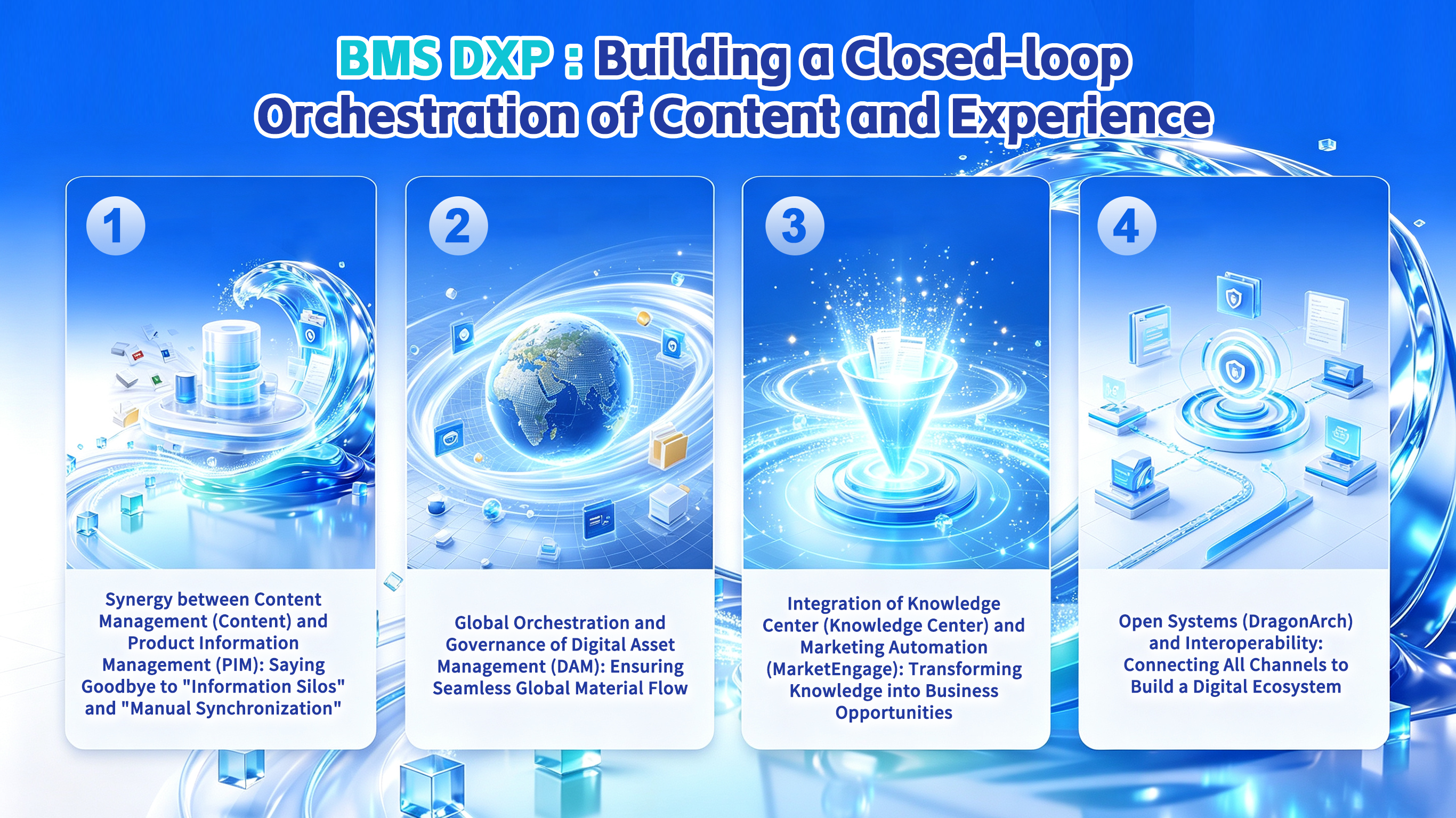
(The image illustrates BMS DXP: Building a Closed-Loop Orchestration for Content and Experience)
IV. A Practical Framework for Evaluating DXP Orchestration Capabilities: Moving Beyond "Buying Features" to Focus on "Building Capabilities"
Facing a wide array of DXP solutions, enterprises that merely compare feature lists risk falling back into the trap of "feature stacking." Forward-thinking enterprises should focus on whether a DXP can deliver genuine "orchestration capabilities."
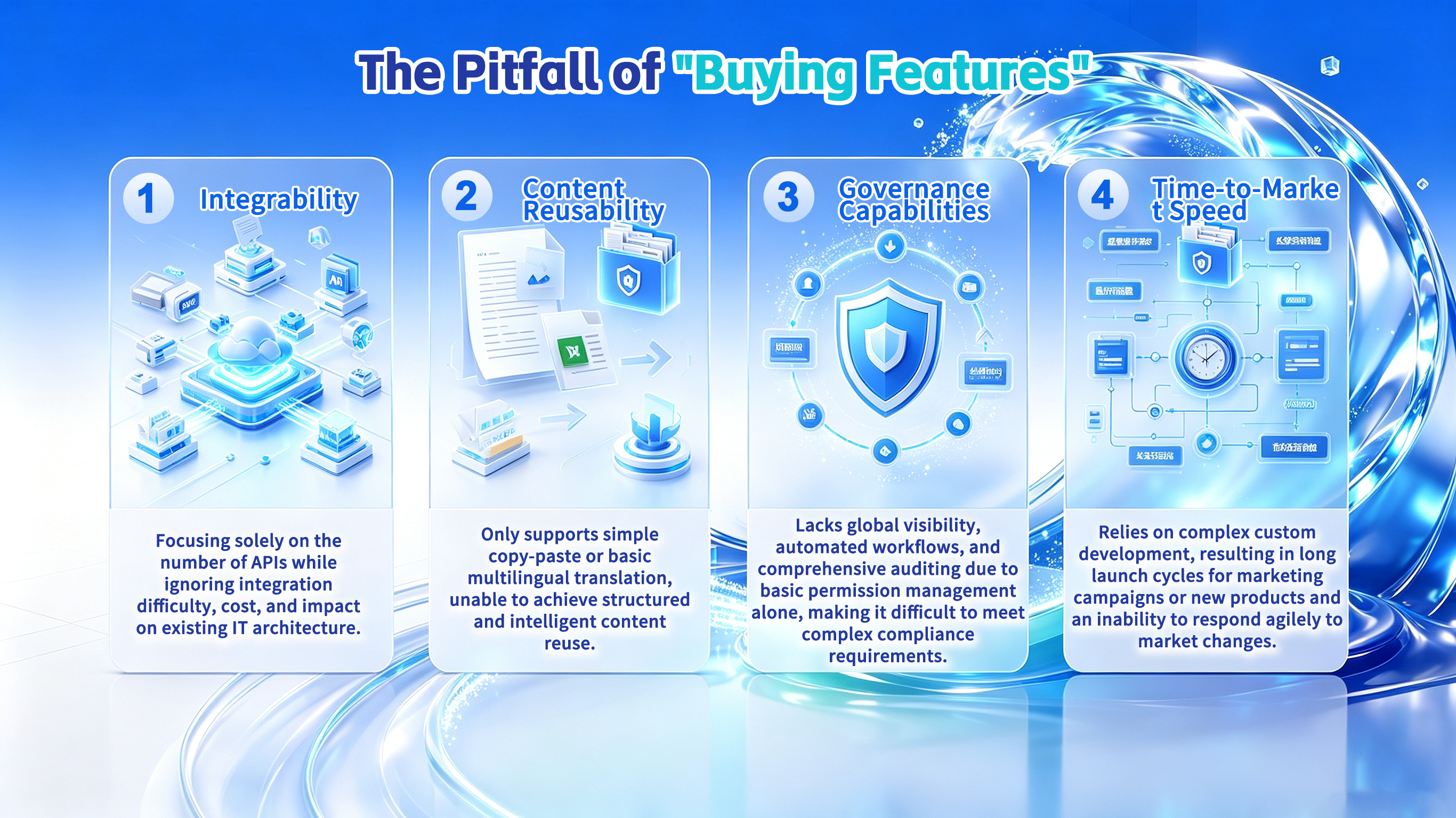
(The image illustrates the pitfalls of buying features)
The following evaluation framework aims to help enterprises shift from "buying features" to "building capabilities":
| Evaluation Dimension | Pitfalls of "Buying Features" | Perspective of "Building Capabilities" | Demonstration of BMS DXP Orchestration Capabilities |
| Integrability | Focusing solely on the number of APIs while ignoring integration difficulty, cost, and impact on existing IT architecture. | Focusing on API openness, documentation completeness, integration examples, ecosystem support, and the ability to connect seamlessly with existing systems to avoid "secondary development." | Provides a Headed/Headless dual-mode architecture and an open RESTful API gateway, supporting integrations with mainstream enterprise applications like Feishu SSO and cloud storage. It ensures rapid, smooth fusion with existing IT architecture, reducing integration bottlenecks. |
| Content Reuse | Only supports simple copy-paste or basic multilingual translation, unable to achieve content structuring and intelligent reuse. | Focuses on the structured and componentized capabilities of content, digital assets, product information, and knowledge, as well as automated derivation and distribution. Can it truly enable efficient cross-channel, cross-language, and cross-scenario content reuse, reducing content production costs? | Integrated management of Content, DAM, PIM, and Knowledge Center. Through AI intelligent tagging, metadata translation, and automated derivative versioning, it achieves efficient reuse and intelligent distribution of content assets, maximizing the value of every piece of content. |
| Governance Capabilities | Only offers basic permission management, lacking a global view, automated workflows, and comprehensive auditing, making it difficult to meet complex compliance requirements. | Focuses on granular permission control, workflow automation, compliance detection mechanisms, complete audit logs, and version traceability. Can it ensure compliance and security in global operations, avoiding potential risks? | Provides file-level permission management, visual and configurable approval flows, AI compliance detection (e.g., sensitive words, copyright risks), full operation logs, and version management to ensure compliance and security in global operations. |
| Time-to-Market Speed | Relies on complex custom development, resulting in long launch cycles for marketing campaigns or new products, unable to respond agilely to market changes. | Focuses on visual editing tools, low-code/no-code development capabilities, automated deployment processes, and rapid iteration. Can it help business teams quickly respond to market demands and rapidly transform creativity into user-facing experiences? | Provides visual drag-and-drop editing interfaces, rich componentized templates, and SSR/SSG fast rendering technologies combined with automated workflows, greatly accelerating time-to-market for content and experiences, enabling enterprises to seize every market opportunity. |
V. Conclusion: From Feature List to Value Loop
In today's increasingly deepening digital wave, enterprise demand for DXP has transcended simple feature stacking. What they truly need is a capability that can efficiently "orchestrate" content, digital assets, product information, customer knowledge, and channel data, ultimately converting it into operable and measurable business value. BMS DXP is built upon this philosophy, striving to become a powerful engine for enterprises to build a digital experience loop. By focusing on orchestration capabilities, enterprises will bid farewell to the misconception of "buying features" and truly step into a new stage of digital transformation focused on "building capabilities," achieving sustained business growth and innovation.
Frequently Asked Questions (FAQ)
Q1: In what aspects does BMS DXP's "orchestration capability" manifest?
BMS DXP deeply coordinates five modules—Content, DAM, PIM, Knowledge Center, and MarketEngage—and leverages an open RESTful API gateway and Headed/Headless dual-mode architecture to connect enterprise content, digital assets, product information, customer knowledge, and channel data into an operable closed-loop system. After PIM updates product parameters, Content automatically refreshes; DAM assets are linked to PIM SKUs; and the Knowledge Center is embedded in marketing automation workflows—achieving full-chain automated orchestration from data source to user touchpoints.
Q2: How to evaluate the orchestration capability of a DXP platform?
From five dimensions: Integrability (API openness and ecosystem compatibility), Content Reuse (componentization/automated derivation/multi-channel distribution capabilities), Governance Capabilities (granular permissions/compliance detection/audit logs), Time-to-Market Speed (visual editing/low-code/SSR rendering), and Measurability (data tracking/user behavior tracking/business conversion attribution). BMS DXP provides complete capabilities across these five dimensions, helping enterprises shift from "buying features" to "building capabilities."
Q3: Which scenarios does BMS DXP's Headless capability support?
Supports both Headed (traditional web) and Headless (API-driven) dual modes. Delivers content to any channel—including mobile apps, mini-programs, IoT devices, dealer portals, and in-vehicle screens—via RESTful APIs. Create content once and distribute across multiple channels: components and data models support cross-channel reuse, eliminating the need to maintain content separately for each endpoint.
Q4: What is the biggest difference between DXP orchestration capabilities and traditional CMS?
Traditional CMS addresses "content publishing," while DXP solves "integrated orchestration of content, assets, product data, and customer experience." BMS DXP does more than just build websites; its workflow engine, open APIs, and multi-system integration capabilities make it the "central hub" of an enterprise digital ecosystem, coordinating the collaborative operation of multiple systems such as CRM, ERP, e-commerce platforms, and social media channels.
Q5: What automation scenarios does the BMS DXP workflow engine support?
Visual approval flow configuration (multi-level co-signing, conditional branching, reminders), automated content translation and distribution, PIM data synchronization to Content and e-commerce platforms, automatic generation of DAM asset derivative versions, and a combination of AI and manual approvals. The workflow engine can be flexibly customized according to business needs to achieve full lifecycle automation from content creation, review, and publication to performance tracking.
Q6: How user-friendly is the open API system for integrating with existing IT architectures?
BMS DXP provides a standard RESTful API gateway covering core functions such as content CRUD, asset management, user permissions, and search. It supports integration with mainstream enterprise applications like Feishu SSO/Cloud Drive and comes with pre-built connectors for对接 with CRM, ERP, and e-commerce platforms. In Headless mode, it offers GraphQL interfaces with free choice of front-end technology stacks. Not tied to specific technology ecosystems, it reduces integration costs.


Want to know more about our products?
With years serving Fortune 500 clients, we offer flexible solutions and integrated implementation.
