





Is DAM On-Premises Deployment Worth It? A Perspective from Data Security, Permissions, Auditing, and Total Cost of Ownership
Release Date: 2026-07-09
Author: William
Introduction
As the Digital Asset Management (DAM) market continues expanding, enterprises’ requirements for content security, permission control, and audit trail are becoming increasingly stringent. According to Fortune Business Insights, the global DAM market is projected to reach approximately USD 6.29 billion by 2026, growing at a compound annual growth rate exceeding 15% over the coming years [2]. Faced with diverse deployment models, enterprise groups and multinational corporations often weigh security compliance against total cost when opting for on-premises deployment. This article objectively compares SaaS, dedicated cloud, and on-premises DAM deployment models from the perspectives of data security, permission management, audit trail, and total cost of ownership (TCO), helping you clarify your decision-making process.
As enterprise digital transformation deepens, the volume and variety of digital assets grow exponentially—encompassing images, videos, documents, design templates, and more formats. This diversified asset management requirement further drives demand for enhanced security and flexibility in DAM systems. Particularly for enterprises handling sensitive information and intellectual property, data leakage risks and compliance audits become critical decision factors. This article analyzes the advantages and disadvantages of different deployment models, integrating real-world enterprise scenarios and technical details, to assist enterprises in selecting the option best aligned with their business needs.
Overview of Three DAM Deployment Models
| Deployment Model | Description | Advantages | Limitations |
| SaaS (Public Cloud) | Hosted uniformly by the service provider; pay-as-you-go | Rapid deployment, lightweight operations & maintenance, high elasticity | Limited data control, constrained permission complexity |
| Dedicated Cloud | Exclusive cloud resource leasing with isolated deployment | Independent environment, higher security | Additional operations & maintenance required; higher cost than SaaS |
| On-Premises Deployment | Enterprise-built or hosted; full control | High data security, flexible permissions | High initial investment, complex operations & maintenance |
When selecting a DAM deployment model, enterprises must balance their IT capabilities, budget constraints, and business compliance requirements. For example, a multinational manufacturing enterprise—with numerous R&D and marketing teams globally and massive volumes of intellectual property–intially adopted the SaaS model but ultimately migrated to a dedicated cloud environment due to inability to meet complex hierarchical permission requirements and compliance audit demands. Custom development enabled finer-grained access control. Conversely, a financial institution directly invested in on-premises deployment, prioritizing data sovereignty and audit integrity—ensuring all assets reside on local servers and achieving deep integration with its internal risk control system.
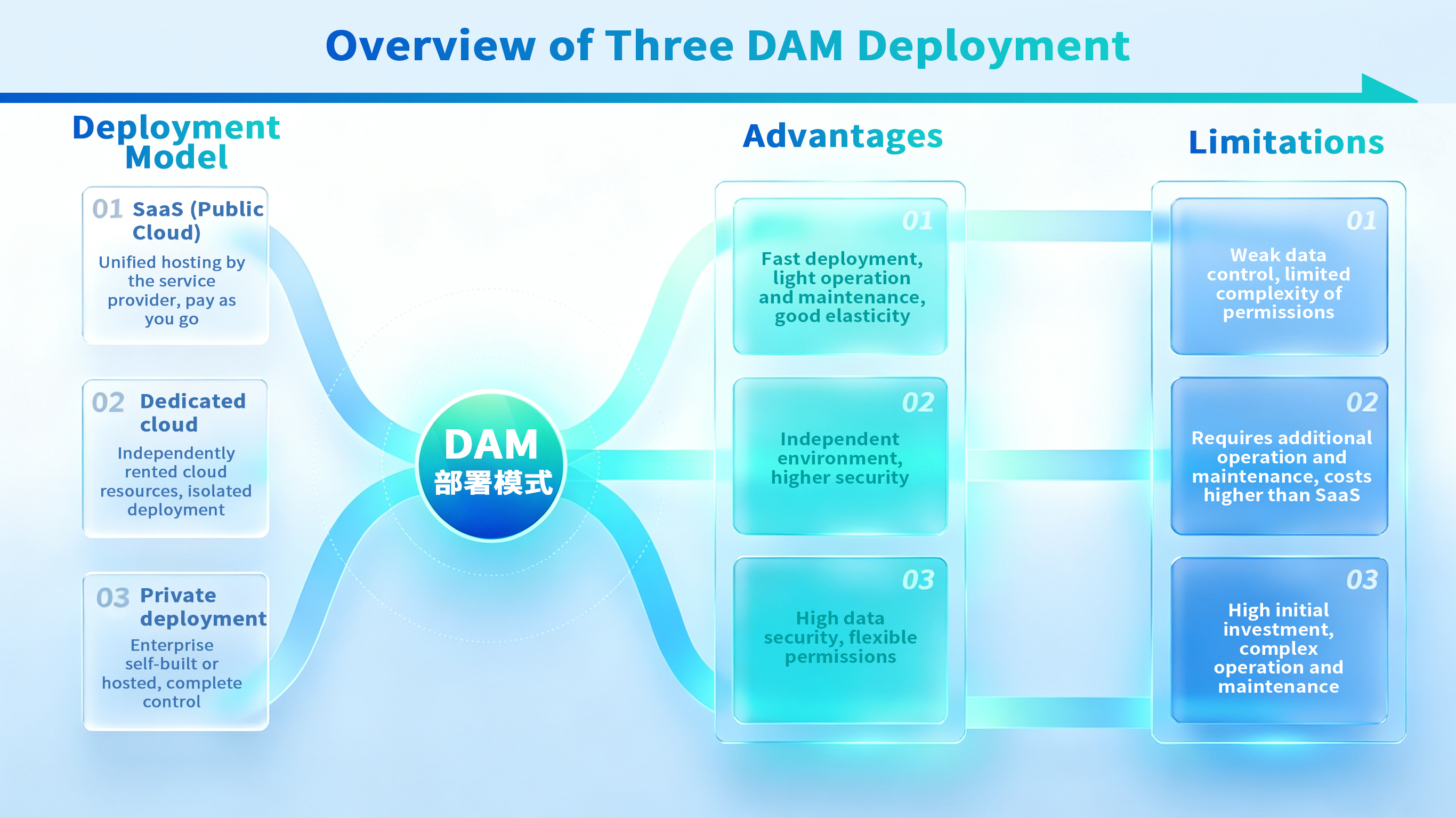
(Illustration depicting three DAM deployment models)
From a content governance perspective, industry reports (e.g., Fotoware) indicate that content ecosystem integration and cross-departmental usage are key DAM development trends [1]. This implies that systems must support multidimensional permission management while enabling cross-system data synchronization and unified views. On-premises deployment offers superior advantages in meeting complex permission and compliance requirements; however, the associated management burden and costs cannot be overlooked. Enterprises should assess trade-offs across security, flexibility, and cost according to their specific business contexts.
Data Security and Permission Management
The primary advantage of on-premises deployment lies in physical and logical data isolation—especially suitable for industries with extremely high data sovereignty and compliance requirements, such as finance, healthcare, and manufacturing. Regarding permission management, enterprises need to design multilevel access controls tailored to departments, projects, and roles. The BMS DXP supports fine-grained permission grading and approval workflows, fulfilling such complex scenarios.
Specifically, real-world permission design typically requires multidimensional composite permissions—for instance, “department + project + role”—to implement the principle of least privilege. For example, in a large e-commerce group’s DAM system, the “product line manager” role can access only design files corresponding to their product line, whereas the “marketing planner” role can access all marketing campaign materials. Furthermore, approval workflows are embedded into the permission architecture, mandating multi-tier reviews for content modifications to ensure asset version security and compliance.
In contrast, SaaS models feature standardized permission frameworks, making full alignment with dynamic enterprise policies difficult. While dedicated cloud environments provide isolated infrastructure, permission customization remains constrained by platform specifications. Moreover, SaaS typically employs uniform permission templates, hindering support for complex cross-departmental permission inheritance and specialized approval flows—limiting granular management of sensitive content.
“DAM security extends beyond data encryption and firewalls—it fundamentally relies on robust permission models and version traceability, ensuring every access and modification is fully auditable.” — Industry expert perspective
At the data security level, on-premises deployment enables enterprises to implement end-to-end encryption strategies and network isolation, satisfying international compliance standards such as GDPR and ISO 27001. Additionally, enterprises may integrate their proprietary identity authentication systems (e.g., LDAP, Active Directory) to enable single sign-on (SSO) and multi-factor authentication (MFA), further strengthening security safeguards.
On-premises deployment also facilitates implementation of fine-grained permission granularity strategies—such as hybrid application of Attribute-Based Access Control (ABAC) and Role-Based Access Control (RBAC)—to meet dynamic business needs. The flexibility and transparency of permission policies constitute the core competitive advantage distinguishing on-premises deployment from other models.
Audit Trail and Compliance Requirements
Audit trail constitutes a core component of enterprise compliance management. On-premises deployment enables comprehensive log collection and version management, supporting traceability of every upload, modification, approval, and publication event for each asset. The BMS DXP provides version traceability functionality, integrated with approval workflow design, to satisfy rigorous regulatory requirements.
In practical implementations, an audit trail system must record not only operation timestamps and operator identities, but also detailed change information regarding the operation content. A multinational manufacturing enterprise, through its on-premises DAM deployment, achieved complete recording of version histories and approval workflows for all design files—meeting both internal audit requirements under the ISO 9001 Quality Management System and external audit demands. Furthermore, automated archival and encrypted storage of audit data ensure immutability and long-term traceability of audit records.
Under SaaS models, audit data is typically managed centrally by the service provider, limiting enterprise access rights. Dedicated cloud environments offer intermediate audit capabilities but remain dependent on provider tools. Given that audit data pertains to core enterprise assets, on-premises deployment delivers higher transparency and control—facilitating adherence to strict compliance mandates in finance, healthcare, and other regulated sectors.
Compliance auditing also encompasses tracking permission changes and verifying approval workflow compliance. Enterprises may leverage customized rule engines to automatically trigger anomaly alerts and compliance reports, reducing human-induced risks. Moreover, integration of audit logs with enterprise Security Information and Event Management (SIEM) systems establishes a holistic security management chain.
Total Cost of Ownership (TCO) Comparison
A DAM system’s total cost of ownership (TCO) includes not only licensing fees but also storage, bandwidth, operations & maintenance, personnel, and migration costs. The table below illustrates typical cost components across the three deployment models:
| Cost Item | SaaS | Dedicated Cloud | On-Premises Deployment |
| Licensing Fee | Subscription-based (per user or capacity) | Subscription + resource leasing | One-time license + maintenance fee |
| Storage Cost | Included in subscription | Purchased separately | Self-built storage infrastructure or leased |
| Bandwidth Cost | Typically included | Subject to cloud provider pricing | Internal network or dedicated line; lower cost |
| Operations & Maintenance Cost | Borne by service provider | Partially self-managed | Fully self-managed; requires specialized team |
| Integration & Customization | Limited; standard interfaces only | Customizable; higher cost | Highest flexibility and highest cost |
| Migration Cost | Low | Medium | High, involving environment setup |
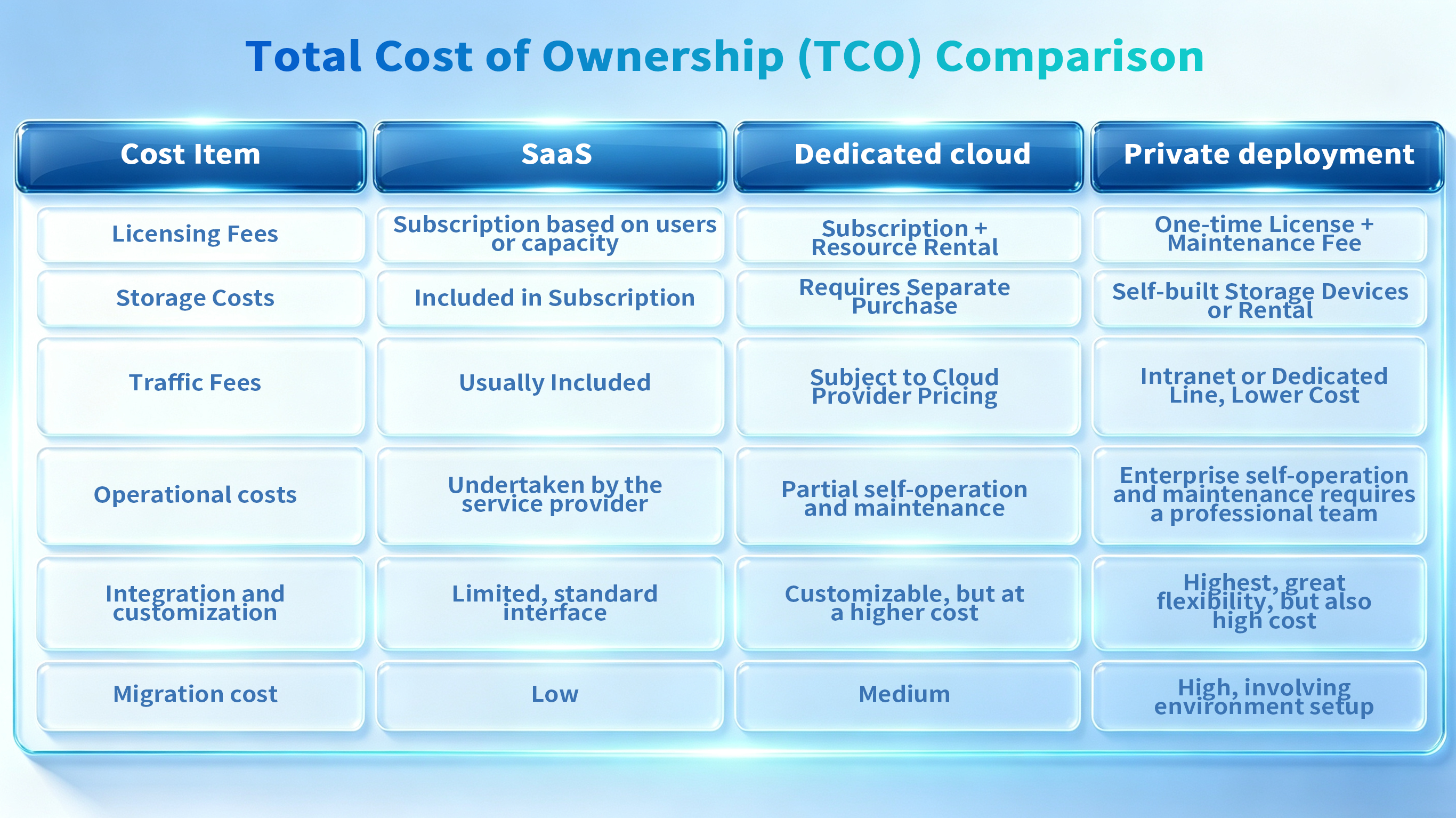
(The image illustrates the typical cost composition of the three deployment models.)
From a budget perspective, SaaS suits cost-sensitive enterprises with standardized requirements—offering low initial investment and flexible, on-demand scaling. Dedicated cloud suits enterprises requiring higher security but wishing to avoid full operational burdens. Private deployment suits enterprises with complex operations, strict permissions, and deep customization needs—but entails high upfront investment and ongoing operational costs.
Analyzing cost components in detail: storage and bandwidth fees are generally included in SaaS, making budgets relatively predictable; private deployment requires self-procurement of storage devices and design of appropriate storage architecture and backup solutions. Regarding operations, private deployment necessitates building a professional team—including system administrators, cybersecurity engineers, and application support personnel—resulting in significant long-term labor costs.
In a private DAM project for a large enterprise, initial hardware procurement accounted for approximately 40% of the total budget, while annual operational staff costs averaged about 15%; additional continuous investments are required for software/hardware upgrades and security audits. By adopting cloud-native technologies and automated operations tools, some enterprises have improved operational efficiency and reduced subsequent TCO.
According to Baklib’s analysis of DAM trends for 2026, automated workflows and ecosystem integration are key to enhancing efficiency; private deployment’s flexibility facilitates deep customization but also increases overall TCO[3]. Enterprises should comprehensively consider long-term operational costs and business growth risks during evaluation, avoiding short-term savings that may lead to high future maintenance expenses.
Technical Architecture and Operational Challenges of Private Deployment
Private deployment requires enterprises to possess certain IT resources and operational capabilities. Cloud-native containerization technology can significantly reduce deployment complexity and operational costs. BMS DXP adopts a cloud-native containerized architecture, supporting elastic scaling and rapid deployment, thereby mitigating traditional technical barriers associated with private deployment.
In practice, enterprises commonly use container orchestration platforms such as Kubernetes to achieve microservices-based deployment of DAM systems. Through automatic container scaling and rolling updates, system high availability and business continuity are ensured. A multinational corporation, via its private DAM project, decomposed its legacy monolithic application into multiple service modules, enabling on-demand scaling and rapid fault recovery, significantly improving system stability.
Additionally, the system’s dual-mode Headed & Headless support, API-based content delivery, and dynamic metadata generation provide enterprises with flexible solutions for cross-channel content publishing, accommodating complex business requirements such as multi-site and multilingual deployments. Private deployment also facilitates deep integration with internal enterprise systems—including content hubs, CMS, and DXP—enabling unified asset management and multi-channel content distribution.
Regarding operational challenges, private deployment must address multiple tasks including hardware failure, software upgrades, security patches, and backup/recovery. Enterprises should establish comprehensive operational processes and monitoring systems—including centralized log management, anomaly alerts, and automated operational scripts. Cross-departmental collaboration is especially critical: IT and business departments must jointly formulate permission policies and emergency response plans to ensure asset security and business continuity.
From a budgetary standpoint, private deployment requires substantial initial hardware and software investment, followed by sustained mid-to-long-term investment in operational manpower and security/compliance costs. Enterprises are advised to adopt a phased implementation strategy—first establishing a core functionality environment, then gradually expanding—to avoid excessive financial pressure from one-time investments.
FAQ
Q1: Given the high initial investment for private deployment, how should enterprises evaluate ROI?
Initial costs for private deployment are indeed high, covering hardware procurement, software licensing, human resources, and system integration. However, over the long term, meeting stringent data security and compliance requirements effectively prevents data breaches, legal risks, and fines, reducing potential losses from business interruption. Enterprises should assess ROI scientifically by combining their own business scale and compliance pressures with phased investment and iterative optimization strategies to progressively enhance system functionality. Quantifying risk costs and compliance benefits—alongside internal IT resource capabilities—enables more accurate ROI assessment.
Q2: If SaaS cannot meet complex permission management requirements, does this mean private deployment is mandatory?
Not necessarily. Dedicated cloud or hybrid cloud solutions offer greater permission customization flexibility and suit enterprises with moderately complex permission needs yet lacking full in-house operational capabilities. Selection should comprehensively weigh enterprise IT capability, compliance requirements, and budget constraints. Some SaaS vendors are also continuously enhancing their permission models; however, for extremely complex multidimensional permissions and approval workflows, private deployment offers greater flexibility.
Q3: How can operational challenges of private deployment be alleviated?
Operational pressure from private deployment primarily stems from hardware maintenance, software upgrades, security patches, and incident response. Adopting cloud-native containerization technology and automated operational tools improves system stability and operational efficiency. Establishing robust monitoring systems and automated processes reduces manual intervention and error risks. Cross-departmental collaboration is equally vital: IT and business teams must jointly define operational standards and emergency response plans to ensure system security and business continuity.
Q4: Are content auditing and version traceability features universally available?
Not all DAM systems offer comprehensive auditing capabilities. In particular, under SaaS models, audit data is typically managed centrally by the service provider, limiting enterprise access rights. Enterprises should prioritize systems supporting fine-grained auditing and version management to ensure full traceability of every operation, satisfying compliance requirements. Comprehensive auditing features should also include anomalous behavior detection and automated alerts to enhance security.
Q5: How much does a Digital Asset Management system cost?
Pricing varies significantly by vendor, deployment model, and functional requirements. SaaS subscriptions are typically priced per user or storage capacity—suitable for budget-constrained enterprises with standardized needs. Private deployment requires consideration of hardware/software procurement, specialized operational teams, and system integration costs—entailing higher budgets. Enterprises are advised to conduct detailed budgeting and TCO analysis based on actual requirements, functional complexity, and long-term operational costs.
Q6: Does privatizing an enterprise’s media library impact cross-regional collaboration?
Private deployment imposes greater restrictions on data access, yet secure cross-regional access can be achieved via VPN, leased lines, or cloud-network convergence technologies. The system itself supports multi-site and multilingual deployments, ensuring efficient cross-regional collaboration. Enterprises should design appropriate network architecture and permission policies to guarantee secure data transmission and convenient access—avoiding business collaboration disruption due to security constraints.
Q7: How is AI applied in Digital Asset Management?
AI is primarily used for auto-tagging, content recommendation, and copy optimization—but relies fundamentally on structured metadata and permission governance. Private deployment enables enterprises to better control data quality and AI application boundaries, avoiding data leakage risks. Enterprises may progressively introduce AI functionalities aligned with specific business scenarios to enhance asset management efficiency and content intelligence levels.
Conclusion
Whether private DAM deployment is worthwhile depends on an enterprise’s trade-offs among data security, permission complexity, audit traceability, and total cost of ownership. For group enterprises and multinational corporations with high compliance requirements, complex permissions, and sufficient IT resources, private deployment—combined with cloud-native operational technologies (e.g., the containerized solution provided by BMS DXP)—offers greater flexibility and security assurance.
However, private deployment is not suitable for all enterprises; budget, operational capability, and business requirements are key decision factors. Enterprises should scientifically evaluate the pros and cons of different deployment models based on their actual circumstances, formulate phased implementation plans, and ensure successful project execution. If you are evaluating the relationship between DAM and DXP—or have specific requirements for private deployment—please visit Dragon Bravo Corporation’s official website: www.dragonsoftbravo.com, or contact us at sales-support@dragonsoftbravo.com. Phone: +86-21-61483130, operating hours Monday–Friday, 9:00–17:00 (Beijing Time, UTC+8).
References
[1] : https://www.fotoware.com/blog/digital-asset-management-trends-2026 "Digital Asset Management trends 2026: What you need to know now"
[2] : https://www.fortunebusinessinsights.com/digital-asset-management-market-104021 "Digital Asset Management (DAM) Market Size, Share and Industry Analysis, 2026–2034"
[3] : https://baklib.com/dam-trends-2026/ "4 Key DAM Trends for 2026"


Want to know more about our products?
With years serving Fortune 500 clients, we offer flexible solutions and integrated implementation.
