





New Engine for Enterprise Growth in 2026: DAM, PIM, and Knowledge Center Integration, Bid Farewell to the Asset Black Hole
Publication Date: 2026-09-17
Author: William
Introduction
Under the digital wave, scattered enterprise content assets and chaotic management have become bottlenecks to growth. The integrated synergy of DAM, PIM, and Knowledge Centers is key to building a credible, efficient, and globalized content asset system. CMOs, Digital Leaders, and CIOs are facing the strategic challenge of how to effectively integrate these systems to build a unified, trustworthy, and reusable content asset system.
I. The Asset Black Hole: An Invisible Obstacle on the Path to Growth—How Many Pitfalls Have You Hit?
Taking a global automotive brand as an example, launching a new model requires synchronizing tens of thousands of digital assets. However, the marketing department often struggles with time-consuming searches for high-definition images, product information varies across regional websites, and overseas dealers complain about delayed localized materials. These fragmented, inconsistent, and hard-to-trace contents form an "asset black hole," severely impacting new product launch efficiency and brand image.
This is not an isolated case. Practices from an outbound automaker indicate that unified management of massive assets, ensuring global accessibility and compliance, is a critical pain point in digital transformation. Adobe's report also points out that data fragmentation and insufficient organizational collaboration are common obstacles to improving customer experience, with the content asset "black hole" being its concentrated manifestation. [1]
II. DAM, PIM, and Knowledge Centers: The Dilemma of Working Alone and the Power of Collaborative Operations
To address content asset management challenges, enterprises often introduce professional systems, but working alone yields limited value.
• Digital Asset Management (DAM): As the enterprise's "Asset Bank," DAM is responsible for storing, managing, retrieving, and distributing unstructured digital media assets, ensuring assets are "findable and usable correctly," maintaining brand visual asset consistency and compliance. For instance, a large enterprise uses DAM to centrally manage massive marketing assets, supporting multi-format uploads, online previews, and utilizing AI intelligent tagging, custom metadata, and fine-grained permission configurations to achieve rapid retrieval and standardized usage.
• Product Information Management (PIM): PIM serves as the "Household Registration" for product data, managing structured product information (models, specifications, prices, features, etc.) to ensure a "single source of truth," avoiding inconsistent information across multiple channels. A manufacturing giant uses PIM to uniformly manage thousands of product parameters, automatically generates multilingual descriptions, significantly improves launch efficiency, and avoids brand risks and operational friction.
• Knowledge Center: As the enterprise's "Intelligent Brain," the Knowledge Center consolidates, organizes, and distributes internal and external structured and unstructured knowledge (FAQs, manuals, documents, etc.), aiming to enhance knowledge "accessibility, understandability, and reusability," thereby improving customer self-service and internal collaboration efficiency. A technology company uses a customer service portal to centrally manage frequently asked questions, alleviates pressure on customer service, and provides a high-quality training knowledge base for AI large models.
However, siloed systems lead to fragmented content production workflows and inefficient information dissemination, creating "information islands." The lack of an intrinsic "dialogue mechanism" among DAM, PIM, and knowledge centers increases maintenance costs and introduces hidden costs such as information inconsistency and low collaboration efficiency. Research by the Content Marketing Institute emphasizes that content strategy improvement stems from strategic refinement rather than technological stacking; content relevance and quality are the core drivers. [2] Isolated systems struggle to meet enterprises' demands for content quality and efficiency.
III. Triad Integration: Building a "Smart Core" for Content Growth, Saying Goodbye to the "Asset Black Hole"
To say goodbye to the "asset black hole," enterprises must view DAM, PIM, and knowledge centers as an organic whole, constructing a "smart core" for content growth. This is not merely technical integration but also a business process upgrade, consolidating scattered digital assets, structured product information, and systematic service knowledge to form a unified, trustworthy, and reusable content foundation.
1. DAM carries multi-modal assets, PIM provides structured facts, and the knowledge center offers contextualized explanations: New product lifecycle content flows through the "smart core." DAM centrally manages high-resolution images, videos, and other assets, ensuring compliance and ease of retrieval through AI tagging, metadata configuration, and permission management. PIM centrally maintains structured information such as core product parameters and features, serving as a "single source of truth." The knowledge center combines assets and information to generate multilingual user manuals, FAQs, and technical white papers, distributing them to different audiences to ensure high consistency and efficiency across the content chain.
2. Global Application Acceleration and Asset Governance: Distinguishing Between "Express Lanes" and "Highways": Enterprises with global operations need to differentiate between two types of acceleration:
• Content Delivery Acceleration (CDN): Provides an "express lane" for global users, accelerating consumers or partners in previewing, accessing, and downloading assets to enhance front-end user experience.
• Global Application Acceleration: Builds a "highway" for internal enterprise teams, ensuring efficient collaboration across global teams within the DAM backend (including login, search, upload, editing, AI tagging, approval, metadata maintenance, permission configuration, and statistical queries). These backend operations have extremely high requirements for network stability and low latency, necessitating reliance on high-quality cross-border networks (such as CN2 or 9929) to improve global operational efficiency and team collaboration experiences. A leading automotive company's practice was divided into two phases: initially, CDN solved asset distribution speed; later, intelligent capabilities such as AI approval, automated workflows, AI translation, and AI tagging were introduced, upgrading the asset library into a growth asset platform capable of global collaboration and intelligent governance.
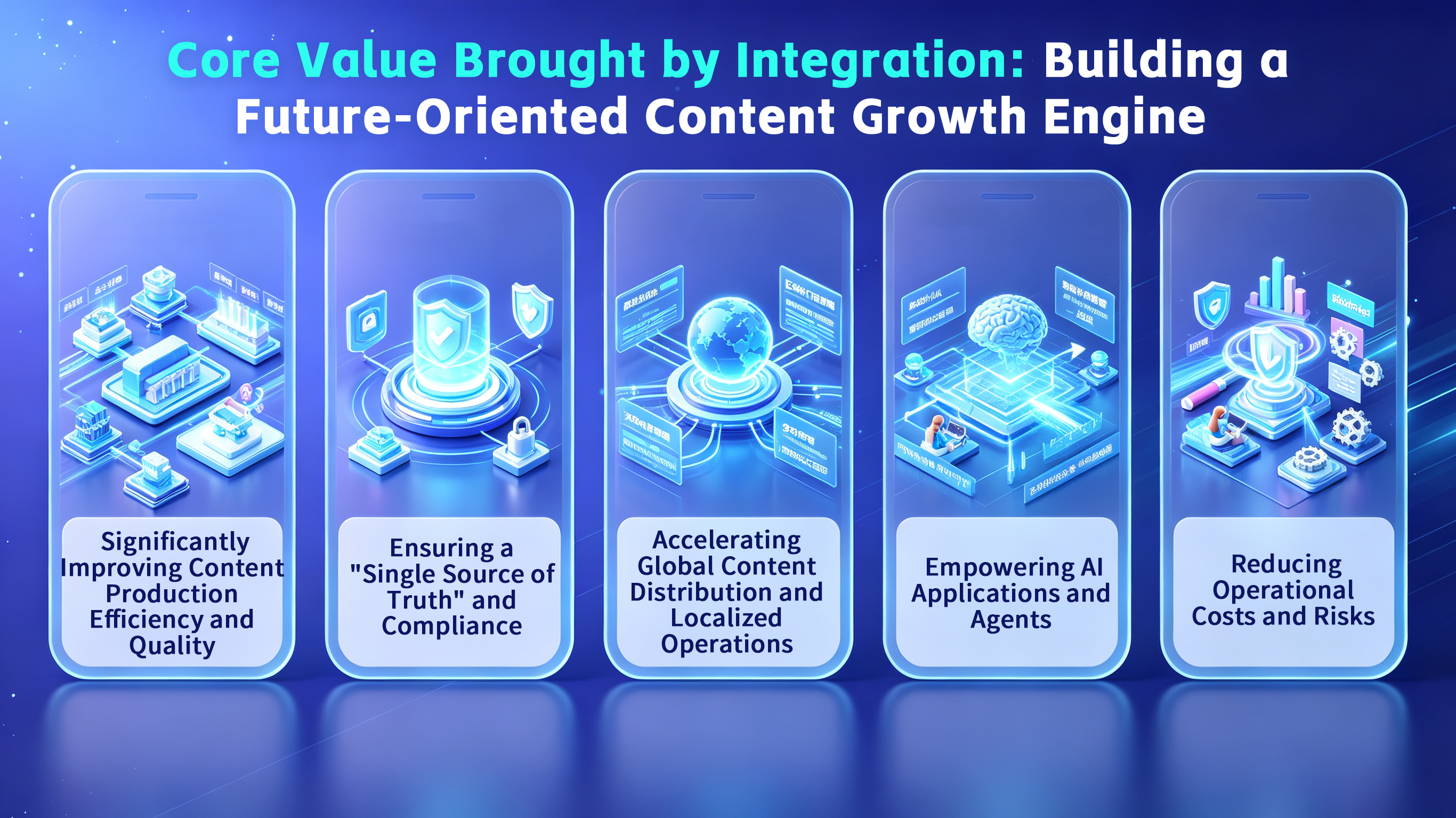
IV. Core Value of Integration: Building a Future-Oriented Content Growth Engine
Integrating DAM, PIM, and knowledge centers to achieve a qualitative leap from the "asset black hole" to "growth assets" is key to building future competitiveness.
1. Significantly Improving Content Production Efficiency and Quality: A unified content foundation aggregates all assets and product information, enabling content creators to quickly locate what they need and reducing time spent searching and verifying. Automated workflows and AI-assisted functions (such as AI translation, AI tagging, and content safety detection) accelerate content localization and publishing, ensuring content aligns with brand tone and high quality, helping enterprises respond rapidly to market changes.
2. Ensuring a "Single Source of Truth" and Compliance: PIM ensures product information accuracy; DAM ensures compliant asset usage (copyrights, validity periods), mitigating legal risks; and the knowledge center guarantees knowledge authority. Their synergy eliminates information inconsistency and compliance risks at the source, which is crucial for maintaining brand reputation in global operations. Comprehensive permission management, version control, and operation logs serve as guarantees for meeting global data compliance requirements.
3. Accelerating Global Content Distribution and Localized Operations: A unified asset库 and knowledge base, combined with global application acceleration and content delivery acceleration solutions, help enterprises quickly bring content to global markets. Multilingual support and granular permission management grant local teams flexible operational space within the headquarters framework, balancing global brand consistency with localized market differentiation needs.
4. Empowering AI Applications and Agents: A unified, structured, and trustworthy content asset system forms the foundation for building high-quality AI applications and agents. AI search, smart customer service, marketing automation tools, etc., all require accurate, authoritative data and knowledge from the "smart core" to provide more precise and personalized user experiences. An Adobe report indicates that 80% of respondents expect real-time, predictive personalized customer experiences; integrated platforms provide a solid content and data foundation for this. [1]
5. Reducing Operational Costs and Risks: Integrated solutions reduce redundant investments in multiple systems and data synchronization work, minimizing errors and rework caused by information inconsistency. Comprehensive permission management, version control, and operation logs effectively mitigate potential risks in content asset management and enhance the maturity of enterprise digital operations.
(The image illustrates the core capabilities of BMS DAM)
V. How to Determine if an Enterprise Needs an Integrated Solution? Manager Self-Diagnosis Checklist
When considering an integrated solution for DAM, PIM, and Knowledge Center, enterprises can use the following checklist for self-diagnosis to clarify needs and priorities:
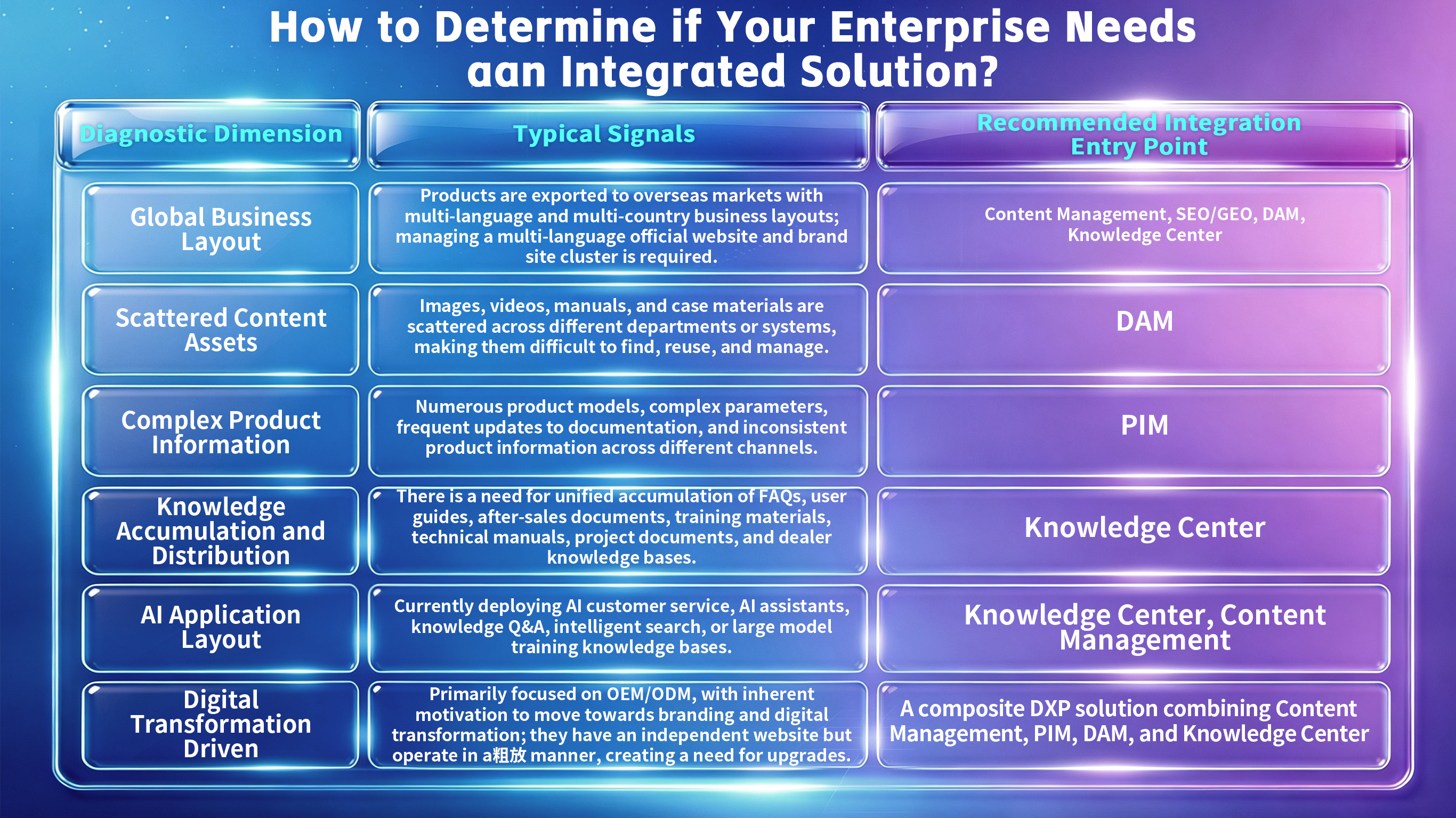
(The image displays a self-diagnosis checklist for the integrated solution)
The self-diagnosis checklist helps enterprises identify content asset management pain points and find entry points for integrated solutions. For manufacturing clients, integrating the Knowledge Center with Content + DAM + PIM enables unified organization and distribution of product materials, graphic assets, manuals, maintenance guides, training documents, FAQs, and service knowledge.
VI. From Asset Black Hole to Growth Asset: It's Time to Take Action
In the 2026 digital competition, enterprises cannot afford the consequences of scattered content assets and chaotic management.Integrating DAM, PIM, and Knowledge Center is key to building a future growth "intelligent hub," addressing issues such as inefficient content production, inconsistent information, and hindered global collaboration. This releases the value of content assets and drives business growth. Enterprises are advised to inventory existing assets, assess systems and processes, and plan an integrated blueprint. Through content governance diagnosis and in-depth communication, enterprises can transition from an "asset black hole" to a "growth asset," establishing a digital content foundation that supports global business development and empowers AI applications. Google emphasizes that in the AI search era, enterprises should focus on the crawlability, understandability, verifiability, and sustainable updateability of official websites, product materials, knowledge bases, and case studies; integrated platforms provide a solid foundation for this. [3]
Frequently Asked Questions (FAQ)
Q1: Why do DAM, PIM, and Knowledge Center need to be integrated?
Siloed single systems lead to "information silos"—product data in PIM, assets in DAM, and documents in the Knowledge Center operate independently without knowing about each other, resulting in broken content production workflows.BMS DXP natively integrates all three: Product data in PIM can be linked to DAM assets and embedded in Knowledge Center documents. Content editors retrieve parameters from PIM and assets from DAM to build product pages, achieving end-to-end content consistency and efficient reuse from R&D to market promotion.
Q2: What intelligent capabilities does the DAM module of BMS DXP offer?
AI Smart Tagging (automatically recognizing image content and generating multilingual tags), Multimodal Search (supporting visual search and natural language search), AI-Assisted Approval (content safety detection, OCR text detection), Automated Derivative Version Generation (batch generation of multi-size, multi-format assets). Fine-grained permission management (four-level permission matrix) and full operation logs ensure asset compliance and traceability.
Q3: How to determine if an enterprise needs a DAM/PIM/Knowledge Center integrated solution?
Refer to the self-diagnosis checklist: Global business layout → Content + SEO/GEO + DAM + Knowledge Center; Scattered content assets, version chaos → DAM; Complex product information, multi-channel inconsistency → PIM; Need to accumulate FAQs/manuals/training materials → Knowledge Center; Layout AI customer service/knowledge Q&A → Knowledge Center + Content. BMS DXP supports modular deployment with customizable combinations.
Q4: How do manufacturing clients combine the Knowledge Center with Content/DAM/PIM?
First, use PIM to manage complex product materials (SKU parameters, specifications, certification documents); then use DAM to manage graphic, video, and other assets; finally, use the Knowledge Center to unify organize manuals, maintenance guides, training documents, FAQs, and service knowledge for distribution to customers, distributors, or internal teams. A single BMS DXP platform covers the complete chain from product data → visual assets → knowledge documents → content publishing.
Q5: What is the accuracy rate of BMS DXP's AI tagging?
In general scenarios (people, landscapes, common objects), AI tagging accuracy can exceed 90%. In specialized fields (e.g., distinguishing different industrial component models, identifying medical device specification labels), domain model fine-tuning is required. BMS DXP supports enterprises in custom-training industry dictionaries. It is recommended to conduct a POC verification using actual assets before implementation.
Q6: How is compliance auditing for content assets ensured?
BMS DXP DAM provides a four-tier permission matrix (file-level/folder-level/user-level/user-group-level), with full log tracking for all operations. The approval workflow supports a combination of AI and manual approvals, while content safety detection and OCR text detection cover sensitive content and copyright risks. Automated workflows and compliance mechanisms ensure content compliance in global operations.
References
[1]: [Adobe, *2026 AI and Digital Trends Report*](https://business.adobe.com/resources/digital-trends-report.html)
[2]: [Content Marketing Institute, *B2B Content and Marketing Trends: Insights for 2026*](https://contentmarketinginstitute.com/b2b-research/b2b-content-marketing-trends-research)
[3]: [Google Search Central, *AI Features and Your Website*](https://developers.google.com/search/docs/appearance/ai-features)


Want to know more about our products?
With years serving Fortune 500 clients, we offer flexible solutions and integrated implementation.
