





Why does asset management often spiral out of control before translation for enterprises going global building multilingual websites?
Release Date: 2026-06-11
Author: William
Asset Management Challenges for Multilingual Websites: It’s More Than Just Translation
For enterprises expanding overseas, translation is often perceived as the biggest challenge when building multilingual websites. However, in practice, digital asset management—including product images, promotional videos, PDF documents, authorization files, and regulatory statements—is far more prone to “loss of control.” Managing versions, usage rights, regional compliance, and cross-channel synchronization of these assets is significantly more complex than language translation.
For example, an electronics manufacturing enterprise building websites for Europe, the Middle East, and Southeast Asia discovered that although translation was relatively smoothly completed through professional vendors, management of product images and regulatory statements descended into chaos. The European market requires product images to display GDPR-compliant privacy protection markings, while video packaging must show local certification marks; the Middle Eastern market imposes strict restrictions on patterns in packaging design, and regulatory statements must comply with local laws; Southeast Asia mandates multilingual PDF manuals, with substantial regulatory differences across countries. Regional teams stored local versions separately, resulting in duplicated assets, version conflicts, and even unauthorized content publication—posing reputational and legal risks to the brand.
Moreover, misuse of outdated assets is a common issue. For instance, a multinational industrial equipment enterprise received a regulatory warning in Europe after using expired product images, leading to marketing claims inconsistent with the latest safety standards. Such risks not only damage brand reputation but may also trigger fines and litigation.
“The complexity of asset management far exceeds translation itself—especially in global multi-site operations. Only by establishing a unified Digital Asset Management (DAM) system can content localization and cross-regional collaboration become truly efficient and controllable.” — Head of Website Operations, a Multinational B2B Brand
The Core Role of Digital Asset Management (DAM) in Multilingual Websites

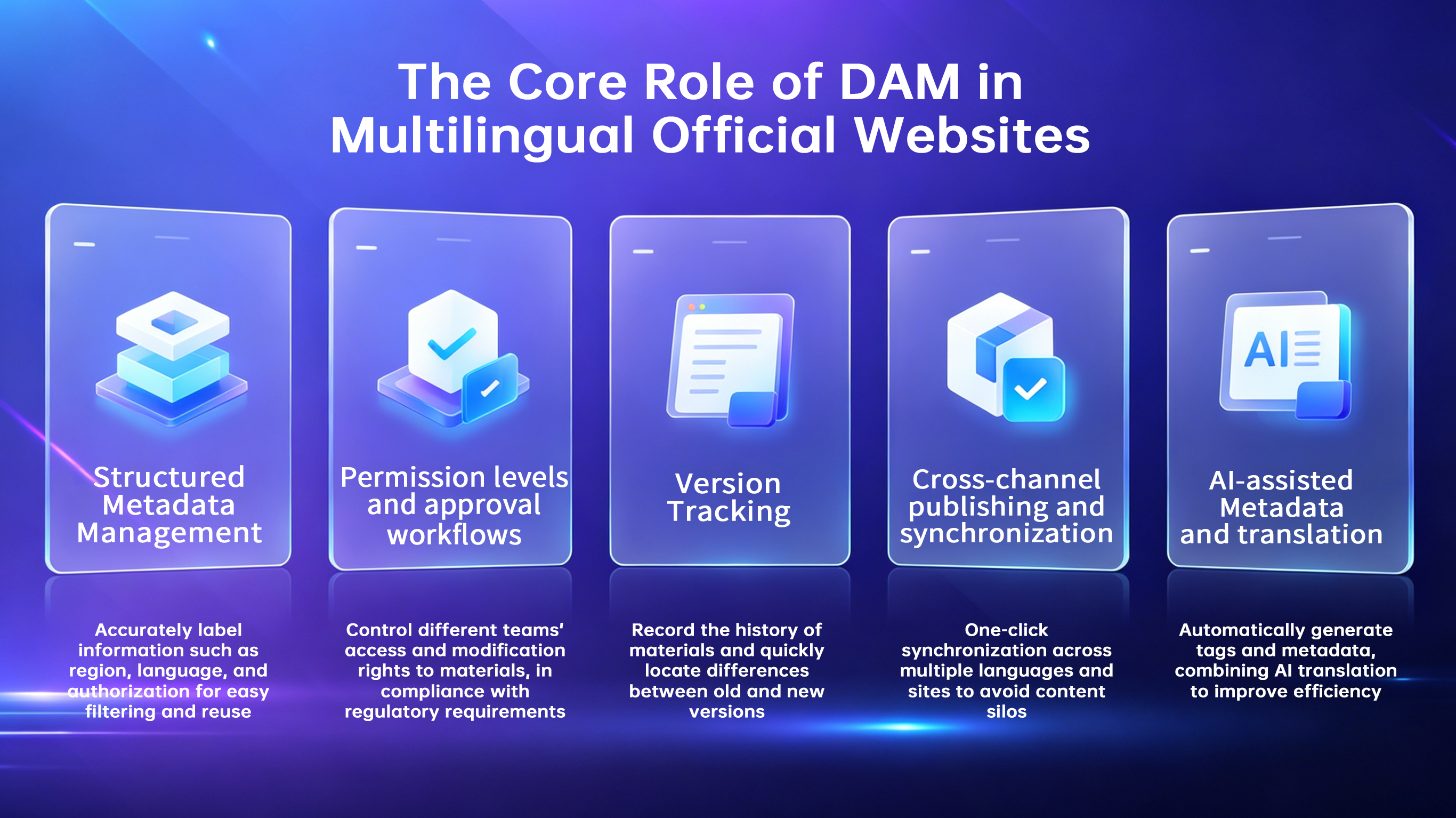
(Illustration showing the core role of DAM in multilingual websites)
Digital Asset Management (DAM) has evolved from a simple asset repository into a critical tool supporting content ecosystems and business processes. In 2026, the global DAM market is projected to reach USD 6.29 billion, growing at a compound annual growth rate (CAGR) of 15.1% [3]. Enterprises expanding overseas require cross-departmental and cross-regional collaboration, and DAM provides structured metadata, permission tiers, version traceability, and automated approval workflows to ensure compliant and efficient asset usage [1][2].
In practice, structured metadata management within DAM is crucial. For example, product image metadata should include fields such as product model, applicable region (e.g., Europe/Middle East/Southeast Asia), language version, copyright ownership, license validity period, and permitted usage channels. This enables marketing and legal teams to quickly identify assets that meet local regulatory requirements and possess valid licenses—avoiding misuse.
Permission tiers and approval workflow design must fully accommodate cross-departmental responsibilities. For instance, the headquarters’ branding department handles initial review and upload of assets; the legal department conducts compliance reviews; and regional marketing teams manage localization adjustments and final publishing. Built-in system approval workflows ensure full audit trails and traceability for every step, minimizing human error.
Version traceability helps operations teams promptly detect and replace outdated assets, reducing risks arising from information latency. In a large-scale manufacturing enterprise’s multilingual website project, DAM’s version management prevented customer complaints caused by inadvertent use of outdated product manuals.
Cross-channel publishing and synchronization capabilities support unified distribution across websites, social media, and e-commerce platforms—reducing redundant work and content inconsistencies, thereby enhancing brand communication efficiency.
| Key DAM Features | Specific Value | Applicable Scenarios |
| Structured Metadata Management | Precisely tags geographic, linguistic, licensing, and other attributes—enabling efficient filtering and reuse | Multi-regional asset filtering, version control |
| Permission Tiers & Approval Workflows | Controls access and modification permissions for different teams, ensuring compliance | Preventing asset misuse, regional compliance approvals |
| Version Traceability | Records asset history and enables rapid identification of differences between old and new versions | Retiring outdated assets, promoting new versions |
| Cross-Channel Publishing & Synchronization | One-click synchronization across multilingual, multi-site environments—eliminating content silos | Multilingual website publishing, multi-channel marketing |
| AI-Assisted Metadata & Translation | Automatically generates tags and metadata; enhances efficiency via AI-powered translation | Accelerating large-scale content management |
Regional Asset Reuse Challenges Facing Overseas Websites
Historically, multilingual website content has been led by translation teams, while asset management remains fragmented across design, legal, and marketing departments—lacking a unified platform.Take an electronic product as an example:
When used on the European site, product images must comply with GDPR requirements, and compliance labels shown in images must be localized;
In the Middle Eastern market, product packaging photos must avoid sensitive elements and include local regulatory statements;
Video content must undergo cultural adaptations per region, and licensing terms vary.
Without a unified asset management system, regional teams typically store local versions separately—leading to duplicated assets, version chaos, and even dissemination of unauthorized content, harming brand image and regulatory compliance.
Furthermore, managing asset licensing is particularly critical. Many enterprises procure or commission third-party production of product images and videos, where copyright ownership and usage scope are often complex. If headquarters and regional teams lack clear license registration and usage permission controls, regional teams may unintentionally use assets beyond their licensed scope—triggering copyright disputes.
In a multinational medical device enterprise’s multilingual website project, the headquarters’ legal team and regional marketing teams clearly defined asset licensing scopes and validity periods, and implemented permission restrictions via the DAM system—ensuring regional teams could only access authorized asset versions. This enhanced compliance in asset usage and avoided risks of copyright-related complaints.
“The complexity of asset management far exceeds translation itself—especially in global multi-site operations. Only by establishing a unified Digital Asset Management (DAM) system can content localization and cross-regional collaboration become truly efficient and controllable.” — Head of Website Operations, a Multinational B2B Brand
Responsibility Allocation and Collaboration Workflow Between Headquarters and Regional Teams
In multilingual website asset management, responsibility allocation and collaboration workflow design between headquarters and regional teams are key to success.
Headquarters typically oversees:
Centralized acquisition, preliminary screening, and copyright registration of assets;
Establishment of asset management policies and usage standards;
Maintenance of the DAM platform and control over the core asset library;
Definition of unified brand identity and compliance requirements.
Regional teams are responsible for:
Localization adjustments and secondary creation of assets based on local market regulations and cultural norms;
Local regulatory statement preparation and compliance review;
Participation in asset approval workflows to ensure published content complies with local policies;
Feedback on asset usage effectiveness and adjustment needs.
To prevent ambiguity in localized asset review boundaries, enterprises can adopt nested Live Copy functionality. Headquarters provides standardized content templates, regional teams perform localized modifications upon them, and local reviews occur via approval workflows. This ensures brand consistency while avoiding excessive regional modifications that could fragment brand identity.
In practice, a multinational consumer electronics enterprise established a three-tier asset management system—“Headquarters Asset Library → Regional Localization Library → End-Publishing Library”—achieving hierarchical asset reuse and permission control. Regional teams may only make limited adjustments within the localization library, and all changes require review and approval by headquarters or legal—ensuring compliance.
Multi-Site, Multi-Language, and Digital Asset Management Practices with BMS DXP
Dragon Bravo Corporation’s BMS DXP combines the advantages of digital asset management and content management platforms to support multi-site, multi-language official website operations. Its nested Live Copy functionality enables flexible replication of headquarters’ content templates to regional sites, allowing regional teams to modify localized content within their authorized scope—ensuring brand consistency while meeting local requirements.
Meanwhile, BMS DXP integrates AI-powered translation and AI-assisted content optimization, reducing manual translation effort. Role-based permissions and approval workflows ensure that all assets and content undergo compliance and brand review prior to publication. Version traceability enables operations teams to quickly revert to historical assets, preventing accidental use of outdated materials.
Typical practices include:
Headquarters centrally uploads product images, tagging them with applicable regions and access permissions;
Regional teams adapt local regulatory disclaimers and visual elements based on Live Copy templates;
API-driven content delivery ensures unified synchronization of assets across official websites, social media, and e-commerce platforms.
Additionally, BMS DXP supports version management and publishing of multi-language PDF documents, resolving previous issues of version chaos in PDF manuals. Compliance-critical documents—such as regulatory disclaimers—are configured with mandatory approval workflows in the system to guarantee legal review for all regional versions. System-enforced permission controls prevent unauthorized files from being inadvertently published.
During implementation, the project team recommends a phased rollout:
1. Demand Research and Process Mapping: Clarify headquarters’ and regional responsibilities for asset management; map existing asset usage processes and pain points.
2. Platform Setup and Metadata Design: Design metadata models and permission structures aligned with business needs to ensure accurate asset classification and granular permission control.
3. Asset Migration and Structuring: Import existing assets into DAM, enrich metadata, and eliminate duplicates and obsolete assets.
4. Permission and Approval Workflow Configuration: Establish multi-tiered approval workflows to ensure published content meets both brand and compliance requirements.
5. Regional Training and Go-Live Support: Conduct training sessions for regional teams to ensure understanding of system operations and workflows; provide hands-on support during initial launch.
6. Ongoing Optimization and Monitoring: Continuously refine asset management efficiency and compliance through data monitoring and user feedback.
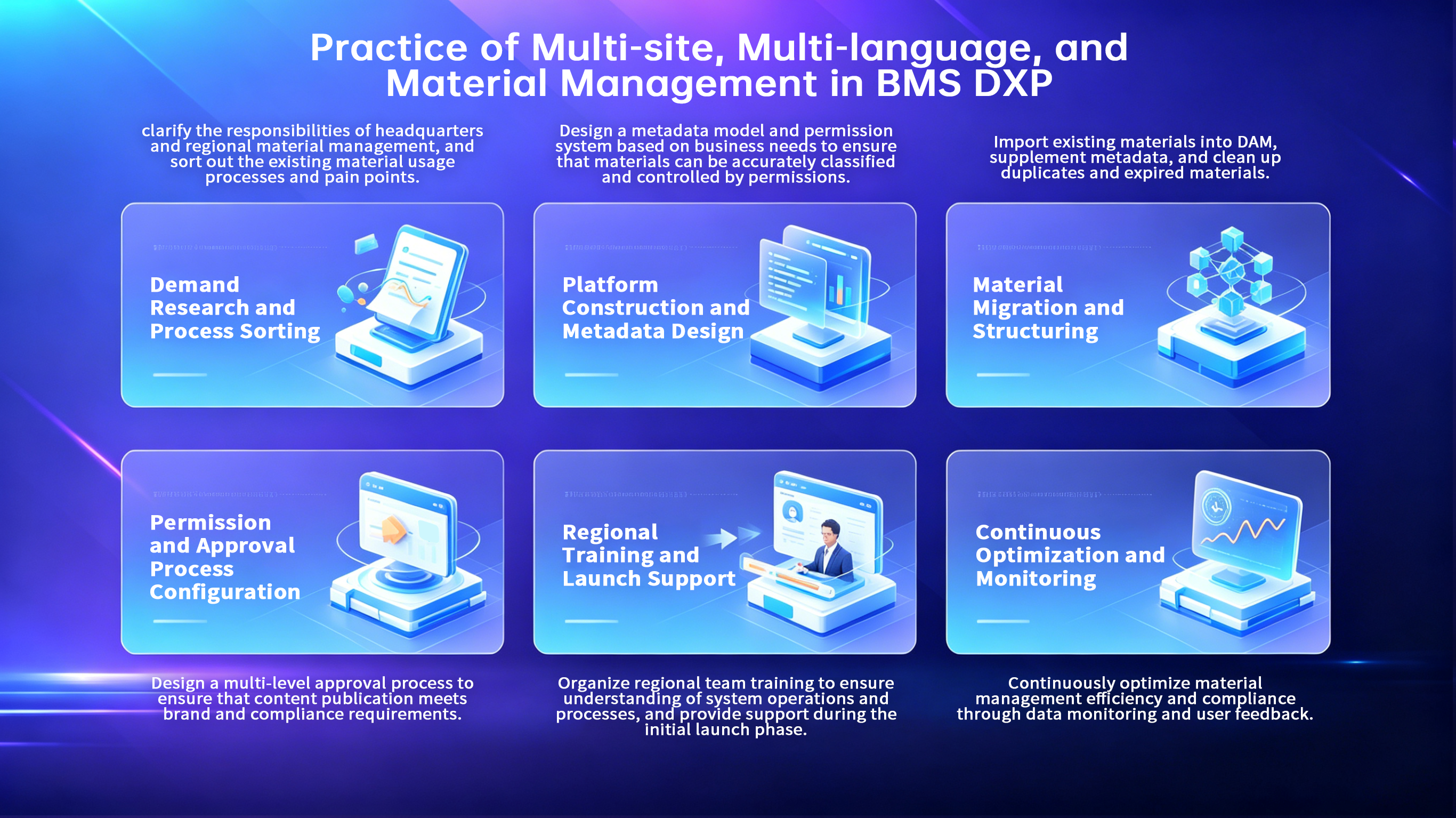
(Image illustrates BMS DXP capabilities)
Recommendations and Future Trends for Multi-Language Official Website Asset Management
Drawing on industry trends and project experience, enterprises expanding overseas should prioritize the following for multi-language official website asset management:
1. Establish a centralized digital asset repository, supporting multilingual and multi-regional tagging for efficient filtering and permission management [4].
2. Implement strict asset usage guidelines and approval workflows to mitigate legal and brand risks arising from permission mismanagement [2].
3. Adopt AI-assisted metadata generation and translation to boost operational efficiency—though foundational structured data and standardized processes remain essential.
4. Integrate the Digital Experience Platform (DXP) with DAM to unify content and asset management and publishing, eliminating content silos [5].
5. Prioritize containerized and private deployment solutions to safeguard data security and operational stability.
6. Strengthen collaboration mechanisms between headquarters and regional teams, clearly defining responsibilities and standardizing workflows to balance localization and global brand consistency.
7. Define key governance metrics, such as asset usage compliance rate, approval cycle time, version update frequency, and duplicate asset rate, to continuously assess the health of the asset management system.
Looking ahead, as digital transformation deepens and global regulatory oversight intensifies, overseas enterprises will face increasingly granular and stringent asset management requirements. Proactive planning to build scalable, flexible, and compliant asset management architectures is essential to underpin stable multi-language website operations and global brand expansion.
FAQ
Q1: Why is multi-language official website asset management more challenging than translation?
Multi-language official website asset management involves diverse file types—including images, videos, and documents—each subject to distinct usage policies and legal requirements. Furthermore, different regions impose strict demands regarding asset compliance, copyright licensing, language variants, and cultural adaptation. In contrast, translation focuses primarily on textual content—complex but comparatively straightforward. Asset management necessitates cross-departmental coordination among marketing, design, legal, and operations teams, resulting in intricate workflows prone to version conflicts and permission ambiguities, thereby carrying higher risk.
Q2: Can traditional file sharing and email meet asset management requirements?
Traditional file sharing and email lack structured management and permission controls, making version tracking and compliance approvals unfeasible. In multi-regional, multi-team collaborations, they frequently lead to version mismatches, redundant uploads, and unauthorized content publication—elevating legal exposure and brand damage. A Digital Asset Management (DAM) system enhances efficiency and compliance via metadata management, role-based permissions, approval workflows, and version control.
Q3: How can we ensure regional teams use assets aligned with headquarters’ standards?
Achieving this requires establishing a centralized asset library and rigorous permission architecture. Headquarters provides standardized content templates and core assets; regional teams localize content using the nested Live Copy feature—but all modifications must pass formal approval. Through tiered permissions and multi-layered reviews, regional content adheres both to local regulations and headquarters’ brand standards, preventing ad hoc edits and misuse.
Q4: What role do AI translation and AI writing play in multi-language official website management?
AI technologies assist in drafting initial content and optimizing output, significantly improving translation and writing efficiency—especially valuable for large-scale, multilingual content management. However, AI-generated content still requires alignment with metadata standards and rigorous approval workflows to ensure accuracy, compliance, and brand alignment. AI serves as an efficiency accelerator—not a full replacement for human oversight.
Q5: Why integrate DAM with DXP?
DAM centrally manages and licenses digital assets, ensuring compliance and version integrity; DXP handles multi-site content publishing and user experience optimization. Their integration bridges asset and content management workflows, eliminates content silos, increases asset reuse, and accelerates content publishing. Global enterprises especially require such cross-departmental, cross-regional synergy to uphold consistent global branding while fulfilling local market needs.
Q6: What advantages does private deployment offer for asset management?
Private deployment safeguards enterprise data security and regulatory compliance, addressing stringent data sovereignty and security requirements of many overseas enterprises. It supports cloud-native, containerized operations, enhancing system stability and scalability. For enterprises handling sensitive information or operating in heavily regulated sectors, private deployment is a critical measure to secure asset management.
Q7: How does BMS DXP perform in multi-language official website projects?
BMS DXP delivers multi-language, multi-site management, nested Live Copy, and granular permission controls—enabling localized asset adaptation alongside globally unified publishing. Integrated AI translation and structured approval workflows enhance content production efficiency and compliance. API-driven multi-channel publishing meets complex multinational operational demands. Real-world implementations confirm BMS DXP successfully balances global brand consistency with local flexibility.
If you are evaluating the relationship between DAM and DXP—and seeking ways to make multi-language official website content and asset management more organized and efficient—contact Dragon Bravo Corporation:
Website: www.dragonsoftbravo.com
Email: sales-support@dragonsoftbravo.com
Phone: +86-21-61483130
Business Hours: Monday–Friday, 9:00–17:00 (Beijing Time, UTC+8)
References
[1]: https://www.fotoware.com "Digital Asset Management trends 2026: What you need to know now"
[2]: https://www.bynder.com "AI in digital asset management: key trends from State of DAM 2026"
[3]: https://www.fortunebusinessinsights.com "Digital Asset Management (DAM) Market Size, Share & Industry Analysis, 2026–2034"
[4]: https://www.baklib.com "4 Key DAM Trends for 2026"
[5]: https://www.orangelogic.com "7 reasons DAM matters more than ever in 2026"


Want to know more about our products?
With years serving Fortune 500 clients, we offer flexible solutions and integrated implementation.
