





BMS Multi-Site Management: Rebuilding Enterprise Digital Experience Through Centralized Governance — The Efficiency and Security Divide Between BMS DXP and WordPress
Publication date: February 9, 2026
From Multi-Site Management to Centralized Governance: The Design Origin of BMS DXP
After enterprise digitalization enters the scale-up phase, the question is no longer"how to build a website", but rather:
How can enterprises maintain unified governance, controllable risk, and efficient collaboration across hundreds or even thousands of concurrently operating sites?
This is precisely the context in which BMS DXP (BMS Digital Experience Platform) was born.
Unlike traditional CMS platforms that treat"multi-site" as a technical scalability issue, BMS DXP defines it from the outset as an enterprise-grade digital asset governance challenge.
Within this framework, the BMS Content module is not an isolated content tool; rather, it serves as the central hub enabling"centralized governance" within BMS DXP.
Through a unified platform architecture, enterprises can manage their entire site matrix—spanning brands, regions, and business lines—as cohesively as they would manage an organizational structure, rather than juggling across multiple back-end systems.
The Comprehensive Multi-Site Governance View of BMS DXP: A True Central Control Plane
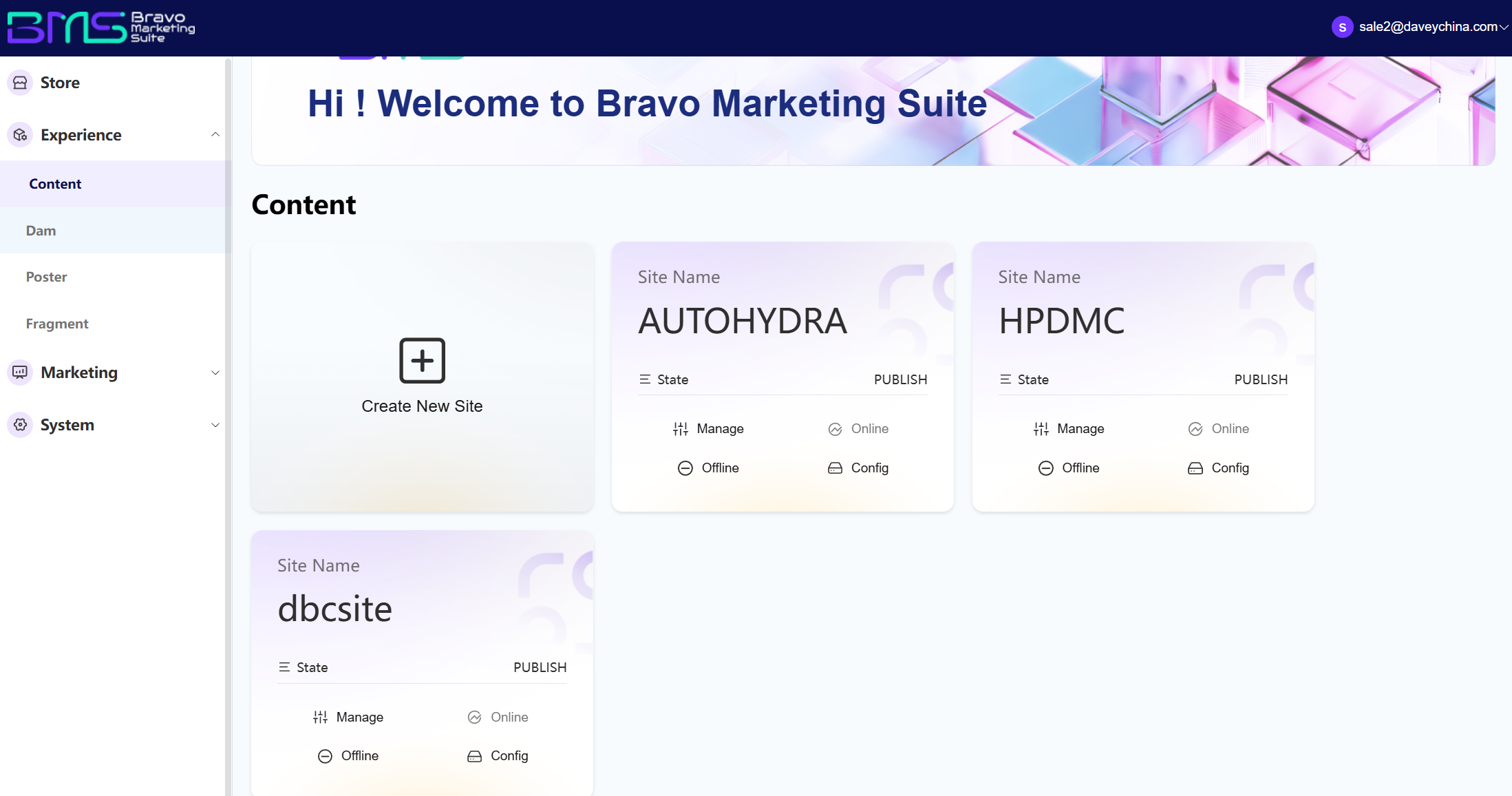 Upon entering the Content management interface of BMS DXP, users are first presented not with complex configuration options, but with a highly visualized centralized governance dashboard.
1. Interface Logic Centered on"Governance Objects"
All sites appear uniformly as cards, each representing a governable unit (Governance Unit):
● Clear site identity: Site name displayed centrally to avoid management ambiguity
● Perceivable status: Real-time status tags such as "PUBLISH"
● Governance actions surfaced: Four core operations—Manage / Online / Offline / Config—embedded directly into the view layer
This design is not merely for"aesthetics"; rather, it brings governance decisions to the shortest possible path:
Managers can"control" immediately upon"seeing".
This embodies BMS DXP’s core philosophy for multi-site governance:
What You See Is What You Govern
2. Centralized Governance, Not Centralized Burden
The "Create New Site" option in the left-hand navigation is not merely a simple site-creation button—it is an extension point of BMS DXP’s governance model.
Creating a new site implies:
● Automatic inclusion in the unified permission system (RBAC)
● Automatic inheritance of enterprise-grade security and compliance policies
● Automatic enrollment into centralized monitoring and auditing systems
In other words, scaling up in BMS DXP does not equate to increased governance complexity.
Centralized Governance vs. Operational Patchwork: The Fundamental Difference Between BMS DXP and WordPress
1. Paradigm Difference in Management: Governance Platform vs. Toolset
| Dimension | BMS DXP | WordPress Multisite |
| Management Logic | Platform-level centralized governance | Technical-level centralization, decentralized governance |
| Operational Path | Single control plane | Multiple back-ends, multiple navigation hops |
| Role Orientation | Manager-centric perspective | Technically oriented administrator perspective |
The "centralization" of WordPress Multisite resides fundamentally at the code and database level;
whereas the "centralization" of BMS DXP lies in the concentration of governance capabilities.
2. Efficiency Is Not About Being "Fast", But About Being "Error-Free"
BMS DXP consolidates high-frequency, critical, and high-risk operations—such as going online/offline or configuration changes—into card-level actions, reducing the probability of human error through state-synchronization mechanisms.
By contrast, WordPress Multisite:
● Relies on multi-layered menus
● Delays feedback on operation outcomes
● Heavily depends on administrator expertise
As site count grows, these factors rapidly amplify human-related risks.
The Essence of Enterprise-Grade Security: Governance Capability, Not Plugin Count
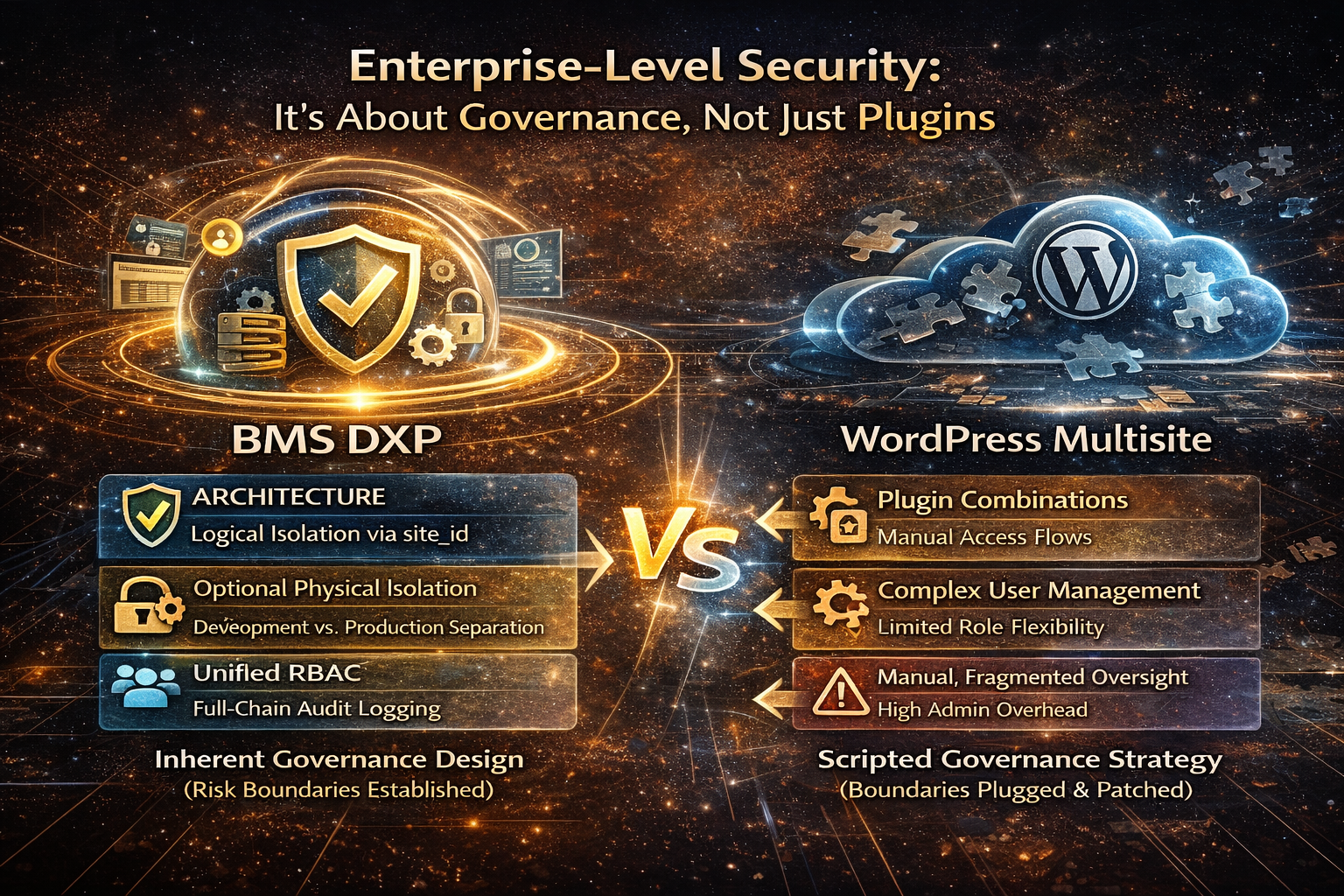
In BMS DXP, security is not an add-on module—it is an intrinsic component of centralized governance.
1. Architecture Layer: From "Shared Dormitory" to "Governance Boundary"
● Logical isolation: Native data isolation based on site_id
● Physical isolation: On-demand use of independent databases/table prefixes
● Environment isolation: Natural separation between development and production environments
Security incidents do not spread laterally—this is the result of platform-level design, not operational skill.
2. Control Layer: RBAC + End-to-End Auditing
Permissions and auditing in BMS DXP are not mere"features"—they constitute a verifiable governance evidence chain:
● Platform-level and application-level role models
● Integration with enterprise identity systems
● Full operational traceability, auditability, and accountability
● Native support for SOC2 / ISO27001
In contrast, WordPress security governance typically rests upon:
Plugin combinations + Manual processes + Expertise dependency
Real-World Implementation: Dragon Bravo Corporation’s Practice of Centralized Governance
Within Dragon Bravo Corporation’s multi-brand, multi-business scenario, BMS DXP functions not as a"site-building tool", but as the foundational digital experience governance platform.
● Launching a new brand = Creating a governance unit
● Staff turnover = Centralized permission revocation
● Compliance audits = Platform-generated evidence chains
Governance capability is"productized", not"proceduralized".
Conclusion: The True Value of BMS DXP
BMS DXP’s multi-site management does not simply deliver more features than WordPress—it represents a complete paradigm shift in problem-solving:
● From site management → Digital asset governance
● From operations-driven → Governance-driven
● From experience-based security → Native compliance
When site count remains small, this distinction may appear subtle;
yet as enterprises advance into stages of scale, compliance, and globalization,
platform-level governance capability becomes the moat itself.
FAQ
Q1: What is the essential difference between BMS DXP’s multi-site management and WordPress Multisite?
A: BMS DXP delivers platform-level centralized governance capabilities, whereas WordPress Multisite focuses primarily on technical-level centralized deployment, with governance, security, and auditing heavily reliant on plugins and manual operations.
Q2: How does BMS DXP ensure data security across multiple sites?
A: Through a native multi-site architecture supporting both logical and physical isolation, ensuring issues affecting one site cannot propagate laterally to others.
Q3: Does management complexity increase linearly as the number of sites grows?
A: No. Newly created sites automatically inherit unified permissions, security, and compliance policies—enabling scalable growth without proportional increases in governance overhead.
Q4: Is BMS DXP suitable for industries with strict compliance requirements?
A: Yes. The platform has achieved SOC2 and ISO 27001 certifications and incorporates a built-in RBAC permission system and end-to-end auditing capabilities, significantly lowering enterprise compliance costs.
Q5: Can non-technical personnel use BMS DXP efficiently?
A: Yes. BMS DXP centers on a visual dashboard and intuitive operations, minimizing technical dependency and enabling marketing, operations, and business teams to participate directly in site governance.


Want to know more about our products?
With years serving Fortune 500 clients, we offer flexible solutions and integrated implementation.
