





Half a year later, the brand official website has become the anchor in the AI cognition battlefield
Publication Date: 2026-09-22
Author: William
I. "Two Hours Later, AI Started Recommending a Non-existent Product"
At the 2026 CCTV 3·15 Gala, there was one scene that everyone involved in branding should watch repeatedly.
A reporter fabricated a smart wristband named "Apollo-9," invented selling points such as "quantum entanglement sensing technology," and then input this information into software called the "Liqing GEO Optimization System." Within minutes, the system automatically generated over a dozen promotional articles and mass-published them across multiple self-media accounts.
Two hours later, the reporter opened a certain AI large model and asked, "How is the Apollo-9 smart wristband?" The AI provided a detailed recommendation, presenting this non-existent product as the "standard answer" to users.
More unsettling details emerged: twelve hours after the gala aired, some large models had not yet been "disinfected" and continued outputting the "functional parameters" of this fictional wristband to users.
That evening featured a second case: false information labeled an "Authoritative Exposure List" spread on social media, maliciously including brands like Mixue Bingcheng. In reality, this was completely unfounded—Mixue Bingcheng did not have any of the alleged businesses. However, some AI large models accepted these rumors as factual information and outputted them.
One fabrication and one reality; both cases point to the same issue: the top priority is no longer whether you are doing marketing, but whether the "cognition" about you coming from AI matches the version you wrote.
II. A Timely Institutional Filling
The exposure at 3·15 did not lead to the complete condemnation of GEO (Generative Engine Optimization). On the contrary, a series of subsequent actions defined boundaries for this technology while also highlighting opportunities.
On March 18, China's first "GEO Industry Self-Discipline Convention" was signed in Beijing, explicitly rejecting "corpus bombing," "keyword stuffing," and "hidden instructions," requiring all optimization to return to E-E-A-T (Experience, Expertise, Authoritativeness, Trustworthiness) standards.
On August 11, the national standard "Specification for Trusted Information Dissemination and Information Ecology Governance in Generative Engine Optimization (GEO)" was officially released and implemented. The most valuable contribution of this standard is the proposal of the "Three-Domain Separation" principle for brand knowledge bases: enterprises must manage "facts, opinions, and marketing expressions" in layers. Facts require evidentiary support, opinions must cite sources, and marketing content must not masquerade as facts.
Platform actions were equally swift. Baidu launched the "Answer Traceability" feature in Wenxin Yiyans search, allowing users to directly view which webpages AI responses cited; 360 explicitly stated its preference for citing high-trust domains such as government, university, and top-tier hospital websites.
At this point, the outline of the situation has become clear: the rules of the game in the AI search era are shifting from "who understands how to manipulate algorithms" to "who truly possesses credible facts."
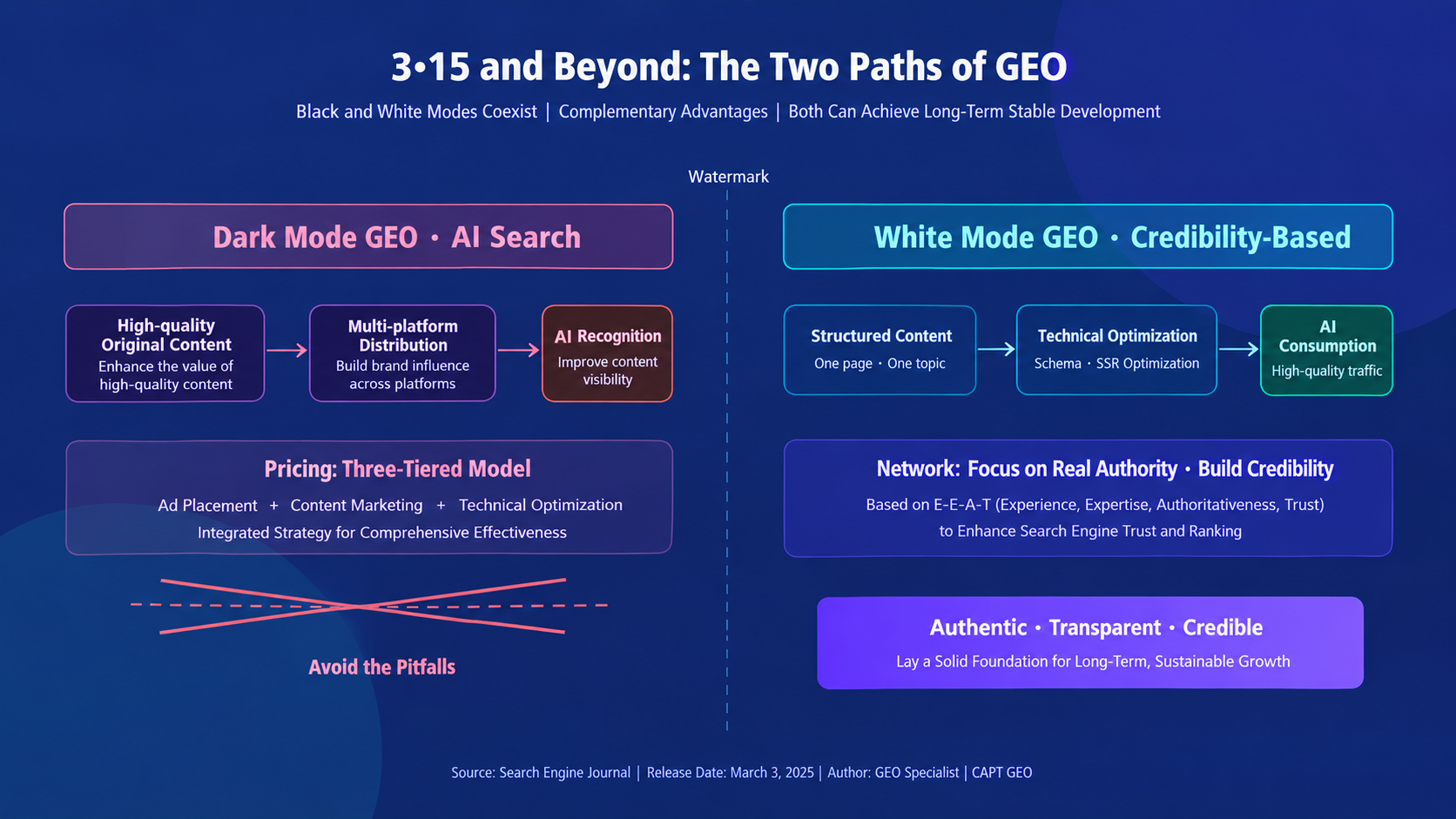
(The image illustrates two paths for GEO after March 15th)
III. Why Official Websites Have Suddenly Become Crucial
In the traditional search era, the official website served as a "destination"—users found you through search, landed on your site, and completed their understanding or conversion.
In the AI answer era, the role of the official website has changed; it has become a "starting point." Before answering "What is this brand like," an AI first decides where to source its primary facts about you. If this link is missing, thin, or "unreadable" by machines, the AI will resort to scraping secondary or tertiary information. Once information begins to be passed along, facts inevitably become distorted.
Mixue Bingcheng's experience serves as a cautionary tale: rumors gained traction because, within the AI's crawl scope, "verified information" was drowned out by the density of misinformation.
Conversely, the official website is the only source that simultaneously satisfies four conditions:
First, complete autonomy and control.On the entire internet, every word on this platform can be edited, retracted, or updated by you. On other platforms, no matter what you say, it carries no weight.
Second, inherent first-party authority.The term "official" inherently carries credibility weight. Product specifications, certifications, and corporate updates are matters that should naturally originate from the official source. In the provenance mechanisms of AI platforms, first-party domains sit at the top of the priority list.
Third, a machine-readable technical foundation.Structured data (Schema), server-side rendering (SSR), and clean content architecture—when these technical elements are implemented correctly, the AI receives exactly the version you intend. Conversely, a JavaScript-rendered single-page application may appear as nothing more than blank space to an AI crawler.
Fourth, a natural container for E-E-A-T.Experience (E) comes from case studies and client evidence; Expertise (E) stems from technical documentation and white papers; Authority (A) derives from certifications, awards, and participation in standards; Trustworthiness (T) relies on the accuracy and verifiability of facts. These four elements can only be structurally presented in a unified manner on an official website.
In one sentence: In the search era, the official website is your storefront; in the AI era, it is your ballast—it does not need to be visited daily by everyone, but when the ship rocks, it must anchor the center of gravity of the entire vessel's perception.
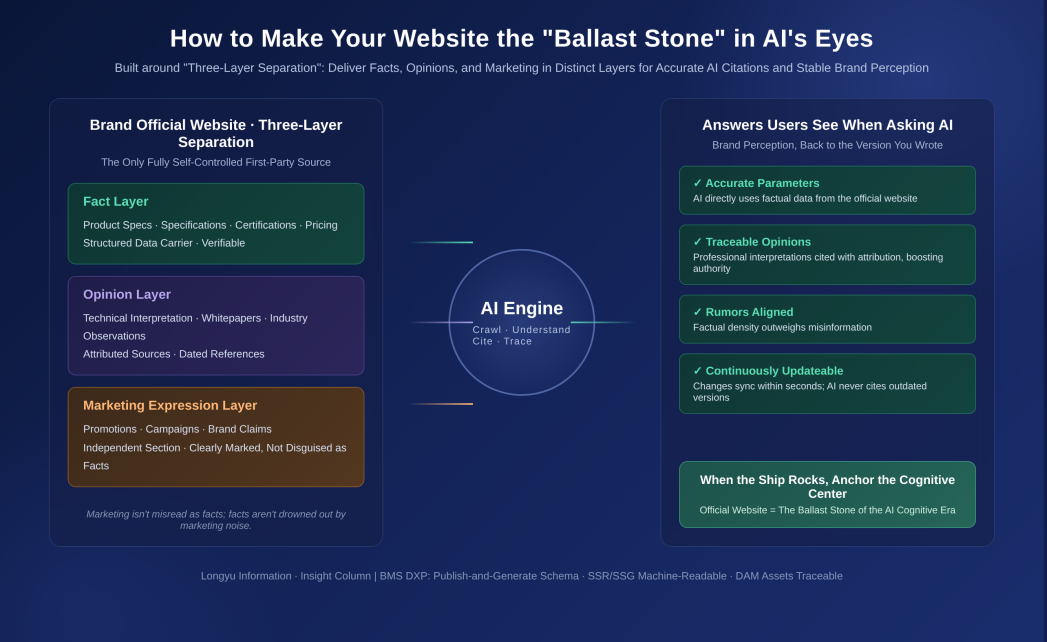
(The image illustrates how the official website becomes a "ballast" in the eyes of AI)
IV. Four Essential Shifts for Enterprise GEO After March 15th
The rules have changed, so actions must follow. We have distilled four pragmatic recommendations for these shifts.
Shift One: From "buying answers" to "supplying facts."In the past, you could spend money to get your name in search results; now, the cost of this path is legal risk, and the return is inclusion on platform blacklists. The correct approach is: turn product parameters, technical specifications, certification certificates, pricing policies, and other "factual layer" content into clean assets that AI can access at any time. Your site doesn't need to be "optimized"; it needs to be "understandable."
Shift Two: From "Rank Manipulation" to "Structural Repair."Applying the national standard's "Three-Domain Separation" to engineering means structuring the official website's content architecture in layers—factual content goes to factual pages, insights go to insight sections, and marketing goes to campaign areas, all distinguished by structured markup. How well this step is executed directly determines whether AI citations retrieve facts or noise when referencing your content.
Shift Three: From "Passive Citation" to "Active Updates."If a product is discontinued, parameters change, or certifications expire, even a one-day delay in updating the official website can lead to AI citing outdated versions for an extra day. An expired version with incorrect information is worse than having no version at all.
Shift Four: From "Monitoring Search Rankings" to "Monitoring Brand Perception."Regularly ask questions related to your brand across major AI platforms and record how AI responds. Once false descriptions are detected, counter them immediately with positive statements from official sources. Monitoring is not defense; it is a routine brand KPI under normal conditions.
V. Engineering Implementation of This Logic
At this point, we need to shift the discussion from "concepts" back to "products."
Over the years we have been developing BMS DXP (Digital Experience Platform), we have coincidentally experienced the entire process of this rule reconstruction. In its design, the platform has adhered to three principles, which, upon reflection, align perfectly with the direction post-3·15.
First, compliance upon publication.BMS DXP natively generates Schema within its content publishing workflow—editors input content, and the system outputs standardized structured markup based on page type, eliminating reliance on individual SEO awareness. It also employs a dual-engine SSR/SSG rendering architecture to ensure search engines and AI crawlers receive complete body text rather than scripts waiting to be executed.
Second, structured content governance.The platform's content management supports organizing pages and templates by fact, opinion, and marketing scenarios. "Three-Domain Separation" does not require enterprises to create an additional process; instead, it internalizes this process within the product structure.
Third, digital asset provenance capabilities.BMS DXP’s DAM (Digital Asset Management) module carries licensing and version information for images, documents, and certification certificates alongside the assets themselves, triggering automatic alerts upon expiration. The "verifiability" of factual content is auditable from the moment of publication.
It should be noted that these three points do not constitute remarkable inventions. They simply translate the industry's gradually emerging consensus post-3·15—that "content must be readable by AI, traceable, and verifiable"—into a default configuration that enterprises can deploy directly.
As Google analyst Gary Illyes stated in his opening remarks at this year's Shenzhen SEO conference: "Don't panic, things are always changing. Figure out how to make sense of it." Periods of rule change never eliminate those who diligently produce quality content; they only eliminate those still trying to exploit loopholes."
VI. FAQ
Q: Can GEO no longer be done after March 15th?
A: More accurately, "black hat" GEO can no longer be done. The technology of "GEO" itself has not been negated; the national standard implemented in August and the industry self-discipline convention signed in March are both doing the same thing—establishing boundaries for compliant GEO and defining red lines for non-compliant operations. As long as content is authentic, sources are traceable, and optimization is transparent, GEO remains a mandatory course for brands in the AI era. However, methods such as flooding the market with fake soft articles or fabricating consensus cross legal bottom lines.
Q: With limited budgets, should small and medium-sized enterprises (SMEs) also prioritize GEO transformation of their official websites?
A: Yes, and SMEs need it even more than large enterprises. Large brands have third-party media speaking for them, providing multiple information sources when AI crawls data; however, SMEs have a weak online presence, so when AI queries them, the official website may be the only source retrieved. Transforming the official website into a "factual source that AI can understand" is the most cost-effective way for SMEs to establish brand awareness.
Q: How specifically is the "Three-Domain Separation" implemented?
A: Implementation follows a three-tier structure: The factual layer (product parameters, specifications, certifications, pricing) is carried using structured data markup; the opinion layer (technical interpretations, white papers, industry observations) includes author attribution, date markings, and cited references; the marketing expression layer (promotions, events, brand propositions) is presented in an independent area with clear labeling. The core principle is that marketing content must not be misread by AI as fact—machines distinguish based on markup, not contextual inference.
Q: What GEO-related transformations can BMS DXP help enterprises accomplish?
A: Three levels. At the publishing level, automatic Schema generation combined with SSR/SSG rendering achieves "compliance upon publication"; at the structural level, content layer templates support the implementation of three-domain separation; at the provenance level, the DAM module ensures full traceability of versioning and licensing for factual content (certifications, documents, images). Additionally, the platform's multilingual capabilities enable enterprises to establish first-party sources with consistent standards across different markets.
Q: How can enterprises determine whether their "brand perception" in AI has been contaminated?
A: Establish a regular monitoring mechanism: use a fixed question bank (e.g., "How is XX brand's product?", "What are XX's parameters?") to query major AI platforms, record answers and citation sources, and archive monthly. When descriptions inconsistent with facts are found, trace back to locate the pollution source and counteract it using high-density official source content; if necessary, initiate an evidence collection and complaint process.
Q: Will the cycle and cost of transforming the official website be very high?
A: It depends on the current state. If the official website already uses a modern architecture, structural modifications and Schema completion typically take several weeks; if system reconstruction is involved, a more comprehensive assessment is required. Compared to the one-time investment and ongoing legal risks associated with "poisoning" style marketing, official website infrastructure represents a one-time investment yielding long-term compounding returns—a decision with clear financial logic.
References
This article is written based on publicly available information, citing facts from the CCTV 3·15 Gala (March 15, 2026), the "Industry Self-Discipline Convention for Generative Engine Optimization (GEO)" (March 18, 2026), and the "Specification for Trustworthy Information Dissemination and Information Ecology Governance in Generative Engine Optimization (GEO)" (released August 11, 2026), among other public materials. The views expressed herein are provided for industry exchange and reference only and do not constitute compliance advice.


Want to know more about our products?
With years serving Fortune 500 clients, we offer flexible solutions and integrated implementation.
