





2026 New Trends in Enterprise Strategic Deployment: Leveraging BMS DXP to Reshape Enterprise DAM and Integrated Content Operations Infrastructure
Release Date: 2026-06-04
Author: William
Content Chaos and Asset Versioning Challenges: DAM Is More Than Just a File Repository
Driven by digital transformation and global markets, the complexity of enterprise content production is increasing. Many enterprises face issues such as asset version chaos and loss of control over regional versions, making it difficult for marketing teams and brand managers not only to locate the latest, compliant assets but also to ensure consistency and accuracy across multi-channel and multilingual environments. Particularly in multinational corporations, localized version management has become standard practice due to regional regulations and linguistic/cultural differences; without effective version tracking and approval workflows, redundant work and compliance risks frequently arise.
For example, during a global marketing campaign, a multinational consumer goods company received feedback from its marketing department indicating significant variations among regional asset versions, resulting in inconsistent advertising effectiveness and even misuse of brand visual elements. Technical investigations revealed multiple unapproved versions in the asset library, lacking clear version labeling and permission management—exacerbating information silos. Such issues are common in traditional asset libraries, highlighting that enterprise demand for DAM extends far beyond simple file storage.
Meanwhile, the rapid growth of AI-generated content further amplifies asset management challenges. Ungoverned digital assets easily trigger copyright and compliance risks—and may even damage brand reputation. Without strict review and version control mechanisms, the automation and batch nature of AI content generation can lead to non-compliant content entering the market, increasing legal liability and reputational loss risks. Enterprises must introduce automated approval, tiered permissions, and version traceability into their asset libraries to ensure every stage of the content lifecycle remains monitorable and manageable.
These issues are prompting enterprises to rethink traditional Digital Asset Management (DAM) systems, positioning them as infrastructure for content operations—not merely file storage spaces. By unifying creation, review, publishing, reuse, and archiving under a single process management framework, enterprises can enhance content production efficiency, safeguard brand consistency, and maximize content value.
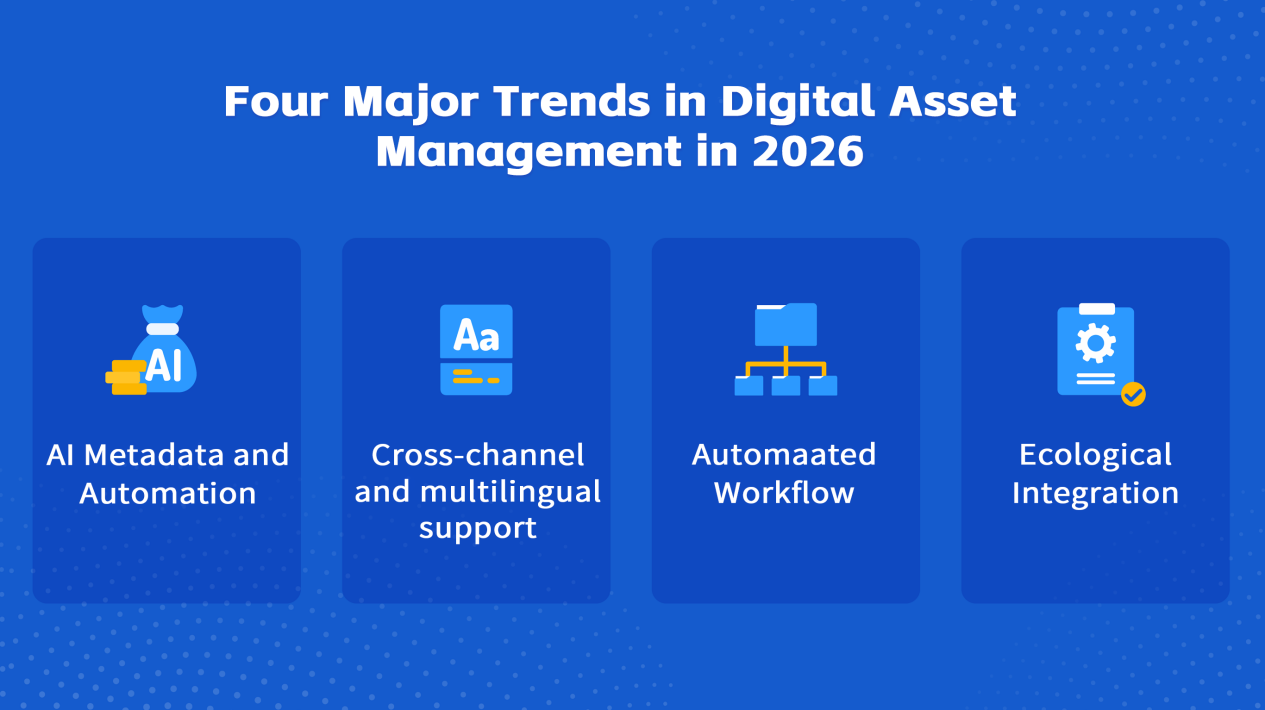
Four Key Trends in Digital Asset Management for 2026
According to multiple industry reports, DAM is undergoing profound transformation in 2026, with key trends including:
| Trend | Description | Typical Impact |
| Ecosystem Integration | DAM is no longer isolated—it must deeply integrate with CMS, DXP, PIM, and other systems | Content workflows become more seamless, reducing redundant operations and improving efficiency |
| AI-Powered Metadata & Automation | Leveraging AI to automatically generate metadata and tags, enhancing search and classification accuracy | Reduces manual tagging costs and improves content retrieval efficiency |
| Automated Workflows | Automating approval flows and permission tiers to support multi-role collaboration | Ensures content compliance and minimizes human error |
| Cross-Channel & Multilingual Support | Supporting multi-site, multilingual content publishing to meet global brand management needs | Unifies brand image and enables rapid response to diverse market demands |
These trends indicate that DAM is evolving from a traditional asset repository into a comprehensive content asset management platform—serving as core infrastructure for cross-departmental, cross-channel content operations [1][4].
In practice, enterprises often begin by conducting an inventory of their current asset library, mapping asset types, quantities, usage frequency, and version status to identify pain points and bottlenecks. Inventory templates typically cover fields such as file format, tag completeness, approval nodes, permission assignments, and cross-departmental usage. Only through data-driven analysis can enterprises scientifically formulate upgrade plans and avoid resource waste caused by blind investment.
Moreover, cross-departmental collaboration is critical to successful upgrades. Marketing, branding, PR, legal, and IT departments must jointly define content governance rules, clarifying responsibilities and approval processes. For instance, the legal department reviews compliance risks, marketing handles creative development and publishing, and IT manages system implementation and maintenance. Establishing collaborative mechanisms and performance metrics fosters efficient coordination and elevates overall content governance standards.

The Relationship Between DAM and AI Content Growth
As AI-powered content creation becomes increasingly widespread, enterprise content volume and variety multiply—making asset management significantly more complex. While AI boosts content output efficiency, its effectiveness depends on high-quality input assets and scientifically managed workflows. Without standardized DAM, AI-generated content cannot guarantee quality or compliance—and may instead heighten brand risk.
Bynder’s report states that AI applications in DAM must be built upon rigorous access governance, structured metadata, and version control to effectively support content operations [2]. Therefore, enterprise DAM systems must support multi-version management, approval workflows, and tiered permissions—ensuring full traceability and auditability of every content chain.
In practical implementations, some enterprises have introduced AI-assisted automatic metadata tagging and content quality detection, markedly improving asset retrieval efficiency and review accuracy. However, they also face ambiguous accountability: whether AI-generated content meets enterprise standards, who bears ultimate review responsibility, and how to mitigate potential risks—all now top management priorities. To address this, enterprises must clearly delineate roles between human and AI review, and establish stringent content publishing standards and exception-handling procedures.
For example, after introducing AI-generated marketing copy, a large retail enterprise implemented a dual-review mechanism—“AI pre-review + human verification.” AI automatically tags content type, keywords, and potentially risky terms, helping approvers quickly identify priority items. Human reviewers then focus on regulatory compliance and brand tone to ensure alignment with enterprise requirements. This approach enhances review efficiency while mitigating risks arising from uncontrolled AI content.
The Necessity of Enterprise Asset Library Upgrades
Upgrading an enterprise asset library is not merely a technology refresh—it represents a strategic shift in content operations. A modern DAM platform should possess the following capabilities:
- Multi-template, multi-component support: Meeting customization needs across diverse marketing campaigns and channels
- WYSIWYG editing: Simplifying content creation and modification for non-technical users
- Multilingual support and AI translation: Ensuring rapid responsiveness across global markets
- Nested Live Copy: Efficiently managing regional versions and minimizing redundant work
- Tiered permissions and approval workflows: Securing content safety and compliance
- Version traceability and automated metadata management: Enhancing content controllability and search efficiency
These features fundamentally resolve issues of version chaos and fragmented management—transforming the asset library into infrastructure for content operations.
For example, during its DAM upgrade, a mid-sized manufacturing enterprise first mapped its content production workflow—dividing asset creation, review, publishing, and archiving into four core phases. Each phase assigned clear responsibilities and approval nodes, enabling online collaboration via automated workflows. Tiered permission design ensured users accessed only required assets—preventing information leakage. Post-upgrade, content update cycles shortened by 30%, and asset misuse rates dropped by 70%—significantly accelerating market responsiveness and strengthening brand consistency.
Regarding budget and total cost of ownership (TCO), enterprises must comprehensively consider system procurement, implementation, training, maintenance, and expansion expenses. Mid-to-large enterprises especially need to assess scalability and compatibility with existing IT architecture—avoiding additional investment from frequent upgrades. Sound investment planning should align with content operations objectives to ensure sustained DAM project value.
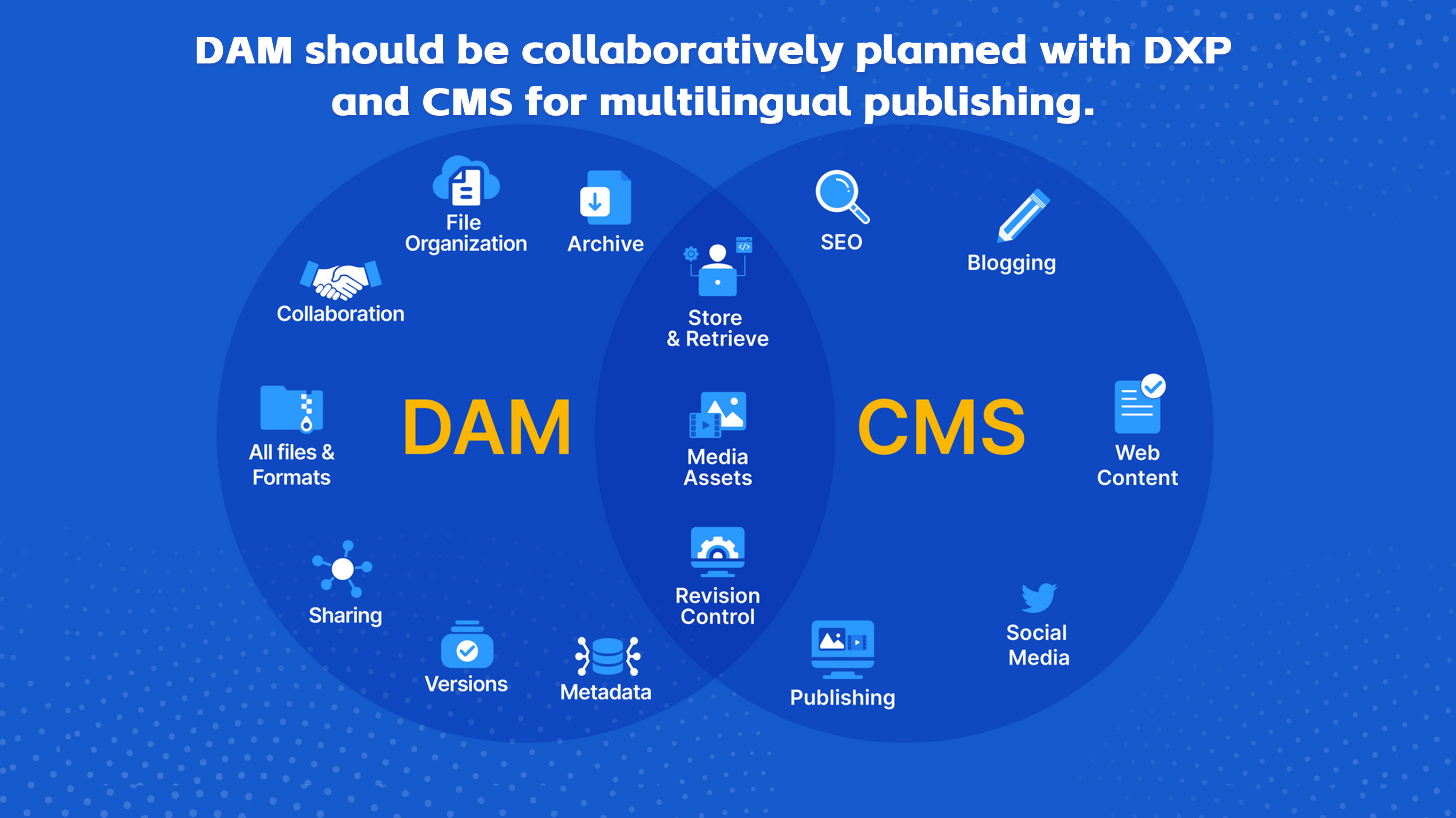
DAM Should Be Co-Planned With DXP and CMS Multilingual Publishing Capabilities
Deploying a standalone DAM alone cannot satisfy modern enterprises’ complex digital content requirements. According to Fortune Business Insights, the global DAM market is projected to reach approximately USD 6.29 billion in 2026, with a compound annual growth rate exceeding 15% over the next several years—reflecting dual enterprise demands for content governance and digital experience [3].
Therefore, when rebuilding corporate websites, content management, and asset governance, enterprises are advised to co-plan DAM, Digital Experience Platform (DXP), Content Management System (CMS), and multilingual publishing capabilities. Take Dragon Bravo Corporation’s BMS DXP as an example: this platform supports multi-component/multi-template configurations, SSR/SSG, headed & headless dual-mode operation, API-based content delivery, and AI writing optimization—enabling deep integration between asset libraries and content operations to fulfill complex multi-site, multilingual requirements of multinational enterprises.
During implementation, cross-departmental collaboration is especially critical. The marketing department defines content requirements and brand standards; the IT department handles system architecture design and integration; the legal department participates in compliance reviews; and the operations department tracks content performance feedback. By establishing a cross-departmental communication mechanism, DAM, CMS, and DXP systems’ functionalities and data interfaces are fully aligned to achieve closed-loop management—from content asset creation to end-user experience.
Additionally, enterprises of different scales vary in their initial-stage approaches. Small teams may begin with core DAM functionalities—first addressing centralized asset storage and version management—then gradually introducing automated approval and multilingual support. Large conglomerates, however, must start from an overarching content operations strategy, establishing unified content standards and governance rules, and progressively advancing deep integration between DAM and DXP to ensure coordinated operations across multiple sites and brands.

FAQ
Q1: Why can’t traditional media libraries meet current enterprise needs?
Traditional media libraries focus primarily on file storage and basic categorization, lacking multiversion management, permission tiering, and multilingual support. As content production and distribution complexity increases, simple storage functionality alone cannot sustain efficient content operations or consistent brand management. Enterprises often face fragmented assets, chaotic versioning, and opaque approval workflows—leading to duplicated content creation, heightened compliance risks, and delayed market responsiveness. Modern DAM must cover the entire content lifecycle—from creation and review to publication—and support cross-departmental collaboration and omnichannel content operations to meet increasingly complex enterprise demands.
Q2: How does DAM help enterprises address challenges posed by AI-generated content?
AI-generated content brings surging volume and enhanced efficiency but simultaneously introduces quality and compliance risks. DAM systems mitigate these through structured metadata and automated approval workflows, ensuring AI-generated content undergoes multi-tiered review to align with enterprise brand standards and regulatory requirements. Version traceability enables tracking of each piece of content’s origin and revision history, while permission tiering prevents unauthorized publishing. Enterprises must also clearly define responsibility boundaries between human and AI-driven review, establish robust content governance standards, and proactively mitigate potential risks—ensuring AI-generated content boosts efficiency without compromising brand reputation.
Q3: How is multilingual and multisite management implemented in DAM?
Modern DAM supports nested Live Copy and AI translation features, enabling enterprises to efficiently manage regional versions while balancing global consistency and local adaptation. Nested Live Copy allows headquarters’ content to serve as the master version, automatically synchronizing updates to regional sub-versions while preserving localized editing permissions. AI translation accelerates multilingual content generation and reduces manual effort. Flexible configuration of permissions and approval workflows ensures regional content complies with local regulations and cultural norms, effectively supporting global brand operations.
Q4: How does DAM collaborate with corporate websites and Digital Experience Platforms (DXPs)?
DAM integrates with CMS and DXP via open APIs and both headed & headless modes, enabling shared content and metadata for omnichannel publishing and dynamic content adjustments. Content is created in DAM, automatically synchronized to corporate websites or DXPs upon approval, eliminating redundant operations. Multilingual content and version management are centrally orchestrated to ensure consistent brand representation. While DXPs handle personalized content presentation and user interaction, DAM ensures standardized content asset management and compliant traceability—collaboratively enhancing overall content operations efficiency and user experience.
Q5: How should enterprises assess whether a DAM upgrade is necessary?
When enterprises encounter chaotic asset versions, cumbersome approval processes, inefficient multilingual management, or AI-content compliance challenges, their existing DAM system may no longer suffice. Assessment should focus on content production efficiency, version management capability, maturity of permission and approval workflows, flexibility of multilingual support, and ease of integration with other systems. Aligning evaluation with business growth and digital transformation plans—and factoring in total cost of ownership (TCO)—helps select a modern DAM platform supporting full-lifecycle content management, automation, and intelligence to achieve strategic content operations goals.
Q6: What advantages does private DAM deployment offer?
Private deployment ensures data security and regulatory compliance, making it ideal for multinational corporations and enterprises with stringent data privacy requirements. By deploying the DAM system within an enterprise-owned or dedicated cloud environment, organizations gain full control over content assets and eliminate data leakage risks. Combined with cloud-native containerized operations, the system achieves flexible scalability and high availability to meet peak business demands. Private solutions typically enable finer-grained permission management and adherence to local regulatory compliance policies—supporting uniform content governance standards across multiple countries and regions.
Q7: How can smooth DAM upgrade implementation be ensured?
We recommend cross-departmental collaborative planning, clear definition of content governance rules and approval workflows, and design of a rational permission-tiering system. Implementation should proceed in phases—first resolving core pain points, then incrementally introducing automation and intelligent features. Select experienced technology partners to ensure DAM compatibility with existing digital experience platforms. Hold regular project reviews to monitor progress and risks, adjusting plans promptly. Prioritize user training and change management to encourage active participation from business units—ensuring effective post-launch adoption and continuous optimization.
If you’re evaluating the relationship between DAM and DXP
When building or upgrading corporate websites and digital content management systems, DAM should not be developed in isolation. Coordinating DAM with Digital Experience Platform (DXP), CMS, and multilingual publishing capabilities delivers superior support for content creation, review, publishing, and omnichannel operations—reducing management complexity and strengthening brand consistency.
Dragon Bravo Corporation’s BMS DXP offers comprehensive functionality—including multi-component/multi-template support, SSR/SSG, AI translation, permission tiering, and version traceability—tailored to the integrated content operations needs of multinational corporations and enterprises expanding overseas. For further information, please contact DragonBravo:
Website: www.dragonsoftbravo.com
Email: sales-support@dragonsoftbravo.com
Phone: +86-21-61483130
Business Hours: Monday–Friday, 9:00–17:00 (Beijing Time, UTC+8)


Want to know more about our products?
With years serving Fortune 500 clients, we offer flexible solutions and integrated implementation.
