





Why Do B2B Manufacturing Companies Need DAM? From Product Images and Technical Specifications to Distributor Material Distribution
Release Date: 2026-07-02
Author: William
I. Overview of Digital Asset Management Processes in New Product Launches
The new product launch cycle in manufacturing is typically tight and complex, spanning product design, validation, certification, and market promotion—each stage generating large volumes of digital assets. These assets include high-resolution product images, multi-angle technical specification tables, scanned certification documents, installation and operation videos, as well as dealer-facing promotional materials and quotation sheets. Effective Digital Asset Management (DAM) not only ensures content accuracy and compliance but also forms the foundation for accelerating market responsiveness and enabling channel collaboration.
Take a mid-sized machine tool manufacturer as an example: prior to launching a new product, it must coordinate across multiple departments—including design, quality assurance, marketing, legal, and channel management. The design team captures multi-angle product photographs; the technical team provides structured parameter data and performance metrics; the legal department reviews certification documents for compliance; the marketing department prepares multilingual promotional materials; and the dealer management team must receive the latest sales materials promptly. Without a unified management system, these assets often result in version chaos and information silos, undermining the effectiveness of new product launches and channel execution.
Key nodes in the DAM process include:
Asset Collection Phase: Design, technical, and marketing teams upload raw assets according to predefined templates per the new product plan. This phase requires standardized field definitions (e.g., product ID, model, version number, language) to ensure traceability and standardization of subsequent data.
Standardization and Field Population: Using preconfigured field templates within the DAM system, tasks such as classifying product images by viewpoint, structuring technical documentation, and annotating metadata for certification files are completed. This step facilitates subsequent automated rendering and content retrieval.
Multidepartmental Approval and Version Management: Content for new product launches in manufacturing must undergo layered approvals by product owners, marketing compliance officers, and legal reviewers. The DAM system should support flexible approval workflow configuration and version control to guarantee that every published version is the latest and fully compliant.
Publication and Distribution Phase: Via API, digital asset content is synchronized to the corporate website, dealer portal, and sales terminals. Consistency across channels is critical to enhancing customer experience and channel responsiveness.
l Maintenance and Monitoring: Post-launch, DAM must support iterative versioning, permission adjustments, and archival backups in response to product upgrades, certification updates, and market feedback—ensuring end-to-end lifecycle management of digital assets.
In practice, manufacturers often integrate DAM with content hubs to automate these processes, reducing manual operational risks and improving launch efficiency. For instance, an automotive parts manufacturer reduced pre-launch content preparation time by approximately 30% using DAM’s automated approval notifications and version-locking capabilities.
II. Key Management Content and Recommended Field Templates for Manufacturing Digital Assets
Manufacturing digital assets encompass diverse content types, including multimedia files and structured data; thus, thoughtful field template design forms the foundation of successful DAM implementation. Below are detailed field recommendations and explanations for typical assets associated with new product launches, aiding manufacturing enterprises in planning database structures and front-end display layouts for their DAM systems.
| Asset Type | Key Fields | Description |
| Product Images | Product ID, Product Name, Viewpoint, Resolution, Color Mode, Copyright Information, Capture Date | Multi-angle photos support front, side, rear, and close-up views for versatile cross-channel presentation. The copyright field ensures compliant image usage. Multilingual caption support is enabled. |
| Technical Specification Documents | Product Model, Specifications, Performance Metrics, Dimensions, Weight, Materials, Certification Standard Number, Update Date | Structured fields facilitate automatic rendering of technical spec tables on the website and support export to Excel and PDF formats. Fields must support unit switching (e.g., mm/inch). |
| Video Assets | Video Type (Installation, Demonstration, Maintenance), Duration, Language Subtitles, File Format, Resolution | Videos serve product showcases, installation guidance, and operational training. Multilingual subtitle support enables global market deployment. |
| Certification Documents | Certificate Number, Issuing Authority, Certificate Type (Safety, Environmental, Quality), Validity Period, Scanned Document Link | Certificate fields support automated expiration alerts to ensure timeliness and compliance of product certification information. |
| Dealer Materials | Material ID, Material Type (Brochure, Quotation Sheet, Promotional Poster), Applicable Region, Language Version, Version Number, Release Date | Materials must support region- and channel-based permissioned distribution. Version-number management guarantees dealers use the latest materials, mitigating brand-image risks. |
Additionally, new product launches in manufacturing often involve extensive product installation videos and operation manuals. It is recommended that DAM supports streaming video playback and online document preview functionality to enhance user experience. The dealer portal can dynamically retrieve the latest materials—by region and language—via API integration, significantly reducing manual distribution efforts.
Thoughtful design of the above field templates also enables automated content generation within the manufacturing enterprise’s content hub—for instance, leveraging parameter fields to auto-generate technical specification tables, thereby minimizing manual input errors and workload.
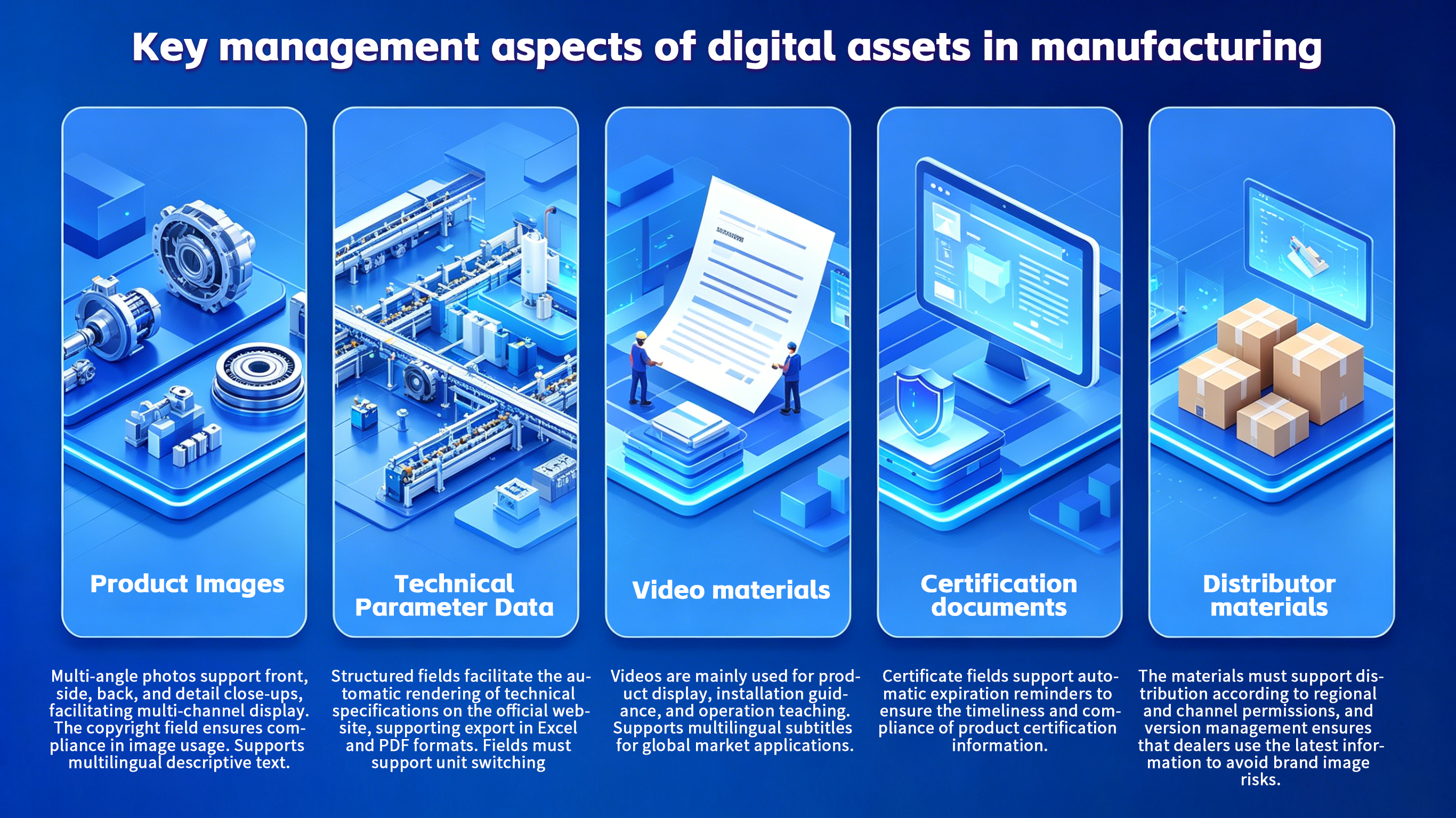
 (The image illustrates key digital asset management content for the manufacturing industry.)
III. From Approval to Publication: Process Design and Multi-Template Content Presentation
Digital asset management processes for new product launches in manufacturing often involve collaboration among multiple departments and roles. Approval process design must reflect business complexity and risk control requirements. Generally, the approval process comprises:
1. Initial Review Stage: Product managers or technical leads verify the accuracy of technical parameters and product images.
2. Compliance Review: Marketing compliance and legal departments review certification documents and promotional content to ensure no regulatory violations exist.
3. Marketing Confirmation: The marketing department confirms the market suitability and linguistic localization quality of promotional materials.
4. Final Publication: The content management team executes content publication within the DAM system, triggering API synchronization to the corporate website and dealer portal.
Version management is critical throughout the approval process. Each content update must generate a new version, while previous versions are locked and archived to ensure full traceability. Role-based permissioning restricts access to content within each role’s authorized scope, minimizing misoperation risks.
Regarding website content presentation, manufacturers commonly adopt multi-component and multi-template designs to meet the needs of diverse product lines and language-specific sites. Leveraging server-side rendering (SSR) and static site generation (SSG) technologies, websites achieve rapid loading and strong SEO performance. Multi-template designs further enable dynamic content presentation tailored to user roles (e.g., dealers vs. end customers).
For example, an industrial automation equipment manufacturer employs a multi-template strategy on its website, adapting product parameter display formats across country-specific sites while ensuring page load speed via SSR. Upon website content updates, APIs automatically push changes to the dealer portal, maintaining consistent channel-side information.
During the publication phase, API-driven content delivery becomes the core mechanism, connecting the DAM system with the corporate website, dealer portal, and sales terminals to enable real-time synchronization and cross-channel consistency. Furthermore, through interface monitoring and log recording, enterprises can track content publication status, promptly identify and resolve anomalies, and reduce operational risk.
IV. Challenges and Practices in Dealer Asset Distribution and Channel Content Management
Manufacturers’ dealer networks are typically widespread, spanning diverse regions, languages, and market environments—making channel content distribution highly complex. DAM system design at this stage directly impacts marketing execution efficiency and brand consistency.
Common challenges include:
Chaotic Version Management: Dealers utilize outdated product manuals, quotation sheets, and other materials, leading to poor customer experience and even post-sales disputes.
High Complexity in Multilingual and Multi-Site Management- Product documentation must support multiple language versions, and content updates involve extensive translation and localization efforts.
Conflict between dealer customization requirements and brand consistency: Dealers wish to adjust marketing materials according to local market demands, but excessive flexibility may compromise brand image.
Manufacturing enterprises commonly adopt the following strategies in practice:
Nested Live Copy functionality: The DAM system supports downward transmission of headquarters’ content; dealers may perform limited adjustments within their permission scope, ensuring core information consistency while meeting localization needs.
Granular permission management: Different dealers receive varying levels of content access permissions based on region and tier, enabling controlled information distribution while supporting differentiated services.
Multi-language content management: Integrating AI translation technology with human proofreading processes improves translation efficiency and quality, shortening the localization cycle for new product launches.
Dynamic content generation and delivery: Through a centralized content hub managing product specifications and images, dealer-specific material packages are automatically generated, supporting on-demand download and real-time updates.
For example, a major machinery manufacturing group implemented real-time DAM API calls from its dealer portal to headquarters’ content, achieving automatic material updates and version locking—reducing manual distribution time by over 30% while significantly lowering customer complaints caused by version inconsistencies.
Additionally, enterprises should establish monitoring metrics for channel content usage—including material download volume, usage frequency, and version update timeliness—and continuously optimize content management strategies based on channel feedback to enhance overall market responsiveness.
V. Synergistic Advantages of Manufacturing Content Hubs and BMS DXP
As digital transformation deepens across manufacturing, integrating content hubs with digital asset management has become a trend. BMS DXP, as a Digital Experience Platform, offers multi-component/multi-template capabilities, SSR/SSG rendering, WYSIWYG editing, and multi-site/multi-language support—ideal for unified management of manufacturing corporate websites and channel content.
Integrating BMS DXP enhances manufacturing digital asset management in the following ways:
Flexible content presentation: Multi-template design supports customized content display across different product lines and markets, improving user experience.
Performance and SEO optimization: SSR/SSG technology ensures rapid website response and improved search engine rankings, aiding new product promotion.
API-driven content delivery: Enables real-time synchronization of DAM content with corporate websites, dealer portals, and sales endpoints, guaranteeing information consistency.
Multi-language and multi-site support: Meets global localization demands and boosts content production efficiency via AI translation.
Permission grading and approval workflows: Ensures content compliance and version control, mitigating risks.
On-premises deployment: Meets manufacturing enterprises’ high standards for data security and regulatory compliance, supports cloud-native architecture for streamlined operations and elastic scalability.
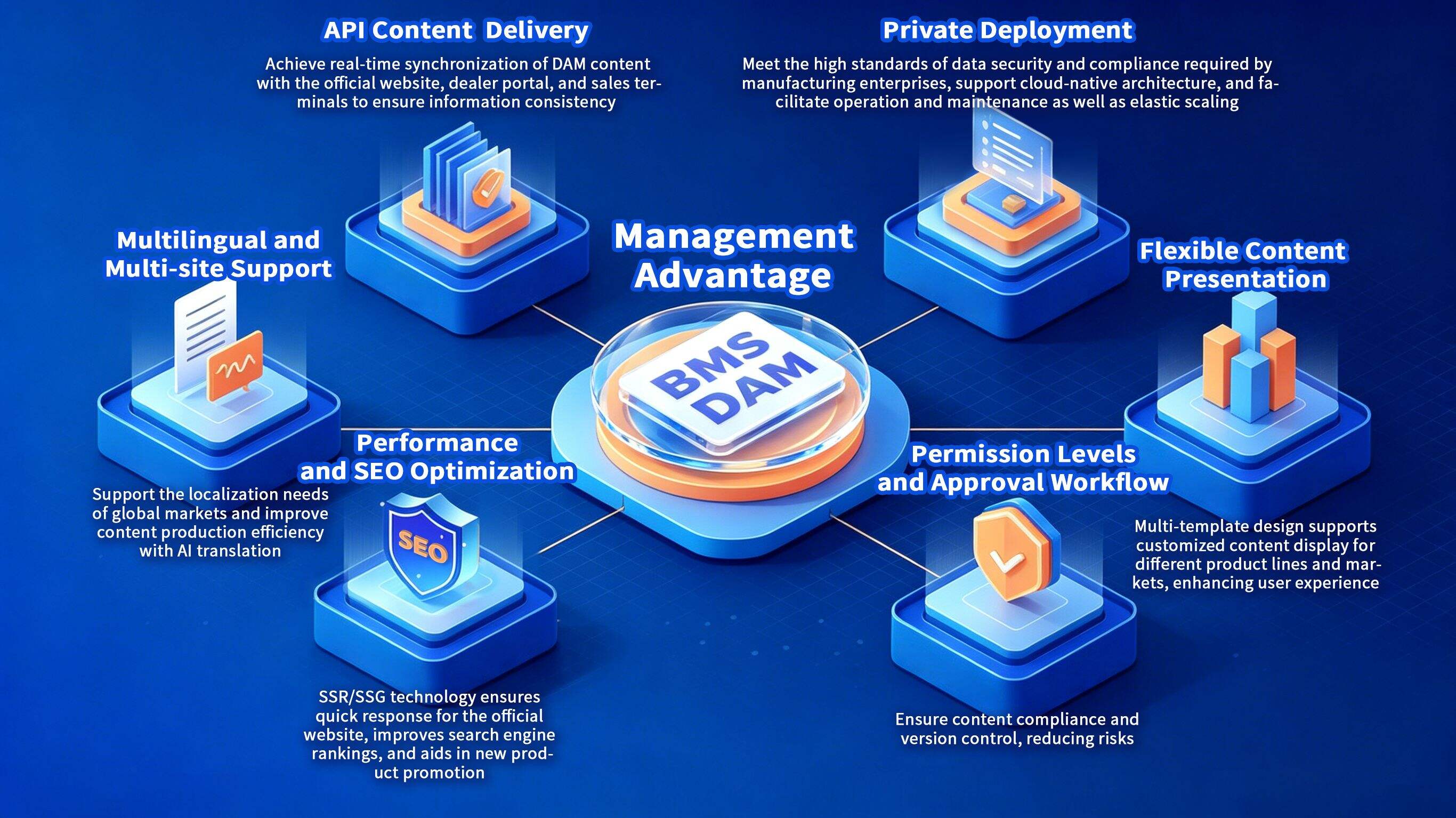
(Illustration showing management advantages enabled by integration with BMS DXP)
From budgetary and TCO (Total Cost of Ownership) perspectives, integrating content hubs with DAM reduces redundant development and manual maintenance costs, increases content reuse rates and channel responsiveness, shortens new product launch cycles, accelerates market ROI, enhances cross-departmental collaboration efficiency, and lowers communication costs and error risks.
Future trends in manufacturing digital asset management are shifting toward intelligent automation and ecosystem integration [1][2][3]. Thoughtful adoption of platforms like BMS DXP—tailored to enterprise-specific business processes—will effectively elevate the digital maturity and market competitiveness of content management.
FAQ
Q1: How does a manufacturing digital asset management system improve corporate website content update efficiency?
A1: Launching new manufacturing products involves substantial structured data and multimedia assets; traditional manual webpage updates are inefficient and error-prone. Leveraging DAM’s structured fields and multi-component template design, content updates require only replacing relevant assets or parameters—the system automatically renders corresponding pages, eliminating repetitive design and manual adjustments and drastically shortening update cycles. Furthermore, automated approval workflows ensure content compliance, minimizing launch delays caused by approval bottlenecks—enhancing both speed and accuracy of corporate website content updates.
Q2: How is the latest version of promotional materials guaranteed for dealer use?
A2: Using DAM’s granular permission management and nested Live Copy functionality, enterprise headquarters centrally manages core digital assets while dealer portals synchronize the latest content versions in real time. The system automatically locks outdated versions to prevent misuse of expired materials. Real-time content push via API—combined with version numbers and publication timestamps—ensures dealers always access official, up-to-date, and compliant promotional materials, minimizing brand risk and execution inconsistency across markets.
Q3: What are the main challenges in multi-language content management?
A3: Key challenges lie in balancing translation quality and timeliness. Manufacturing products feature technical complexity and abundant specialized terminology; while AI translation improves efficiency, human review remains essential to ensure accuracy and localized expression. Additionally, frequent content updates pose another challenge: rapidly synchronizing multi-language versions without information lag. Centralized multi-language version management via a content hub—paired with AI translation pre-processing and native-language expert review—enables efficient, quality-controlled multi-language content management.
Q4: How does digital asset management assist in handling product certification documents?
A4: Product certification documents are critical for manufacturing compliance and market access. DAM systems structurally store and retrieve certificates by tagging metadata—including certificate number, issuing authority, certificate type, and validity period. Automated expiration alerts and renewal notifications ensure continuous regulatory compliance. Linking certifications to product documentation facilitates official website display and channel inquiries, enhancing customer trust and after-sales service efficiency.
Q5: What on-premises deployment requirements does BMS DXP support?
A5: Given manufacturing’s stringent data security and compliance requirements, BMS DXP supports deployment on enterprise-owned private clouds or on-premises data centers, ensuring data residency. Its cloud-native, containerized architecture enables elastic scaling and automated operations, reducing operational overhead. On-premises deployment also supports custom security policies and access controls, fulfilling industry regulations and internal audit requirements—strengthening the security foundation of digital asset management.
Q6: What is the relationship between DAM systems and content hubs?
A6: DAM primarily handles centralized storage, management, and version control of digital assets—focusing on standardized processing of multimedia files and structured data. A content hub integrates DAM with other data sources to orchestrate content creation, assembly, and distribution—supporting multi-channel, multi-device content delivery. Their synergy ensures standardized digital asset governance while boosting content production and publishing efficiency, driving comprehensive digital transformation of manufacturing content management.
Q7: How can DAM optimize search engine performance?
A7: Corporate websites in manufacturing often contain highly technical content; well-structured content better aids search engine comprehension. DAM systems automatically inject Schema Markup structured data, dynamically generate sitemaps and metadata, and help search engines accurately crawl product images, technical specifications, and certification details. Coupled with SSR/SSG technology, page load speed and user experience improve—further enhancing SEO performance, online visibility for new products, and customer conversion rates.
If you are evaluating the relationship between DAM and DXP—or seeking ways to improve manufacturing corporate website and channel content management efficiency—contact Dragon Bravo Corporation (DBC).
Website: www.dragonsoftbravo.com
Email: sales-support@dragonsoftbravo.com
Phone: +86-21-61483130
Business Hours: Monday–Friday, 9:00–17:00 (Beijing Time, UTC+8)
References
[1] : https://www.fotoware.com/blog/digital-asset-management-trends-2026 "Digital Asset Management trends 2026: What you need to know now"
[2] : https://www.bynder.com/en/blog/ai-in-digital-asset-management/ "AI in digital asset management: key trends from State of DAM 2026"
[3]: https://www.baklib.com/blog/2026-dam-key-trends "4 Key Trends in DAM Digital Asset Management for 2026"


Want to know more about our products?
With years serving Fortune 500 clients, we offer flexible solutions and integrated implementation.
