





2026 AI Search Optimization and GEO Content Infrastructure Construction Guide: Making Corporate Websites a Trusted Source for AI Answers
Publication date: May 13 , 2026
Author:William
As users begin to hand over "search questions" to ChatGPT, Perplexity, Gemini, Copilot, and Google AI Overview, the competitive goal of corporate websites is shifting from "ranking on the first page of search results" to "becoming a trusted source in AI-generated answers." GEO optimization is not a replacement for traditional SEO, but a systematic upgrade built on SEO, content governance, structured data, brand entity authority, and multi-site operational capabilities. This article will start from the underlying logic of AI search optimization, dissect how corporate websites can build content infrastructure that can be retrieved, understood, extracted, and cited by AI, and explain why enterprise-level digital experience platforms like BMS DXP will become the key foundation for B2B brands to enhance AI search visibility.
1. The Search Entry is Changing: From "Ranking Competition" to "AI Citation Competition"
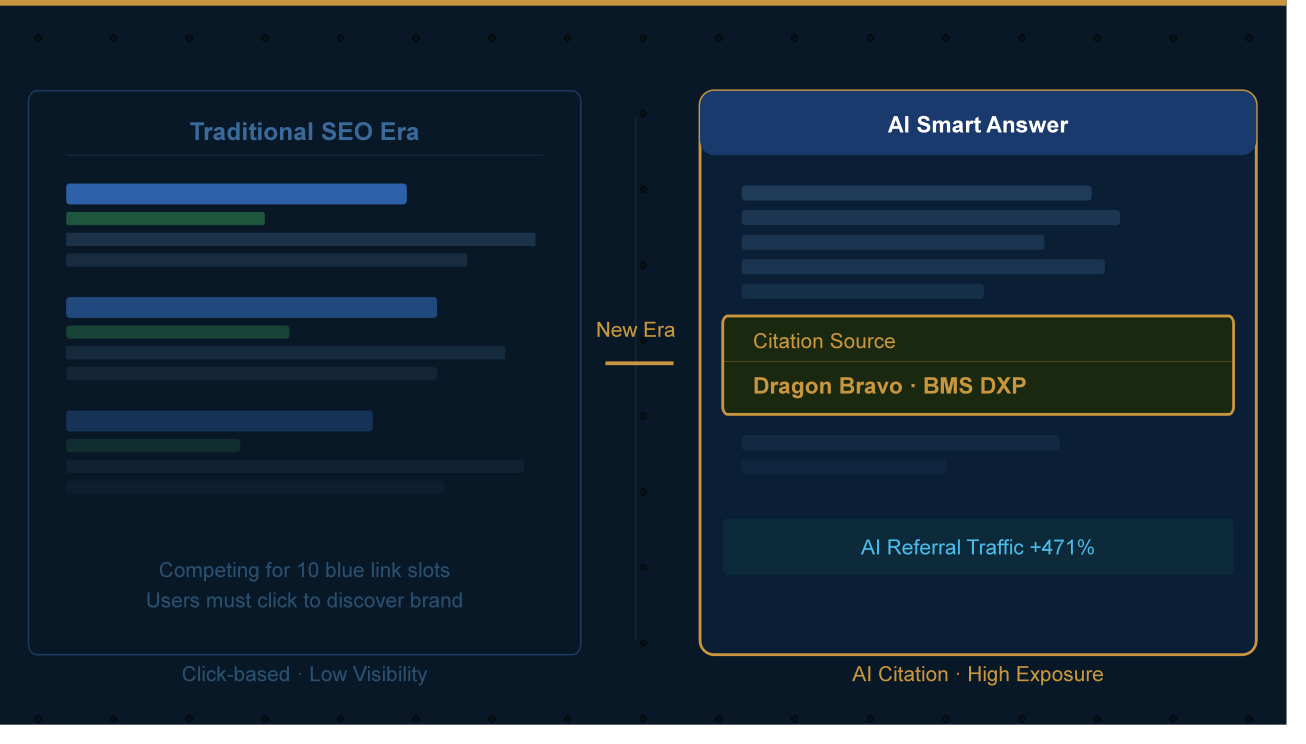
In 2026, corporate SEO can no longer be measured solely by traditional search result page rankings. Adobe's analysis of SEO trends for 2026 points out that search is shifting from a discovery mechanism centered on ranking links to a mechanism that generates answers through AI Overviews, generative search engines, and large language models. Brand visibility will increasingly depend on whether it is referenced in AI-generated answers, rather than just its page ranking position.[1]
Search Engine Land defines GEO more directly: Generative Engine Optimization is the practice of enabling AI search platforms like ChatGPT, Google AI Overviews, Perplexity, Claude, and Copilot to retrieve, cite, and recommend brands through structured content and digital presence.[2] This means that in the past, companies competed for positions among ten blue links, but now they also have to compete for the limited citation spots in AI responses.
| Dimension | Traditional SEO | GEO Optimization and AI Search Optimization |
| Core Objective | Improve keyword rankings and organic search clicks | Enhance brand mentions, recommendations, and citations in AI responses |
| Content Evaluation Focus | Keyword relevance, backlinks, page experience, content quality | Extractability, factual density, degree of structuring, entity authority, credible sources |
| Typical Entry | Search result pages from Google, Bing, Baidu, etc. | ChatGPT, Perplexity, Gemini, Copilot, Google AI Overview |
| Operational Metrics | Ranking, Impressions, Click-Through Rate, Organic Traffic, Conversion Rate | AI Citation Rate, Brand Mention Rate, Citation Sentiment, AI Referral Traffic, Share of Model |
| Technical Dependencies | crawlable, indexable, mobile-friendly, page speed | Schema structured data, semantic HTML, FAQ/HowTo structure, content update mechanism, AI crawler accessibility |
This does not mean that SEO is ineffective. On the contrary, Google's official SEO starter guide still emphasizes that the essence of SEO is to help search engines understand content and assist users in discovering websites; useful, reliable, well-organized, and timely updated content has a greater impact on search performance than mere technical adjustments. Therefore, good GEO must first be built on good SEO. The difference is that traditional SEO focuses more on "whether users click into the webpage," while GEO is more concerned with "whether AI is willing to use the webpage as a basis for answers."
For the enterprise clients served by DBC, this change has practical significance. Multinational automotive companies, professional service organizations, industrial manufacturing enterprises, and B2B technology companies often have a large number of product pages, solution pages, case study pages, knowledge center articles, FAQs, PDF documents, and multilingual sites. If this content is scattered across different systems, languages, and teams, even if the content quality is high, it will be difficult for AI systems to consistently recognize it as a "citable authoritative source."
II. What content is more likely to be cited by AI: Corporate websites need to meet four conditions
The AI search system does not simply copy the full text of web pages, but retrieves, filters, extracts, and synthesizes information from multiple sources. Adobe summarizes the focus of AI search optimization as extractability, verifiability, and contextual clarity. [1] Search Engine Land also emphasizes that AI engines break pages down into independent information fragments and assess the relevance, clarity, and factual density of each fragment. [2]
This means that to enhance AI search visibility, corporate websites cannot just repeat popular keywords like “GEO optimization,” “AI SEO,” and “AI search optimization” in their articles; instead, the content itself must have a structure that is machine-readable, user-trustworthy, and continuously updatable.
1. Content should be “answer-oriented”: Each section should independently answer a question
A common issue with traditional marketing articles is excessive buildup, conclusions placed at the end, and scattered viewpoints. In the context of AI search, such pages are difficult to extract accurately. A content structure more suitable for GEO optimization is to directly answer a clear question at the beginning of each core section, and then elaborate on the background, methods, and case studies.
For example, when potential customers search for “How do companies perform GEO optimization,” AI is more likely to cite a clearly structured answer: “To perform GEO optimization, companies should prioritize conducting an AI search visibility audit, restructuring core pages, configuring Schema structured data, building brand entity authority, and continuous monitoring.” If the same information is buried in long paragraphs, the likelihood of citation decreases.
2. Content should be “structured”: Schema, tables, FAQs, and semantic pages are all essential
Google's official documentation clearly states that structured data is a standard format for providing Google with information about the meaning of pages and the classification of page content; when conditions allow, Google recommends using JSON-LD because it is easier to implement and maintain on large-scale websites. [4] Structured data is not a decoration to “please the algorithm,” but rather a way to help search engines and AI systems better understand which parts of the page are articles, organizations, products, FAQs, steps, breadcrumbs, and author information.
| Page types | Recommended structure for priority use | GEO value |
| Product page | Product, Organization, Breadcrumb, FAQ | Help AI understand product positioning, features, brand entity, and common questions |
| Solution page | Article, Organization, FAQ, HowTo | Help AI extract applicable scenarios, implementation paths, and industry solutions |
| Knowledge center article | Article, FAQ, Breadcrumb, author information | Help AI identify the content's theme, update time, and professional sources |
| Comparison Page | Tables, FAQs, Reviews, or Custom Structured Modules | Addressing comparative queries like "Which is better, X or Y?" and "AEM alternatives" |
| Multilingual Pages | hreflang, multilingual URL rules, unified entity information | Avoid content fragmentation across different language sites to enhance global brand consistency |
It is important to note a common misconception: more Schema is not necessarily better; accuracy is what matters. Google's official documentation reminds us that structured data should describe content visible to users and should not create tags for empty pages or invisible information; complete and accurate recommended properties are more important than piling up a large number of incomplete or incorrect properties.
3. Content must be "trustworthy": E-E-A-T is not just an SEO concept, but also a threshold for AI citations
When generating answers, AI search prioritizes information sources that are more reliable, consistent, and authoritative. If a corporate website lacks author information, update timestamps, sources, client cases, corporate qualifications, and external endorsements, it will be difficult to stand out in the competitive landscape of AI responses, even if the page content appears complete.
For B2B companies, E-E-A-T can be applied to very specific content assets. Product pages should specify applicable industries and actual deployment scenarios, case pages should present client backgrounds and business problems, knowledge articles should indicate update times and reference sources, and "About Us" pages should fully present the company entity, service capabilities, and contact information.DBC long-term service to clients such as Ford, Lincoln, KWM King & Wood Mallesons, and AutoHydra in enterprise-level digital experience practices is an important content asset reflecting brand credibility and professional experience.
4. Content must be "maintainable": outdated content will weaken the competitiveness of AI citations.
The Google SEO Starter Guide recommends that websites check published content and update or delete content that is no longer relevant as needed. In the era of AI search, this is even more important. This is because AI systems tend to prefer pages that are recently updated, have complete data, and clear context when faced with multiple candidate sources on the same topic.
Therefore, businesses should not view GEO optimization as a one-time revision, but rather incorporate it into content lifecycle management: topic planning, production, review, publication, structured tagging, monitoring, updating, and archiving. Only when the content management system can support this closed loop can GEO optimization transform from a single article experiment into a scalable operational capability.
Ⅲ, for businesses to do GEO optimization, it is not about writing a few more articles, but about rebuilding the content infrastructure.
Many businesses, when discussing "how to improve AI search visibility," instinctively think of increasing the number of articles. However, from an enterprise-level operational perspective, the core of GEO optimization is not "more content," but "more usable content assets." If content is scattered across the official website, public accounts, PDFs, product manuals, sales materials, regional sites, and local files of overseas teams, AI search systems will find it difficult to identify a unified, stable, and trustworthy brand entity.
The content infrastructure suitable for GEO optimization should address at least four issues: first, can content be uniformly managed by topic, product, industry, scenario, language, and region; second, can the marketing team build pages and configure structured data without relying on development; third, can content be reused across the official website, knowledge center, social media, and sales touchpoints; fourth, can the business continuously monitor AI search citations, organic search performance, and content conversion.
| Infrastructure capabilities | If missing, what problems will arise | Direct impact on GEO optimization |
| Unified CMS content management | The standards for product pages, article pages, and case pages are inconsistent, and the page structure is chaotic. | AI struggles to consistently extract answer segments, leading to a decline in brand information consistency. |
| DAM Digital Asset Management | Images, videos, white papers, and product materials are stored in a scattered manner. | Low content reuse efficiency, with high costs for cross-language and cross-market publishing. |
| DMS Document Management | PDFs and technical materials are difficult to link with web content. | High-value knowledge cannot be transformed into indexable and citable pages. |
| Knowledge Knowledge Center | FAQs, tutorials, and terminology explanations lack systematic accumulation. | It is difficult to cover long-tail AI search questions such as "What is," "How to," and "Best practice." |
| Multilingual and Multi-site Management | Global site content updates are not synchronized, leading to inconsistent brand representation. | This affects cross-market AI search visibility and brand credibility. |
| GEO/SEO Toolchain | Schema, Meta, Canonical, and hreflang rely on manual processing for development. | Optimization cycles are long, error rates are high, and scaling costs are increasing. |
This is also why keywords like "enterprise content middle platform," "digital experience platform," "content management system (CMS)," and "multilingual official website GEO optimization solutions" are becoming high-intent search terms in B2B website construction and digital marketing selection, alongside "GEO optimization" and "AI search optimization." What users truly care about is not the concepts themselves, but whether enterprises can connect content production, content governance, content distribution, and AI visibility enhancement through a single platform.
IV. How BMS DXP Supports Enterprise GEO Optimization: From Page Transformation to Systematic Operations
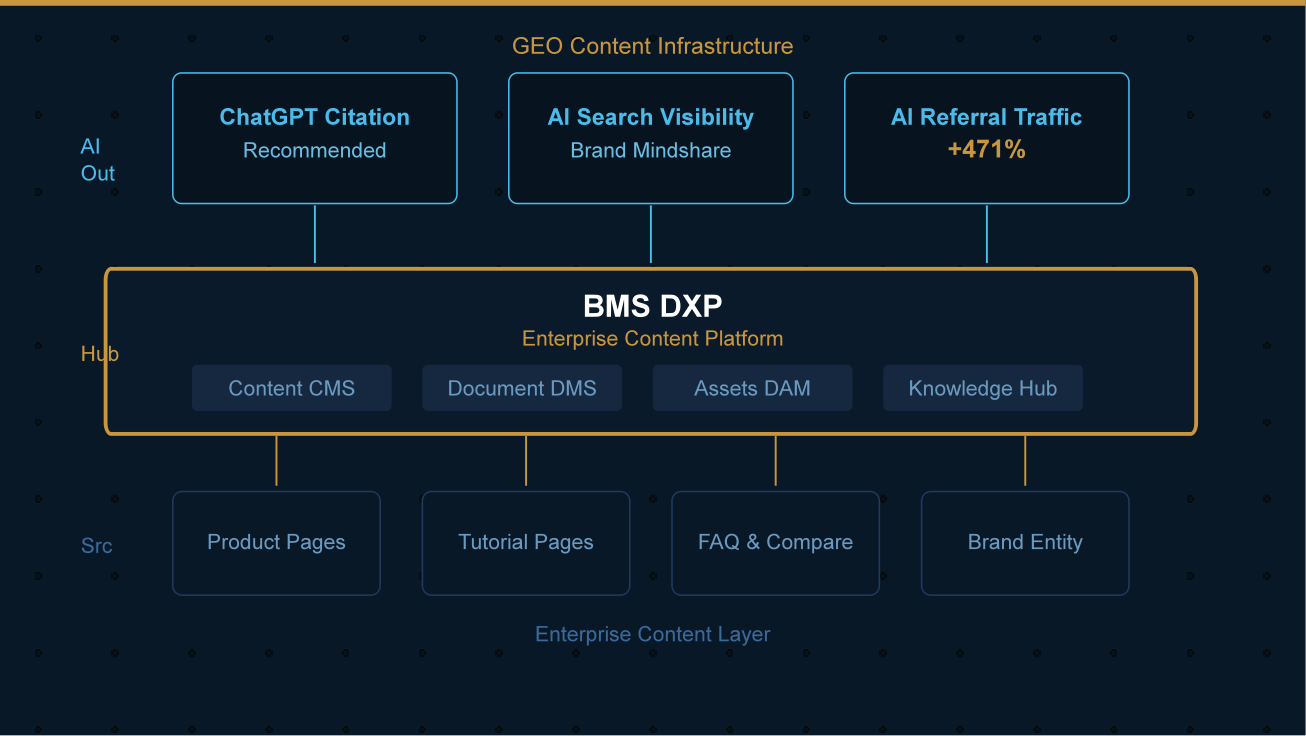
BMS DXP (Bravo Marketing Suite Digital Experience Platform) is a platform developed by DBC for enterprise-level digital experience and content operation scenarios. It integrates CMS Content Management,DMS Document Management,DAM Digital Asset Management, and Knowledge Center are integrated into a unified platform to help enterprises build a content asset system that is reusable, governable, multilingual, and sustainably optimized.
For enterprises that are laying out AI SEO, GEO optimization, and AEO answer engine optimization, the value of BMS DXP is not just "publishing pages," but transforming content from fragmented production into infrastructure that can be understood by AI.
1. Improve content extractability with standardized components
GEO-friendly pages typically require clear title hierarchies, summary sections, upfront conclusions, comparison tables, FAQs, step-by-step instructions, and CTAs. BMS DXP can solidify these structures into the daily production standards of content teams through reusable components and page templates. Marketers do not need to design the structure from scratch each time when building product pages, solution pages, knowledge articles, or comparison pages, nor do they need to repeatedly rely on the development team to adjust the front end.
This is particularly critical for "how corporate websites can enhance AI citation rates." The competition for AI citations does not only occur within individual articles but also within the content structure of the entire site. When a company's core pages adopt a stable, clear, and semantically consistent structure, the probability of the brand being understood and cited by AI search systems will continue to increase.
2. Lower technical barriers with built-in GEO/SEO toolchains
Many enterprise content teams understand the importance of Schema structured data but find it difficult to implement it consistently in practice. The reason is simple: if every configuration of Article Schema, FAQ Schema, Breadcrumb, Canonical, Meta Title, Meta Description, and hreflang requires developer intervention, the optimization actions will be slowed down by scheduling, testing, and deployment processes.
BMS DXP is designed for content teams SEO/GEO configuration capability standardizes the management of structured data, TDK, internal links, page templates, and multilingual pages. For large enterprises, this capability can significantly reduce the collaborative friction between technical SEO and GEO optimization.
3. Strengthen global AI search visibility with multi-site and multilingual management
Multinational companies often face a real dilemma: Chinese sites, English sites, regional sites, and brand sub-sites are maintained by different teams, leading to inconsistencies in product naming, solution expressions, customer cases, and FAQs. For AI search systems, such inconsistencies can weaken brand entity signals.
BMS DXP supports multi-site, multilingual, and centralized content operations, helping enterprises maintain a unified brand expression in the global market while retaining localized content for different regions. For companies that focus on Google AI Overview, Bing Copilot, ChatGPT, Perplexity, and the content ecosystem in the Chinese market, this capability is closer to enterprise-level needs than single-point SEO plugins.
4. Turn long-tail prompts into long-term assets with a knowledge center
An important change in AI search is that users' questions are becoming increasingly specific. For example, traditional searches might be "GEO optimization," while real questions in AI search are more likely to be "How can B2B companies get ChatGPT to cite official website content?" "How to optimize AI search for multilingual official websites?" "How can a content middle platform support GEO optimization?" These long-tail prompts may not have high search volumes when viewed individually, but their conversion intent is often clearer.
BMS DXP's Knowledge Center is suitable for addressing these long-tail questions. Enterprises can build thematic clusters around product terminology, industry scenarios, implementation methods, FAQs, comparative questions, and best practices, turning scattered experiences into sustainable and updatable knowledge assets. This not only enhances traditional SEO coverage but also increases opportunities for AI search extraction and citation.
5. Enterprise GEO Implementation Roadmap: From 30-Day Pilot to 90-Day Scaling
GEO optimization should not remain at the conceptual level. Enterprises need an executable roadmap to transform "AI search visibility" into a workflow that involves content, technology, and operations teams.
| Phase | Objective | Key Actions | Deliverables |
| Phase 1: AI Search Visibility Audit | Confirm whether the brand is currently referenced by AI | Test core keywords and long-tail prompts, record responses from platforms such as ChatGPT, Perplexity, and Google AI Overview; check the TDK, Schema, indexing status, and content update time of core pages | AI Reference Baseline Report, List of Problematic Pages, Competitor Reference Samples |
| Phase 2: Core Page GEO Transformation | Prioritize enhancing the extractability of high-value pages | Transform product pages, solution pages, case pages, and knowledge articles; supplement with summaries, FAQs, comparison tables, author information, update times, and structured data | GEO optimization page templates, Schema configuration specifications, FAQ library |
| Phase 3: Topic Cluster Construction | Cover more high-intent long-tail questions | Establish content clusters around themes such as "AI Search Optimization," "Enterprise Content Middle Platform," "Multilingual Official Website GEO Optimization," and "BMS DXP GEO Optimization Solutions" | Knowledge center topic pages, long-tail prompt content library, internal linking system |
| Phase 4: Monitoring and Iteration | Incorporate GEO into long-term operations | Observe AI Referral Traffic in GA4, regularly test AI response citations, track brand mentions, cited URLs, competitor changes, and conversion quality. | Monthly GEO report, content update plan, conversion optimization suggestions |
In this roadmap, BMS DXP plays the role of a platform that "makes processes run." Without a unified enterprise content middle platform, GEO optimization can easily remain at the level of individual articles; with scalable content infrastructure, enterprises can continuously produce content assets that are understandable by AI, reusable by sales, and can be simultaneously published in multiple languages.
Ⅵ. Keywords are not just piled up: How to naturally integrate popular and long-tail keywords into official website articles
Users have pointed out the importance of "selecting currently popular SEO keywords, paying attention to the combination of popular and long-tail keywords." This is crucial. However, in the era of AI search, keyword strategies cannot revert to the early SEO stacking model. Google's official SEO guidelines also remind us that users will search for the same topic using different vocabulary, and the search system can understand the relationship between pages and various queries; content should primarily target readers, rather than mechanically covering every keyword variant.[3]
Therefore, official website articles should adopt a writing style where "core words define the theme, long-tail words convey intent, and product words connect conversions." For example, popular core keywords like "AI search optimization," "GEO optimization," and "enterprise content infrastructure" can be used in titles and abstracts; the main sections can naturally expand on long-tail questions such as "How enterprises do GEO optimization," "How to get ChatGPT to reference brand content," and "How to improve AI citation rates on enterprise websites"; in the solutions section, high-conversion product words like "enterprise content middle platform," "digital experience platform," and "BMS DXP GEO optimization solution" can be introduced.
| Keyword types | Recommended keywords | Writing style |
| Popular core keywords | GEO optimization, generative engine optimization, AI search optimization, AI SEO, AEO answer engine optimization | Used for titles, abstracts, H2 headings, and concept definitions to help search engines confirm the topic |
| High-intent long-tail keywords | How companies can perform GEO optimization, how to improve AI search visibility, how to get ChatGPT to reference brand content, how corporate websites can enhance AI citation rates | Used for chapter questions, FAQ questions, and knowledge center topics to improve Prompt coverage capability |
| Technical support terms | Schema structured data, semantic HTML, FAQ Schema, llms.txt, AI crawlers, JSON-LD | Used for methodology and technology lists to enhance professionalism and citation potential |
| Platform conversion terms | Corporate content middle platform, digital experience platform, content management system CMS, multilingual corporate website, BMS DXP | Used for product solution paragraphs to transform information needs into platform selection requirements |
| Comparison decision words | AEM alternatives, enterprise-level CMS selection, Sitecore alternatives, limitations of WordPress corporate websites | For subsequent topic pages or comparison pages, catering to solution evaluation search intent |
The advantage of this writing style is that the article does not sacrifice the reading experience for SEO, yet it can cover the complete path from user awareness, research, comparison to consultation. For B2B companies, this is more valuable than simply chasing high-ranking keywords, as long-tail AI search questions often correspond to more specific business needs.
Ⅶ. Frequently Asked Questions (FAQ)
Q1: Will GEO optimization replace traditional SEO?
No. GEO optimization is more accurately understood as an extension of traditional SEO in the AI search era. SEO is still responsible for getting search engines to crawl, index, understand, and display website content; GEO further requires that content can be accurately extracted, verified, synthesized, and cited by AI systems. The most reasonable approach for companies is to overlay the GEO perspective on the existing SEO framework, rather than starting from scratch.
Q2: How can companies perform GEO optimization, and where should they start?
Companies should start with an AI search visibility audit. The specific approach is to select core business terms, brand terms, competitor terms, and long-tail prompts, and test on platforms like ChatGPT, Perplexity, and Google AI Overview to see if the brand is mentioned or cited; then prioritize transforming high-value pages by adding summaries, FAQs, structured data, author information, update times, case evidence, and comparison tables.
Q3: How can we get ChatGPT or Perplexity to cite content from the brand's official website?
Companies cannot directly "command" AI platforms to cite a specific page, but they can increase the probability of the page being retrieved and cited. Effective methods include: publishing clear, original, and verifiable content; using Schema structured data; maintaining consistent brand entity information; establishing FAQs and knowledge centers; increasing authoritative external mentions; continuously updating core pages; and ensuring important pages are not incorrectly blocked by robots rules.
Q4: Is structured data with Schema really important for AI search optimization?
It is important, but it should not be viewed in isolation. According to Google, structured data can provide search engines with information about the meaning of a page and its content classification, and it is recommended to use JSON-LD format when conditions allow. For GEO, Schema can reduce the cost for AI to understand the page, but it must be used in conjunction with high-quality, user-visible, and factually accurate content.
Q5: Do small and medium-sized enterprises also need to do GEO optimization?
Yes, especially for businesses with a clear vertical field, specialized services, or B2B solutions. AI search does not only reference large brands; it also cites pages that are clearly structured, specific in content, and professionally credible. Small and medium-sized enterprises can start with niche scenarios and long-tail questions, such as "How to do multilingual website GEO optimization in a certain industry" or "Selection criteria for content platforms in a certain type of enterprise," to establish authority in specific topics with high-quality content.
Q6: What types of enterprises are suitable for GEO optimization scenarios with BMS DXP?
BMS DXP is more suitable for enterprises with large content scales, multiple brands or sites, multilingual operations, decentralized digital assets, a need for coordination between the official website and knowledge center, and a desire to reduce technical SEO execution costs. Typical scenarios include multinational corporations, B2B industrial brands, automotive and manufacturing companies, professional service organizations, consumer electronics companies, and organizations needing alternatives to AEM.
Q7: How is the effectiveness of GEO optimization measured?
Enterprises can measure effectiveness using four types of indicators: first, the brand mention rate and cited URLs in AI responses; second, the AI visibility share of the brand relative to competitors; third, referral traffic and conversion quality from AI platforms like ChatGPT and Perplexity; fourth, changes in impressions, clicks, and conversions of core pages in traditional SEO. GEO is not a single ranking metric, but a set of comprehensive indicators related to AI search visibility and business conversion.
Conclusion: In the era of AI search, content infrastructure determines whether a brand is seen.
The competition for AI search optimization is essentially not about "who can chase trending keywords better," but rather about who can continuously provide clearly structured, factually reliable, timely updated, and easily extractable corporate content assets. As AI becomes the new search entry point, corporate websites will no longer just be a window for brand display, but will become an important data source for AI systems to understand corporate capabilities, product value, and industry experience.
For teams contemplating "how to optimize GEO for enterprises," "how to improve AI search visibility," and "how content platforms can support GEO optimization," the most important first step is not to blindly increase article production, but to check whether the existing content infrastructure is sufficient to support content operations in the AI era. BMS DXP helps enterprises transform scattered content into governable, reusable, multilingual publishable, and AI-understandable digital assets through the integrated capabilities of CMS, DMS, DAM, and Knowledge.
If your enterprise is planning a website upgrade, multilingual site construction, knowledge center establishment, AEM alternatives, or GEO optimization system construction, please visit the Dragon Bravo Corporation website to learn about BMS DXP, or contact the Dragon Bravo team for evaluation suggestions regarding enterprise content infrastructure.
References
[1]: https://business.adobe.com/blog/seo-in-2026-fundamentals "Adobe Business Blog, SEO in 2026: How AI is reshaping the fundamentals of search"
[2]: https://searchengineland.com/mastering-generative-engine-optimization-in-2026-full-guide-469142 "Search Engine Land, Mastering generative engine optimization in 2026: Full guide"
[3]: https://developers.google.com/search/docs/fundamentals/seo-starter-guide "Google Search Central, Search Engine Optimization (SEO) Starter Guide"
[4]: https://developers.google.com/search/docs/appearance/structured-data/intro-structured-data "Google Search Central, Introduction to structured data markup in Google Search"


Want to know more about our products?
With years serving Fortune 500 clients, we offer flexible solutions and integrated implementation.
