





DAM in the AI Era: It's Not About Generating Images, but About Making Assets Discoverable, Reusable, and Trustworthy
Release Date: 2026-06-11
Author: William
Misconceptions in Conventional Thinking: AI DAM Is Not Just About “Generation”
In many enterprises’ perception, the most direct link between AI and Digital Asset Management (DAM) is “image generation” or “automated creative production”—a facet of AI’s application in content creation. However, what truly drives improvements in enterprise content management and brand operations efficiency is AI’s application in digital asset discovery, management, and compliance.
Within a digital asset library, massive volumes of images, videos, documents, and other assets suffer from low retrieval efficiency and poor reusability if accurate and trustworthy metadata is missing. AI excels precisely in the following areas:
Automatically identifying and enriching asset metadata (e.g., intelligent tagging, semantic descriptions)
Enabling multimodal search across images, text, and video based on semantic understanding
Providing copyright risk alerts and assisting compliance review
These capabilities constitute the core value proposition of AI-powered DAM.
In fact, image generation and other creative assistance features represent an added-value function—not the core—of AI DAM. Enterprises implementing such solutions have found that relying solely on AI-generated content often fails to resolve fundamental pain points in asset management: “inability to locate suitable assets” and “untrustworthy assets.” For example, a multinational retail group initially focused on automatically generating product promotional imagery when introducing AI DAM. However, as the project progressed, the biggest bottleneck proved to be fragmented historical asset metadata and low retrieval efficiency—causing marketing teams to repeatedly produce similar content, increasing costs and risks.
Thus, enterprise decision-makers have gradually recognized that the key to applying AI in DAM lies in enhancing digital asset discoverability and compliance—not merely generative capability. This cognitive shift directly influences budget allocation and technology selection strategies, directing more resources toward metadata automation, semantic search, and compliance risk control.
AI Metadata and Semantic Search: Critical Enablers of Asset Discovery Efficiency
Enterprise digital asset volumes typically number in the tens of thousands—or even millions—making manual metadata tagging costly and error-prone. Leveraging deep learning, AI automatically identifies image content, people, scenes, and even semantic information within videos to generate structured metadata. Combined with Natural Language Processing (NLP), it enables semantic search—understanding user intent rather than relying solely on keyword matching.
In a DAM project for a large manufacturing enterprise, IT and marketing departments jointly defined a semantic tagging taxonomy covering multiple dimensions including product model, shooting scene, usage context, and copyright status. During AI model training, the team leveraged an existing manually tagged asset repository for semi-automated tagging, followed by targeted accuracy reviews conducted by the marketing team. This workflow not only improved metadata quality but also laid the groundwork for subsequent semantic search capabilities.

Comparison of Benefits: AI Metadata & Semantic Search
| Functional Dimension | Traditional DAM | AI-Driven DAM |
| Metadata Generation | Manual tagging—time-consuming and prone to omissions | Automatic identification—multidimensional tags with real-time updates |
| Asset Search | Keyword-based matching—high false-positive rate | Semantic search—hybrid queries across text and visual content |
| Multimodal Retrieval | Most systems support retrieval limited to single media types | Supports unified retrieval across images, text, videos, and other modalities |
| Copyright & Risk Alerts | Manual review—delayed detection | AI automatically identifies copyright information and sensitive content to assist compliance review |
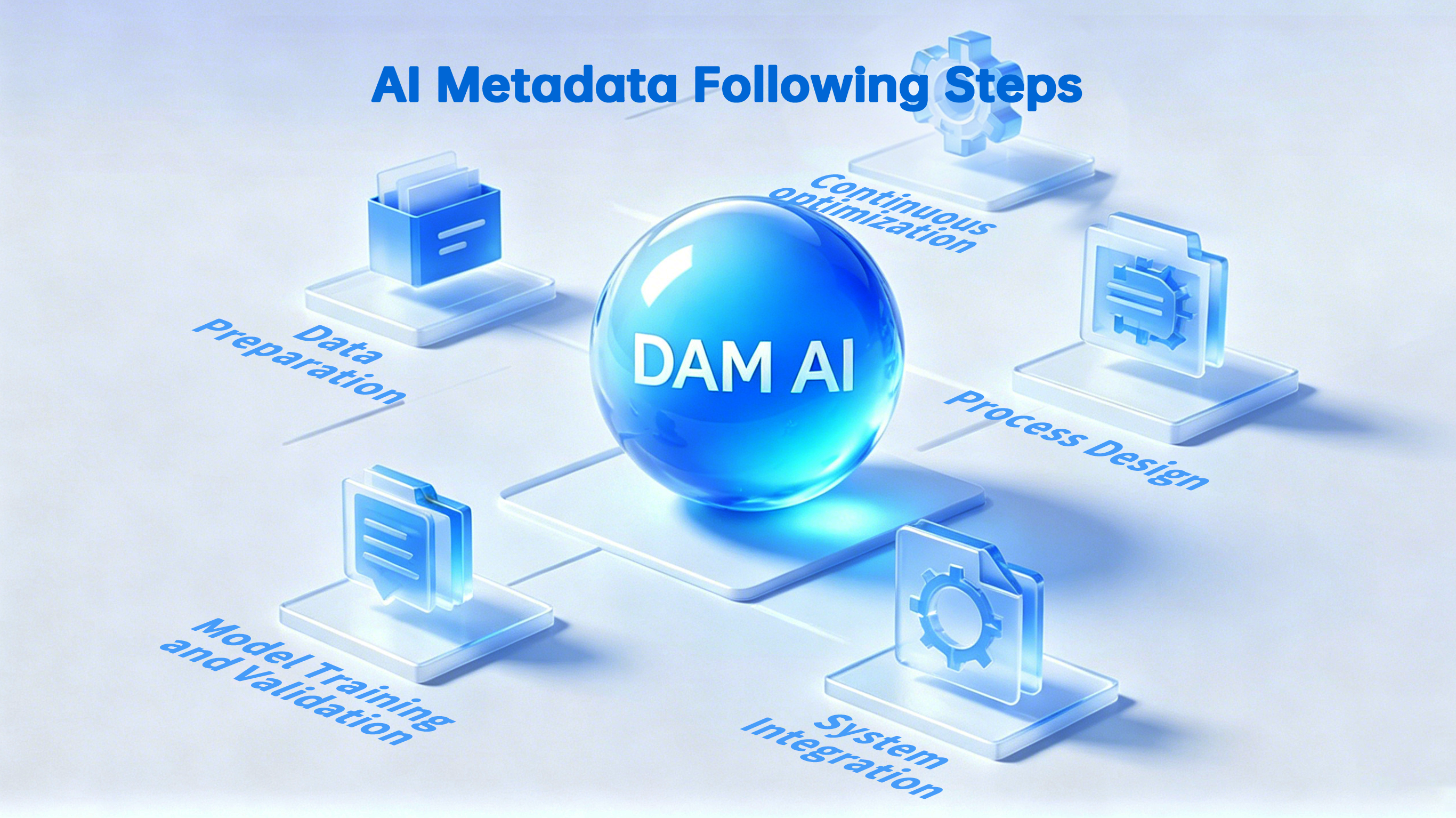
When implementing AI metadata, enterprises typically follow these steps:
1. Data Preparation: Organize existing assets and their metadata; clean inconsistent tags; standardize field definitions.
2. Model Training & Validation: Train image recognition and NLP models using enterprise-specific assets; test tag accuracy and search responsiveness.
3. Workflow Design: Establish human-AI collaborative review workflows, clarifying responsibilities and review criteria.
4. System Integration: Embed AI modules into the existing DAM system to enable automated tagging and semantic search.
5. Continuous Optimization: Refine models and tagging taxonomies based on user feedback and usage analytics to improve accuracy and user experience.
This structured approach ensures AI metadata’s practicality and business alignment, avoiding trust crises arising from “black-box” effects.
Multimodal Retrieval and Enhanced Enterprise Asset Reuse Rates
Multimodal retrieval refers to a system’s ability to unify indexing and searching across different digital asset types (e.g., images, videos, text)—particularly critical for multinational corporations and multi-brand enterprises. Asset management is no longer confined to single file formats; users can rapidly locate required assets via natural-language descriptions.
In practice, implementing multimodal retrieval requires cross-departmental collaboration:
Marketing & Brand Teams define business requirements and search scenarios, and specify common query terms and semantic tags.
IT Department handles technical implementation and system stability, ensuring unified management and high-performance retrieval of multimodal data.
Legal Team participates in designing copyright and compliance-related fields to ensure search results adhere to usage policies.
For instance, a global consumer goods company implemented multimodal retrieval, enabling marketers to simply input “summer outdoor advertising video” and receive relevant video clips, supporting images, and copywriting assets. This functionality reduced asset search time by nearly 40%, significantly accelerating content delivery.
The value of multimodal retrieval extends beyond search experience—it boosts asset reuse rates while reducing redundant creation and copyright risks. When planning budgets, enterprises should prioritize cost-benefit analysis of data storage architecture optimization, indexing technologies, and cross-departmental workflow design to ensure long-term TCO (Total Cost of Ownership) remains controllable.
AI Applications in Digital Asset Governance and Compliance
As digital content volume surges, compliance risks multiply. AI applications in DAM are not merely technological innovations—they are essential for content governance. AI can automatically detect unauthorized usage, expired licenses, and sensitive content, generating compliance alerts and supporting approval workflows and version traceability.
In a DAM project involving the financial industry, the legal team emphasized strict controls over sensitive information and copyright usage. By introducing an AI-powered review queue, the system automatically flags potentially risky assets for priority legal review—reducing blind spots in manual processes. During approvals, the system automatically logs every review comment and version change, establishing a fully traceable compliance chain.
“AI does not replace human review entirely; instead, it serves as an assistant tool to enhance visibility and management efficiency for asset compliance risks.” — Senior DAM Consultant, Industry Veteran
When designing AI compliance modules, enterprises must clearly define risk boundaries:
AI identification results serve as warnings or recommendations—not final determinations.
Review queues and mandatory human verification are indispensable.
Copyright alerts must be precisely matched against contractual terms and usage scope.
AI models require periodic updates to adapt to regulatory changes and emerging risks.
Additionally, enterprises should establish key governance metrics (KPIs)—such as copyright dispute rate, review response time, and percentage of non-compliant assets—and continuously optimize governance processes through data-driven monitoring to ensure content risks remain under control.
Why Image Generation Is Not the Top Priority for Enterprise AI DAM
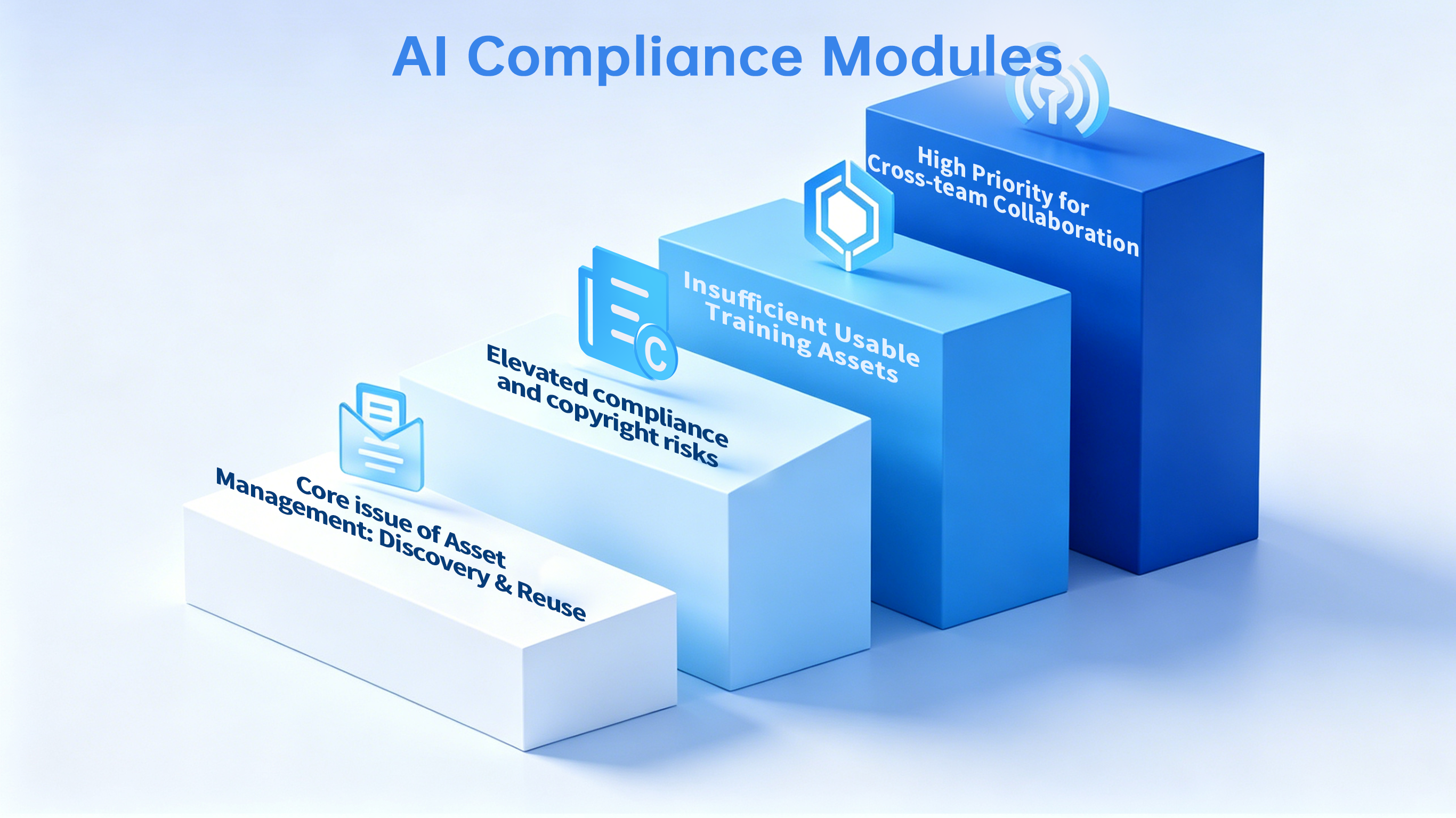
Although AI image-generation technology has advanced rapidly in recent years, generating content is rarely the most urgent need in enterprise digital asset management environments. Key reasons include:
The Core Challenge in Asset Management Is Discovery and Reuse: Enterprises possess vast amounts of historical assets; thus, rapidly and accurately locating suitable assets is the key to improving efficiency and reducing costs. Generating new images cannot replace the value of existing assets.
High compliance and copyright risks: Generated content involves copyright ownership, brand consistency, and compliance risks; enterprises prioritize the lawful use of existing assets.
Limited availability of training assets: Internal enterprise assets are often highly specialized and diverse; AI generation models require large volumes of high-quality training data and extensive customization for enterprise business needs, demanding substantial investment.
High priority for cross-departmental collaboration: Marketing, branding, legal, IT, and other departments must jointly advance asset governance; generative image technology remains inadequate for complex business processes.
Therefore, enterprises’ investment focus for AI DAM should center on foundational capabilities such as metadata automation, intelligent search, and compliance review. Image generation may serve as a supplementary tool for subsequent content innovation but should not be the primary objective.
AI-Powered Practices with BMS DXP
DragonBravo’s BMS DXP platform integrates AI-powered copywriting optimization, AI translation, automatic Schema Markup injection, and multimodal asset retrieval, delivering a meticulous and practical solution for enterprise content management. It supports multilingual and multi-site management, fulfilling multinational corporations’ requirements for content localization and compliance.
BMS DXP ensures strict control over copyright and brand consistency during content reuse and modification through nested Live Copy, permission hierarchies, and version traceability. Its AI metadata and semantic search modules help marketing and branding teams rapidly locate required assets, enhancing asset reuse rates and content delivery efficiency.
In real-world projects, BMS DXP also supports AI-driven copyright alerts and audit queue management, enabling legal teams to monitor content risks in real time and reduce approval bottlenecks. Cross-departmental collaboration is achieved efficiently via platform permissions and workflow design, ensuring synchronized progress between content production and compliance.
Additionally, BMS DXP focuses on overall TCO, supporting private deployment and hybrid cloud architecture to meet diverse enterprise information security and budget requirements, helping organizations continuously optimize operational efficiency in digital asset management.
FAQ: Enterprise Questions on AI DAM Implementation
Q1: How accurate is AI-generated metadata, and is manual correction required?
A1: Accuracy of AI-generated metadata has significantly improved in recent years—particularly in image recognition and natural language processing—typically reaching 80% to over 90%. However, since core enterprise assets involve brand elements and compliance-sensitive content, manual verification remains advisable. In practice, AI handles initial large-scale tagging, while humans focus on reviewing critical tags and anomalous cases—enhancing efficiency while ensuring data quality and business alignment.
Q2: How does AI DAM ensure accurate management of multilingual content?
A2: AI DAM supports automated translation and localization, integrated with multilingual version management and approval workflows, ensuring consistency and compliance across markets. Platforms typically incorporate translation memory and terminology management to minimize redundant translation costs. Permission hierarchies ensure regional teams retain appropriate control over local content. Platforms like BMS DXP provide multilingual, multi-site management functionality to support unified governance for multinational corporations.
Q3: How can enterprises prevent content copyright risks?
A3: AI automatically identifies asset copyright information, licensing status, and sensitive content; combined with approval workflows and permission hierarchies, it ensures compliance reviews occur prior to usage. The system flags expired licenses and potentially non-compliant assets, prompting timely action by relevant personnel. Legal teams can prioritize risk assets via audit queues, minimizing copyright disputes. Such mechanisms effectively reduce legal risks arising from misuse or unauthorized use.
Q4: What resources does multimodal retrieval require from enterprises?
A4: Multimodal retrieval relies on structured metadata for digital assets and unified platform support. Initial investment includes technical integration, metadata standardization, and model training—requiring collaboration across IT, marketing, and legal departments. Long-term, multimodal retrieval significantly improves search efficiency and asset reuse rates while reducing redundant production costs. Enterprises should evaluate ROI from a total cost of ownership (TCO) perspective and allocate budgets and human resources accordingly.
Q5: Is AI DAM suitable for enterprises of all sizes?
A5: AI DAM is especially suited for enterprises managing large volumes of content across departments and regions. Smaller enterprises with limited assets may opt for simplified versions and scale gradually. The key lies in assessing asset management complexity, compliance requirements, and budget to determine AI DAM investment priorities and functional scope.
Q6: How is AI-generated data security and privacy ensured?
A6: Compliant DAM platforms support permission hierarchies, private deployment, and cloud-native security operations, ensuring controlled data access and adherence to industry- and region-specific data protection regulations. Enterprises must establish stringent access control policies and audit mechanisms to prevent data leakage and misuse. AI model training and inference processes must also comply with privacy protection standards to avoid sensitive information exposure.
Q7: How should DAM and DXP platforms be integrated?
A7: DAM manages and governs digital assets, while DXP handles content publishing and digital experiences. Their integration enables efficient asset discovery, compliance control, and multi-channel publishing—enhancing overall digital content operations. Ideally, DAM provides structured, trustworthy asset data, and DXP leverages these assets to deliver personalized, dynamic user experiences. Cross-departmental collaboration and technical integration are critical to achieving this goal.
If You Are Evaluating the Relationship Between DAM and DXP
Digital asset management in the AI era should focus not solely on generation but rather on asset discovery, reuse, and compliance. Dragon Bravo Corporation’s BMS DXP platform—integrated with AI metadata, semantic search, and permission management—is ideal for multinational corporations and enterprises expanding overseas to manage multilingual, multi-site digital assets.
Visit our official website at www.dragonsoftbravo.com, or contact sales-support@dragonsoftbravo.com or call +86-21-61483130. Business hours are Monday to Friday, 9:00–17:00 (Beijing Time, UTC+8).
References
[1]: https://www.fotoware.com/digital-asset-management-trends-2026 "Digital Asset Management trends 2026: What you need to know now"
[2]: https://www.bynder.com/resources/ai-digital-asset-management-state-of-dam-2026 "AI in digital asset management: key trends from State of DAM 2026"
[3]: https://www.fortunebusinessinsights.com/digital-asset-management-market-103068 "Digital Asset Management (DAM) Market Size, Share & Industry Analysis, 2026–2034"
[4]: https://baklib.com/dam-trends-2026 "4 Key Trends in DAM Digital Asset Management for 2026"
[5]: https://www.orangelogic.com/7-reasons-dam-matters-2026 "7 reasons DAM matters more than ever in 2026"


Want to know more about our products?
With years serving Fortune 500 clients, we offer flexible solutions and integrated implementation.
