





2026, the 'Speed Trap' of AI Content Factories: How to Shift from Mass Production to High-Quality Conversion?
Publication Date: 2026-09-09
Author: William
Introduction: As AI-powered content production hits the “accelerate” button, enterprises find their growth curves failing to rise in tandem. Where is the problem? This article uncovers the quality and governance challenges lurking behind AI content factories and provides a practical framework to help enterprises transform AI’s speed advantage into tangible business growth and brand value.
When “Speed” Is No Longer the Only Answer: Deep Reflections on AI Content Factories
When a marketing department head enthusiastically demonstrates how an AI content factory produces massive volumes of copy within weeks, have you ever questioned the actual conversion effectiveness of that content, its brand consistency—or even whether users complain, “This doesn’t sound like our brand”? A CMI study reveals that 95% of B2B marketers use AI, 87% report increased productivity, yet only 39% believe content performance has improved, while 12% perceive a decline in quality [2]. This exposes a harsh reality: the true value of an AI content factory lies not merely in “faster production,” but in “better conversion.” For B2B decision-makers, globalized markets, or high-value products, content demands stringent accuracy, professionalism, brand tone, compliance, and conversion effectiveness. If AI merely accelerates low-quality content production, it risks flooding the market with “content waste” and eroding brand trust. Therefore, transforming AI’s “speed” advantage into a growth flywheel for “quality” and “conversion” in 2026 remains a pivotal challenge in enterprise digital transformation.
Beware the “AI Content Black Hole”: Hidden Costs and Potential Risks of Ungoverned AI Content
When enterprises become intoxicated by the “speed” of AI content production, they often overlook the substantial risks and hidden costs lurking beneath. These hidden costs extend beyond simple declines in content quality—they represent long-term erosion of brand equity, regulatory compliance boundaries, and overall operational efficiency, potentially plunging enterprises into an “AI content black hole”:
1. Intangible Erosion of Brand Reputation: Imagine a global automotive brand whose AI-generated content exhibits inconsistent styles, terminological chaos, or even contradictions with core brand values across different markets. Mass-produced, homogenized content lacking depth and emotional resonance rapidly dilutes the brand’s unique “voice,” leaving consumers feeling alienated—or even repelled. Once factual errors or cultural insensitivities occur, years of accumulated brand trust can vanish instantly, with recovery costs proving prohibitively high. This represents not only financial loss but also long-term damage to core brand value.
2. Escalating Compliance Red Lines: In the digital era, compliance is no longer the sole domain of legal departments. AI-generated content may inadvertently cross legal red lines related to copyright, data privacy (e.g., GDPR), or sensitive information usage. For multinational enterprises, varying national and regional regulations form an impenetrable web; any unreviewed content risks triggering astronomical fines and reputational crises. We’ve witnessed a fintech company incur millions in compensation after AI-generated content unintentionally used an unlicensed image. Worse still, in highly regulated sectors such as healthcare or finance, noncompliant content could directly halt operations—or even result in license revocation.
3. “Silo Effect” and Loss of Control over Content Assets: If AI-generated content proliferates like weeds—scattered across departmental computers, cloud drives, or personal tools—it becomes not a valuable corporate asset but a new “content silo.” Such content cannot be effectively retrieved, reused, or iterated upon, instead increasing management overhead. When the marketing team needs a high-resolution image of the latest vehicle model for a global launch, only to discover it scattered across three separate cloud drives and five WeChat groups, they’re forced to reshoot or recreate—classic “bottlenecking.” This loss of control wastes prior investment and obstructs organizational knowledge accumulation and value realization, causing content production ROI to plummet.
4. The Efficiency Trap of “Human-AI Collaboration”: AI is not the end of content creation but an efficient collaborator. However, without clear AI content strategy, multi-tier approval workflows, and human review mechanisms, human editors fall into an endless “hole-filling” cycle—exhaustedly correcting AI’s grammatical errors, factual inaccuracies, and stylistic inconsistencies, rather than focusing on higher-value strategic planning and creative optimization. This inefficient collaboration model not only drains precious human resources but also fails to unlock AI’s full potential, ultimately lowering overall efficiency—and even dampening team morale, creating a vicious cycle.
Adobe’s report likewise highlights that although generative AI is reshaping customer journeys, data fragmentation, insufficient cross-departmental collaboration, and enterprise-grade deployment capabilities remain formidable “roadblocks” [1]. This clearly indicates that the challenge of AI content factories lies not in the technology itself, but in effectively integrating it into existing enterprise content governance systems and workflows—achieving a qualitative leap from “AI writing” to an “AI-empowered intelligent content supply chain.”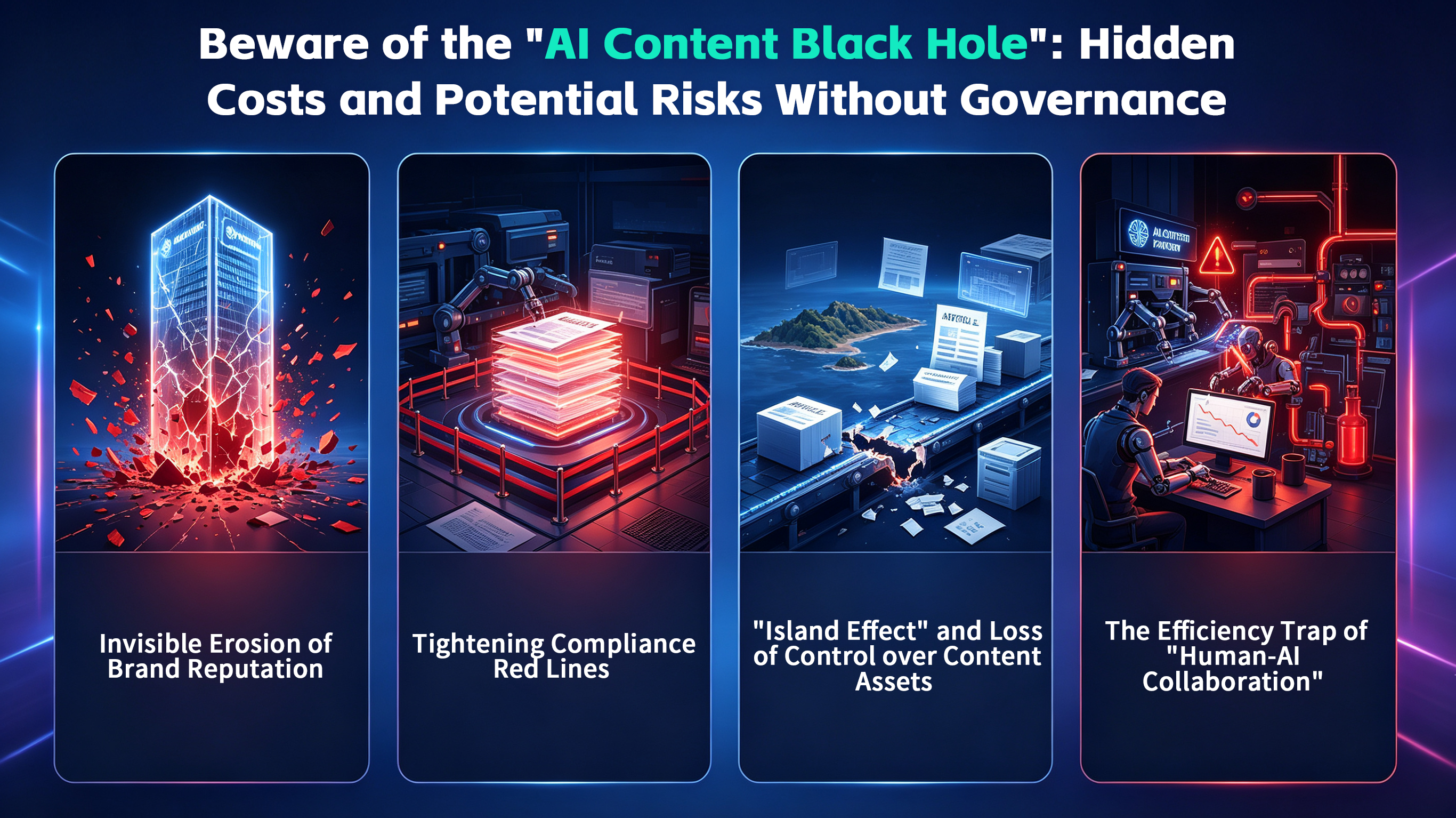
(Image illustrates the warning against the “AI content black hole”)
Solutions: Building an AI-Native Content Supply Chain Centered on Governance
To convert the speed of AI content factories into quality and conversion, enterprises must build an AI-native, governance-centered content supply chain. This entails more than simply adopting AI tools—it requires deeply embedding AI capabilities across all stages of content production, safeguarded by rigorous workflows and governance mechanisms, ensuring the entire content lifecycle—from planning through publishing to optimization—is controllable, efficient, and compliant.
1. Intelligent Topic Selection and Strategic Planning: AI serves as a “strategic advisor,” assisting in analyzing market trends, user needs, and competitor content to generate diverse topic directions. Final strategic decisions still require human professional judgment and brand insights to ensure alignment with enterprise strategic objectives.
2. Content Creation and Brand Verification: AI excels at initial draft generation, multilingual translation [2], and content expansion. Enterprises must establish automated brand verification mechanisms to ensure AI-generated content adheres to brand tone, terminology standards, and legal requirements. Human review remains indispensable to guarantee depth, emotional resonance, and brand consistency.
3. Multi-Tier Approval and Compliance Review: The efficiency of AI content factories must be paired with rigorous approval processes—including AI-assisted preliminary reviews (e.g., content safety detection, OCR text detection) and human expert review. Approval workflows must be configurable, supporting multi-level co-signature, conditional branching, and follow-up reminders to ensure thorough quality and compliance checks before publication, mitigating risks related to copyright, privacy, and sensitive information.
4. Unified Governance and Reuse of Content Assets: Once approved, AI-generated content must be treated as a critical digital asset, uniformly governed within DAM and CMS systems. This includes:
• AI-Powered Smart Tagging and Metadata Management: AI automatically generates multilingual tags and metadata for images, videos, documents, and other assets, enhancing searchability and reuse efficiency. For example, an automotive OEM’s DAM system automatically identifies vehicle models, colors, and scenes, generating standardized multilingual metadata to enable rapid global team retrieval and usage—reducing manual tagging effort.
• Version Control and Permission Management: Ensures traceable asset versions and supports historical version rollback. Teams across regions and roles receive granular access and editing permissions, preventing misuse or abuse and ensuring content asset security and compliance.
• Global Application Acceleration and Collaboration: For multinational enterprises, DAM’s global application acceleration capability is essential. CDN acceleration improves preview, access, and download speeds for assets, enhancing end-user experience; high-quality cross-border networks (e.g., CN2 or 9929) ensure smooth DAM backend operations—including login, search, filtering, upload, editing, AI tagging, approval, metadata maintenance, permission configuration, and statistical queries—for overseas employees. This guarantees efficient global collaboration on a unified platform, minimizing productivity losses caused by network latency.
5. Performance Feedback and Continuous Optimization: Establish a robust content performance measurement mechanism. Leverage analytics—including page views, conversion rates, user behavior, SEO rankings—to continuously refine AI content strategies and generation models, forming a closed loop of “production—governance—publication—feedback—optimization.” Ensure AI investments deliver tangible business growth.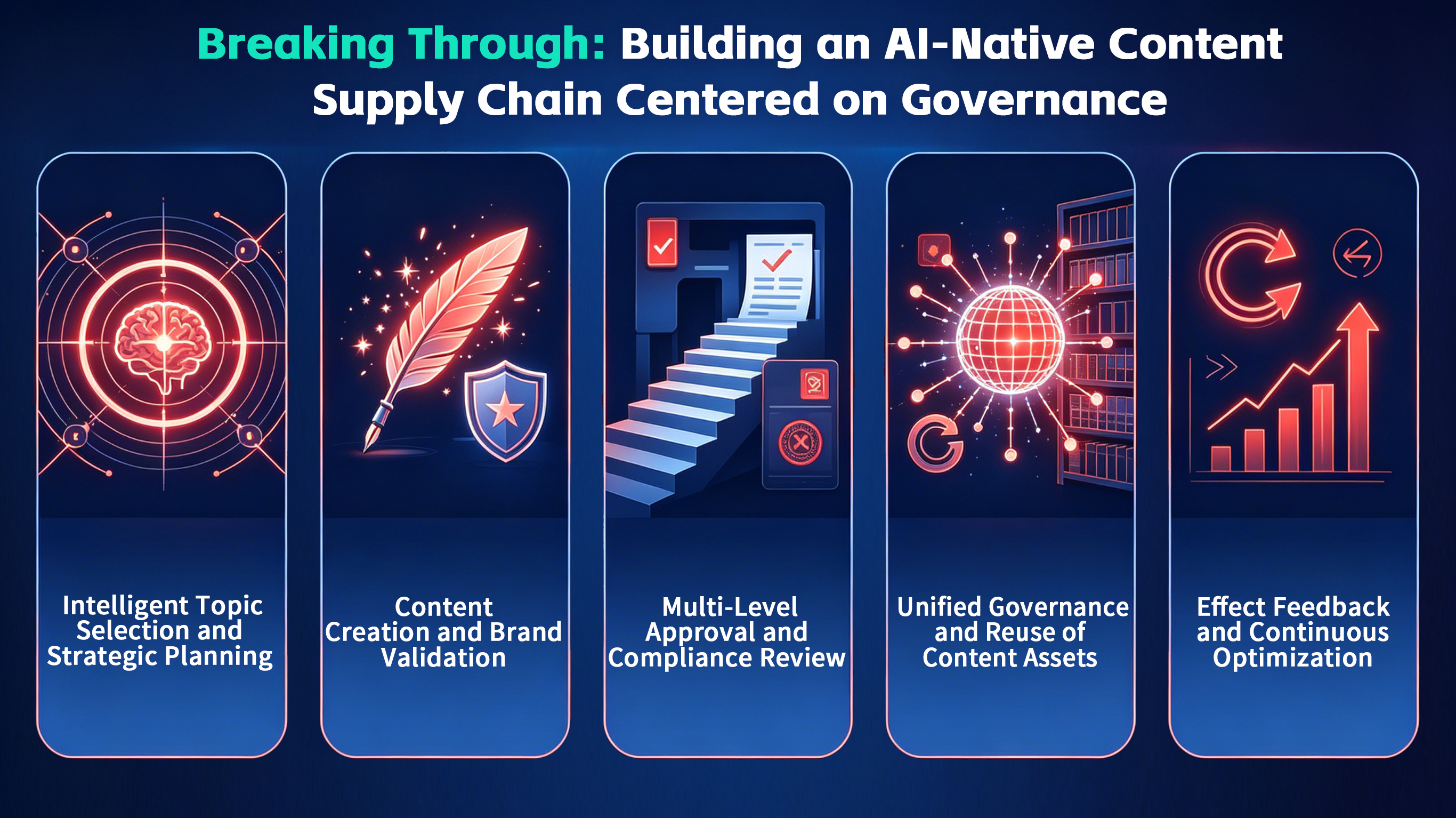
(The image illustrates: Solutions for Enterprise Content Governance)
Implementation Practice: A Blueprint for Enterprise-Grade AI Content Governance
Building an efficient and compliant AI-native content supply chain requires enterprises to undertake systematic planning across strategy, processes, technology, and talent. A practical framework for managers includes: defining AI content strategy and governance objectives; establishing a cross-functional AI content governance committee; designing end-to-end AI content workflows and approval mechanisms; building a unified content and digital asset management platform; and continuously monitoring, evaluating, and optimizing. This framework aims to integrate AI’s speed advantage with robust governance capabilities—better orchestrating AI to drive content quality and conversion.
BMS DXP: The Solution from “AI Uncontrolled” to “Intelligent Orchestration”
DBC BMS DXP addresses governance and conversion challenges in AI content factories. It integrates core modules—including Content Management (Content), Digital Asset Management (DAM), Marketing Automation (MarketEngage), and System Workflow (System)—to build an AI-native content supply chain that enables intelligent content production, granular governance, and high-efficiency conversion. Its key strength lies in providing a unified platform that deeply integrates AI capabilities with enterprise content operations.
| BMS DXP Modules | How They Drive AI Content Quality & Conversion |
| Content (Content Management) | Supports multi-site, multilingual management, visual editing, and flexible content approval workflows—ensuring AI-generated content complies with brand guidelines and regional requirements, while enabling personalization and A/B testing. |
| DAM (Digital Asset Management) | Centrally manages both AI-generated and human-created digital assets through AI-powered smart tagging, multimodal search, version control, and global delivery acceleration—enhancing asset reuse efficiency and global collaboration experience, and ensuring brand asset consistency and compliance. |
| MarketEngage (Marketing Automation) | Seamlessly integrates AI content into lead nurturing, personalized recommendations, and multi-channel distribution—enabling full-funnel automation from insight to conversion, plus comprehensive performance measurement and attribution analysis. |
| System (System Management) | Provides a powerful workflow engine, user/role/permission management, and audit logging—establishing a solid governance foundation for AI content creation, approval, and publishing, ensuring transparent, controllable, and compliant processes. |
For example, the MarketEngage module of BMS DXP can rapidly transform expert interviews into multilingual articles, EDM emails, social media short posts, and FAQs—automatically embedding them into approval workflows and brand verification steps [2]. The DAM module ensures rapid global distribution and efficient management of multimodal assets—whether front-end CDN acceleration for user access or back-end high-quality cross-border networks supporting overseas editorial collaboration—providing solid assurance for content quality and conversion. Through its integrated platform capabilities, BMS DXP combines AI’s efficiency advantages with enterprise-grade governance requirements, helping enterprises maintain competitiveness in complex and dynamic market environments.
Conclusion: From “Speed Illusion” to “Value Realization”
The true value of an AI content factory lies in producing high-quality, convertible, and governable content assets. In 2026, CMOs, digital transformation leaders, and CIOs face the challenge of converting AI’s efficiency gains—through refined content governance and intelligent workflows—into enhanced brand influence and business growth. DragonBravo’s BMS DXP is committed to becoming the ideal partner for enterprises building AI-native content supply chains. Leveraging its integrated platform capabilities, BMS DXP helps enterprises convert AI’s “speed illusion” into a sustainable flywheel of quality and conversion—ultimately achieving comprehensive enterprise value realization. We welcome your inquiries regarding content governance diagnostics or discussions.
Frequently Asked Questions (FAQ)
Q1: How does BMS DXP govern bulk AI-generated content?
BMS DXP employs a four-layer governance framework: First, source tagging—Content module embeds an AIGC tag field, automatically marking content generation method (human/AI-assisted/AI-generated) upon creation; Second, tiered review—approval paths are configured by content type and risk level, with high-risk content requiring legal or brand review; Third, version traceability—records the complete chain from generation tool → prompt → edits → review → publication; Fourth, brand consistency verification—componentized templates + brand asset governance + AI prompts embedded with brand constraints.
Q2: Does AI-generated product description require manual review?
High-risk externally published content (e.g., product specifications, safety instructions, advertising materials) requires full manual review. Low-risk content (e.g., internal documents, email templates) may undergo reduced review intensity. BMS DXP supports automatic routing to different review workflows based on content type; high-risk content must pass through legal or brand review nodes, with review checklists integrated directly into the approval interface.
Q3: How does BMS DXP ensure both production efficiency and brand consistency for multilingual AI content?
BMS DXP’s AI Writing Assistant generates multilingual draft copy based on structured product parameters from PIM; final versions are manually reviewed before publication. A componentized template system ensures consistent operation across all languages within a unified brand framework. Key constraints from brand guidelines are embedded directly into the AI Writing Assistant’s prompt templates—ensuring that regardless of team or AI tool used, all content published on the BMS DXP platform undergoes uniform brand tone verification.
Q4: How does BMS DXP mitigate AI content copyright risks?
Critical brand content should never be 100% AI-generated—retaining human editing and final review establishes “human-AI collaboration.” BMS DXP’s version management clearly logs timelines and responsible parties for AI generation and human edits, providing auditable evidence for copyright ownership. AIGC tags meet platform compliance requirements (e.g., Sohu and Baijiahao mandate labeling of AI-created content).
Q5: How does BMS DXP MarketEngage integrate with AI content?
BMS DXP MarketEngage seamlessly incorporates AI-generated content into lead nurturing, personalized recommendations, and multi-channel distribution. For instance, expert interviews are transformed via AI into multilingual articles, EDM emails, and social media short posts—automatically embedded into approval workflows and brand verification steps. MarketEngage’s analytics capability tracks AI content conversion performance, forming a closed loop: “Production → Governance → Distribution → Feedback.”
Q6: How is ROI of AI content governance measured?
Quantify across three dimensions: Risk mitigation (number of customer complaints or platform penalties avoided due to inaccurate AI content); Efficiency gain (labor hours saved through AI-assisted generation + automated approval workflows); Content quality (user engagement and conversion rates of AI-published content vs. benchmarks). BMS DXP’s System module provides audit logs and operational statistics to quantify actual output from governance investments.
References
[1] Adobe, 2026 AI and Digital Trends Report
[2] Content Marketing Institute, B2B Content and Marketing Trends: Insights for 2026
Internal project functional documentation (de-identified, no public link)
(The image illustrates the breakthrough approach to enterprise content governance.)


Want to know more about our products?
With years serving Fortune 500 clients, we offer flexible solutions and integrated implementation.
