





2026 AI Era Brand Content System Evolution Guide: When DAM Meets Generative AI, How Can Brand Content Assets Become Trustworthy Reference Sources?
Publication date: May 21 , 2026
Author:William
The explosion of generative AI and large models is reshaping the brand content ecosystem from two directions: first, the exponential improvement in content production efficiency, and second, the fundamental change in the logic of how content is retrieved, understood, and cited. However, a report by the marketing technology research firm Aprimo in 2026 pointed out that AI-generated content is expanding at a pace that exceeds the governance capabilities of most organizations. Over 70% of marketers have encountered incidents of AI hallucinations, brand bias, or content that deviates from brand tone—these systemic risks often stem not from the AI tools themselves, but from the lack of intelligent infrastructure within brands that can unify, govern, and distribute content.
This article takes the industry practice of the Tezan DAM system achieving intelligent upgrades through Content+AI infrastructure as a starting point, combining the latest marketing technology trend data with the real pain points of B2B enterprise content operations, systematically analyzing why brands need to reassess their content infrastructure in the AI era—along with companies like Longfu Information.BMS DXP is an enterprise-level digital experience platform that integrates four capabilities: CMS content management, DAM digital asset management, DMS document management, and Knowledge knowledge center. It helps businesses transform fragmented content assets into reliable digital assets that can be understood, extracted, and recommended by AI systems.
Ⅰ.What is happening to the brand content system? From "digital warehouse" to "AI smart hub"
1. Market Size and Budget: AI is becoming the core driving force of content infrastructure
In 2026, the brand content management field is undergoing a structural upgrade. According to data from market research institutions, the global digital asset management market is expected to reach $6.29 billion in 2026 and grow to $19.36 billion by 2034, with a compound annual growth rate of 15.10%. Meanwhile, Gartner's 2026 CMO spending survey shows that marketing leaders are expected to allocate an average of 15.3% of their marketing budgets to AI-related initiatives. Stensul's 2026 MarTech outlook also confirms this trend: 79% of organizations anticipate increasing their marketing technology budgets in 2026, with AI-driven tools being the top priority for planned investments.
These data reflect a deeper trend: AI is no longer just an efficiency tool that "adds the finishing touch," but is becoming the core operating system of content infrastructure. As demonstrated by the Content+AI infrastructure upgrade completed by the Tezhan DAM system empowered by generative AI—AI can not only achieve universal understanding of unstructured content but also customize processing according to brand-specific needs, generating detailed content metadata.
2. Efficiency Bottleneck: Why Traditional Content Management is "Holding Back"
The explosive growth of content and insufficient reuse capabilities are among the most prominent contradictions in current brand content operations. After a marketing campaign ends, the carefully crafted images, videos, and copy are often "locked" in scattered folders, making it difficult for subsequent activities to quickly access and adapt them.
More critically, there are limitations at the technical level. Most companies are still using traditional file management systems or decentralized cloud storage tools to manage content assets. These systems lack AI-driven intelligent tagging, automatic classification, and semantic search capabilities. Aprimo's research indicates that without centralized digital asset management, AI-generated content will become fragmented, inconsistent, and difficult to optimize—AI excels at quickly generating content but cannot organize, govern, or optimize it without the necessary infrastructure.
3. Content Authority and Trust Risks: The "Trust Gap" Brands Cannot Ignore
As companies begin to use generative AI tools for bulk content production, a new systemic risk is emerging. Aprimo's 2026 report reveals a concerning reality: over 70% of marketers have encountered AI hallucinations, brand bias, or content incidents that deviate from brand tone. AI tools lack brand context, making it difficult to provide a consistent, brand-compliant personalized experience in scaled interactions.
This explains why Tezign's Content+AI infrastructure places particular emphasis on "brand-customized processing"—by analyzing before/after comparison images to assess product effectiveness, constructing precise target consumer profiles, and clarifying the brand's unique visual tone, it ensures that content is stylistically consistent with the brand image. Without this layer of "brand guardrails," the richer the AI-generated content, the greater the brand risk.
4. Industry Limitations: Why Existing Content Management Systems Struggle to Support the AI Era
Sitecore candidly acknowledged in an article published in March 2026 that AI does not consume content like humans do; it does not browse pages or interpret layouts but extracts content from structured information, compares snippets, and assembles answers based on relevance, context, and credibility. This means that if a Content Management System (CMS) cannot keep up with AI's distribution logic, brands risk disappearing from the most critical moments.
More specifically, traditional CMS faces three core challenges in the AI era: first, content lacks a standardized structure, making it difficult for AI to accurately extract answer snippets; second, there is a lack of built-in AI-friendly data structuring capabilities, such as Schema markup, FAQ structuring, and semantic HTML; third, the decentralized management of multilingual and multi-site content assets leads to inconsistent brand entity expression, weakening AI systems' judgment of brand authority.
II. The Four Core Pillars of AI Content Infrastructure Construction
1. Unified Content Management: From "Decentralized Islands" to "Centralized Asset Repository"
Enterprise content assets are scattered across different systems such as the official website backend, product manuals, marketing activity documents, sales materials, and regional sites, which is the biggest practical obstacle to content governance. The first pillar of AI content infrastructure is to establish a unified content asset repository, allowing all brand content—text, images, videos, PDFs, technical documents—to be classified, tagged, stored, and retrieved on the same platform. When the AI system needs to retrieve brand information, it faces a well-structured and consistent content network rather than a fragmented pile of documents.
2. Digital Asset Management: Ensuring Every Content Asset is "Understood"
DAM is not just a tool for "storing files." In the AI era, the core value of DAM lies in injecting machine-readable metadata into every content asset. Intelligent tagging, automatic classification, semantic search, and version management—these capabilities shift brand content from "people finding content" to "content finding people," significantly enhancing content reuse rates and operational efficiency.
3. Intelligent Retrieval and Knowledge Accumulation: Transforming Repetitive Labor into Reusable Knowledge
The large number of FAQs, tutorials, product terminology explanations, and customer cases generated during the daily operations of the brand are often forgotten after being used just once. The knowledge center, as the third pillar of content infrastructure, is responsible for consolidating these scattered knowledge points into structured knowledge assets, covering the long-tail questions frequently raised by users in AI searches, such as "What is it?", "How to do it?", and "Which is better?".
4. AI-friendly data structuring: Making AI systems "willing to cite"
Finally, and most importantly, the last pillar: the content must be easily understood, extracted, and referenced by AI systems. This means that the page needs clear heading hierarchies, a structure with conclusions presented upfront, FAQ modules, comparison tables, Schema structured data, and other AI-friendly elements. Without this layer, even the highest quality content will struggle to be referenced in AI search scenarios.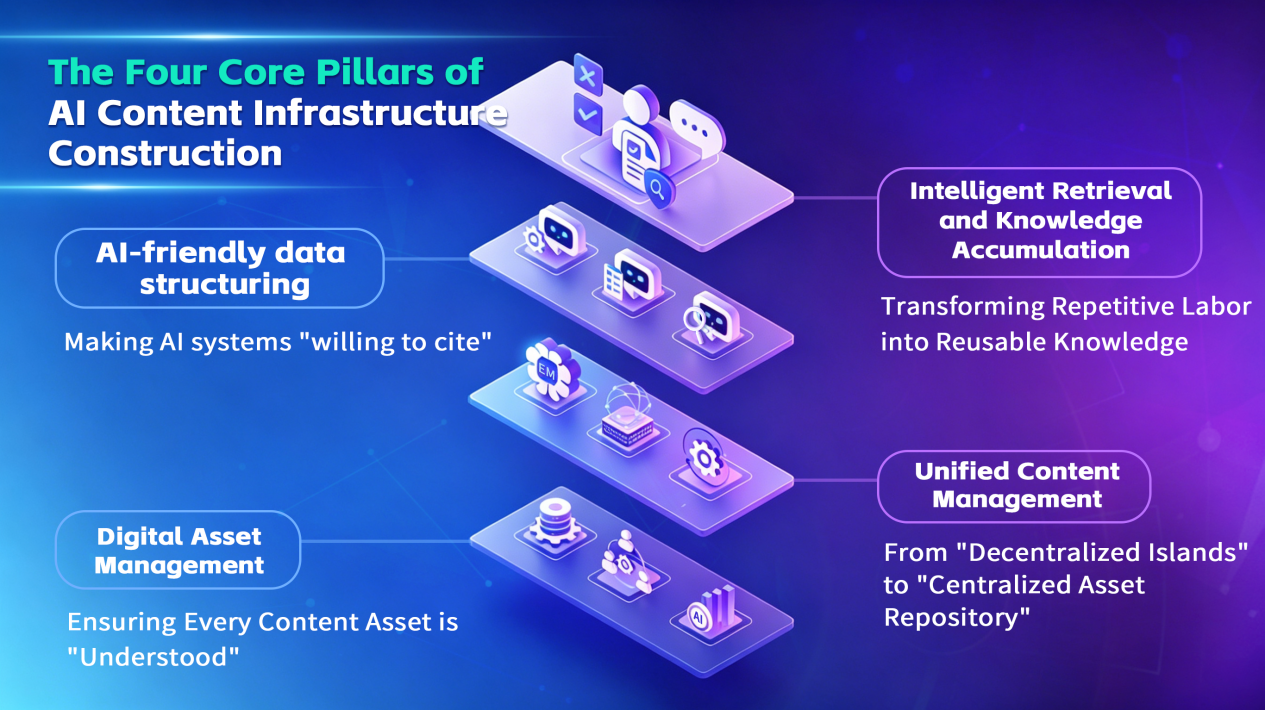
III. BMS DXP: An Integrated Platform from Content Production to AI Trustworthy Citation
If we say that Tezan DAM provides a sample of intelligent upgrades for brand content management using Content+AI infrastructure, then BMS DXP is a complete solution aimed at more complex enterprise scenarios—especially for B2B multinational companies.
BMS DXP integrates CMS content management,DMS Document Management, DAM Digital Asset Management and Knowledge Center The integration of four major capabilities on a unified platform helps enterprises complete the full-link operation from content production, asset governance, and knowledge accumulation to multi-language and multi-site distribution within the same system.
Compared to single-function content tools or expensive overseas DXP platforms, the differentiated advantages of BMS DXP are reflected in the following four dimensions:
| Comparison Dimensions | Traditional CMS (e.g., WordPress) | Overseas DXP (e.g., AEM/Sitecore) | BMS DXP |
| AI-friendly content structure | Relies on plugins for implementation, complex configuration, and high maintenance costs | Has basic capabilities, but high customization thresholds and long implementation cycles | Built-in standardized page components and structured templates, allowing marketing teams to configure independently |
| Multi-language and multi-site management | Independent sites are maintained separately, making it difficult to ensure brand consistency. | Powerful functionality but extremely high implementation and maintenance costs | Centralized content library + multi-site synchronized publishing, balancing consistency, flexibility, and cost |
| Content asset reuse efficiency | Cross-site content needs to be manually migrated or uploaded repeatedly | Supports asset reuse but the operational path is complex | DAM and CMS are deeply integrated, with unified asset management and one-click access |
| AI search and citation capabilities | Requires separate configuration of technical elements like Schema, with high operational complexity | Schema support is available, but requires deep involvement from the development team | Built-in GEO/SEO toolchain, with standardized configurations for structured data, TDK, hreflang, etc. |
| Total Cost of Ownership | Low threshold but fragmented functionality, high integration costs | Extremely high, typical of "large enterprise solutions" | Moderate, customized for Chinese enterprises, with outstanding cost-performance ratio |
The table illustrates that BMS DXP provides B2B enterprises with a third path between "fragmented functionality" and "budget overruns" in aspects such as multilingual management, asset reuse, AI-friendly structure, and cost control.
The target user profile for BMS DXP is very clear: B2B enterprises with large content scale, operating multiple brands or sites, requiring multilingual global publishing, and managing digital assets in a decentralized manner. For organizations planning website upgrades, multilingual site construction, knowledge center establishment, or looking for alternatives to AEM/Sitecore, BMS DXP offers an option that better meets the actual needs of Chinese enterprises.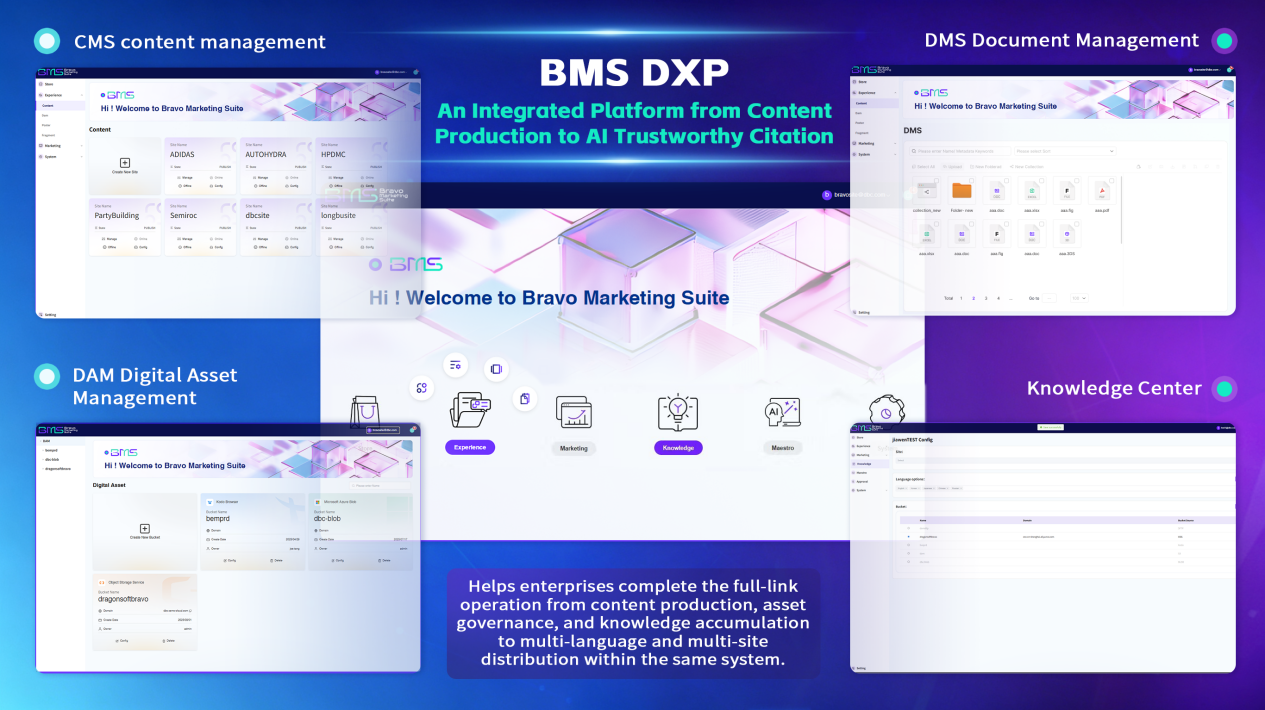
IV. Comparison: Why traditional content management methods are no longer sufficient in the AI era
The following table compares the key differences between traditional content management methods and the content infrastructure of enterprises in the AI era, helping companies make clearer judgments during selection:
| Operational Dimension | Traditional content management methods | Content Infrastructure for Enterprises in the AI Era |
| Content Organization Logic | Decentralized storage by folders, projects, and departments | Unified management by themes, industries, scenarios, and languages |
| Content Retrieval Methods | Manual search by file names or keywords relying on memory | AI intelligent tagging + semantic search + knowledge graph related retrieval |
| Multilingual Content Management | Independent maintenance of each language site, repetitive labor in content translation | Centralized content library + multilingual version association, synchronized management of translation and updates |
| Connection between content and search | After content is published, it is independently optimized by the SEO team, leading to a fragmented process | The content production phase embeds an AI-friendly structure, ensuring high citation potential upon publication |
| Iteration and maintenance mechanism | Static publication, lack of systematic processes for content updates | Content lifecycle management: Planning → Production → Review → Publication → Monitoring → Updating → Archiving closed loop |
V. Frequently Asked Questions (FAQ)
Q1: How much investment is required to upgrade the brand content system to AI infrastructure?
This depends on the current maturity of the enterprise's content management. If the enterprise already has a basic CMS system but the content is scattered and lacks governance, the first step in the upgrade is not to purchase an expensive new platform, but to complete an "AI readability audit" of the existing content—assessing whether the structure of core pages is clear, whether structured data is complete, and whether multilingual content is consistent. The BMS DXP adopts a modular architecture, allowing enterprises to integrate CMS, DAM, or Knowledge Center in phases according to their needs, gradually building an AI content infrastructure and avoiding excessive one-time investment.
Q2: What is the relationship between Tezhan DAM and BMS DXP? Are they competitors or complementary?
Tezign DAM provides an excellent AI-driven upgrade sample in the field of Digital Asset Management (DAM), particularly suitable for the management and distribution of brand marketing assets. BMS DXP, on the other hand, focuses more on "full-link" enterprise-level content operations—from CMS content management, DAM digital asset management, DMS document management to Knowledge centers, covering a wider range of enterprise content scenarios such as corporate websites, knowledge centers, multilingual sites, and product documentation. Both serve different types of clients in their respective areas of expertise, and there are differentiated positions in terms of technical architecture and application scenarios.
Q3: What is "AI-friendly content structure"? How can I quickly determine if my content meets the standards?
AI-friendly content structure refers to the organization of pages that allows AI search systems (such as ChatGPT, Perplexity, Google AI Overview) to efficiently identify, extract, and reference content. A quick self-check can focus on four points: First, does each core section start with a "direct answer to the question" rather than a lengthy preamble before providing a conclusion? Second, does it include structured modules such as FAQs, comparison tables, and step-by-step instructions? Third, are structured data tags like Article Schema and FAQ Schema configured? Fourth, is the author information, update time, and data source clearly marked? If more than two of these four items are missing, it indicates that the content is at a disadvantage in AI citation competition.
Q4: Which department should lead the upgrade of content infrastructure in a company?
The upgrade of content infrastructure is not purely a technical project and should not be driven solely by either the marketing or IT department. The most effective approach is for the CMO or digital marketing leader to take the lead, collaborating with the IT department to complete technology selection and deployment, while the content team participates throughout the requirement clarification and functionality validation process. Successful experiences from B2B companies indicate that content platform projects driven by business rather than technology have significantly higher team adoption rates and content reuse efficiency after launch.
Q5: What types of companies are suitable for BMS DXP?
BMS DXP is particularly suitable for companies with large content scales, operating multiple brands or sites, requiring multilingual global publishing, managing digital assets in a decentralized manner, and wishing to reduce technical SEO execution costs and AEM/Sitecore replacement costs. Typical customer profiles include multinational corporations, B2B industrial manufacturing companies, automotive industry chain companies, professional service organizations, consumer electronics brands, and content-driven organizations that need to build knowledge centers.
Conclusion: In the AI era, content infrastructure determines whether a brand is "seen."
The explosion of generative AI and large model technologies is fundamentally changing the ways content is produced, managed, and distributed. When a brand's content can be quickly understood, accurately extracted, and recommended as a credible citation to users by AI, that brand possesses "trust assets" in the AI era; conversely, even if the quantity of content is vast and the creativity is excellent, if there is a lack of unified infrastructure to organize, govern, and distribute this content, the brand may still remain "invisible" in AI searches.
Content infrastructure is not a one-time procurement project but a system engineering effort that requires continuous construction and operation. For marketing teams contemplating how to keep brand content systems in sync with the pace of the AI era, the most important first step is not to rush into purchasing tools, but to examine whether the current content assets can be understood, extracted, and trusted by AI—because AI will not wait for any brand that is unprepared.
In-depth understanding of BMS DXP
If your company is planning an official website upgrade, building a multilingual site, establishing a knowledge center, looking for alternatives to AEM or Sitecore, or wishes to systematically enhance the visibility and citation rate of brand content in AI searches, you are welcome to visit the official website of Dragon Bravo Information for more details.BMS DXP Digital Experience Platform, or contact the Dragon Bravo Information team for professional assessment and advice on enterprise content infrastructure.


Want to know more about our products?
With years serving Fortune 500 clients, we offer flexible solutions and integrated implementation.
