





Stop building Agents in-house, the orchestration layer is the real solution
Published : 2026-10-27
Author: William
Introduction
Here is the judgment: Once the issues at the entrance are resolved, enterprises will immediately hit a second wall—the speed wall. The most popular yet incorrect solution after hitting this wall is to develop a general-purpose Agent in-house. The correct solution lies in another term: Orchestration.
The first article discussed rewriting reception rules: when machine guests arrive, your content must be structured, traceable, and up-to-date. However, once the front-end tasks are solidified, a sharper contradiction emerges. Machine guests do not sleep, do not queue, and do not follow human rhythms for requests. A client’s procurement Agent sends a structured request: within seventy-two hours, provide selection parameters for forty models, installation drawings, maintenance manuals in three languages, and the certification status of each model in the target country.
Fulfilling such a request with manual labor takes two weeks at best. Using traditional cross-departmental collaboration processes—first emailing, then creating group chats, then waiting for scheduling—can easily take a month. The window given by the counterpart is seventy-two hours, and it will not wait for you. It simultaneously sends the same request to three suppliers; whoever delivers complete and clean data first advances to the next round.
Thus, all enterprises ask the same question: Who can handle these tasks? There are two directions for the answer, one wrong and one right. The wrong direction is called “building a smarter robot,” while the right direction is called “connecting existing systems into a pipeline.” This article breaks down these two directions clearly.
I. Why “Developing an Agent In-House” Is the Wrong Direction
First, acknowledge the appeal of the wrong answer. It is indeed tempting: stories about general-purpose Agents are hyped in the market, internal technical teams always want to achieve great things, and the four characters “AI Strategy” carry inherent prestige during budget approval meetings. When these three forces converge, an in-house Agent project gets approved.
Then, it likely fails. This is not pessimism; there are numbers behind it. Gartner predicts that by 2027, forty percent of Agentic AI projects will be canceled. A 2025 MIT study based on fifty-two executive interviews, one hundred fifty-three surveys, and three hundred public deployment cases is even more direct: ninety-five percent of enterprise generative AI pilots have not produced measurable return on investment. Note the criteria of this study; failure does not mean the model cannot run, but rather that it has “not brought sustained productivity improvements and verifiable profit and loss impacts.” In other words, a successful demo does not count as success; clear accounting does.
Another painful finding from the same MIT study is that the highest ROI for AI investment comes from back-office process automation, yet most enterprises put the bulk of their budget into sales and marketing. Money is spent in the hardest places to see results.
The reasons for failure are highly consistent: the model is smart enough, the demo is impressive, but it collapses in production due to engineering aspects like tool orchestration, environment adaptation, long-term consistency, and error recovery.
These engineering aspects are precisely where platforms excel and enterprises struggle. The competitiveness of general-purpose Agents consists of three layers: model reasoning, tool orchestration engineering, and data feedback flywheels. All three layers are heavy assets. Platforms iterate weekly, while enterprises accept quarterly; they are not on the same time scale. Developing a general-purpose Agent in-house is like sending an amateur team to compete in a professional league; before the match starts, the result is already written.
More critically, there is a positioning error: what enterprises truly lack has never been “general intelligence.” General intelligence will become stronger and cheaper on platforms; this is a trend, and resisting it is meaningless. What enterprises truly lack is the layer of “hands” that connects their own system’s data, rules, and processes to intelligence. Hands must grow on one’s own body; brains can be borrowed. Saving money on borrowing brains and spending it on growing hands is the configuration with positive ROI.
II. Orchestration: The Native Solution for DXP Platforms
The right direction has an accurate term in the industry: Orchestration. Orchestration does not produce intelligence; it schedules intelligence. It does not replace systems; it connects them. And DXP platforms have a natural advantage in orchestration: they sit in the middle of all content.
CMS manages publishing, PIM manages product facts, DAM manages assets, e-commerce engines manage transactions, and knowledge centers manage Q&A. In the past, collaboration between these modules relied on humans: Marketing exports parameters from PIM, sends them to Design to create pages, Design finishes and hands off to CMS for publishing, and after publishing, notifies E-commerce to sync. Every handoff in this chain is a wait, a drift in standards, and a “you didn’t send me the latest version.”
What the orchestration layer does is change the handoffs in this chain from humans to scheduling. It understands natural language task descriptions and breaks them down into a series of cross-module actions: which facts to retrieve, which assets to use, which approvals to go through, which sites to publish to, and which channels to sync. Humans transform from porters to approvers.
In DragonBravo BMS DXP, the role is played by the Maestro agent platform. Its positioning deserves to be nailed down in one sentence: Maestro does not build a general brain; it builds orchestration hands. Brains can be borrowed; the capabilities of general Agents can directly call upon platform resources. Hands must grow on one’s own body because they need to grip the enterprise’s own modules, its own data, and its own rules.
Returning to the initial seventy-two-hour request, here is how the orchestration layer runs: The request comes in, Maestro parses the list of involved models, retrieves parameters and certification statuses from PIM, pulls corresponding versions of drawings and manuals from BMS-DAM , matches multilingual versions according to target languages, generates task tickets for missing parts and pushes them to translation workflows, packages everything into a structured delivery package once complete, and returns it to the client Agent. Human intervention occurs only at two nodes: legal review of certification statuses and final sign-off of the delivery package. Sixty-one hours later, everything is delivered before the window closes.
This is the distinction between orchestration and in-house development. In-house development builds a robot that knows everything from scratch; orchestration connects modules that already have strengths into a running line. The former fights against platform iteration speed; the latter only needs to manage its own household affairs.
III. Content Supply Chain: From Workshop to Assembly Line
Viewing orchestration in a larger context, it actually fills a piece of the puzzle that has been missing for twenty years: the content supply chain.
Everyone accepts that manufacturing has a supply chain. A screw going from warehousing to the assembly line has ledgers, batches, quality checks, and traceability. But what about content? For a product image going from shooting to online publication, who handled it, how many versions were revised, which parameters were used, and who approved it? Most companies cannot answer. The content industry has operated for twenty years, essentially remaining a workshop: skills reside in people, processes reside in chat groups, and ledgers reside in shared drives maintained by no one.
The workshop model was tolerable in the era of low volume, but not in the AI era. As mentioned earlier, industry forecasts suggest that by 2028, eighty percent of content teams will use AI tools, reducing the production cost per asset by approximately forty-five percent. Volume is skyrocketing, yet governance still relies on manpower. The Widen survey figure mentioned in the first article applies again here: forty-six percent of enterprises recreate existing assets due to lack of management processes. The greater the volume, the more shocking the waste caused by this ratio.
The AI era has sentenced the workshop model to death for a simple reason: workshop capacity cannot keep up with the appetite of machine guests. Agent retrieval is batch, concurrent, and around-the-clock; workshop delivery is serial, single-threaded, and limited to working hours. When your customers become machines, if your production method remains stuck in handcrafted workshops, the gap is not just slightly lower efficiency; it is fundamentally unable to cope.
What does content production look like on an assembly line? Raw material warehousing: facts enter PIM, assets enter DAM. Process flow: translation, compliance checks, localization adaptation. Quality inspection: rule validation, version verification. Factory exit: multi-site publishing, multi-channel synchronization. After-sales traceability: citation records, version recall. Every process has inputs, outputs, responsible persons, and timestamps. Content finally has batch numbers.
Several native AI capabilities of DragonBravo BMS Digital Experience Platform run on this assembly line. They are worth highlighting individually because they determine the upper limit of the assembly line’s speed.
AI Tagging. At the moment assets are warehoused, the system identifies content and generates tags, bulk-backfilling tags for historical stock. Without this step, the first process of the assembly line is blocked: raw materials cannot be found, causing idle spinning downstream. Many enterprises’ asset libraries are not empty; rather, items are undescribed. Filenames like “Final Version-2-Really” are unreadable by both machines and humans. Tagging means attaching machine-readable labels to every raw material.
AI Translation plus Multilingual. From asset publication to page rendering, multilingual support is not an after-the-fact translation and paste, but flows as a content attribute with versions. Manuals in six languages are not six files, but six language facets of one content item. Changing one place synchronously updates all six language facets, ensuring standards never drift.
AI compliance detection. Pre-publication assets are automatically compared against the regulations and cultural customs of target markets, checking for legal red lines as well as cultural minefields, such as color taboos in certain markets or sensitivities regarding portrait displays. This is a quality inspector on the assembly line that does not sleep, take leave, or make exceptions based on personal relationships. It cannot replace the final judgment of local legal counsel, but it can intercept obvious risks before publication rather than after marketing budgets have been burned.
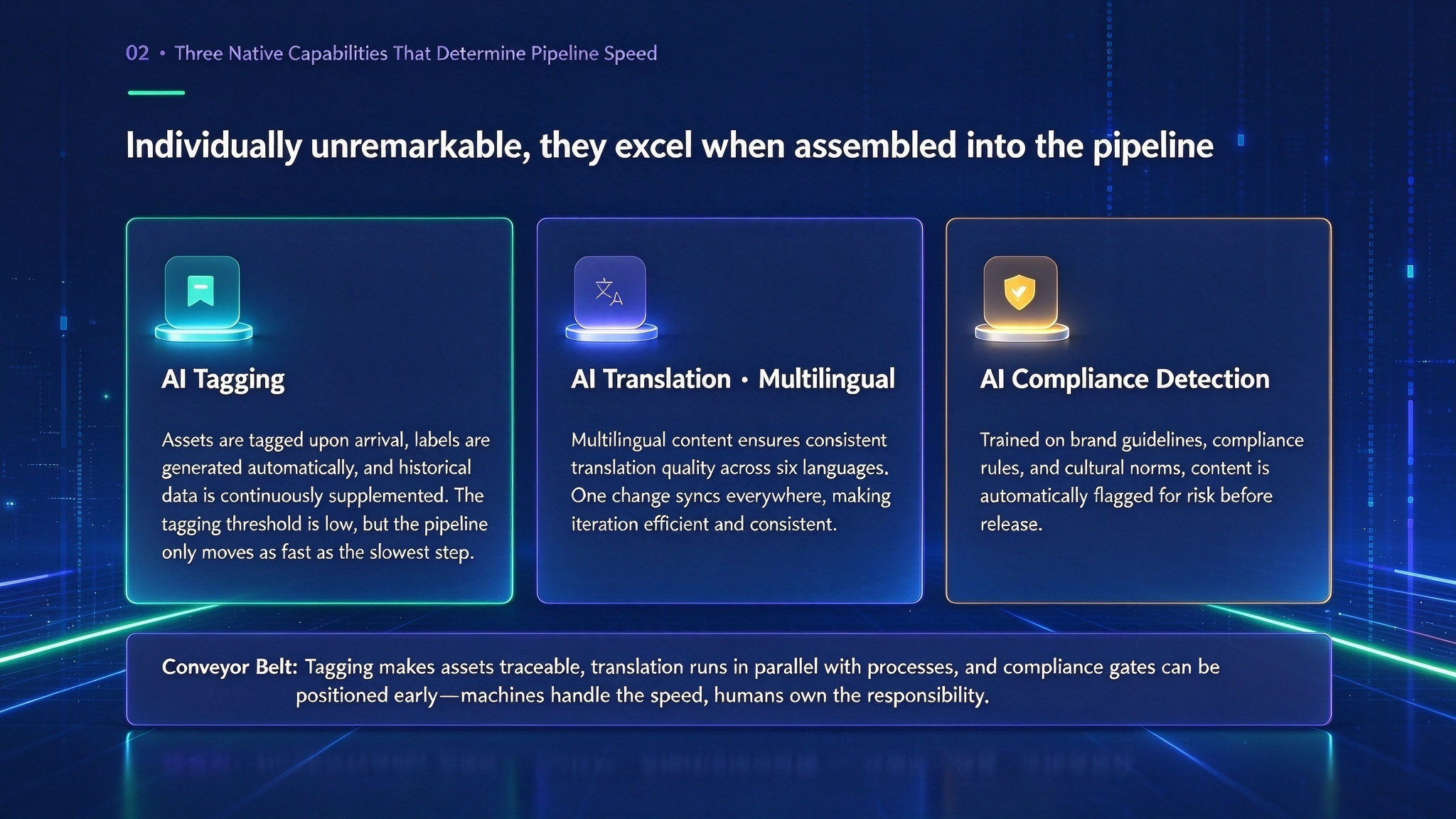
(The image displays three native capabilities of the Agent)
Viewed individually, these three capabilities are not stunning; what is stunning is that they are integrated into the assembly line. Tagging makes raw materials searchable, translation enables parallel processing steps, and compliance allows quality inspection to be front-loaded. The difference between a workshop and an assembly line has never been about any single machine, but whether there are conveyor belts between the machines. The orchestration layer is that conveyor belt.
Incidentally, an observation at the role level illustrates the essence of the assembly line. After AI translation went live, the translation team was the first to panic, but the actual change was role migration: AI translates eighty percent of sentences, while humans retreat to the critical twenty percent positions—local terminology usage, contractual wording nuances, and handling cultural sensitivities. The faster machines translate, the more valuable final review becomes, because the cost of errors is signed under human names. This is a microcosm of human-machine division of labor in the assembly line era: machines take over speed, humans take over responsibility. Speed can be replicated infinitely; responsibility cannot.
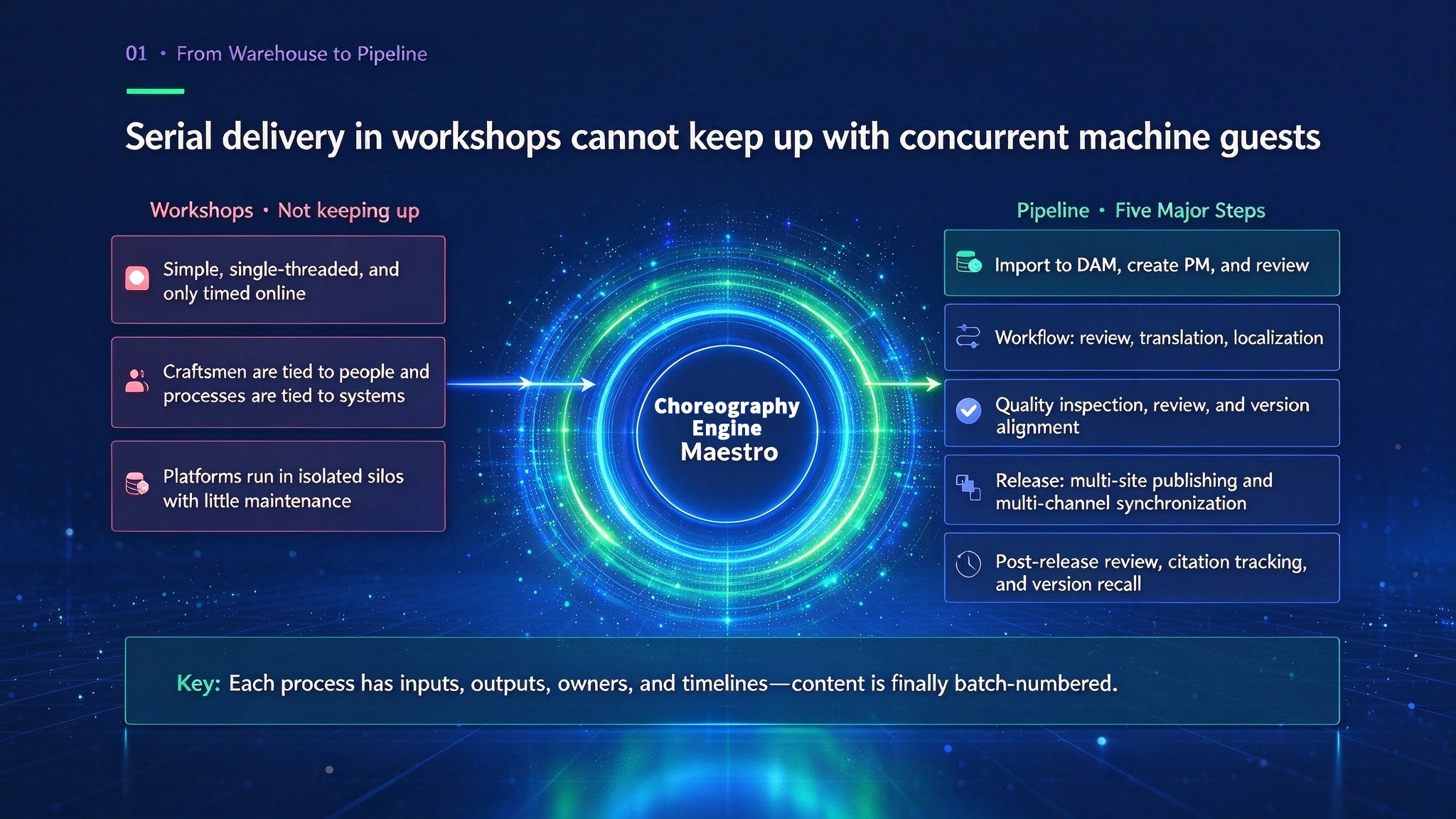
(The image displays the orchestration engine Maestro)
IV. Assembly Line Shipping Documents: Delivery Packages and Packing Lists
Once the assembly line starts running, what ships out changes too: previously, clients received "a pile of files," now they receive "a package," complete with accompanying documents.
The documents list five items. Fact List: which parameters are included in this package, which records from the PIM they originate from, and the final approval time. Asset List: which images, which manuals, version numbers, and licensing scope. Language List: whether all language versions are complete, which ones are missing, and why. Compliance List: detection results for each target market, what passed, what was blocked, and where blocked items went. Sign-off Record: which two nodes had signatures, and who signed them.
The value of these documents is most directly reflected in the counterpart's research-oriented Agent. Since their Agent needs to verify anyway, rather than letting it discover three questions itself and send follow-up emails, it is better to provide all evidence at once. Fewer follow-ups lead to higher first-pass rates, further amplifying the advantage in response speed. This is not just icing on the cake: Gartner data shows that B2B buyers spend only 17% of their procurement time meeting with suppliers, and when comparing multiple vendors, only 5% to 6% of that time is allocated to a single supplier's salesperson. Buyers do not have time to listen to your explanations; your delivery package must speak for itself. When a competitor's Agent compares two suppliers, the one that arrives first with complete evidence naturally gains three points of impression.
These documents also have an external negotiation byproduct: they translate "we are very professional" into "here is the evidence." In past collaborations, the biggest disputes were often about "your materials are incomplete," leading to conflicting claims; now, pointing to the documents settles completeness in one glance across five columns. Once production processes have batches and ledgers, deliverables naturally come with birth certificates. Past deliveries relied on character; current deliveries rely on documents. Character gets tired; documents do not.
V. Calculating Three Accounts, Then Pouring Two Buckets of Cold Water
The value of the orchestration layer ultimately lands on the balance sheet. Three accounts are the most tangible.
First account: Response time. Average response times for client Agent requests, revision needs from overseas branches, and asset retrieval by channel partners drop from days to hours. Orders requiring completion within seventy-two hours shift from "impossible" to "routine."
Second account: Rework rate. Rework caused by caliber drift was previously the largest hidden cost for content teams: page parameters inconsistent with manuals, differing descriptions between Chinese and German sites, e-commerce pages using expired images. The assembly line unifies fact sources, attaches versions to assets, and routes publishing through a single gate, significantly reducing rework. What is saved is not money, but trust; the number of cross-validation mismatches encountered by the counterpart's research-oriented Agent approaches zero.
Third account: Human positioning. This account is the most easily misinterpreted. After launching the orchestration layer, content teams usually retain the same headcount, but everyone's work changes: from moving and stitching together, to defining rules, making judgments, and reviewing sign-offs. Previously, eighty percent of time was spent transferring files; now, that eighty percent is returned to judgment. Humans did not disappear; they moved up.
Combined, these three accounts point to the true value of the orchestration layer: it does not replace humans; it replaces waiting between humans. Waiting is the most expensive thing in an organization because it does not appear on any invoice, only in the customer's remark, "Why are you so slow?"
Cold water must also be poured, two buckets.
First bucket: Orchestration is not universal glue; if rules are not in the database, they are landmines. A typical failure mode looks like this: someone assigns a task to the orchestration layer, "Sync spring promotion assets to all sites." The orchestration layer complies, but assets for two sites have not yet passed local legal compliance review and should not be published according to regulations. However, that rule was written in legal emails, not in the system's rule base. The orchestration layer is unaware of the email's existence; it only knows the asset status is "Approved." The result is an emergency takedown of one site, a customer complaint, and an internal retrospective. The conclusion of the retrospective does not blame the orchestration layer, but the failure to enter rules into the system. Hence, an iron law emerges: Any constraint not written into the system effectively does not exist. Rules in people's heads, agreements in emails, and verbal consensus in chat groups are all invisible landmines in the orchestration era. The orchestration layer will not violate rules; it will strictly execute "the rules it knows," and what it does not know is what no one manages.
Second bucket: The upper limit of the orchestration layer is determined by the lower limit of module quality. If facts in the PIM are dirty, ledgers in the DAM are incomplete, and structures in the CMS are chaotic, smooth orchestration merely delivers chaos faster. The three standards mentioned in the first part—fact outbound control, birth certificates, and visible expiration dates—are the foundation of the orchestration layer. Without a solid foundation, the orchestration layer is just a slightly faster porter. Therefore, before launching orchestration, enterprises must do hard work: dig out constraints scattered throughout the organization one by one and write them into the system. This hard work has no shortcuts and cannot be outsourced, because it excavates organizational memory.
VI. Boundaries: The Dispatcher Is Not the Boss
In the final section, we nail down the boundaries. This is the most important takeaway for buyers.
Today's orchestration layer has clear capability boundaries: it excels at orchestrating tasks with clear rules and complete chains. Long-chain cross-module tasks run smoothly; tasks involving ambiguous judgment, multi-party gamesmanship, or organizational politics cannot and should not be handled by it. Letting the orchestration layer act as the decision-making layer is the most common failure mode in this wave of Agent implementation: elevating a tool to boss status, then losing all organizational trust in it over a complex task it inevitably botches.
There is another type of work that the orchestration layer cannot handle today and may not necessarily need to handle tomorrow: creative judgment. Choosing which image serves as the main visual, whether the tone of copy is correct, or whether a case study should be shared externally—these are issues of taste and stance, not process. The assembly line can take away eighty percent of the manual labor, but the final twenty percent of judgment must remain with humans. Enterprises that hand over this last twenty percent will pay back the saved costs double on their brand reputation. The mature approach is to keep a "human gate": every delivery package processed by the machine must be fully reviewed by a human before sign-off. This review is not about content, but about responsibility.
DBC's roadmap for Maestro is equally worth viewing through the lens of boundaries. Its next step is not a "smarter brain," but "longer hands": connecting to more external systems, extending the boundary of orchestration from within the DXP to enterprise customer systems, channel systems, and supply chain systems. It should be noted that cross-system orchestration is currently in an early investment phase; this is the vendor's claim, lacking third-party verified benchmarks. Extending reach by an inch adds a fraction of value; inflating intelligence by an inch increases risk by ten feet.
Three practical lessons for enterprises about to implement an orchestration layer. First, task descriptions should be written like contracts, not wishes. "Sync promotional assets" is a wish; "Sync promotional assets to sites that have passed compliance review, excluding the two sites not yet approved by Legal" is a contract. The orchestration layer understands wishes, but executing them leads to failures. Second, leave a human gate in every pipeline—not for efficiency, but to establish accountability. Third, before going live, ask one question: If this chain had no machines, could humans run it? If humans can’t run it, machines won’t either; they will only increase the speed of failure tenfold.
VII. Summary: From Warehouse to Pipeline
Connecting the judgments from both articles: The first stated that the platform’s role shifts from "presenting content" to "hosting the source of truth"; this article adds that it further evolves from a "content warehouse" to a "content pipeline."
The logic of a warehouse is storage and retrieval; the logic of a pipeline is production. The bottleneck of storage and retrieval is findability; the bottleneck of production is connectivity. When customers become all-weather machines, only pipelines can handle them. And the three things a pipeline needs—an orchestration conveyor belt, ingestion rules, and a clean foundation—cannot be solved by buying a "smarter AI." They are all engineering and management tasks, entirely the enterprise’s own responsibility.
This is precisely good news: Platforms cannot do these tasks for you, and competitors cannot quickly replicate them. Whoever gets the pipeline running smoothly first will secure delivery capabilities in the era of machine customers.
But there is a further downstream aspect to pipelines. When customer Agents can directly converse with enterprise systems, and when delivery packages shift from "sent to the other party" to "picked up by the other party," a more fundamental question arises: If guests no longer need to enter, does the room designed for human viewing still need to exist?
Part III discusses that potentially disappearing room.
Data Source Notes
Gartner’s statements—"40% of Agentic AI projects will be canceled by 2027" and "B2B buyers spend only 17% of their time meeting suppliers, with single-vendor sales reps receiving only 5–6% of that time"—are based on Gartner’s public research and reports; MIT’s 2025 study stating "95% of enterprise generative AI pilots failed to produce measurable ROI" is based on 52 executive interviews, 153 surveys, and 300 public deployment cases, reported by media such as Fortune. Note that this study’s methodology is controversial in the industry, so care should be taken regarding its scope when citing; the claim that "80% of content teams will use AI tools by 2028, reducing per-asset production costs by approximately 45%" comes from compiled reprints of public industry forecasts; the statistic that "46% of enterprises redundantly recreate existing assets" originates from Widen research (cited via third-party data platforms); the orchestration capabilities of the Maestro agent platform reflect DBC’s vendor perspective, where cross-system orchestration is in early investment stages and lacks third-party validated benchmarks; AI tagging, AI translation, and AI compliance detection are native AI capabilities delivered by BMS DXP (vendor perspective); delivery timelines, rework rates, etc., in the text are contextual illustrative expressions, not actual statistical measurements.


Want to know more about our products?
With years serving Fortune 500 clients, we offer flexible solutions and integrated implementation.
