





Machine Visitors Are Arriving: AI Checking Your Official Website on Behalf of Customers
Publication Date: 2026-10-20
Author: William
Introduction
First, a verdict: The concept of enterprise digital experience is being quietly redefined because the party coming to "view" content is no longer just human.
For the past two decades, from the Yellow Pages era to the search era and then to the information stream era, corporate websites have served the same type of guest: people with eyes, patience, and an appreciation for good design. The entire product logic of the DXP (Digital Experience Platform) industry has been built on the premise that "humans browse pages." The homepage serves as the storefront, landing pages drive conversions, animations enhance the experience—all designed to keep users engaged a few seconds longer or capture more leads.
This premise is beginning to shift. A new class of visitor is increasingly appearing in the backend logs of corporate websites: they do not browse; they extract; they do not appreciate; they verify; they leave no mouse trails, only API calls. These are AI Agents, sent by their human counterparts to gather data, compare parameters, and conduct due diligence. Most enterprises' first reaction is to treat them as advanced crawlers and block them at the door. This reaction may be the most costly misjudgment of this decade.
This article is the first installment in the series "AI Agents Are Reshaping Enterprise Digital Experience," focusing on a single question: When machine guests arrive at the door, how should enterprise content infrastructure adapt? The second article will discuss internal orchestration, and the third will address the room that may soon disappear.
I. This Is Not Science Fiction, But a Data-Driven Present
Consider the scale first. At the 2025 Gartner IT Symposium, a prediction was made: By 2028, AI Agents will mediate over $15 trillion in B2B procurement, with approximately 90% of B2B purchases going through agents.
Translating this figure into plain language: In two years, the ones sitting across the negotiation table requesting quotes, comparing prices, and urging delivery will mostly no longer be the procurement managers themselves, but the agents they have dispatched. It reads your parameter tables, verifies your certifications, compares your figures against those of your peers, and delivers a clean comparative conclusion to its owner.
The foundation for this trend has long been laid. Another set of Gartner data reveals that B2B buyers spend only 17% of their entire procurement journey meeting with suppliers, allocating merely 5% to 6% of their time to a single supplier's sales representative when comparing multiple vendors; additionally, 27% of their time is spent on independent online research. A buyer experience report from 6sense extends this further: buyers complete 60% of their procurement journey independently before contacting any supplier, and 80% of B2B orders ultimately go to the supplier the buyer had already favored prior to initial sales contact.
Both sets of data point to the same reality: Deals are closed before you even meet the buyer. In the past, buyers did their own homework by reviewing materials; now, the buyer's agent does it for them. Before your sales team even meets the client, the outcome has largely been decided at the data layer.
Let's look at the changes in traffic structure. SparkToro's research shows that in the first four months of 2026, 68% of Google searches generated no clicks, compared to 60% in 2024; among queries triggering AI Overviews, zero-click rates are as high as 80% to 83%. BrightEdge statistics indicate that AI Overviews now cover approximately 48% of tracked queries, a 58% year-over-year increase. The impact on content publishers is even more direct: Google-referred traffic dropped by 38% year-over-year.
Meanwhile, 80% of the content cited by large models does not even rank within Google's top 100. Taken together, these figures illustrate one thing: traffic entry points are shifting from "the blue ten links" to "an AI response that directly provides answers." Only those cited in the answer will have the opportunity for the next stage.
What does this mean for businesses? It means that your expensive SEO rankings, landing pages, and conversion funnels are serving a channel that is narrowing. Meanwhile, another channel is widening, with its entrance governed by AI citation logic—a set of rules most enterprises still haven't fully grasped.
II. Three Quirks of Machine Guests
To accommodate such guests, you must first understand their quirks. These can be summarized into three points, each pointing to a distinct strategy for handling them.
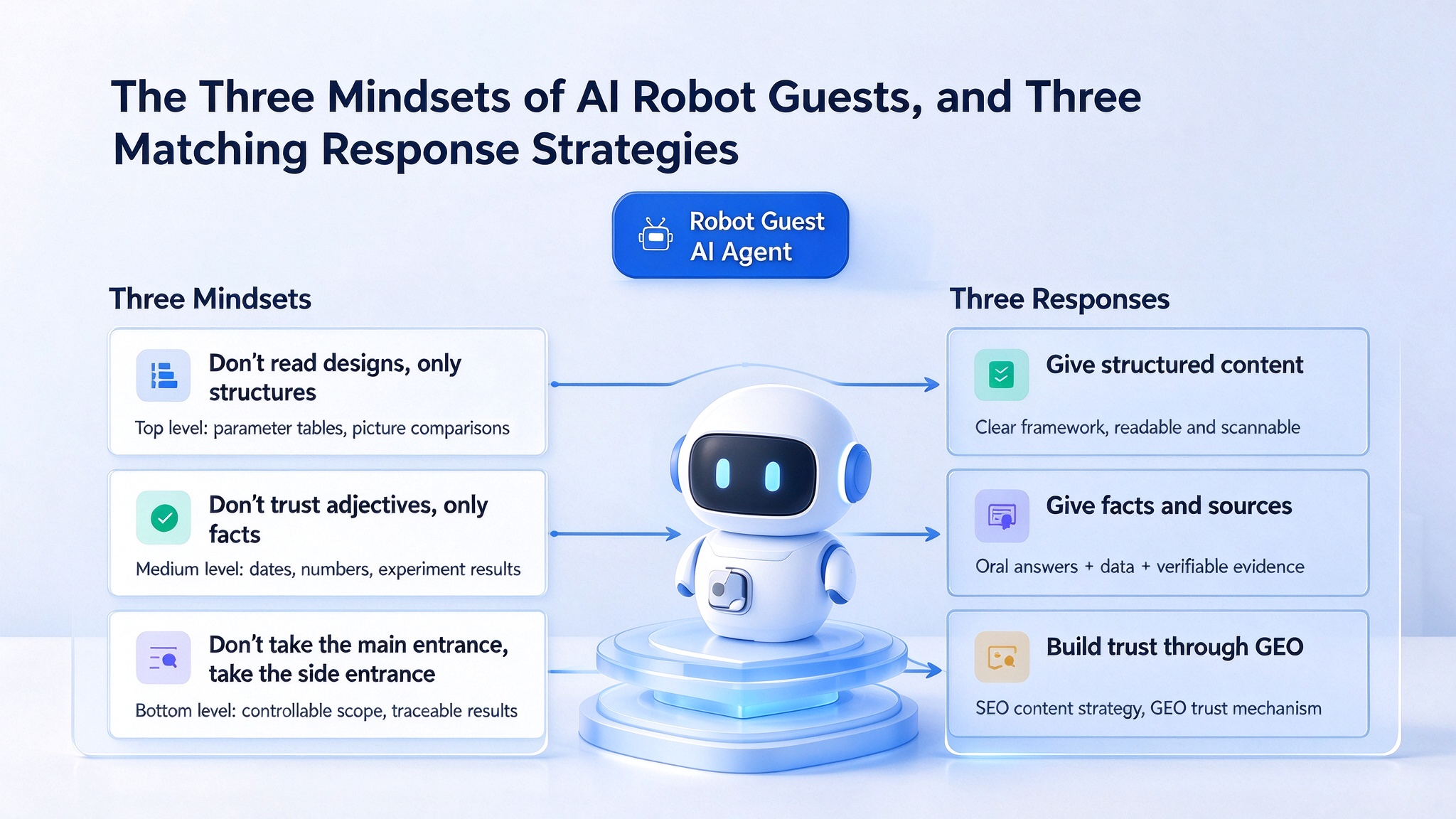
(The image illustrates the three quirks of machine guests.)
First quirk: They don't care about design, only structure.
Whether a page looks beautiful is meaningless to an Agent. It reads the skeleton of the content: Are heading hierarchies clear? Are parameters presented in tables or scattered across prose? Do images have descriptions? Do tables have headers? A page designed to please human eyes may appear as a tangled mess to a machine.
An industry statistic highlights this issue well: long-form pages exceeding 20,000 words are cited by AI 4.3 times more often than short-form pages under 500 words. This number is counterintuitive because past mobile optimization experience dictated that "shorter is better." However, AI doesn't prefer brevity; it prefers completeness, structure, and modularity. Your minimalist landing pages optimized for mobile, which compress information into images and animations, are essentially equivalent to having no door open in the eyes of these new guests.
Second quirk: They distrust adjectives, trusting only facts and sources.
Phrases like "industry-leading," "craftsmanship quality," and "widely praised" are noise—or even negative assets—in front of an Agent. It extracts numbers, dates, certification IDs, authorization scopes, and testing standards. It also cross-validates: whether website parameters match manuals, whether case study dates align with public reports, and whether Chinese and German sites maintain consistent messaging. Inconsistencies lead to distrust; distrust leads to non-citation, causing the Agent to cite the source that checks out instead. Brands previously built awareness through repetition, but with these new guests, they build trust through consistency. Most corporate marketing teams are only familiar with the former logic.
Third quirk: They bypass the main entrance, using side doors instead.
This is the most frustrating aspect for those who have practiced SEO for over a decade. Eighty percent of content cited by large models does not rank within Google's top 100. The old main entrance remains, and ranking still matters, but the new guest climbs through the window. What is this window? It is content that is machine-readable, traceable in origin, and quotable by paragraph.
The industry has coined a term for this craft: GEO (Generative Engine Optimization). It focuses not on how to rank a page higher, but on how to get specific content selected and cited by AI. SEO competes for position; GEO competes for trust. Position can be bought; trust must be earned.
Taken together, these three quirks point to a single reality: the reception protocols have changed. It isn't the sofa or tea service that has changed, but the methods of verifying credentials and revealing one's background. In the past, hosts showed guests model rooms; now, they must present blueprints, ledgers, and quality inspection reports.
A fair note must also be added: Machine guests are not monolithic. Browsing Agents are relatively lenient, requiring only parameters and prices before taking what they need and leaving; Procurement Agents are meticulous, verifying qualifications, tracking delivery timelines, and checking versions; Research Agents are the most suspicious, cross-examining every statement against secondary sources. Therefore, reception strategies must be tiered: provide complete facts for browsing agents, streamline processes for procurement agents, and ensure comprehensive sourcing for research agents. Among these, establishing credible sourcing is the hardest to achieve, as it relies less on technology and more on years of content governance habits. This is why the third article dedicates a separate section to trust.
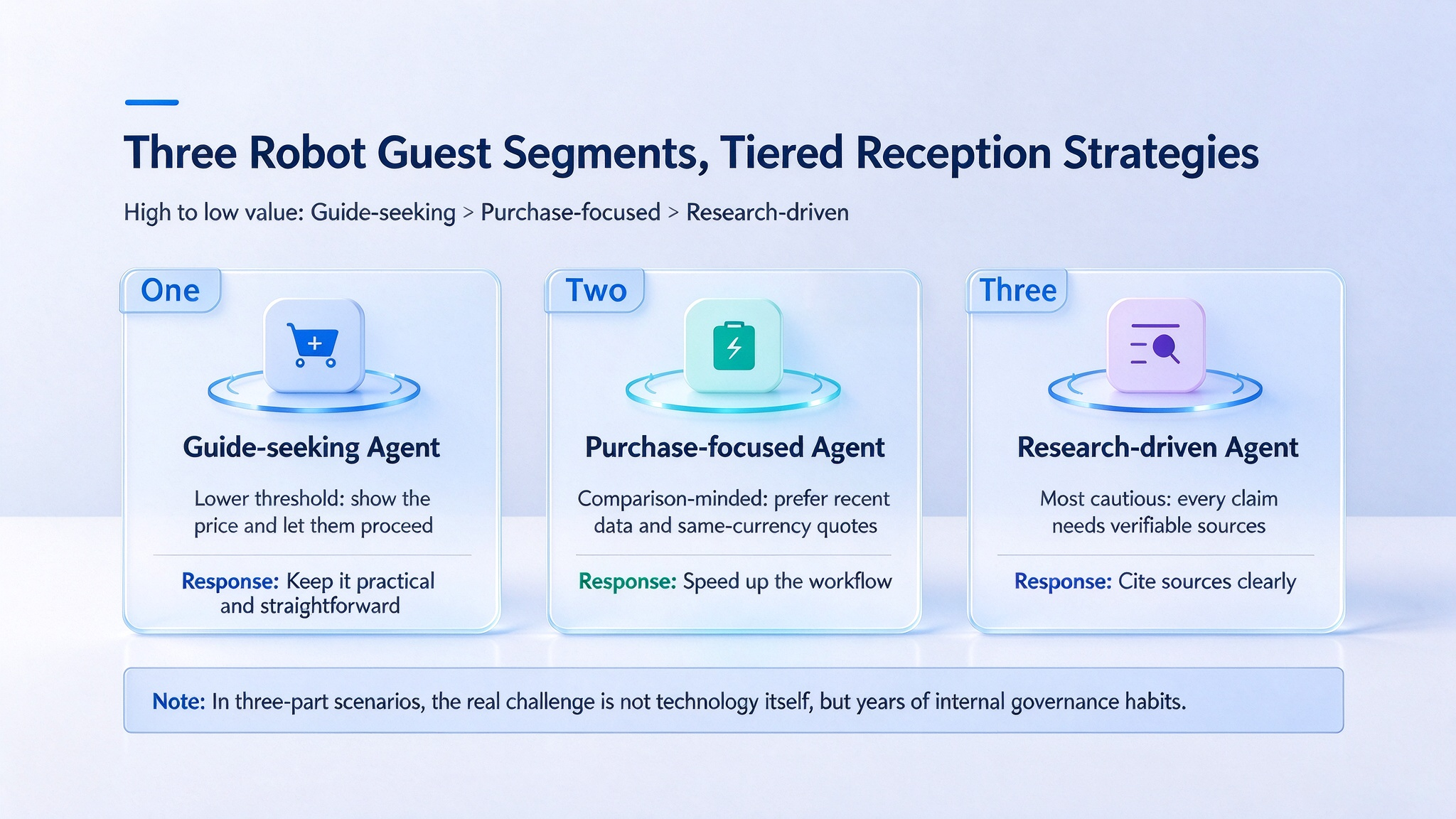
(The image illustrates that strategies for dealing with machine guests require tiering.)
III. An Overlooked Fact: DXP Has Been Preparing for This All Along
By this point, many might assume this requires building an entirely new capability from scratch. On the contrary. The digital experience infrastructure enterprises built to "please humans" was inherently designed for "structured content management"; it was simply overshadowed by visual presentation. Now that the guests have become machines, the value of that obscured layer is finally coming to light.
Take Dragon Bravo BMS DXP To compare, its existing capabilities are almost tailor-made for machine guests. This is no coincidence; it's precisely what the DXP category is designed to do.
The first capability: structured content publishing.Dragon Bravo’s CMS supports multi-site and multi-language official website publishing. The key lies in storing and publishing content as structured blocks rather than pasting prose onto pages. The same set of product facts can simultaneously render a German site, a Spanish site, and a Thai site with consistent messaging and synchronized updates. For humans, this represents multilingual capability; for an Agent, it retrieves clean facts tagged with language metadata and field boundaries, rather than unstructured prose that requires guesswork.
The second capability: a single source of truth for parameters. The PIM (Product Information Management) module manages all product parameters, categories, and relationships. Whether an Agent retrieves the parameter table, a distributor downloads it, or it appears in a printed manual, they all stem from the same record, passing the "cross-validation" test immediately. While this sounds straightforward, it is extremely difficult to implement because most enterprises have their parameters scattered across four Excel files and three departments' verbal communications.
The third capability: asset provenance. BMS-DAM Digital Asset Management provides a ledger for every image and video clip: who created it, when it was created, the scope of authorization, the current version, and where expired versions are stored. When a research-oriented Agent traces the origin of an installation image, it receives a definitive answer rather than silence. In AI distribution environments, provenance equals trust, trust equals citation, and citation equals new traffic.
The fourth capability: native GEO (Generative Engine Optimization). BMS DXP embeds generative engine optimization into the publishing workflow: content structure, semantic tagging, and organization of citable segments are completed at the moment of publication, not added as an afterthought. The logic is simple: if you want to be cited, you must first make yourself citable. A segment that cannot be extracted independently without losing meaning simply does not exist in the eyes of an Agent.
The fifth capability: often overlooked knowledge center Q&A. By ingesting years of accumulated application cases and troubleshooting records into the knowledge center and providing structured Q&A externally, research-oriented Agents receive answers complete with timestamps, scenarios, and outcomes when investigating "what exactly this vendor has done in a specific industry," rather than a list of case studies requiring them to flip through pages and guess.
In other words, the value of the DXP platform manifested as "how well it presents information" during the era of human customers, but now manifests as "how clean the source of truth is" in the era of machine customers. It is the same system, but the evaluation dimensions have shifted. The latter is precisely the aspect DXP has been refining for twenty years yet rarely highlights as a selling point.
IV. Three Standards for Machine-Readable Content
If you remember only one section from this article, remember this one. Any enterprise aiming to serve machine customers should first conduct a self-assessment using these three standards.
First standard: Facts in the repository.
Any critical fact a customer might ask about—parameters, pricing rules, lead times, warranty terms, certification lists—must reside within a structured system, not buried in a PDF, an email, or the mind of a retiring employee. If the fact isn't in the repository, the Agent cannot retrieve it; if it cannot retrieve it, it will cite someone else.
There is a common misconception here: many companies believe that "it's on our official website" equates to having facts in the repository. This is incorrect. Information embedded in page prose is semi-structured for machines, making extraction costly and error-prone. The standard for "facts in the repository" means they are entered into structured entries within PIM, DAM ledgers, or the knowledge center, complete with fields, sources, and version numbers. Companies that have conducted internal audits often find that 30% of frequently asked customer facts still exist solely in PDF manuals. That 30% represents the portion of responses lost to competitors.
Second standard: Every sentence has a birth certificate.
Content must carry provenance: who wrote it, who reviewed it, what it was based on, and when it was last reviewed. Originally a compliance requirement in the DAM domain, this has become a prerequisite for citation in the Agent era. Machines do not trust tone; they trust records. Content lacking a birth certificate carries the same low weight in a research-oriented Agent's ranking algorithm as a rumor.
The value of this standard is particularly significant in B2B scenarios. B2B procurement decision chains are long and due diligence is rigorous; the role of a research-oriented Agent is to trace every claim made by suppliers. Content with verifiable provenance withstands tracing, earns credibility through verification, and ultimately makes it into the comparative conclusions presented to decision-makers.
Third standard: Expiry is visible.
Expired content is not merely outdated; it must be explicitly marked as expired. If an Agent retrieves an expired parameter table, the damage caused exceeds ten customer complaints, as it inserts false facts into another party's decision-making process—a decision potentially worth tens of millions.
Within the BMS-DAM rule framework, versioning and validity periods are attributes attached directly to assets. Expiration automatically triggers workflows: delisting, replacement, and notification to citing parties. Relying on human memory for expiration dates is an old-world practice; humans forget, systems do not. When your customers are machines operating around the clock, your expiry management must also be fully automated and operational 24/7.
These three standards sound like management common sense. They indeed are common sense. It's just that for nearly twenty years, almost no one has treated content this way, because past customers would self-screen, call to ask questions, and tolerate your vagueness. New customers do not tolerate it. New customers simply quietly stop citing you and go on to cite your peers instead.
V. Silent Churn: The Cost of Inaction
Some might counter: "Our clients are all long-term customers; relationships are built on people, and the Agent approach is far from our reality."
This statement is half true. Relationships are indeed built on people, but the way these relationships sustain themselves is changing. As mentioned earlier, buyers have already independently completed 60% of their procurement journey before even contacting any supplier. Even the procurement departments of old clients are undergoing personnel changes; the first assistant a newly appointed procurement manager brings is their Agent. Its very first task is to run a sieve through all existing suppliers: checking if parameters are complete, certifications are valid, and document structures are readable. After the sieve passes, only three names remain for the next round. No matter how strong your relationship, if your name isn't among those three, you don't even get a chance to be remembered.
This is the cost of inaction: it doesn't manifest as complaints or churn reports; it manifests as silence. You're off the list, and nobody tells you. There are already cases in the industry: a parts manufacturer with thirty years of operation saw its renewal rate suddenly drop by 20%. After six months of review, they couldn't find the cause. Finally, an acquaintance—a purchasing director—let it slip: "It's not that you're bad; it's that your data can't be read in our new system." Four words—"can't be read"—and thirty years of friendship wiped clean.
Silent churn is ten times more expensive than noisy churn. Noisy churn forces you to change; silent churn just lets you slowly shrink. By the time you see that downward curve on your report, it's often already two years too late.
There is another, more hidden cost: internal organizational alignment costs. Facts no longer have a single source of truth. Sales, marketing, after-sales, and legal each maintain their own narratives, requiring constant realignment of terminology every time cross-departmental collaboration occurs. This cost is usually recorded under "poor communication," and nobody calculates the total sum. Once the source of facts is unified, it silently disappears from the reports, just as quietly as it appeared.
By the way, let's correct a popular misjudgment: some interpret this shift as "building another AI version of the website." That's incorrect. Machine customers don't need a website; they need the structured fact layer behind the website. Spending budget on "AI versions of pages" is equivalent to renovating a room for customers who never look at the page. Money should be spent on fact extraction, asset ledgers, and "ensuring every piece of content can be extracted individually without losing meaning." The page is merely a byproduct of this investment.
VI. Ecosystem Blood Transfusion: Repricing Roles and Budgets
When rules are rewritten, the ones who feel the chill first are never the vendors, but the ecosystem that feeds off them.
Let's start with service providers. Agencies that have done search optimization for enterprises for years are undergoing business restructuring: traditional SEO projects are getting thinner, while GEO consulting fees are rising. In the past, they helped businesses queue up high in search results; now, customers don't queue—they send robots directly into the warehouse to pick up goods. The skill of queuing has depreciated, while the skill of managing the warehouse has become valuable. Skill repricing has already occurred: designers skilled in motion graphics are oversupplied, while those who can write content schemas, understand asset ledgers, and manage authorization chains are becoming scarce. With every container replacement, it's not the hard workers who disappear—it's those who bet on the wrong container. This round bets on pages; the next round will bet on structure.
Now consider roles within enterprises. The weekly agenda of the marketing department is undergoing blood transfusion: in the past, there were three items—what was published, how the data looked, what will be published next week; now there are four additional items—who cited us this week, what the pickup success rate is, which fact lacks a source, and which batch of assets is expiring soon. Two new roles are beginning to appear in job requirements: Content Structurist, who transforms prose into citable paragraphs, ensuring one idea per paragraph and preserving meaning when extracted; and Asset Ledger Clerk, who monitors authorizations and expiration dates, with a simple KPI: zero expired inventory. These roles lack standardized titles yet, but headhunters are already recruiting based on these profiles.
Finally, the flow of budgets. In the past, the bulk of marketing budgets went to advertising and redesign; now, a new category has emerged: Fact Governance. This shift is backed by macro data: in 2026, content marketing budgets account for 26% of total marketing expenditure, and the global content marketing market size has grown from approximately $72 billion in 2023 to over $107 billion in 2026. Money is flowing toward content, but the manner of flow has changed: it's no longer about producing more content, but about governing produced content into reusable assets. Industry forecasts predict that by 2028, 80% of content teams will use AI tools, reducing the production cost of individual assets by about 45%. Once production costs come down, scarcity shifts from volume to order. Changes in budget categories are the most honest signal of wind direction: when an enterprise begins to allocate a separate line item for content governance, it acknowledges that this shift is fundamentally an issue of order, not interface.
VII. The Gatekeeper's Job Remains Unchanged, But the Method of Verification Has Evolved
Returning to the opening judgment: corporate digital experiences are being redefined.
What's being redefined isn't the goal of the experience—that old adage still holds: deliver the right content, at the right moment, to the right customer. What's being redefined is the definition of "customer": it no longer refers solely to the patient person in front of the screen, but also includes the machines coming on behalf of others. And this machine customer is more honest than humans: give it structure, and it returns orders; give it vagueness, and it returns silence.
For enterprises, this isn't about starting from scratch; it's about "re-solidifying the foundation that should have been solid all along." Fact extraction, birth certificates, and visible expiration dates—these three standards should have been implemented during the era of human customers, though the benefits weren't obvious then. Now, in the era of machine customers, implementing them yields immediate returns, and failing to implement them leads to immediate elimination.
Therefore, the role of DXP platforms in this turning point becomes clear: they are the carrier of corporate fact sources and the operating system for content order. Their value is no longer just making websites look better, but managing corporate content in a way that any customer can trust. When humans arrive, provide rooms; when machines arrive, provide shelves; when both arrive, ensure the same product is displayed on both the room and the shelf.
This is the first layer of change, and also the most fundamental one, addressing the entrance problem: enabling machine guests to enter, be accessible, and be trustworthy.
But the entrance is just the beginning. When a machine guest demands a complete delivery package comprising 40 SKUs, six languages, and three warehouses within 72 hours, a new question arises: who will orchestrate this? Relying on humans means speed can't keep up; relying on building an in-house general Agent means you're heading in the wrong direction.
In Part II, we step inside the house to discuss orchestration.
Data Source Explanation:
Gartner's "AI agents will mediate over $15 trillion in B2B purchases by 2028, with approximately 90% of B2B buying going through agents" and "Buyers spend only 17% of their procurement time meeting suppliers and 27% on independent online research" are sourced from Gartner's public research and reports; 6sense's "2025 Buyer Experience Report," stating that "buyers have completed 60% of their purchase journey before contacting suppliers and 80% of orders are won by pre-qualified suppliers," is based on third-party data; SparkToro's "68% zero-click rate for Google searches in the first four months of 2026 (60% in 2024)" and BrightEdge's "AI Overviews cover approximately 48% of tracked queries, with zero-click rates in AI Overview scenarios ranging from 80-83%, and Google-referred traffic down 38% year-over-year" come from third-party public statistics; "AI citations on pages exceeding 20,000 words are 4.3 times those on short pages" and "80% of LLM citations do not appear in Google's top 100" are compiled and reprinted from statistics by institutions such as Seer Interactive and Peec AI; content marketing budget accounting for 26%, market size growing from $72 billion to $107 billion, eight out of ten content teams using AI tools by 2028, and single asset costs dropping by approximately 45% are compiled and reprinted from public industry reports by Statista, Technavio, etc.; Dragon Bravo BMS DXP module capabilities represent delivered features described from the vendor's perspective; statements in the text such as "renewal rates declining" and "only one-third of facts exist in PDFs" are illustrative representations of common industry conditions, not specific enterprise test data.


Want to know more about our products?
With years serving Fortune 500 clients, we offer flexible solutions and integrated implementation.
