





Winning the AI Search Era: When Prospects Ask AI Questions, Can Your Brand Still Be Seen?
Publication date: March 27, 2026
Author:William
I. Cognitive Dissonance: The Same Question, Radically Different "Worlds"
When your potential customers ask AI questions, the answers they receive may differ drastically from what you expect. According to the latest research by Writesonic, using identical prompts to query ChatGPT’s default model (GPT-5.3Instant) and its advanced model (GPT-5.4Thinking), the information sources cited by the two models overlap almost not at all—sharing only 7% of references.
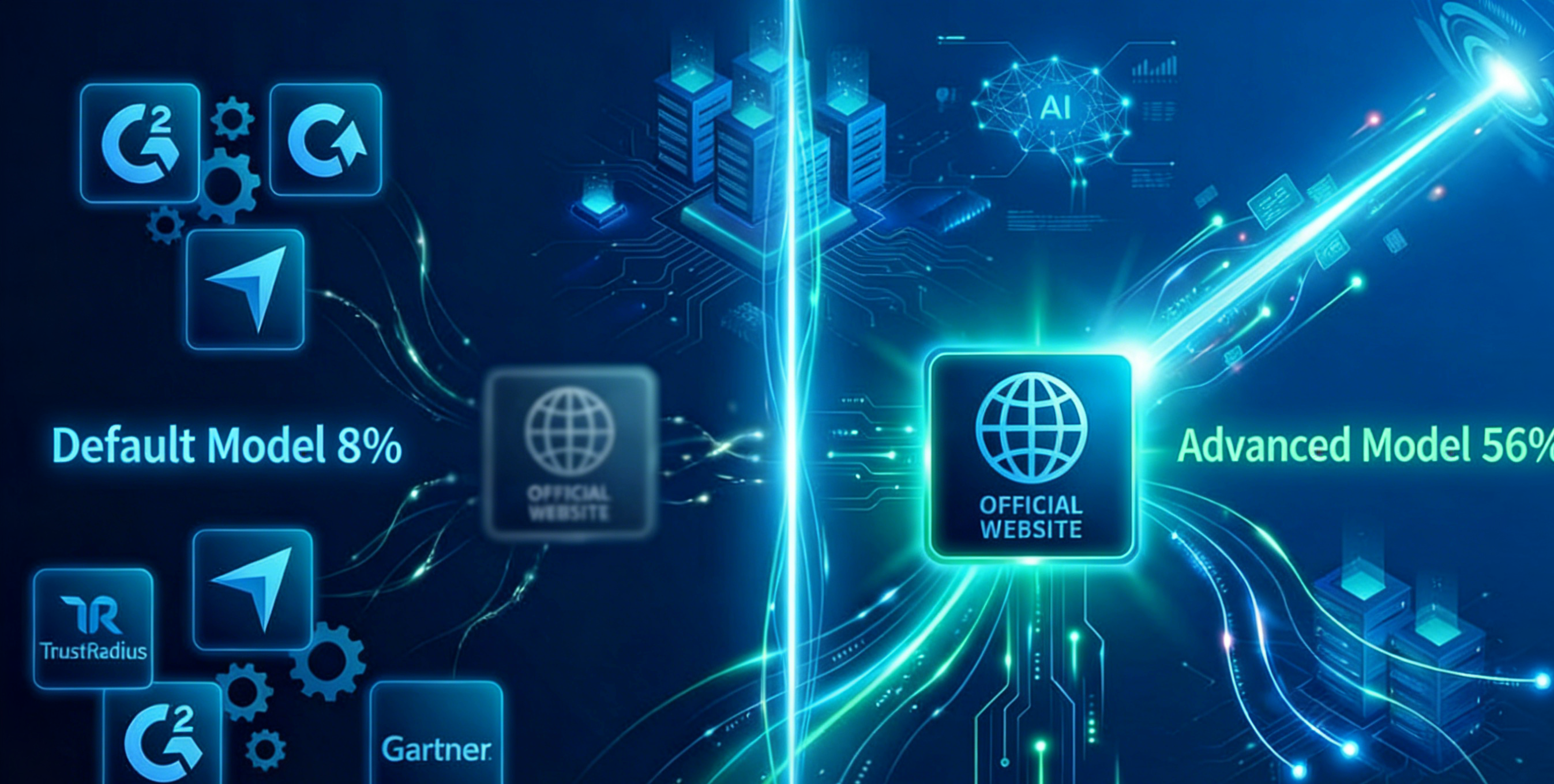
| AI Model Type | Percentage of Brand Official Website Citations | Percentage of Third-Party Citations | Search Behavior Characteristics | Target User Profile |
| Default Model (GPT-5.3 Instant) | 8% | 92% | Broad queries, relying on third-party reviews from G2, Capterra, etc. | General users seeking basic information |
| Advanced Model (GPT-5.4 Thinking) | 56% | 44% | Multi-subquery + site: operator for in-depth retrieval of brand official websites | Professional decision-makers with high willingness to pay |
This divergence reveals a harsh reality: if your brand’s official website fails to host deep, authoritative content, you will entirely miss high-net-worth customers who use advanced models and are willing to pay for value. Yet, many B2B enterprises’ websites today remain stuck at the "electronic brochure" stage—lacking detailed technical documentation, structured product specifications, and transparent pricing systems.
This is precisely the core pain point that Dragon Bravo Corporation is dedicated to solving. As a digital transformation service provider with years of expertise in automotive, finance, healthcare, and other sectors, we understand that enterprises must elevate their official websites—from mere "showcase windows"—into the most authoritative primary information source in the AI search era.
II. From "Conversation" to "Execution": The Comprehensive Evolution of AI Agents
Google Maps’ newly launched Ask Maps feature marks the arrival of true local-search AI Agents. When users pose complex, compound queries such as "Where can I find a public tennis court with lighting tonight?", Ask Maps instantly generates personalized decision-making solutions by integrating a database of 300 million locations and 500 million reviews.

In this process, traditional Local SEO signals—such as mere completeness of Google Business Profile or sheer volume of reviews—are being superseded by deeper content relevance. AI Agents have evolved beyond simple "chatbots" into intelligent "execution assistants" capable of understanding complex context and synthesizing multi-source data.
For enterprises, adapting to this shift is no longer an optional "nice-to-have"—it is an existential necessity. A monolithic website architecture can no longer support such complex interactions; businesses urgently require a digital foundation capable of supporting multi-channel content distribution, unified data management, and intelligent content optimization.
Dragon Bravo’s BMS DXP (Digital Experience Platform) was developed to meet exactly this need. It is far more than just a content management system (CMS); it serves as an enterprise-grade digital experience hub designed to help businesses build unassailable competitive advantages across AI search, multi-platform distribution, and personalized interaction dimensions.
III. Shortcuts Are Dead: The "Gray-Market" Cost of Third-Party Tools
On March 3, 2025, OpenAI rolled out an update that completely removed the previously scrapable search_model_queries field. Overnight, numerous third-party SEO tools relying on this undocumented browser-network traffic lost their core functionality and collapsed.
History repeats itself with startling similarity: from Facebook’s acquisition and subsequent shutdown of Parse in 2013, to Instagram’s tightening of API permissions in 2018, and finally to Twitter’s termination of its free API in 2023—which led to the total collapse of third-party clients. Whenever developers attempt to build products atop "borrowed" underlying data, all prosperity vanishes instantly once platform providers tighten their policies.

Do not anchor your brand’s digital lifeline to third-party tools built upon "gray-market" data sources. Building proprietary content moats and accumulating fully controllable data assets is the enduring, long-term winning strategy for navigating market cycles.
Dragon Bravo’s BMS DXP adopts an independently developed cloud-native technology architecture—without reliance on any internal interfaces of third-party platforms. We provide enterprises with private deployment capabilities and multi-cloud management to ensure absolute security and full autonomy over your digital assets.
IV. Breaking Through: An Enterprise-Grade GEO (Generative Engine Optimization) System Strategy
Faced with the profound evolution and uncertainty of AI search, enterprises must abandon fragmented, piecemeal fixes and instead pursue systematic strategic upgrades. Dragon Bravo recommends that enterprises reshape their content ecosystems along the following three dimensions:

1. Solidify First-Party Authoritative Content
Advanced AI models and autonomous AI agents are now crawling brand websites’ pricing pages, product whitepapers, and technical API documentation with unprecedented depth. Your official website must become the most authoritative, AI agent-friendly information source in its domain. This means product pages must shift from "marketing-oriented" to "technology- and value-oriented," offering structured FAQs, clear specification parameters, and comprehensive implementation of Schema Markup and other structured-data annotations optimized for AI agent parsing and citation.
2. Understand the Underlying Logic of Diverse AI Platforms
Different AI engines possess radically distinct information preferences; enterprises must therefore develop targeted content strategies:
| AI Platform | Content Preference | Optimization Focus |
| ChatGPT (Advanced Model) | In-depth content from brand official websites, authoritative reviews | Technical documentation, product white papers, structured FAQs |
| Gemini | Google ecosystem data, authentic user reviews | Google Business Profile, localized content, review management |
| Perplexity | Academic papers, in-depth industry reports | White paper publishing, industry reports, authoritative citations |
3. Deploy a Long-Term, Stable Monitoring System
Abandon "black-tech" tools reliant on platform vulnerabilities, and instead adopt AI agent-powered long-term monitoring systems built on official APIs or publicly available, legally compliant data sources—ensuring the legality and continuity of data tracking. As your end-to-end digital partner, Dragon Bravo provides an integrated, omnichannel search marketing (SEO/SEM/GEO) solution with native AI agent optimization capabilities. Leveraging BMS DXP, we centrally manage global, multilingual, and multi-market site matrices—ensuring brand message consistency and significantly boosting crawl efficiency for mainstream AI agents and generative models.
V. The Future Is Here: Opportunities Unlocked by AI Search Transparency
A critically important industry trend is emerging: most URLs cited by AI now carry parameters such as utm_source=ChatGPT.com. This signals that AI platforms are transitioning from closed "black boxes" toward openness—beginning to provide content creators with trackable attribution mechanisms.
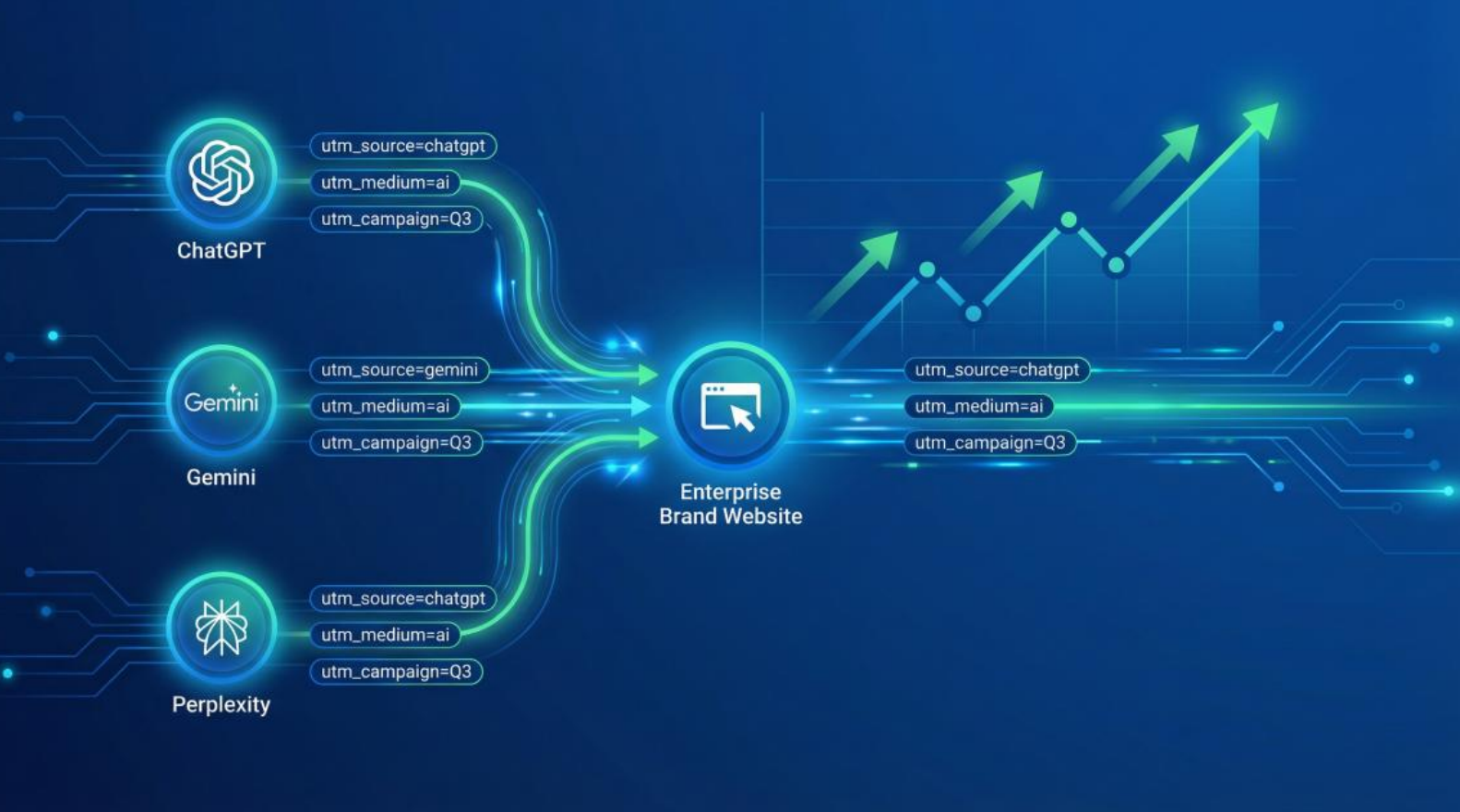
Brands can now directly track and measure conversion from AI agent-recommended traffic within analytics tools. This marks the maturation of GEO (Generative Engine Optimization)—no longer a blind man’s guesswork, but a precise, ROI-measurable marketing channel built for the AI agent era.
For enterprise decision-makers, the present moment represents the golden window to establish AI agent search visibility. Early adoption not only secures first-mover advantage in the generative AI landscape, but also positions brands to capture exponential traffic dividends once AI agent traffic attribution mechanisms mature fully. Dragon Bravo’s technology team consistently stands.
at the forefront of technological evolution—not only delivering powerful technical foundations like BMS DXP, but also providing seasoned business-technology consulting teams to deliver full-lifecycle services spanning strategic planning, custom development, and operations & maintenance support.
VI. Frequently Asked Questions (FAQ)

Q1: Why do high-net-worth customers more readily see your brand’s official website, while ordinary users only see third-party reviews?
This stems from the underlying logic of AI models. Ordinary users typically employ default models (e.g., GPT-5.3Instant), which tend to issue broad queries and directly scrape aggregated information from third-party review sites. In contrast, high-net-worth customers and professional decision-makers prefer advanced models (e.g., GPT-5.4Thinking), which generate complex sub-queries and use the site: operator to directly delve into brand websites for technical details. If your website lacks deep content, you will directly lose these high-value leads.
Q2: What is GEO (Generative Engine Optimization), and how does it differ from traditional SEO?
Traditional SEO primarily optimizes for keyword matching and backlinks on search engines such as Google and Baidu, aiming to improve rankings on search engine results pages (SERPs). In contrast, GEO (Generative Engine Optimization) optimizes for the generative logic of large AI models—including ChatGPT, Gemini, and Perplexity. GEO places greater emphasis on content structure, factual accuracy, richness of first-party data, and deep application of Schema markup—intending to position your content as the most reliable "raw material" when AI generates answers.
Q3: How does Dragon Bravo’s BMS DXP platform help enterprises achieve GEO optimization?
Dragon Bravo’s BMS DXP is architected from the ground up for the AI era. First, it supports unified management of multi-site, multilingual deployments—ensuring high consistency of global brand messaging, which forms the bedrock of AI trust. Second, the platform includes a deeply embedded structured-content management module that automatically generates Schema Markup aligned with AI crawler preferences. Finally, its ultra-responsive cloud-native architecture guarantees peak performance during AI crawling.
Q4: If our enterprise already has an official website, do we still need to rebuild it?
This depends on your current website’s "AI-friendliness." If your website consists primarily of images and simple marketing copy—lacking structured technical documentation, transparent pricing pages, and comprehensive FAQs—it is effectively "invisible" in the AI search era. Dragon Bravo offers professional digital asset audits and—via BMS DXP or API integration—enables smooth, non-disruptive upgrades to your existing architecture without requiring a complete rebuild.
Q5: Why does Dragon Bravo emphasize "independent technology architecture" and "non-reliance on third parties"?
Recent events—such as OpenAI’s API update causing widespread paralysis among third-party SEO tools—demonstrate that tools depending on undocumented platform interfaces or gray-market data carry extremely high operational risk. Dragon Bravo adheres to an independently developed technology foundation, offering private deployment options to ensure complete customer control over digital assets, business data, and content ecosystems—free from disruption caused by sudden external platform policy changes.
Q6: As an e-commerce enterprise operating cross-border, does GEO optimization benefit our overseas expansion?
Absolutely critical. Overseas users’ information-seeking habits are rapidly shifting toward AI. Dragon Bravo’s cross-border e-commerce solution not only delivers multilingual, multicurrency independent storefronts but also deeply integrates localized SEO with GEO. By optimizing the structured representation of product data, we help your products directly enter overseas consumers’ AI-powered shopping recommendation lists—freeing you from dependence on costly traffic fees from traditional e-commerce platforms.
Q7: How do we begin collaborating with DBC?
We offer end-to-end services—from requirements analysis to system implementation. You may contact our business-technology consulting team directly; we will schedule a professional system demonstration and deliver customized, omnichannel digital experience upgrade plans tailored to your specific industry (e.g., automotive, finance, healthcare, manufacturing).


Want to know more about our products?
With years serving Fortune 500 clients, we offer flexible solutions and integrated implementation.
