





From AEM to Next-Gen DXP: Bidding Farewell to the 'Sweet Burden' and Reshaping Global Digital Experience Governance
Published: 2026-09-30
Author: William
Introduction: For enterprises migrating from AEM to a next-generation Digital Experience Platform, the core challenge lies not in page migration, but in reshaping content models, digital assets, and operational habits. This article delves into key methodologies for smooth migration and explains how globalized Digital Asset Management (DAM) empowers enterprises to achieve efficient governance and accelerated application delivery.
I. When AEM Becomes a "Sweet Burden": Migration, An Unavoidable Battle
Amid the wave of digital transformation, many multinational corporations once regarded Adobe Experience Manager (AEM) as the cornerstone for building digital experiences. AEM was once an industry benchmark, but faced with rapidly changing markets, accelerating technological iterations, and increasingly granular cost considerations, its high licensing and maintenance costs, coupled with its inability to respond swiftly to market demands, are turning it into a "sweet burden" during global expansion.
The decision to abandon AEM in favor of a more flexible, open, and cost-effective next-generation DXP platform is by no means merely a technical tool replacement. The underlying challenges lie in restructuring content models, achieving efficient governance of digital assets, and transforming entrenched team operational habits. For instance, a global consumer goods giant once experienced delays of several weeks in new product launches and damage to its brand image due to scattered marketing materials across regions, chaotic versioning, and unclear licensing. This precisely illustrates the bottlenecks exposed by traditional DXPs when facing globalization challenges. If migration is simply copy-pasting, problems from the old system will only be amplified on the new platform. Therefore, the transition from AEM to a new DXP is a systemic transformation encompassing business strategy, technical architecture, and operational models, requiring enterprises to respond with strategic vision and determination.
II. Clearing the Fog: The Crux of Migration Lies in the "Complete Transformation" of Content and Assets
When considering migration from AEM to a new DXP, enterprises can easily fall into the mindset of "feature benchmarking," focusing solely on whether the new platform possesses all of AEM's functionalities. However, this comparative approach often overlooks deeper fundamental differences in "content models" and "digital assets." As a traditional platform, AEM typically binds its content model tightly to page structures, resulting in close coupling between content and presentation layers. In contrast, next-generation DXPs, especially those adopting Headless or Hybrid Headless architectures, emphasize complete separation of content and presentation layers to enable more flexible and efficient multi-channel content distribution. This shift in core principles means that migration is not just a technology stack replacement, but also a rethinking and reshaping of enterprise content production, management, and distribution models.
In-depth Analysis of Core Challenges:
1. Reshaping Content Models and Redefining Structured Data: Previously in AEM, content was built around "pages." In the era of new DXPs, content must be mapped into reusable, composable independent units. A thorough inventory and redesign of content types, attributes, and relationships are required to ensure the new platform supports more flexible semantic content capabilities. For example, elements such as product detail page names, descriptions, high-definition images, 360-degree videos, and technical specifications should be defined as independent structured data callable by different channels (official websites, mini-programs, apps, smart speakers), enabling "create once, publish everywhere" and enhancing content value.
2. Smooth Transition and Efficient Governance of Massive Digital Assets: With the global expansion of enterprise businesses, the volume of digital assets has exploded, becoming scattered and lacking unified management. Migrating from AEM requires securely and completely transferring digital assets carrying brand value to the Digital Asset Management (DAM) module of the new DXP. More critically, leveraging the globalization capabilities of the new DAM is essential to resolve critical bottlenecks such as slow cross-regional asset access, high compliance risks, unintelligent AI tagging, and cumbersome multilingual metadata maintenance. We once served a globally renowned automotive brand whose overseas marketing colleagues complained that finding a high-resolution front-view image of the latest car model often required repeated inquiries across multiple internal chat groups or enduring painfully slow loading times in legacy systems. Even when found, they were often uncertain if it was the latest version or properly licensed. They discovered that while traditional CDN acceleration solutions could address preview, access, and download acceleration for end-users visiting official websites, they remained inadequate for high-frequency, interactive backend operations performed by overseas employees in the DAM system—such as login, search, filtering, upload, editing, AI tagging, approval, metadata maintenance, permission configuration, and statistical queries. These backend operations demand extremely high network real-time performance, which traditional CDNs cannot support. At this point, specialized global application acceleration solutions based on high-quality cross-border networks like CN2 or 9929 become necessary to ensure that overseas teams can operate in the DAM backend as smoothly and efficiently as flowing water, truly boosting productivity for heavy-duty tasks.
3. Adapting Operational Habits and Workflows Accordingly: Any platform migration ultimately impacts the daily working habits of content editors, marketers, and IT operations teams. AEM's "What You See Is What You Get" editing experience is deeply ingrained. How can the new DXP provide an equally efficient or even superior editing experience? How can existing content approval and publishing workflows be seamlessly migrated to the new platform, further optimized using the new DXP's automated workflow capabilities, or even made intelligent? All these require thorough planning and training before migration to ensure teams can quickly adapt to the new platform, avoiding efficiency drops or even resistance caused by drastic changes in operational habits.
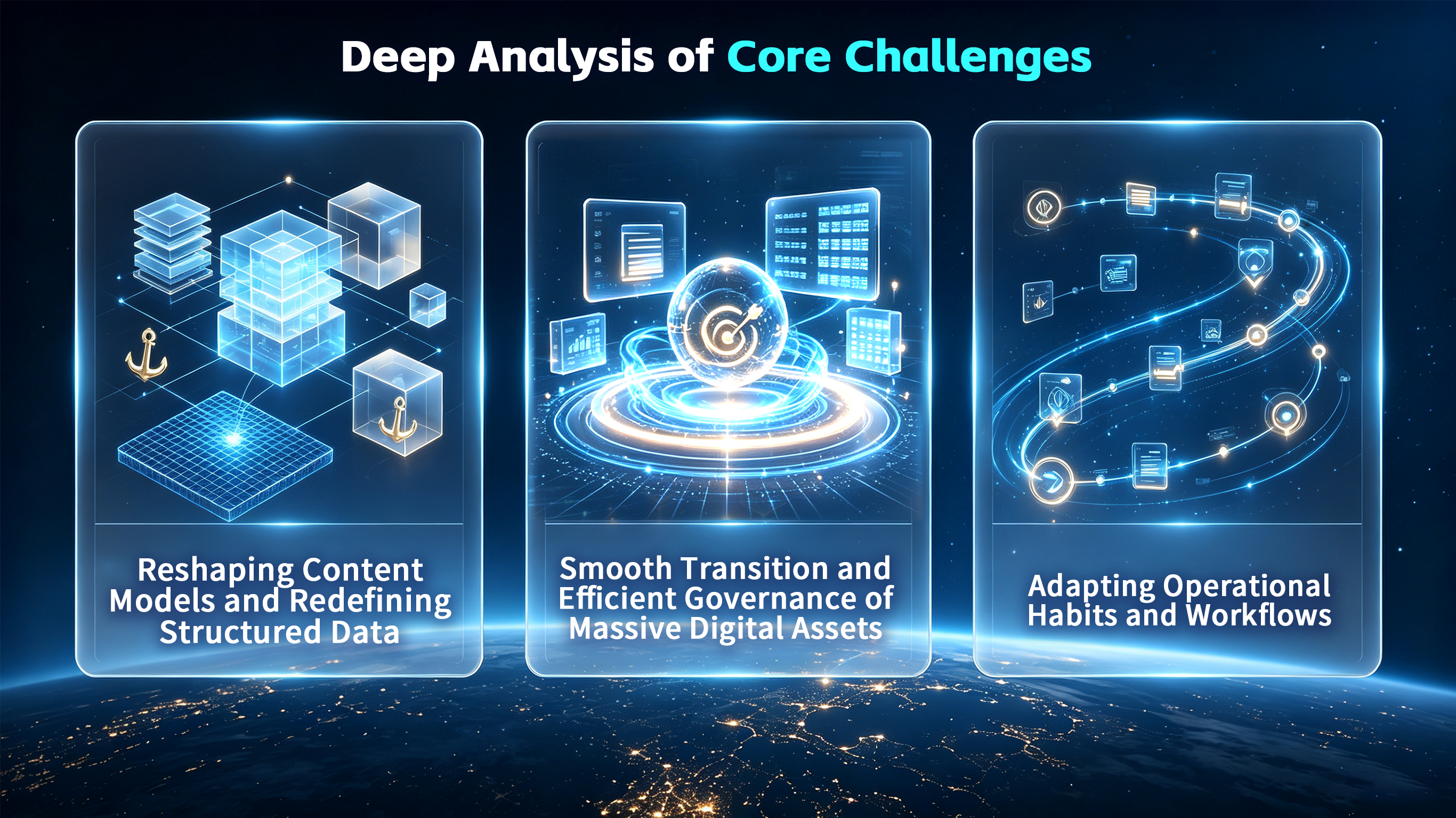
(Image illustrates an in-depth analysis of core challenges)
III. Breaking Through: "Four Strategic Moves" for Smooth Migration and DAM as a Strategic Pivot
Successful DXP migration does not happen overnight; it resembles an intricate game of chess requiring systematic methodology to guide every move. Based on extensive practical experience serving numerous enterprise clients, DragonBravo has developed an effective "Four Strategic Moves" migration strategy designed to minimize business risks, ensure smooth transitions, and ultimately achieve comprehensive upgrades in digital experiences. In this strategic game, Digital Asset Management (DAM) serves as a pivotal strategic anchor in globalized content governance; the depth and breadth of its capabilities often determine the success or failure of the entire migration effort.
Move One: Comprehensive Current-State Assessment and Precise Requirement Diagnosis
Before initiating any technical migration, the most critical step is conducting a thorough assessment of your existing assets. This includes:
• Comprehensive Inventory of Content Assets: Meticulously catalog all content types, page templates, components, content fragments, and massive volumes of digital assets (images, videos, documents, etc.) within AEM—including their quantities, structures, metadata, version histories, permission configurations, usage frequencies, and interrelationships. Particularly important is acting like a "detective" to identify long-dormant, redundant, or potentially non-compliant "sleeping assets," preparing adequately for subsequent cleansing and optimization. This step provides authentic data support for designing the new platform's content model.
• Detailed Analysis of Business Processes and User Habits: Conduct in-depth research into daily operational workflows of core teams—including content editors, marketers, and IT operations staff—on AEM. Listen to their pain points, complaints, and genuine expectations for the new platform. These frontline insights are invaluable treasures for designing future workflows better aligned with actual needs and improving user experience.
• Comprehensive Evaluation of Technology Stack and Integration Points: Identify integration methods between AEM and external systems such as CRM, ERP, marketing automation platforms, and e-commerce platforms. Evaluate API interface stability and data synchronization efficiency. Ensure the new DXP integrates seamlessly with the existing ecosystem to avoid creating new "information silos."
Move Two: Blueprint Design for Target Architecture and Content Model Restructuring
With clear understanding of the current state established, the next step involves outlining the future blueprint for the new DXP and performing surgical-style restructuring of the content model:
• Refined Design of New DXP Content Model: Based on the inventory results and business requirements from Step 1, design the content model for the new DXP, including content types, field definitions, relationship models, multilingual strategies, etc. Special emphasis must be placed on the core principle of "separation of content and presentation," laying a solid foundation for multi-channel publishing in Headless or Hybrid Headless modes. This is akin to building a brand-new, more flexible "skeleton" for the enterprise's content assets.
• Meticulous Planning of Digital Asset Management (DAM) Architecture: Plan the storage strategy, metadata system, AI tagging rules, permission model, and global distribution and acceleration solutions for the new DAM. Ensure the DAM can support efficient management, intelligent retrieval, and convenient reuse of massive assets while meeting the real-time collaboration needs of global teams. A powerful DAM enables the marketing department to find images with "one-click access" instead of "searching through three chat groups."
• Flexible Design of Integration and Extension Solutions: Design integration solutions between the new DXP and existing business systems, including API connectivity, establishment of data synchronization mechanisms, and implementation of Single Sign-On (SSO), ensuring smooth internal data flow and preventing systems from operating in silos.
Step 3: Meticulous Data Migration and Intelligent Activation of Assets
This is the most labor-intensive phase of the migration process, requiring an extremely high degree of meticulousness and professionalism:
• Precise Conversion of Content and Metadata: Securely export content from AEM and perform structured conversion according to the new DXP content model. This typically involves complex scripting and extensive data cleansing to ensure data integrity and accuracy. Special attention must be paid to metadata mapping and inheritance to ensure the value of historical assets continues on the new platform rather than becoming a pile of disorganized legacy data.
• Smooth Migration of Digital Assets and Intelligent Activation of AI Tags: Smoothly migrate massive digital assets from AEM to the new DAM. During this process, fully leverage the AI capabilities of the new DAM to automatically tag, intelligently classify, and even perform content safety checks on historical assets, significantly improving asset retrievability and compliance. For global enterprises, this step is critical: we must ensure that after migration, assets can be efficiently accessed and managed by overseas teams via a global application acceleration network (e.g., based on CN2/9929), while CDN acceleration ensures content delivery speed for end-users, truly achieving a competitive edge.
• Zero-Change URL Paths and Ironclad Protection of SEO Equity: Ensure that original page URL paths remain unchanged after migration, or implement rigorous 301 redirect mechanisms to maximize protection of website SEO weight and user experience. This requires meticulous URL mapping planning and execution to avoid drastic drops in traffic and rankings caused by migration.
Step 4: Refined Post-Launch Operations and Continuous Iterative Optimization
A successful launch does not mark the end of work but the beginning of a new journey. Refined post-launch operations and continuous optimization are key to maximizing DXP value:
• Team Training and Deep Adaptation to Workflows: Provide comprehensive training on the new DXP platform for content editors and marketers to help them familiarize themselves with the new content model, editing interface, and workflows. Establish a robust knowledge base and support system to enable the team to get up to speed quickly and translate the new platform's capabilities into actual productivity.
• Performance Monitoring and Continuous Optimization: Continuously monitor the performance, stability, and security of the new DXP platform, and conduct iterative optimizations based on user feedback and business needs. Pay special attention to key metrics such as access speed and load times under global deployment to ensure a consistent user experience.
• Data Analysis and Quantitative Measurement of Business Value: Fully leverage the powerful data analysis capabilities of the new DXP to track content performance, user behavior, and conversion paths, quantify the business value brought by migration, and provide data support for future content strategies and platform evolution. Only by "calculating the accounts clearly" can one determine if the investment is worthwhile and where the future direction lies.
Through these "four strategic steps," enterprises can systematically address the complex challenges of migrating from AEM to a new DXP, integrating the reconstruction of content models, digital assets, and operational habits into the entire migration process, ultimately achieving business growth driven by platform upgrades, bidding farewell to past "sweet burdens," and embracing a broader digital future.
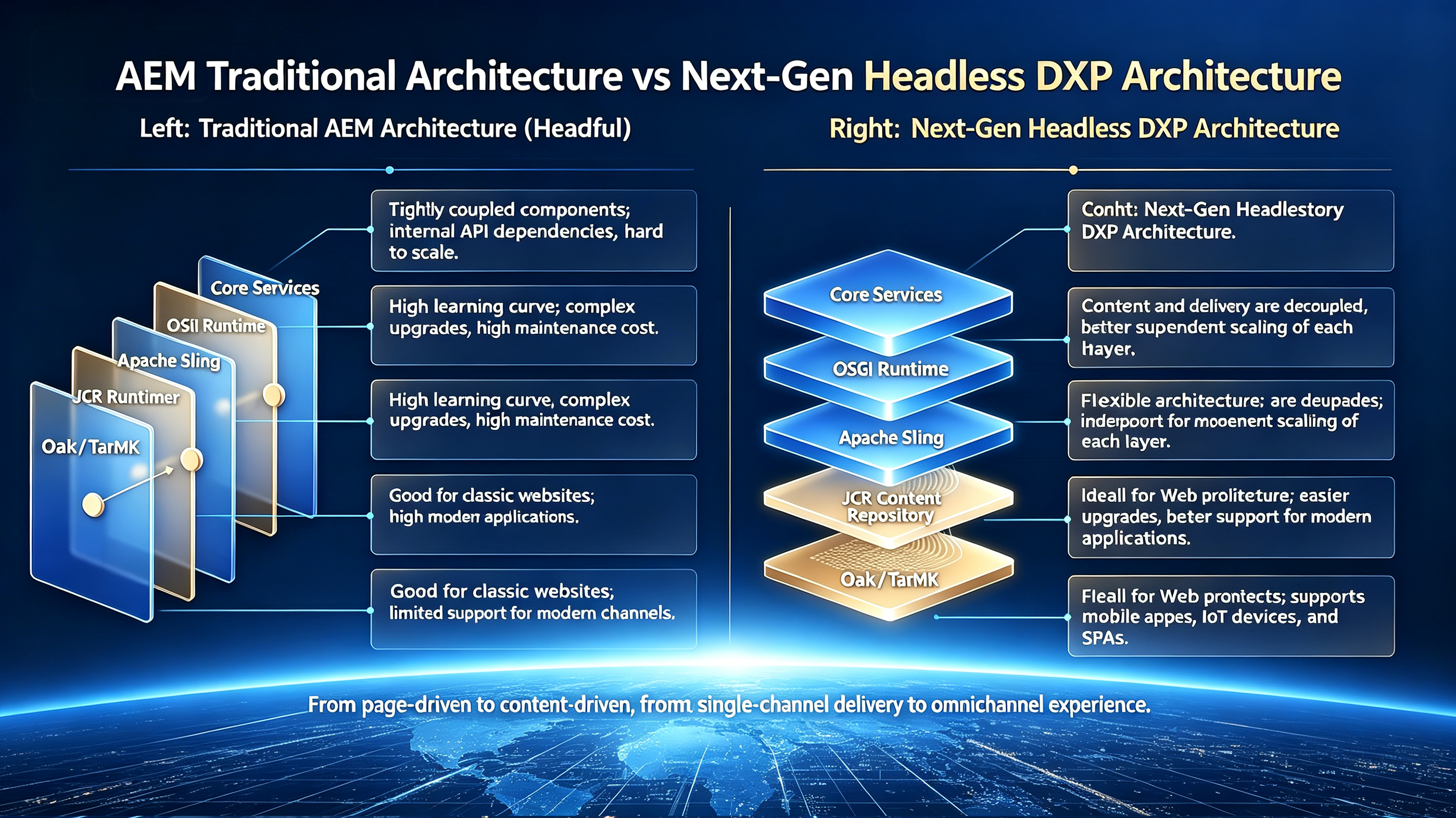
(Image shows comparison between old and new architectures)
IV. Conclusion: Opening a New Chapter in DXP with Content at the Core
The migration from AEM to a next-generation DXP is by no means merely a simple technical platform replacement; it represents deep reflection and comprehensive upgrading of corporate digital strategy. It requires enterprises to break away from the traditional mindset of "page relocation," truly focus on content as the core, and re-examine and rebuild their digital experience architecture. Through deep reconstruction of content models, digital assets, and operational workflows, enterprises can not only break free from the constraints of legacy platforms but also embrace AI-native, open, and flexible next-generation DXPs, achieve efficient governance and distribution of global content, and ultimately drive sustained business growth.
We understand deeply that every platform migration is a severe test of an enterprise's strategic resolve and execution capability. DragonBravo is committed to being the most trusted partner in enterprise digital transformation, providing full-lifecycle services ranging from strategic consulting and solution design to implementation and operational optimization. If you are facing challenges in DXP platform selection and migration, or wish to discuss in depth how to drive business growth through content governance and global asset management, please contact us to jointly open a new chapter in digital experience.
FAQ
Q1: What is the four-step methodology for migrating from AEM to BMS DXP?
Step 1: In-depth Status Assessment—Comprehensive inventory of content assets + Analysis of business processes and user habits + Evaluation of tech stack and integration points. Step 2: Target Architecture Blueprinting—Refined design of new DXP content model (separation of content and presentation) + DAM architecture planning + Integration and extension solution design. Step 3: Meticulous Data Migration—Precise conversion of content and metadata + Smooth migration of digital assets + Intelligent activation of AI tags + Zero-change URL path protection for SEO. Step 4: Continuous Post-Launch Operations—Team training and workflow adaptation + Performance monitoring and continuous optimization + Data analysis and business value quantification.
Q2: What asset governance upgrades have overseas-bound automotive companies achieved through BMS DAM?
A global automotive brand achieved the following through BMS DAM: AI auto-tagging and multilingual metadata management improved material retrieval efficiency; automated derivative generation (batch creation of multi-size, multi-format materials); automated workflows combining AI approval and manual approval; CDN acceleration for end-user access + CN2/9929 acceleration for overseas team DAM backend operations; and a four-level permission matrix ensuring compliant use of global materials. This resulted in significantly improved material search efficiency and enhanced global collaboration experience.
Q3: What is the biggest risk during migration? How can it be mitigated?
Business continuity is the greatest risk. Mitigation measures include: gradual traffic increase via grayscale release strategies, establishing rollback mechanisms for emergencies, switching during off-peak business hours, and closely monitoring SEO keyword rankings and website traffic changes.BMS DXP migration team provides full-process technical support and standardized migration tools.
Q4: What exactly does content model restructuring entail?
AEM content is built around "pages"—content is tightly coupled with the presentation layer. Next-generation DXP (such as BMS Digital Experience Platform) emphasizes "separation of content and presentation layer"—mapping content into reusable, composable independent units. For example: the name, description, images, and technical specifications on a product detail page should be defined as independent structured data that can be invoked across different channels such as official websites, Mini Programs, and apps. The JSON data model of BMS Digital Experience Platform supports Headless multi-channel distribution.
Q5: How to perform quality verification after migrating historical digital assets?
The BMS Digital Experience Platform migration team uses automated tools to compare asset counts, file sizes, metadata completeness, and permission mapping accuracy between the source and target systems. Key brand assets are sampled for manual review to verify display effects and access paths. During the grayscale release phase, CDN loading logs and user feedback are closely monitored to ensure no broken links or missing images. The verification checklist covers: asset integrity, metadata accuracy, permission consistency, and global CDN access speed.
Q6: How long does team training take to adapt to the new platform?
BMS Digital Experience Platform provides a WYSIWYG editor with a lower learning curve compared to AEM's editing experience. Content editing teams can typically independently handle daily content publishing and updates within 1-2 weeks. IT operations teams require 2-4 weeks to become familiar with the platform architecture and API system (the Java+SpringBoot+Vue3 tech stack is more prevalent in the domestic talent market, making recruitment significantly easier than for AEM's Sling/OSGi system). DBC provides standard training courses and online knowledge base support.
References
[1]: Adobe, *2026 AI and Digital Trends Report*
[2]: Content Marketing Institute, *B2B Content and Marketing Trends: Insights for 2026*
[3]: Google Search Central, *AI Features and Your Website*
[4]: CMSWire, *Digital Experience Platforms (DXPs): 2026 Comprehensive Guide*


Want to know more about our products?
With years serving Fortune 500 clients, we offer flexible solutions and integrated implementation.
