
How C2PA Content Provenance Standards Reshape the Trust System of Corporate Digital Assets
Publication Date: 2026-08-07
Author: William
Abstract
When a photo undergoes cropping, color correction, AI modification, screenshot capture, and re-uploading—from capture to dissemination—each step alters its “identity.” The Coalition for Content Provenance and Authenticity (C2PA) provides a “digital birth certificate” embedded in the file’s metadata, documenting who created the file, how it was created, and what modifications it underwent. For enterprises managing vast digital asset libraries, what does this mean? From brand content protection to AI training data governance, C2PA is redefining the boundaries of “trustworthy content.”
I. What Is C2PA? A “Birth Certificate” for Digital Files
C2PA stands for the Coalition for Content Provenance and Authenticity—an open technical standard jointly initiated by industry leaders including Adobe, Microsoft, Intel, Sony, BBC, Google, and OpenAI. Simply put, it is a “digital birth certificate” embedded within image and video metadata, recording who created the file, how it was created, and what modifications it underwent.
Built upon Public Key Infrastructure (PKI), C2PA appends an immutable “digital ID” to each image—recording creation time, creator identity, tools used, and editing history—and ensures tamper resistance via SHA-256 hashing and digital signatures. As of 2026, the C2PA Steering Committee includes global top-tier institutions such as Adobe, Microsoft, OpenAI, Google, Sony, Nikon, Leica, BBC, and The New York Times. Over 6,000 members and affiliates within the C2PA ecosystem have deployed real-world applications of Content Credentials.
The emergence of this standard stems from a straightforward reality: AI-generated imagery is becoming increasingly realistic, making it progressively harder for the public to verify the origin of images, videos, and audio. A 2023 Statistics Canada report found that 59% of Canadians were “very” or “extremely” concerned about online disinformation, while 43% believed distinguishing truth from falsehood had become more difficult than three years prior. It was against this backdrop that C2PA emerged.
C2PA’s technical implementation path has also matured significantly. In March 2024, Sony released firmware updates for its α1, α7S III, and α7 IV cameras, introducing built-in digital signing and native C2PA format support. Adobe’s full suite (Photoshop, Lightroom, Premiere), Google Pixel cameras, and Leica cameras all natively support C2PA. In February 2026, C2PA released Content Credentials version 2.3, further optimizing data verification and tamper-detection mechanisms.
A real-world C2PA record might look like this:
Capture → iPhone 15 Pro, July 15, 2026, 14:32
↓ Crop → Adobe Lightroom, July 15, 2026, 15:10
↓ Publish → Digital Asset Platform, Authorized User ID #38271
↓ Download → User john.doe@email.com, July 16, 2026, 09:45
Anyone, at any time, can open this file and use a C2PA verification tool to retrieve this complete “life history.”
II. Why Enterprises Must Pay Attention to C2PA: Three Unignorable Trends
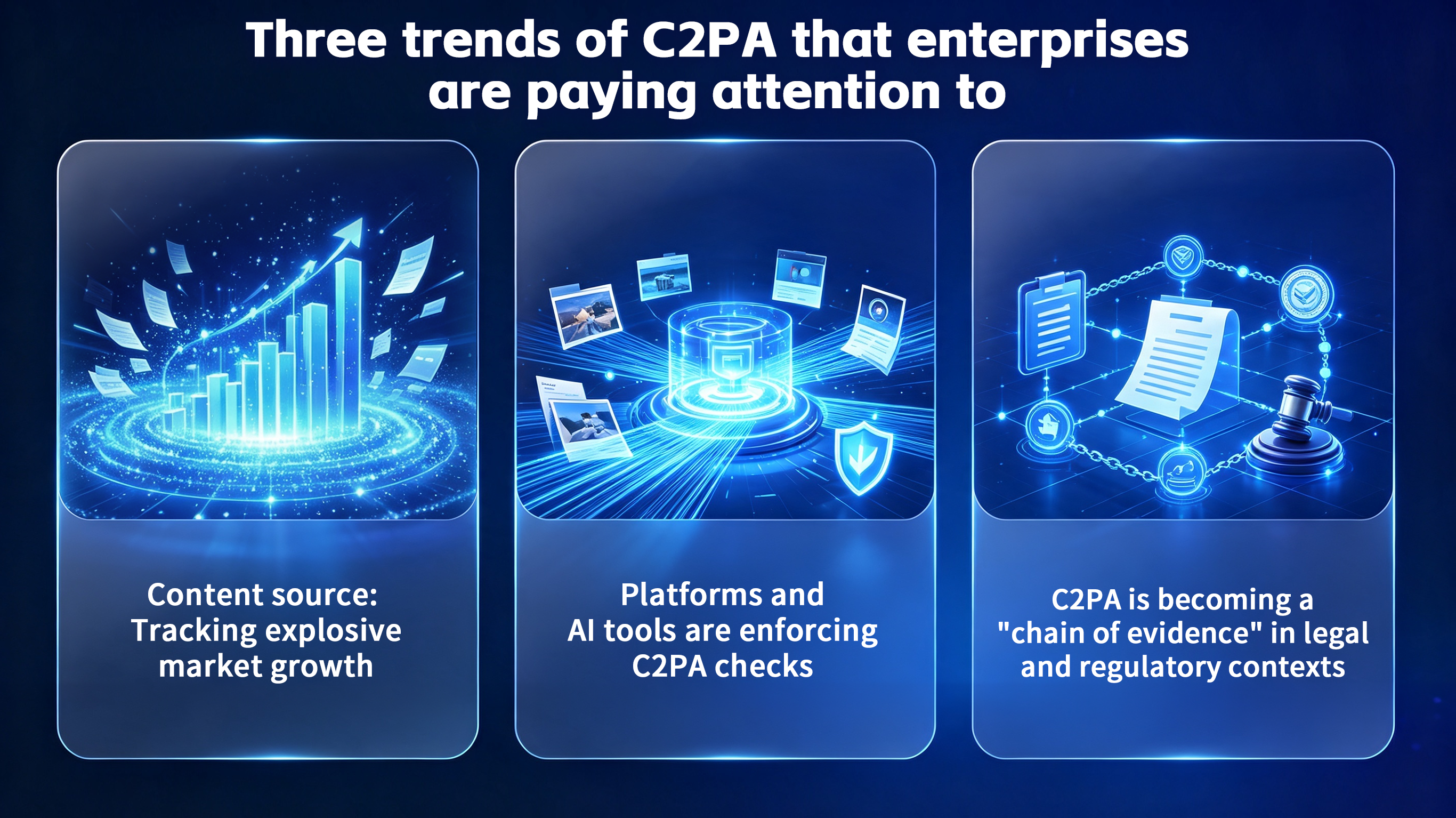
2.1 Explosive Market Growth
According to C2PA data, the market for content provenance tracking solutions is experiencing explosive growth. Market size is projected to increase from USD 1.63 billion in 2025 to USD 2.06 billion in 2026—a compound annual growth rate (CAGR) of 25.9%. By 2030, the market is expected to reach USD 5.12 billion.
2.2 Platforms and AI Tools Are Enforcing C2PA Checks
This is not a distant trend—it is happening now:
l Adobe Firefly now rejects processing images marked by C2PA as “For Personal Use Only”
l Google announced integration of C2PA into Gemini at its 2026 I/O conference, with gradual expansion to Search and Chrome
l OpenAI joined the C2PA Steering Committee; DALL-E 3 automatically adds Content Credentials to all outputs
l Meta joined the C2PA Steering Committee and labels AI-generated content on Instagram and Threads
l EU AI Act Article 50 officially entered into force on August 2, 2026, mandating transparency obligations for specific AI systems
(Illustration depicting three enterprise trends driving C2PA adoption)
This means that if an image is labeled “For Internal Use Only—Prohibited for AI Training,” it will theoretically be blocked when fed into an AI model.
2.3 C2PA Is Becoming a Legal and Regulatory “Chain of Evidence”
In today’s environment of rampant deepfakes and AI-synthesized content, C2PA records are becoming admissible evidence in court. Should the worst occur—a corporate product image maliciously altered or synthetically manipulated using AI—C2PA records can prove “which account downloaded this image, and at what time.”
III. From C2PA to DAM: Upgrading the Infrastructure of Digital Asset Trust
C2PA solves the question of “where this file originated,” whereas Enterprise Digital Asset Management (DAM) addresses “how this file is managed, used, and distributed.” Together, they form a complete closed loop of digital asset trust.
3.1 Sign on Download: Embedding an “Identity Stamp” in Every Asset
Traditional DAM systems focus on asset storage, retrieval, and distribution. Yet in the AI era, an asset’s fate after leaving the system is equally critical. The value of C2PA lies in this: it remains effective even after download.
Watermarks may blur during dissemination, but C2PA metadata is cryptographically signed and cannot be forged. If an image later appears in an AI training dataset, on a social platform, or as an AI-generated derivative—its “origin path” will be exposed by the C2PA record.
For enterprises, this means embedding C2PA credentials at download time—tagging usage restrictions (e.g., “For Internal Use Only,” “Prohibited for AI Training,” “Restricted to Specific Regions”)—ensuring every asset transfer remains traceable.
3.2 From “Store-and-Find” to “Use-with-Confidence”
IBM defines DAM as the processes and systems used for “storing, organizing, managing, retrieving, and distributing digital files.” However, by 2026, DAM has already transcended this definition. As practiced by DragonBravo’s BMS DXP, DAM is evolving from a traditional media library into a comprehensive content asset management platform—the core infrastructure supporting multi-department, multi-channel content operations.
When DAM integrates with C2PA, enterprises gain more than just “store-and-find”—they achieve “use-with-confidence”: clear source attribution for every asset, auditable modification history, and fully traceable distribution.
3.3 A “Fuse” for Compliance and Risk Management
On August 2, 2026, EU AI Act Article 50 officially entered into force. Enterprises operating globally must meet increasingly stringent content compliance requirements. C2PA records serve as powerful proof of content compliance—demonstrating that a given image is an original capture rather than AI-generated, verifying which edits a video underwent, and confirming the provenance and licensing scope of a document.
For multinational enterprises, digital asset license management has become the core defense line for brand content compliance. BMS DAM’s License Compliance Management module—with capabilities including license sub-table architecture, region-specific granular control, and automated expiration alerts—elevates license management from passive response to proactive defense.
IV. How BMS DXP Builds a Trusted Content Supply Chain
DragonBravo BMS DXP (BMS Digital Experience Platform) is powered by three core capabilities: Content Management+Digital Assets+E-commerce Engine, enabling unified content distribution, intelligent digital asset control, and closed-loop brand-performance conversion. Regarding digital asset trust, BMS DXP delivers unique value in three aspects:
4.1 Native Integration of DAM and DXP
Most DAM solutions on the market operate as standalone systems, disconnected from enterprise website building, store management, and content operations modules. In contrast, BMS-DAM was designed from inception as a native component of BMS DXP—not an external tool stitched together via APIs, but an enterprise content foundation deeply integrated with stores, sites, pages, knowledge bases, and other modules.
This architecture delivers immediate value:Digital assets are no longer temporary campaign materials, but persistent digital elements continuously driving website building, store operations, content distribution, and knowledge management. A single set of content assets can be flexibly invoked, uniformly updated, and synchronized across all channels per requirement.
4.2 Multi-Cloud Integration and Global Delivery
BMS DAM supports unified management across multi-cloud environments. Whether assets reside on Alibaba Cloud, Tencent Cloud, AWS, or Azure, the system consolidates them into a single interface. Additionally, BMS DAM features built-in CDN networks to enable rapid global content distribution and loading.
For multinational enterprises, this means global teams can collaborate in real time on one platform, ensuring brand consistency and operational efficiency.
4.3 AI-Powered Intelligent Asset Management
BMS DAM incorporates AI technologies to automatically identify content within images and videos and apply precise tags. AI also recommends relevant content based on existing assets and usage contexts—and even generates derivative versions.
More importantly, BMS DXP’s approval workflows and version control mechanisms—combined with the Content module’s content approval functionality—constitute the foundational infrastructure for enterprise AI content governance—not a separately procured “AI governance tool,” but a capability natively embedded within the content management foundation.
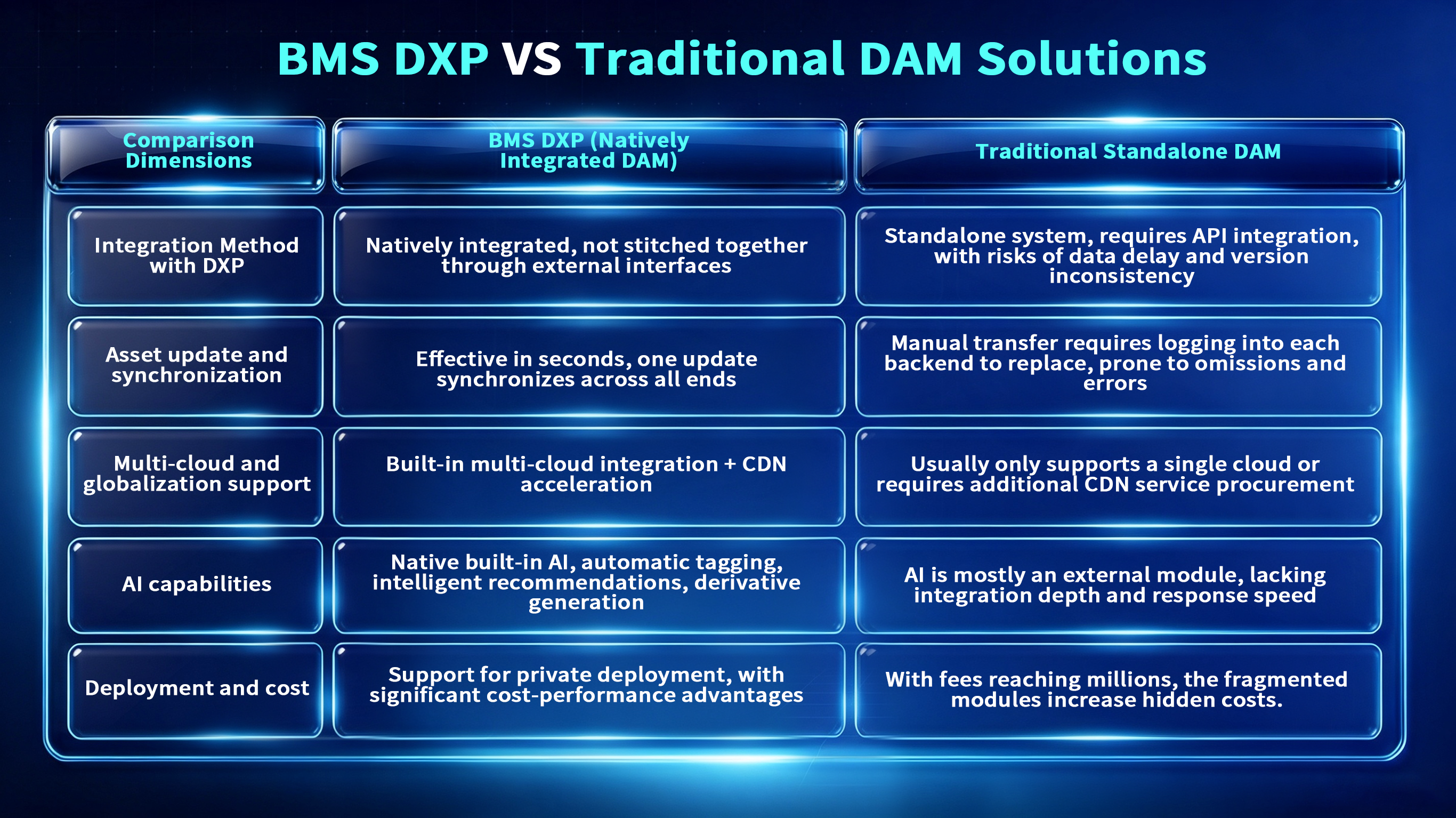
Comparison: BMS DXP vs. Traditional DAM Solutions
| Comparison Dimension | BMS DXP (Natively Integrated DAM) | Traditional Standalone DAM |
| DXP Integration Approach | Native integration—not external API stitching | Standalone system requiring API integration, carrying risks of data latency and version inconsistency |
| Asset Updates & Synchronization | Second-level activation; updates propagate instantly across all endpoints | Manual transfers required; assets must be individually replaced across multiple backends, increasing risk of omissions or errors |
| Multi-Cloud & Global Support | Built-in multi-cloud integration + CDN acceleration | Typically supports only a single cloud, or requires additional CDN service procurement |
| AI Capabilities | Natively embedded AI: automatic tagging, intelligent recommendations, derivative generation | AI usually implemented as add-on modules, lacking deep integration and responsiveness |
| Deployment & Cost | Supports private deployment, offering significant cost-effectiveness | Annual licensing fees often exceed hundreds of thousands of dollars, with fragmented modules adding hidden costs |
(Illustration comparing BMS DXP vs. traditional DAM solutions)
Frequently Asked Questions (FAQ)
Q1: What distinguishes C2PA from traditional digital watermarking?
A: Traditional watermarks are visible or invisible image markers that may be cropped, blurred, or removed during distribution. C2PA is encrypted signature metadata based on Public Key Infrastructure (PKI), embedded directly within file structures, making it non-falsifiable and tamper-proof. Watermarks answer “Is this image marked?” while C2PA answers “Where did this image originate, and what has it undergone?”
Q2: Is C2PA metadata lost when uploading to social platforms?
A: Most mainstream social platforms currently compress or strip metadata upon upload. However, C2PA’s design philosophy is “proving authenticity when present,” not “preventing removal.” More critically, Google Search already labels C2PA-certified images in search results, and Chrome browser supports C2PA verification. As regulatory frameworks advance (e.g., EU AI Act), platforms’ retention and recognition capabilities for C2PA are rapidly improving.
Q3: What level of technical investment is required for enterprise C2PA deployment?
A: C2PA is an open SDK and standard with readily available toolkits for direct integration. For most enterprises, implementing server-side C2PA signing before asset distribution—technically akin to appending an encrypted metadata segment to files—is straightforward.
Q4: Does BMS DXP support C2PA integration?
A: The DAM module of BMS DXP enables systematic management of digital assets such as images and videos. Enterprises may flexibly enable or disable C2PA signature embedding at the bucket, folder, or individual asset level, according to business requirements. Specific integration approaches can be customized based on compliance needs and operational workflows.
Q5: Are C2PA records legally admissible in court?
A: Based on cryptographic signatures and PKI, C2PA’s tamper-resistance provides a solid technical foundation for electronic evidence. As adoption expands among international institutions—including news organizations like BBC and The New York Times—its evidentiary value in legal proceedings is increasingly recognized. Admissibility ultimately depends on each jurisdiction’s specific regulations governing electronic evidence.
Making Every Digital Asset Trustworthy
From C2PA’s “digital birth certificate” to BMS DXP’s “trusted content supply chain,” the digital asset trust framework is evolving from concept to implementation. As AI-generated content proliferates and regulatory demands intensify, enterprises need more than a simple “warehouse” for storing assets—they require a content infrastructure where every asset can clearly trace its origin and withstand verification.
DragonBravo BMS DXP was built precisely for this purpose—leveraging a natively integrated DAM module as its foundation, AI capabilities as its engine, and multi-cloud integration plus global delivery as its support pillars, to help enterprises build a complete closed loop spanning content creation to distribution, asset management to compliance governance.
Want to learn how BMS DXP can help your enterprise build a trustworthy digital asset ecosystem? Visit ourProduct Center or contact our Solutions Team.


Want to know more about our products?
With years serving Fortune 500 clients, we offer flexible solutions and integrated implementation.
